Our final pre-booked trip sees us cruise around the Whitsundays onboard SeaLink’s Reef Quest III, a new and fast, powered catamaran. SeaLink provide courtesy coach transfers from several pickup points in and around the Airlie Beach area for the short drive to Shute Harbour, around 10-minutes from central Airlie Beach.
Whitehaven Big Island Day Tour
Our choice of cruise with SeaLink is the ‘Whitehaven Big Island Day Tour’ taking in North and South Molle Islands, Cid Island and Hook Island, which we saw from the air yesterday but this time cruising through the narrow Hook Passage before taking anchor at Tongue Point. From there we transfer to the beach aboard the ship’s tender to walk up to the Hill Inlet viewpoints before sailing around to Whitehaven Beach for a bush-walk or to pass a couple of hours wandering along the 7KM beach before returning back to port via Chance Bay, Hamilton and Dent Islands.
First impressions
Stepping aboard Reef Quest immediately impresses with two large, immaculate and brightly lit indoor cabins with plenty of outdoor seating also available for those who enjoy the cool sea breeze or keeping a lookout for wildlife. Tea and coffee facilities greet you in the air conditioned dining cabin with large viewing windows and comfortable banket seating.

All aboard
We’re soon underway with the morning snack of fresh fruit and muffins being served. The ship can carry 280 guests but limiting each cruise to only 84 means there is no problem finding a seat or waiting too long to be transferred by tender at each landing.

Our skipper was also our guide while onboard and ran a commentary throughout most of the cruise detailing the history of the Whitsundays and facts about each of the islands as we passed them. He also kept an eye out from his high vantage point for whales and it wasn’t long before we started sighting them. Perhaps not quite as close as you would see on a dedicated whale watching tour but very visible and on several occasions very active breaching high in the air and creating a huge splash as they dropped to the sea. Giving maximum viewing time the skipper slowed right down to give everyone the opportunity to take a photograph or ‘oooh’ and ‘aah’ each time a whale launched itself into the air.

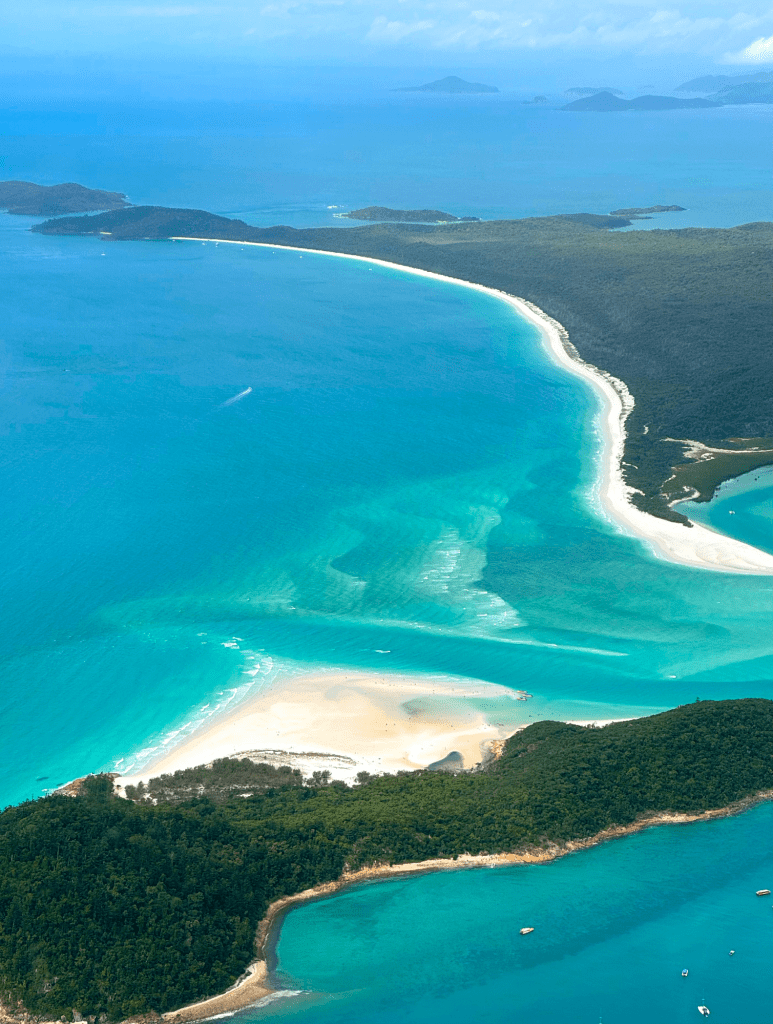
Back on course and speeding towards Hook Passage it was very noticeable that the sea was beginning to churn with waves forming as the tide was being squeezed between the adjacent islands. Next, turning to the south and we’re into clear water again passing along the coast of Whitsunday Island heading for anchorage just to the north of the spectacle that is Hill Inlet. Yesterday we got stunning views of Hill Inlet from our flight above but today was our opportunity to view the swirling sand and sea formation from a vantage point with our feet firmly on solid ground.
Tongue Point to Hill Inlet
Our boat set anchor in a sheltered bay at Tongue Point to transfer passengers to shore ready for the bush walk up to the Hill Inlet viewpoints. It’s a relatively easy walk with many well built steps to negotiate as it passes through native vegetation and small trees. Brief glimpses of the sea tease before reaching the summit and then a short decent before opening out to the first of three viewing platforms. And what a view! Although quite busy with our three groups amongst others, it was easy to get to the front of each platform. It wasn’t the best weather for photographs today with rain in the distance and low, patchy cloud but the scene was still stunning with the swirling and twisting Hill Inlet passage making its way further into the Island’s interior. Created by the ever changing tides, the wavy patterns are constantly changing with the best views to be had at low tide. To the left of the passage, and continuing into the distance, is the famous Whitehaven beach, which we will be stepping onto next.
As the three groups began their walk back to the beach, I stayed on a little longer when I noticed a gap starting to open up in the cloud shading the inlet. It was well worth the wait to see the sea light up in such a stunning shade of turquoise. It could only have been better if the tide was a little lower.
Before long we were being ferried back to our boat and enjoying a delicious buffet lunch the crew had laid out for us while we continued around to Whitehaven Beach.

Whitehaven Beach
Our ship’s tender ferried us to the beach giving us two hours to wander, take a guided bush walk or just laze around in the sun. We chose to walk along the almost deserted beach and paddle in the surprisingly cool water for a kilometre or so before sitting under the shade of a tree and watching the waves lap gently against the shore. The beach sand has a few unusual characteristics; being almost white allows it to reflect away most of the intense sun meaning it’s actually cool to walk on and even squeaks as you do so. It is also extremely fine and, apparently, makes an ideal polish for jewellery. I’m sure our feet felt softer after our walk too. Local myth even suggests NASA took advantage of the silica’s purity using it to create glass for the Hubble Space Telescope. When questioned if the story was actually true, allegedly the response was, “um, we may have done.” That’s a ‘No’ then.

Whitehaven’s 98% pure silica beach really is quite special, though, and something of a quandary. Sand is usually deposited on shore from local sources such as finely broken down rock, coral or sea shells. Here, however, there is no known source of silica of such high grade anywhere nearby. It is believed to have been deposited here potentially millions of years ago and is such an important and irreplaceable asset that it is legally protected with heavy fines for anyone attempting to take home a ‘souvenir’ of their visit. That is, of course, unless you are Oprah Winfrey, who’s advisers clearly didn’t make her aware of the rules.
The beach does, however, have a claim to fame being regularly voted best beach in the world and was featured in the ‘Pirates of the Caribbean – Dead men tell no tales’ feature film. Prior to, and during, filming the production company bought every available day trip and boating adventure in the area to ensure the beach was free of tourists and the sea clear of any boat that didn’t fit the era. And just to add to the authenticity of the ‘Caribbean Island’ it was standing-in for, the production crew planted palm trees along the beach, which natively do not grow on the island. After production ended they were removed and replanted at Airlie Beach.
Wildlife
There is plenty of wildlife around the Whitsunday Islands both on land and in the sea. Snakes such as pythons and grass snakes are common but there’s also the highly venomous eastern brown and taipan, though mostly found around properties or sunbathing on the roads. Dugongs, countless reef fish and six of the seven species of turtle in the world call the Whitsundays home and not forgetting the migrating whales, white and blacktip reef sharks, manta rays and several species of dolphin. Of course being in the Australian tropics means stinging jellyfish, some of which can be lethal, should be avoided during their most active time between October and May – probably not the best time of year to go swimming. And I suppose I should mention the common ‘handbag’, known also as the saltwater crocodile, is present in these waters. Usually confined to rivers and river estuaries they do often wander further afield in search of a decent meal. But for us, apart from the odd spider and sea birds, all we saw was a friendly Lace Monitor scavenging for food.
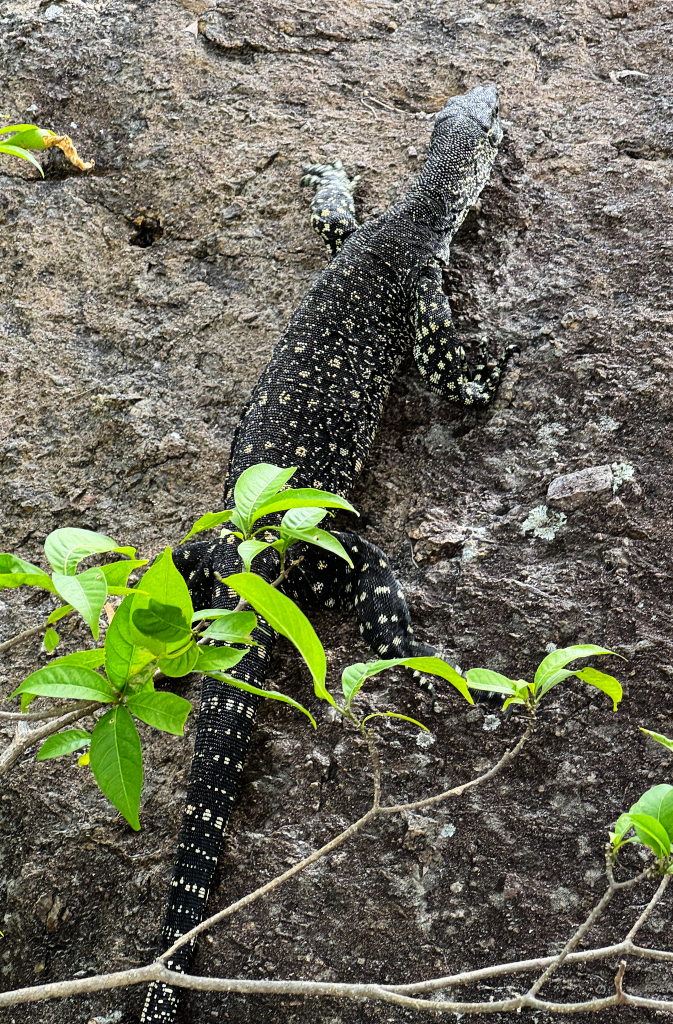
The lace monitor is both active and highly agile being just as happy walking along the ground or climbing up rock faces or trees in search of a tasty morsel… and growing up to two metres in length, big enough to scare the life out of an unsuspecting tourist!
Heading for Home
Back onboard we settled in for the return leg of our cruise passing between Whitsunday and Haslewood Islands to follow the southern coast of Whitsunday Island through Chance Bay admiring some exclusive properties. We skirted Hamilton Island, home to a few eye wateringly expensive resorts such as the hyper-exclusive, 6-star ‘qualia’ resort – deliberately written with a lowercase ‘Q’ and a registered name to boot – now that’s exclusive! Well, Chris Hemsworth, Taylor Swift and Johnny Depp must think so being just a few of the celebrities that have stayed there.
Finally passing by Dent, Henning and Long Islands we arrived back at Shute Harbour after a thoroughly enjoyable day, made all the more special by good friends of ours who we have been sharing this week of adventures with in and around Airlie Beach.
A Grand Day Out
We’d highly recommend SeaLink’s ‘Whitehaven Big Island Day Tour’ suitable for all ages with the added opportunity to see whales during July to October and at the very least some magnificent scenery.
More details available from SeaLink’s website.




 Discovery Down Under