Skyrail Rainforest Cableway

We’ve finely reached our most northerly destination on this trip – Cairns in Far North Queensland (FNQ). And where better to get an overview of the city than from up above.

Up in the Air

A great place to get an overview of Cairns is to climb onboard Skyrail’s 7.5km Rainforest Cableway – a cable car with a dramatic view and once the longest cableway in the world. Located just 15-mins north of Cairns at Smithfield within the UNESCO World Heritage Listed Barron Gorge National Park.
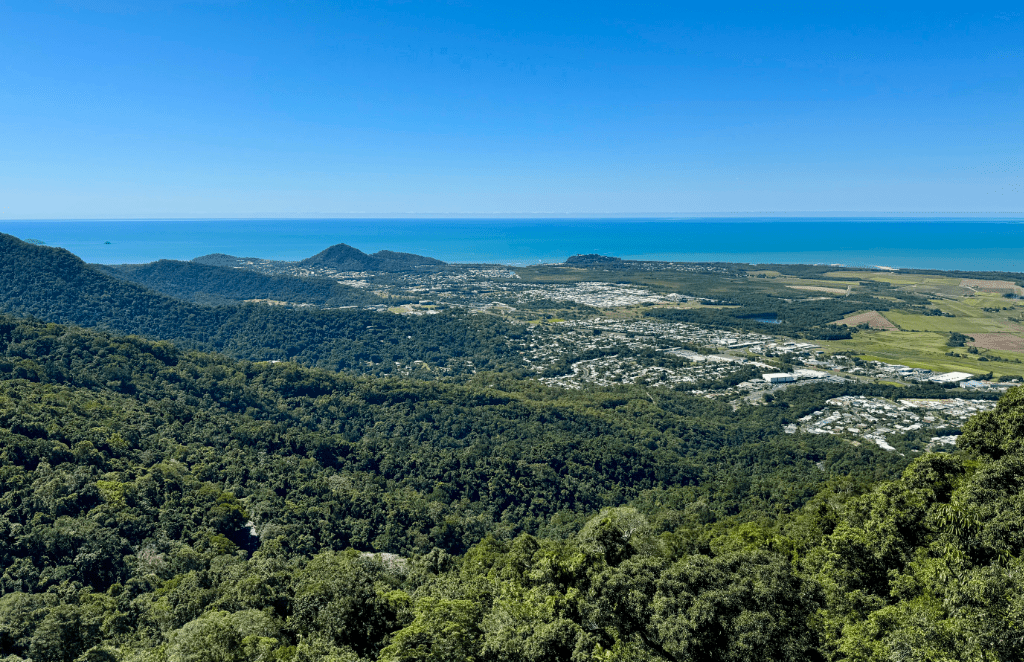
Cairns from above

Free parking is provided directly in front of the Smithfield terminal and serves both the Skyrail and Kuranda Scenic Railway. For those booking Skyrail to Kuranda in one direction and the train in the other, a courtesy bus, stopping in front of the Skyrail terminal, takes guests to and from Freshwater Train Station. Alternatively the train can be caught in Cairns directly.

Bookings Essential

It should be noted that during peak periods, this currently being one of them, it is essential to pre-book tickets. Each car seats six people and you may be required to share with others. Look on it as being an opportunity to meet like minded people and share travel adventures – we did.

Boarding is a little slow at this time of year but we were soon setting-off on the first section of the cableway. The steep 10-minute ride climbs to the 545-metre summit of Red Peak with expansive views over the city and beyond before descending a little over the rainforest to Red Peak Station. A change of car is required for the next span, by far the longest, but the opportunity to take a short break to explore along the signed boardwalk at Red Peak is recommended. Time permitting, there is still the option to take-in the walk on the way back if returning by Skyrail.

Riding over the Rainforest

The cableway then traverses the spectacular tropical rainforest for another 20-minutes giving the opportunity, if you’re brave enough, to look down below at the diversity of trees, shrubs and vines and potentially the Ulysses butterfly as its iridescent blue wings standout against the backdrop of tree foliage. As an extra paid option the Skyrail Diamond car is available with a transparent floor if the standard car is not scary enough for you or the little ones.

Barron Falls

The next stop is Barron Falls, a huge rocky ravine where the Barron River falls over granite rock as it descends from high in the Atherton Tablelands towards Cairns.

Barron Falls in Winter

In the ‘Dry’ season (April to October) the falls still flow, and more so following rain, but during the ‘Wet’ (November to March) you can witness the falls at their best where the torrential tropical downpours create a boiling, seething maelstrom of water and spray as it crashes down into the gorge. A good viewpoint is the Edge Lookout opened in 2019, which, incidentally, has a glass floor to make the drop of 160-metres to the gorge all the more enjoyable! It’s highly recommended to stop here and take the short walk to the cantilevered lookout before rejoining the next available car for the 15-minute ride to the final stop at Kuranda Station.
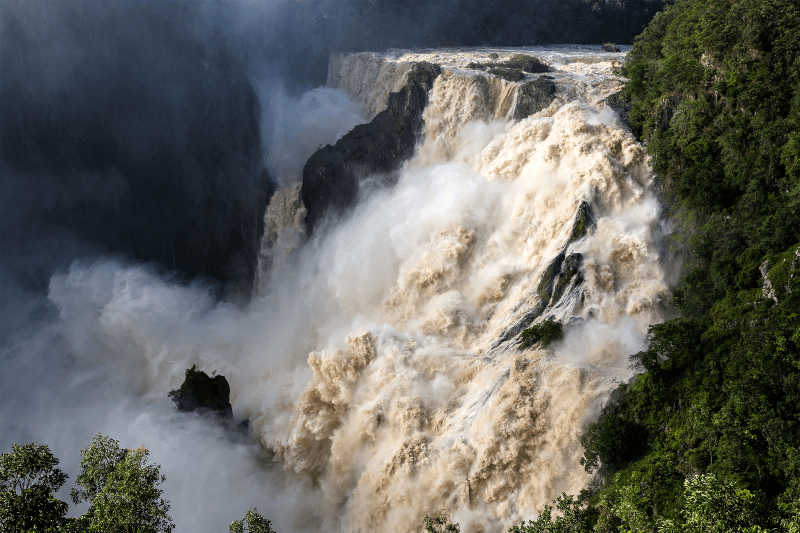
Barron Falls in Summer. Credit: Tourism Tropical North Queensland

Kuranda

Originally settled by the Djabugay indigenous people around 10,000-years ago and whose relatives continue to this day, Kuranda was later settled by Europeans in the mid 1880’s taking up farming in the area and producing timber, dairy cattle and eventually coffee. During the ‘Flower Power’ and anti-Vietnam War period of the mid-1960’s, hippie communes developed seeking a simple, self-supporting, laid-back lifestyle. Today the hippie influence is still very much in evidence as is the drifting scent of incense, especially in the ‘Kuranda Original Rainforest Markets’. Sadly the market has lost its once popular craft and food scene and looks increasingly neglected as new stores open on the main streets selling cheap tourist junk. To us, and since our last visit more than a few years ago, Kuranda has lost its edge. It’s not cheap to get here and apart from the picturesque Kuranda Scenic Railway Station and the Butterfly Sanctuary the journey here is now the highlight and no longer the destination.

Kuranda by Rail

For those not having the stomach for a swinging cable car, there is an alternative option. The Kuranda Scenic Railway can be caught in Cairns or Freshwater Station and provides views of the surrounding landscape on its winding climb up to Kuranda Station with a brief stop at Barron Falls to get the best photo opportunity.

The train can also be combined, for those choosing a little more variety, to go up to Kuranda by train and return on the cable car or vice-versa. We have done both and the two are equally recommended.

Construction of the 37KM long railway started in 1887 and reached Kuranda in 1891. The railway required 15-tunnels, which were dug by hand and 37-bridges. It wasn’t until 1936 that the railway was opened to tourism.

Kuranda Scenic Railway Station

How do you build in a protected Rainforest?

Think for just a minute about all the indigenous people of the region, save the trees campaigners, the political activists and those that genuinely want to protect natural forests for future generations, and you have to wonder how Skyrail got permission to build a 7.5km cable car through a rainforest, a World Heritage listed one at that. Well, certainly there were protests both from locals, environmentalists and the indigenous people. It was regularly in the press and on TV and in radio reports. It gained worldwide attention not only for the proposed development within a pristine and ancient environment but also for the precedent that it would set for other developments around the world in highly sensitive environments. Should it get approval the proposal would be the first ever commercial development in a World Heritage listed area.

And, remarkably, it did! It would give people the opportunity to see and experience this ancient rainforest without any erosion causing foot traffic. After much debate and negotiations a compromise by the developer was reached requiring construction of the cableway to be made from the air, the concrete, steel gantries and the construction teams – all delivered by helicopter. And so it was, Skyrail opened to the public in August 1995. Today Skyrail is so busy during the peak season that, as we have mentioned, pre-booking is essential.

Booking options and further details available on Skyrail’s website
Montezuma Falls

Western Tasmania isn’t short of waterfalls – the mountains and three metres of rain brought in each year from the Southern Ocean ensures that. But what we’re exploring today is something very special. It’s one of Australia’s best.

Our walk started from the deserted Montezuma Falls parking area accessed from Rosebery via the blacktop and dirt Williamsford Road. It’s a relatively easy 11.5km return walk, which follows the old Montezuma Silver Mining Company’s Northeast Dundas Tramway that once ran between Zeehan and the mine at Deep Lead (now known as Williamsford).

A World First

The train used on the tramway was of an unusual design known as a K Class Garrett. Named after its designer, Herbert William Garrett, the locomotive was articulated and divided into three interlinked units; the steam engine unit used to drive the wheels, the boiler/cab unit and the fuel/water unit. The advantage of this design was its ability to negotiate tight, twisting curves – a necessity among the terrain of western Tasmania. It is believed the Garrett design chosen for the tramway was the first of its type in the world having already been rejected by the government of New South Wales.

Signs of the Past

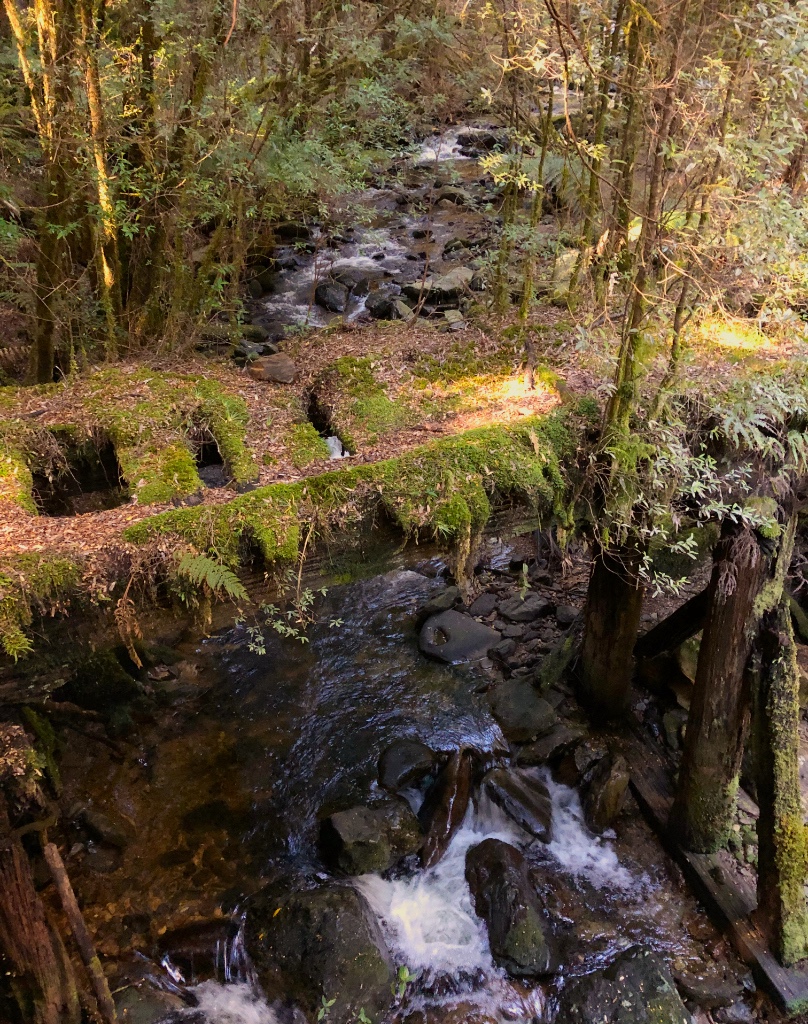
Glimpses of the old tramway are still very evident as you pass between moss and tree-lined cuttings blasted through rock and many timber sleepers exposed, some with hand made nails still in place. More impressive though are the original bridges that cross the streams and gullies. No longer safe to cross and sectioned off, the bridges are now home to many forms of moss, fungi and lichen with young trees even taking hold in the slowly decaying timbers.

Original bridge of the Northeast Dundas Tramway

Watch your Step

The track remains wet and muddy in places throughout the year and you’ll find yourself navigating across thoughtfully placed rocks and logs to avoid some of the worst spots. Though mostly level, the track requires sensible footwear and not the thongs that we witnessed several people wearing.

Thick rainforest hides much of the view of the Pieman River below, which is amazing considering the valley was heavily felled in the 1890’s. Now autumn, bright yellow and red Myrtle leaves litter the track like confetti among the many large tree ferns and moss covered leatherwood and sassafras trees. It’s for good reason the stunning, unspoilt scenery has made this a very popular walk.

A surprise Reveal

The highlight of the walk, of course, is the waterfall and although you can hear it in the background as you approach, its sudden appearance around a corner still comes as a surprise. Climbing a small observation deck just beyond the narrow suspension bridge and you get your first view of Montezuma Falls. But look upwards and there’s more. Crane your neck even further and the top of the 104-metre fall, Tasmania’s largest single drop, comes into view. It’s a surprising reveal and completely unexpected.

Montezuma Falls

Without a frame of reference it is hard to portray the true size of the cascading fall. You really have to be there to witness it for yourself. To stand back a little further requires a walk across the suspension bridge. It’s not for those with a fear of heights or a platform that sways with every step. It’s a white knuckle crossing and a real test of those brave pants.

A hike to Montezuma Falls is absolutely recommended if you are ever in the area and a must if planning a trip around this spectacular island.

Blowing a Hoolie

Our last day in Cradle Mountain National Park and despite snow overnight and bitterly cold winds, we were determined to make one last trip to Dove Lake to try and capture a photograph of last night’s snow on the mountains. The weather had other plans.

A Big Disappointment

But first we wanted to visit the close-by Wilderness Gallery located beside the Cradle Mountain Hotel. We had visited the gallery previously many years ago and vividly remember the stunning photographic landscape exhibition. We checked the gallery’s website to make sure it was open during this Easter Monday. Disappointingly we arrived to find it closed. We were later advised staff shortages were responsible. A simple update to their website shouldn’t have been that difficult to do.

Too close to the Edge

Everyone taking the shuttle bus to Dove Lake from the Visitor Centre will be aware that the road isn’t in the best condition. It is also very narrow in places with large trees restricting passage even further. Our driver this morning didn’t help settle any passenger’s discomfort when she described an accident here in 2001 where the road beneath a bus, making space for a passing vehicle, collapsed and fell 33-metres before hitting a tree leaving 4-people dead and 14-injured, some seriously. A subsequent report to the government recommended improvements to the road but were restricted by its World Heritage Management Plan, which stated: “Retain the Cradle Mountain Road from the Visitor Centre to Cradle Valley car park as a narrow, winding tree-lined road to protect the character of the park.” Good to know where public safety priorities stand. In the end there were improvements with some of the gravel road surfaces being sealed and kerbside markers installed. From our experience it still needs more work on the potholes.

Blowing a Hoolie*

We were greeted by a strong gusting wind and rain as soon as we climbed off the bus. The view towards the mountains was little more than an icy grey mist and we chose to wait in the glass fronted viewing shelter in the hope that the weather would improve. It was a while but patches of blue sky occasionally appeared and the vegetation around the lake briefly took on a some colour. Eventually the sun stayed long enough to produce a rainbow across the lake as we attempted to take a photograph between raindrops on the window. Needless to say we didn’t stay much longer.

It’s blowing a hoolie

Knyvet Falls

Wanting to make the best of the day we joined our travel buddies on a short walk from the Ranger Station near Cradle Mountain Lodge. It was a walk we were so glad we took.

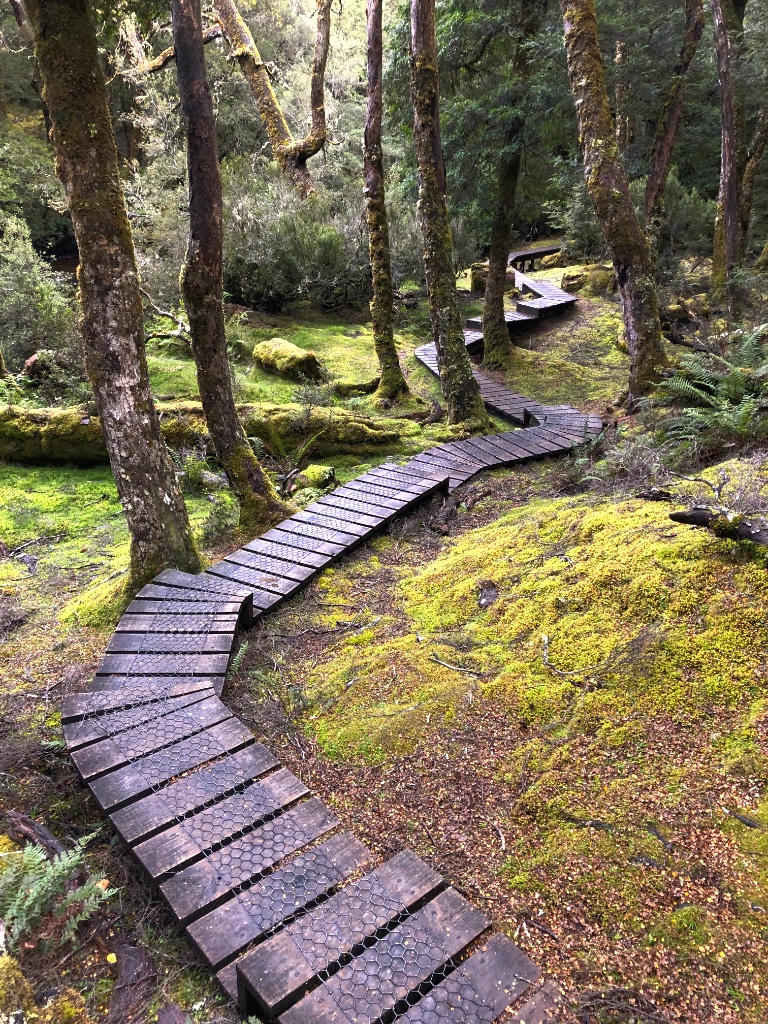
Knyvet Falls boardwalk

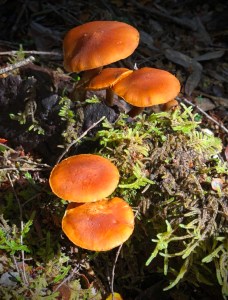
Descending into Dove Canyon beside Pencil Pine Creek was like stepping into another world – a very green one. Masses of twisted trees were covered in lichen, mosses and old man’s beard. Streams trickled among mounds of moss, fungi and golden leaves fallen from Myrtle trees while in the background the river was tumbling among the granite boulders that remained from the last ice age. It was a magical place.

Vivid greens

Protecting the delicate mosses from footfall was a boardwalk for the entire length of the walk, which snaked around trees, up and down slopes and across streams. There was so much to look at and photograph we were soon being overtaken – tricky on a narrow boardwalk without passing places!

It helped that we were protected from the cold winds and passing showers overhead. We were in no rush to move on and could have happily spent hours wandering around here but there was something else to see a little further along and in the background we could hear it – the rush of falling water.

Knyvet Falls

Named after Knyvet Roberts, an early explorer who, along with three colleagues, completed a 5-day cross country hike to Lake St Clair in 1908. It was a time before maps were available and with no defined track over rough country, mountains and rivers. All four survived their gruelling adventure living on the few supplies they carried and echidna, which they occasionally managed to catch.

Knyvet Falls is a wide but not a particularly long drop but it does make up for it in volume – at least at the time we visited in April. The water here, common to the West Coast, is more the colour of a milk-less tea than the crystal clear water you would expect filtering down from the mountains. It is caused by tannins leaching from the roots of the button grass plant and the peat on which it grows.

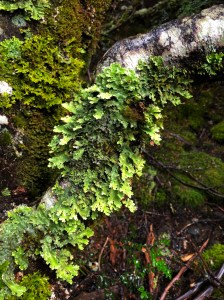
Unfortunately the viewing platform is perhaps the worst place to get a good photograph of the falls. Several images published via the Internet show a view from the front-left side of the falls but to reach there requires stepping-off the path and that risks damaging the delicate plant life. The main highlight of this walk, though, for us at least, was the coverage of mosses and lichen that forms on anything stationary long enough for it to get a hold.

Lichens

Time for a little Warmth

There’s nothing better than a hot drink in front of a log fire after a walk in the cold weather. And that’s exactly what we had in mind as we crossed the road and headed for the Cradle Mountain Tavern. We weren’t alone. Two roaring log fires were warming the chills off the hikers with wet clothing draped across the back of chairs.

Mulled wine by the mug was on offer. So too were delicious hot cross buns eased along with a latte and the good company of our travel buddies. It was a great way to relax before catching the shuttle back to camp.

One last cold night before we move on and the promise of warmer, drier weather ahead. Cradle Mountain was everything we hoped it would be. Mixed weather didn’t spoil our visit, instead it emphasised the wild and unpredictable nature of high altitude wilderness.

* The word ‘hoolie’ is believed to come from the Orkney Scots word ‘hoolan’, meaning a strong gale and the Irish word for a noisy party.

Dip and the Big Tree

We’ve been experiencing some of Tasmania’s wild and windy weather over the past few days but that was not going to stop us exploring the northwest of Tasmania and all it has to offer those adventurous enough to brave the inclement weather.

Totally Wild

Today we headed 56km inland to see a big tree, actually The Big Tree, and Dip Falls both situated within the stunning Dip River Forest Reserve and the 450,000 hectares cool temperate rainforest known as the Tarkine. It’s a remote place and visually spectacular with large tree ferns and mosses lining the narrow road. It’s not hard to imagine dinosaurs still roaming around.

Upper Dip Falls

Sadly the signboard at Dip Falls had been vandalised by some idiot who must have thought it helpful to melt a hole in the perspex protective screen and fill it with gravel. Fortunately it’s very easy to see where the path leads and there are two choices. The easiest route to the falls crosses the road bridge where you can see the river disappear below, and a short level stroll to an observation platform overlooking the upper falls.

Lower Dip Falls

For the more adventurous, and sure footed, you can take the route into the forest direct from the car park and climb down the very well constructed staircase to the first platform, which gives a good view of the upper falls backed by gum trees partly obscured by drifting mist. Continuing further, the weaving steps drop to a platform extending over the Falls River with the most amazing view of the upper and lower falls as they cascade over the dark hexagonal basalt columns. It is worth every one of the 214-steps down and the same up to return to the car park.

An absolute must see during your visit to the northwest of Tasmania and all the better during the cool, damp weather as we visited.

Tasmania has some of the oldest forests in the world populated by some of the planet’s tallest trees.

Just a short drive from Dip Falls is the car park for the Big Tree. And there’s not just one big tree but many that you’ll find hard to miss right beside the car park. These majestic, Royal even, trees are of a species known as Eucalyptus regnans, from Latin meaning ‘to reign’ but more common known as Mountain Ash or a less inviting Swamp Gum.

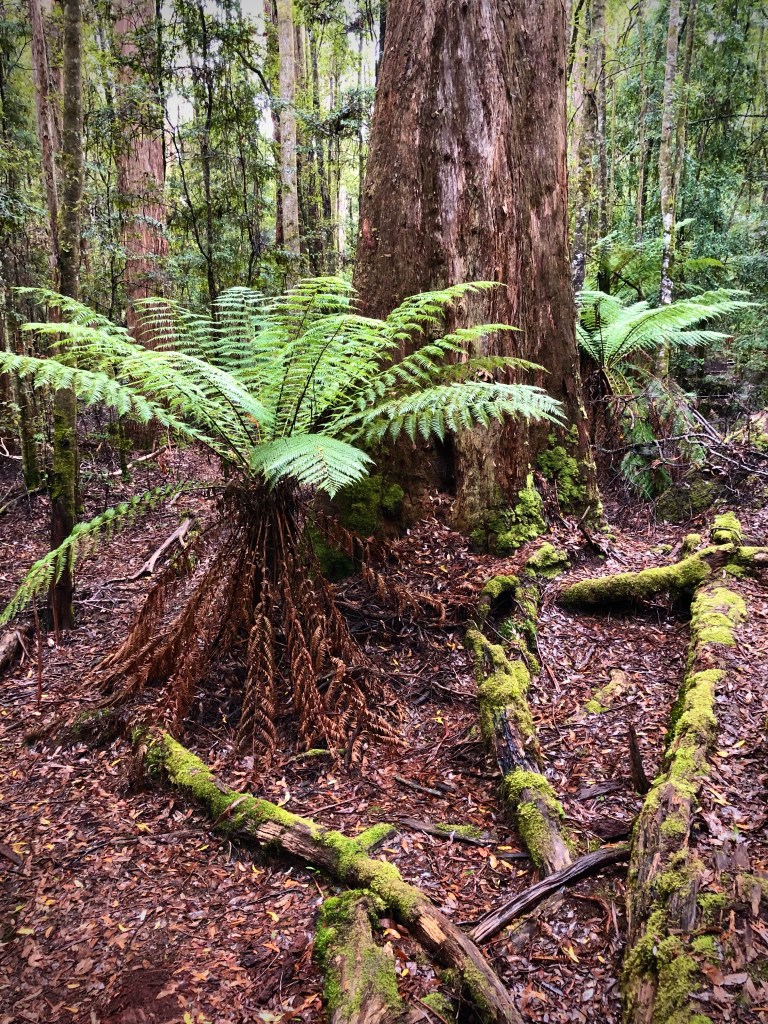
Tree ferns and Mountain Ash

Surrounded by tree ferns, mosses and lichen covered tree trunks, the short path leads past several impressive but smaller ‘Big Trees’ until it reaches The Big Tree. And it is big, very big! Standing almost 100-metres tall and a girth to match at nearly 17-metres. Sadly this 400-year old specimen is reaching the end of its life and is slowly decaying.

The Big Tree

A Fight for survival

How this stand of trees survived the relentless logging of the 19th and early 20th century is remarkable and owes its survival to its remoteness and difficulty of access. However that may change. Unbelievable 90% of the Tarkine is not protected and under real threat from logging, mining and damage by off-road vehicles. Worryingly the Tasmanian government sees the Tarkine as a resource to be exploited despite the region’s considerable Aboriginal heritage and being one of the last intact wilderness areas in the world.

The only way to guarantee these magnificent trees and the wilderness of the Tarkine survive intact is to get listed as a World Heritage Site – a process that an increasing voice is demanding.