60KM north of Cairns and bordering on two UNESCO World Heritage listed sites, Daintree Rainforest and the Great Barrier Reef, is the coastal town of Port Douglas – another town in Queensland established following the discovery of gold in 1877.
What’s in a name… or several?
Named after the former Premier of Queensland, John Douglas, Port Douglas’ development was largely based on the mining industry with timber cutting playing a part along the Daintree River. Unusually Port Douglas wasn’t the port’s first name, nor the second. It was previously known as Terrigal, Island Point, Port Owen and Salisbury.
Driven by tourism
These days Port Douglas is largely driven by tourism thanks to its location close to the Daintree Rainforest, 4-Mile Beach, Hartley’s Crocodile Adventures, Cape Tribulation and fast boat access to the inner and outer regions of the Great Barrier Reef. But it wasn’t until the 1980’s that tourism took-off following construction of the Sheraton Mirage Port Douglas Resort. Now the Mirage is just one of the many hotels and resorts that Port Douglas has to offer as well as holiday apartments, caravan sites and private accommodation.
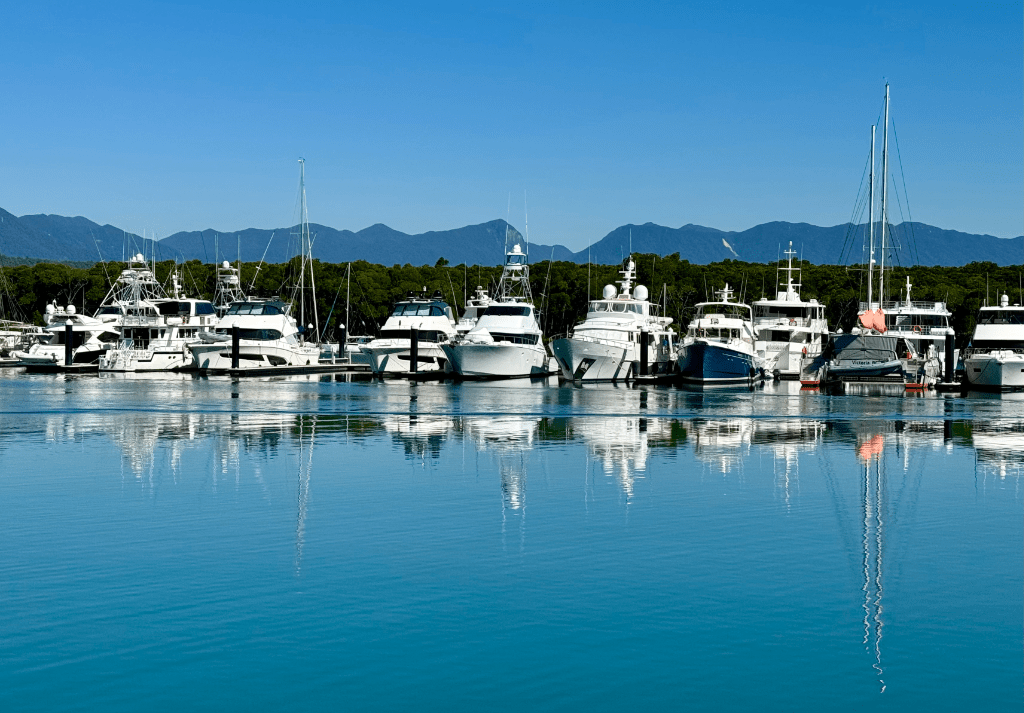
While staying in Cairns this week we decided to spend Sunday in Port Douglas, specifically to visit the Sunday Market located on the foreshore. It was our third visit to the Port in 18-years and likely not the last.

The market is open from 8am to 1.30pm at ANZAC Park and features locally made products including jewellery, clothing, crafts and artwork as well as food and the all important coffee and pastry stalls.
The market backs onto the beach and one of the classic Port Douglas photo spots – the Sugar Wharf.

Saint Mary’s by the sea
Another popular photography location and adjacent to the market is the cute timber clad Saint Mary’s by the sea – a non-denominational chapel. Initially constructed in the 1880’s as Saint Mary’s Roman Catholic church, it was destroyed by the cyclone of 1911 and rebuilt between 1913 and 1914. Saint Mary’s is now a popular wedding chapel available for hire as is the Sugar Wharf for wedding receptions.

Since our last visit the once immaculate chapel is now clearly in need of a fresh coat of paint. However, a peek inside will impress with a lofty vaulted ceiling and a window directly behind the alter providing a stunning view over Trinity Bay towards the Daintree Rainforest in the distance.
Cyclone Yasi
No different to all coastal towns in Far North Queensland, Port Douglas is not immune to the seasonal cyclones. To date the Cairns and Port Douglas region has felt the impact of 53-cyclones since 1876 with the worst for Port Douglas being on March 16th 1911 when only 7 of the 57-properties remained standing with two lives lost. More recently, in December 2023, cyclone Yasi made landfall. It wasn’t the wind that devastated the area but the weather events that followed with more than 3.2-metres of rain falling in less than a week – that’s more than 2-year’s average rainfall. Over 100-land slips and rockfalls caused widespread damage with severe flooding, houses destroyed and some communities isolated as a result of collapsing coastal roads. Almost a year later and road repairs are still ongoing with many sections of the Cairns to Port Douglas road affected. And up in the mountains the scars of landslips will remain visible for a great many years to come.
Balancing Stones
Something we first spotted along the coast of the South Island of New Zealand is the art of stone balancing. Seemingly something of a bit of a hobby for our New Zealand cousins, stacking round stones has spread across the ditch and nowhere better displayed than on the rocks beside the Cairns to Port Douglas road.

There’s parking available for a few cars to pullover and explore the many stacks that have been built. Maybe even have a go yourself.
The Crocodile Hunter
In 2006 Port Douglas hit the international news when Steve Irwin, the ‘Crocodile Hunter’, was tragically killed by a stingray, ironically, during filming of the documentary ‘The Ocean’s Deadliest’ on nearby Batt Reef. Steve’s death came as a shock and was so unexpected for someone who had spent most of his life working with some of the most deadly creatures on this planet. His wildlife warrior legacy continues with his family – Terri, Bindi and especially his son, Robert, who has stepped into Steve’s shoes with the same infectious enthusiasm as his father.
Australia Zoo, based in Beerwah, Southeast Queensland, is dedicated to Steve’s quest to better understand and protect wildlife wherever it exists anywhere in the world.










 Discovery Down Under