It sounds like the name for a recipe but just another day in Northern Tasmania.
We’re digging the North Coast
Rolling hills characterise the agricultural land hugging the north coast from Devonport to Wynyard, some so steep it’s hard to imagine a tractor capable of climbing, let alone plough, the fields. A mix of grass for cattle and dark earthy soil provide fertile ground for vegetables of all types. And local grown is reflected in the price of potatoes – a fraction of the price you would pay in any of Australia’s larger cities.
Not far to the west of Devonport is the town of Ulverstone sitting on the coast beside the Levin River from which it was originally named. Predominantly an agricultural region, Ulverstone is a large potato grower and processor supplying 24% of Australia’s potato market, making it Australia’s second largest producer after South Australia.
Each year 320,000 tonnes of potatoes are processed into frozen French Fries within Ulverstone’s Simplot factory. An additional 75,000 tonnes are supplied to McCains. However, potatoes are not the reason we were here.
In a Pickle
Blue Banner Tasmanian Pickled onions was the reason for our visit. Well, not us personally but our travel buddies. And we were so glad we tagged along.
To the front of the factory is the cafe and shop selling all things pickled and flavoured pickles too. A scent of vinegar wafts through the door as soon as you enter triggering fond memories of the days my grandparents used to pickle their own homegrown vegetables.
Of course you have to give the onions the taste test and we did just that sitting in the large cafe after ordering a savoury cheese scone. Blue Banner claim their locally grown onions are ‘The crunchiest pickled onions you’ll ever taste’. I can say with certainty that they are the, freshest, crunchiest and tastiest pickled onions I have ever tasted. For those that have only experienced pickled onions from a large jar in their local fish and chip shop, you’re missing a lot!
Not to be outshined by the onions, the cafe also makes a very good latte.
The Giant Penguin
There are many towns in Australia, both large and small, named in part after an animal. The obvious combining the name and a landscape feature such as Kangaroo Flat, Emu Plains or Crocodile Creek. But here in Tasmania they have gone one further and simply named a small settlement on the North Coast ‘Penguin’. And they are proud of it, or I could say obsessed with it.
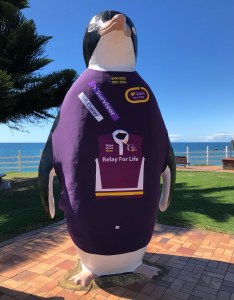
There can’t be a shop that has neither the name in it or sells penguins in one form or another. Even the street bollards have been made into penguins. It’s all a bit too much and sadly it has become a little ‘tacky’. Still, the children will love it for sure.

Now what I can’t figure out is Penguin’s connection with the Time-lord, Dr. Who. Why is the Dr’s travel machine, the Tardis, standing beside the Giant Penguin on the pavement. A look inside reveals a seemingly enormous library of lending books. It requires a double-take. I don’t know how it is done but the Tardis really is much bigger on the inside. Dr. Who is clearly an avid reader.


 Discovery Down Under