Our 3-month adventure in Tasmania has come to an end and we’ll soon be boarding the Spirit of Tasmania ferry back to the ‘mainland’ and the long drive home with a little detour through the Gold Fields of Victoria.
Brrrrr!
We can probably sum up our time here as becoming increasingly cold as Winter sets in. Very windy too with gales at times strong enough to shake the caravan and loosen fillings. But we’ve also had plenty of sunshine to enjoy the golden leaves of the deciduous trees throughout Autumn. There has been snow and rain too, lots of it, but mostly overnight and it hasn’t stopped us getting out and about and exploring what Tasmania has to offer the independent traveler.
Flora, Fauna and Roadkill
We’ve seen far less wildlife than on our previous visit. Plenty of bird life, sea life, sheep and cattle, the odd snake but also many, many wallabies, pademelons and possums apparently fast asleep on the roads and verges being watched over by hungry crows.
The Tarkine – Land of the Giants
And trees, lots of those too, especially the giants in the Tarkine, Mount Field National Park and Styx Tall Trees Conservation Area. But also not forgetting the beautiful Fagus trees at Cradle Mountain and the Leatherwood and Myrtle trees and mosses and algae everywhere we went. Of course no forest would be complete without fungi and in Tasmania there’s no exception with more variety and colours than I’ve seen anywhere before.
Hygrocybe pseudograminicolor
We did get to see our first wild Platypus and Fairy Penguins – the world’s smallest, which waddle onto land overnight to shelter and feed their young. We saw Pink Robins and Fairy Wrens flitting among hedgerows, Black Swans gliding across the lakes and coastal shores and Egrets and Herons wading in the shallows. Even the Lonely Albatross put in an appearance during a feeding frenzy off the coast of the Tasman Peninsula along with giant Tuna rocketing out of the water chasing after bait fish.
Less popular though were the mosquitoes, seemingly fitted with silencers, putting in a late season appearance when you least expect them. Oh, and heat-seeking leeches ready to climb up your trouser leg if you stand still too long.
History
We’ve experienced the history telling of past explorers; Cook, Bass, Bligh, D’Entrecasteaux, Flinders, Furneaux and Tasman, of the indigenous people of Lutruwita (Tasmania) and the appalling way Truganini was treated. We discovered more about the Australian Convict era and the often petty crimes that brought the unwanted from the UK to Tasmania’s shores. And never to forget the modern day massacre at Port Arthur.
Port Arthur
Scenery
For a relatively small island state Tasmania has an enormous variety of scenery. From rolling grassy hills, mossy forests, mountains, lakes, waterfalls, towering sea cliffs, the orange coloured boulders along the Bay of Islands, white sandy beaches, turquoise water and true wilderness – there’s something here for everyone.
Dove Lake – Cradle Mountain National Park
We’re sad to be leaving Tasmania, our home for the past three months, but the warmer weather of Queensland is now calling us home. But, of course, there are more adventures to come. We still have so many more places to explore around Australia and further afield. Our 10-month ‘Big Lap’ around Australia in 2019/20 was just the start and we only skirted around the country – there’s a whole world to discover inland and off the beaten track.
For now we’ll be heading north and exploring the gold fields of Victoria and following the Australian Silo Trail.
Beaconsfield Gold Mine, 40km north-west of Launceston in Tasmania, became the site of a global media frenzy when, at 9.26am on 25th of April 2006, a small earthquake triggered a rockfall 925-metres below the surface where 17 miners were working. It was a story of endurance, incredible bravery and tragedy.
Early Escape… for some
Of the 17-miners working underground on that day, fourteen managed to reach a safety chamber and ultimately made it to the surface without injury. However, for Brant Webb, Todd Russell and Larry Knight it was another story.
Larry was operating a Telehandler while Brant and Todd were in a 1.5 cubic metre steel cage on the front of the Telehandler’s extendible arm fixing a steel mesh to a barricade when the rockfall was triggered. The three men were trapped underground and their condition unknown leaving their families and work colleagues fearing the worst.
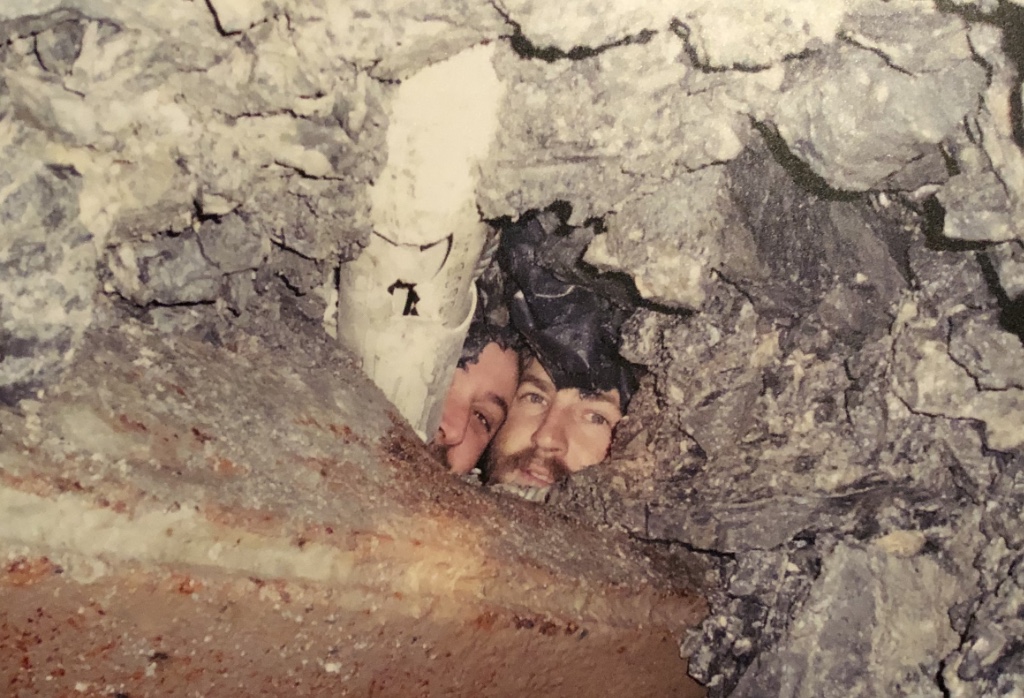
Unknown to the world above, both Brant and Todd had survived the collapse but were partly buried with rubble that had fallen through the mesh of their cage. They managed to free themselves within the cage by cutting through their clothing and boots that were wedged between rocks.
Trapped Miners Brant Webb and Todd Russell
While rescue teams were working to discover if the mine was safe to enter, the two trapped men were able to collect water in their safety helmets that was seeping through the fallen rock. Other than water and a single muesli bar they had nothing to sustain them until rescuers could reach them.
The search for Survivors
After confirming the mine was now safe to renter, rescuers began the search for the missing men. They managed to reach within 15-metres of where they believed the men would have been prior to the rockfall but a large and potentially unstable debris pile blocked their way.
By the 26th of April a remotely-controlled earth mover had been brought in to begin removing the debris and early the following morning the body of telehandler driver, Larry Knight, was discovered having been pushed clear of the rear of the machine by the fall.
Progress came to a halt when further inspection showed it was unsafe to continue.
Action Plans
Rescuers, colleagues, mining experts, surveyors, medical staff and mine management worked through countless options to form a rescue plan to try and extract Brant and Todd from the mine whether they were alive or not.
Surveyors identified a potential route from the main access tunnel to a point just in front of the telehandler where they hoped they would find the remaining two miners. The rescue effort resumed on the 29th of April by blasting a new tunnel using at least six powerful explosive charges. Unknown to the rescuers the blasts were dislodging rocks, which were falling into the cage at times faster than Brant and Todd could clear them. With each blast Brant wrote the time and date on his overalls in the event they didn’t survive the explosions. Rescuers would at least know they had survived the initial rock fall but died as a result of one of the blasts during the rescue attempt.
Both men wrote letters on their clothing to their families in the event they didn’t survive and sang favourite songs to try and keep up moral.
They’re Alive!
At 5.45pm on April the 30th the Underground Manager, Pat Ball and Mine Foreman, Steve Saltmarsh descended to the level known as ‘925’ (925-metres below the surface) and, on approach to the rockfall, they yelled out in the hope they could be heard by the trapped miners. Both Brant and Todd immediately yelled back, “We’re in here!”. The pair were alive and news quickly reached the surface and the waiting families, friends, colleagues and media. Within minutes the news was heard on TV and radio around the world.
In the meantime one of the rescuers managed to find a way past the debris pile and got so close to the cage that he was able to reach through and shake hands with Brant. However, as an escape option, it would have required cutting the cage wires that were supporting the weight of the rock pile above the two men and the option was subsequently abandoned. Blasting was halted and instead a small, 90mm hole was chosen to reach the miners. Both Brant and Todd listened out for the drill to help guide it toward their location.
After successfully drilling through to the cage, a PVC pipe was fed through by which food and water could be passed to the men. A telephone was disassembled and passed through the pipe along with instructions on how to reassemble it. Later a torch, magazines, toothpaste and an iPod was fed to them via a modified plastic water bottle. A digital camera was also passed to the men so they could photograph their situation and the rock around them. Importantly this allowed the rescuers to ascertain the safest way to reach them without triggering further rockfalls.
A change of Plan
It wasn’t until The 1st of May that Brant and Todd were told about their colleague Larry Knight. On the same day the decision to continue blasting and drilling was stopped over fears of another collapse. Instead a machine known as a ‘raise borer’ was assembled, which it was hoped would be able to drill a horizontal tunnel one metre in diameter. It was designed to be used only vertically but it was thought to be the fastest option to get to the men and create a tunnel large enough for them to escape through. However, it would require bolting to a concrete base, which would take time to construct and allow the concrete to set.
In the evening of May the 3rd drilling of a pilot hole began, which ultimately took more than three days to bore through the remaining 12 metres of rock. Drilling was much slower than expected after hitting a form of quartz that was described as being five times harder than concrete. At 8pm the following day the drilling of the one metre wide escape tunnel began. It would follow the pilot hole to a point just below the trapped men.
Breakthrough! – Brant and Todd
By early morning of the 6th of May the raise borer was 5-metres short of its target and took a further 12-hours to complete the escape tunnel. After disassembling and removing the borer the plan was for miners to lay on their backs and use hand tools to dig upwards to reach Brant and Tod. But the following day the rescuers hit extremely hard rock once again and their powered jack hammers were making no progress. Explosives expert, Darren Flanagan, fretted over the use of low-impact charges to break through the rock fearing it could trigger another rockfall and cause the cage to collapse. But there were no other options available and to the relief of all it was successful. At 9.30pm on May the 8th the rescuers were able to pass a probe through to the base of the cage – they were just one metre away from freeing Brant and Todd.
Breakthrough!
At 4.27am on the morning of the 9th of May, fourteen nights since the initial rockfall, rescuers Glenn Burns, Donovan Lightfoot and Royce Gill finally reached Brant and Todd, “I can see your light!” they yelled as they broke through into the cage, “ I can see your light too!” the miners replied.
Brant was the first to be pulled from the cage followed minutes later by Todd. After being checked over by a doctor, both men ascended the shaft’s lift and at 5.58am they walked out unaided to the cheers of the waiting crowd and the arms of their relieved families.
Brant and Todd reach the surface
Both men were treated for their injuries at Launceston General Hospital and just six hours later both men were able to attend their lost colleague, Larry Knight’s delayed funeral.
Looking to the Future
Twelve months after the rescue the mine restarted production and continued operating until June 2012 by which time reduced gold prices and high operational costs made the mine unviable. However, plans are ongoing to reopen the mine with gold prices doubling since closure. This despite repeated theft and vandalism at the site with the most recent break-in causing an estimated $1.5M damage to the site’s infrastructure.
Beaconsfield Mine and Heritage Centre
In addition to the exhibition detailing the 2006 rescue, the Beaconsfield Mine and Heritage Centre contains over 10,000 items of machinery and household items from the days of steam through to the 1970’s. There’s something of interest for everyone and you’ll find yourself spending hours exploring the many displays and buildings.
Situated just a few hundred metres from the centre of Launceston, Tasmania’s second largest city, is an unlikely mix of a Victorian Pleasure Garden and wilderness. Rarely will you find such a dramatic location so close to a city.
Cataract Gorge is a 5km long, 65-million year old natural wonder. Comprised of four distinct features; South Esk River, Cliff Grounds, First Basin and Duck Reach, and each of them unique.
South Esk River – Cataract Gorge
In the beginning
A settler by the name of William Collins made note of his visit here while exploring the Esk River and Port in 1804. It is believed to be the earliest record of the area in which he noted, “Upon approaching the entrance I observed a large fall of water over rocks, nearly a quarter of a mile up a straight gully between perpendicular rocks about 150 ft high. The beauty of the scene is probably not surpassed in the world”. Obviously in the early 19th century he would not have seen that much of the world to which he could compare. However, it is certainly impressive in its scale.
Victorian Splendour
The gorge quickly became a popular destination for Victorian visitors to ‘partake in the air’. Access up the river was initially restricted to walkers over a steep zig zag track or by boat to a large rocky outcrop jutting into the river known as Picnic Rock. Access was greatly improved in the early 1900’s when a suspended pathway, known as the King’s Bridge – Cataract Walk, was built by volunteers linking King’s Bridge to First Basin. Anchored high on the cliff wall, it was constructed by volunteers over a period of eight years. The walk provided an easy and mostly level pathway for pedestrians to approach First Basin and Cliff Grounds, once a swamp but converted to a park with exotic plants, specimen trees, Peacocks and a bandstand and restaurant.
First Basin – Cataract Gorge
To Pay, or Not
The Launceston City and Suburbs Improvement Association, formed at the end of the 19th century, was instrumental in the construction of the suspended walkway and additionally the Toll Keeper’s Cottage and Toll Booth adjacent to King’s Bridge, both of which were built in 1891. Unusually the toll was entirely optional and many, not too surprisingly, chose the option not to pay. The toll was intended to raise money towards further development of the gorge so, again not too surprisingly, the Association made the toll compulsory later in the year.
Cataract Gorge Toll Keeper’s Cottage
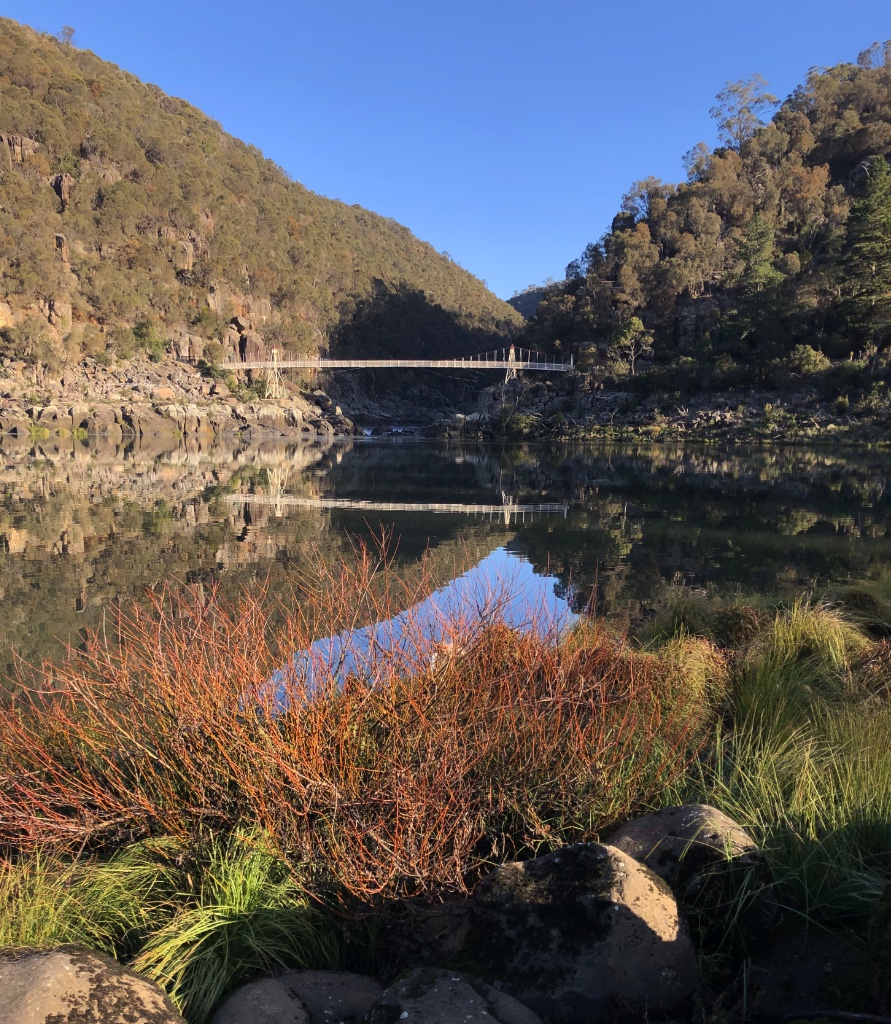
In 1904 the Alexandra Suspension bridge was formally opened. Situated to the south of First Basin, the bridge extended the King’s Bridge Cataract Walk and crossed the South Esk River giving safe pedestrian access to First Basin and a pathway leading further up the river for people to explore.
Alexandra Suspension Bridge – First Basin
First Basin
Most visitors today arrive directly at First Basin with its good parking facilities, a cafe, open grassy areas, a playground, the largest single span chairlift in the world and a large outdoor swimming pool. It’s more like a park with cliff side views – ideal for a weekend picnic with a young family. However, looks can be deceptive. Cataract Gorge is a place where raging torrents can and have swept away bridges and carry huge boulders downstream.
Upper South Esk River
Duck Reach Trail
The Duck Reach Trail from the Alexandra Suspension Bridge shows a marked contrast in scenery. No longer a place to sit and admire the green lawns and specimen trees and shrubs, here you are thrown right into a wilderness with native trees fighting for soil among the steep and fractured gorge walls and the boulder strewn river churning the water as it heads downstream towards First Basin.
The trail is a moderate walk with a steady incline and a number of steps as you approach the Duck Reach Suspension Bridge. On crossing the bridge there are two further tracks – the steep Reed Gully and Snake Gully. Both are for experienced and energetic hikers and form a 2km return track to First Basin. But we were here to see the now disused Duck Reach Hydro-Electric Power Station.
Power for the People
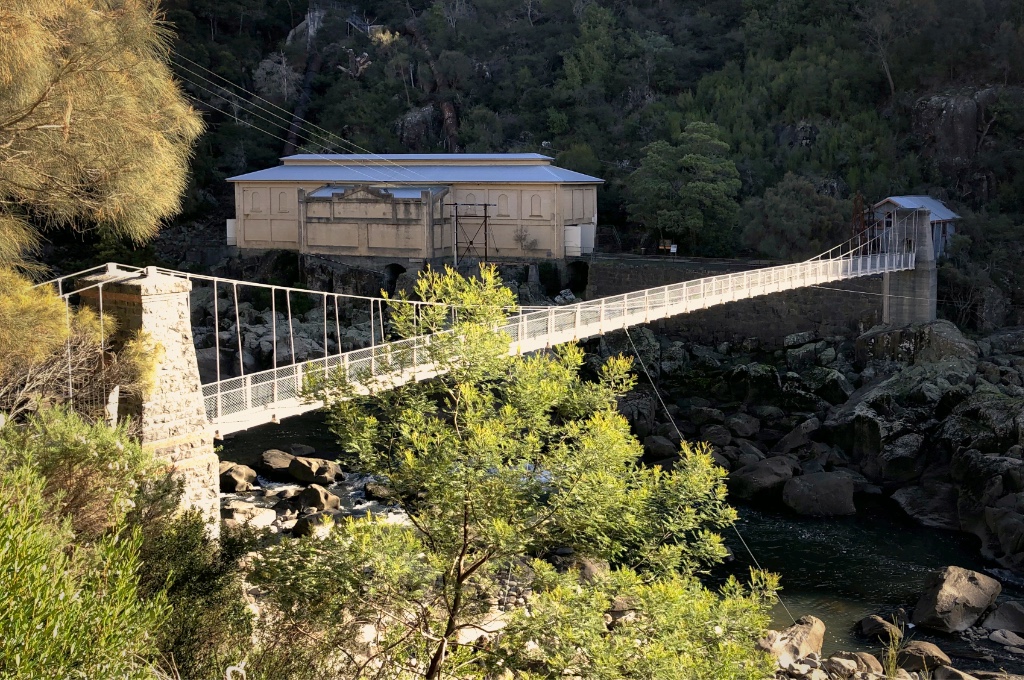
In 1893 Launceston City Council commissioned the construction of the Duck Reach Hydro-Electric Power Station. Frequent flooding in the gorge necessitated the station be built high above the South Esk River, which complicated construction and required the building of a heavy-lifting Flying Fox to transport materials across the river. However, just two years later on the 10th of December 1895, the turbines were generating electricity for Launceston and lighting the city with brilliant arc lights. It was Australia’s first commercial hydro-electric scheme and is believed to have been a world first providing water-generated electricity for a city south of the equator.
Duck Reach Hydro-Electric Power Station
To facilitate safer pedestrian access to the power station a second suspension bridge was constructed creating a permanent link across the gorge.
With a greater demand for electricity, partly triggered by the city’s introduction of an electric tram and the city’s increasing rollout of electric street lighting, the power station was upgraded to double its output and by 1910 it was producing, for its time, a considerable two megawatts of power.
The Big Flood
Even though the power station was built high above the river, the planners could not have anticipated the events that unfolded in the December of 1929. Unprecedented and persistent heavy rain followed a long dry spell flooding much of Tasmania’s low-laying land. The torrent of water forcing its way through Cataract Gorge, compounded by the merging of the flooded North and South Esk Rivers and the tidal Tamar River, raised the water at Duck Reach by 9.5-metres destroying the power station and sweeping away both suspension bridges. Despite such destruction the urgent need for power saw the station being quickly rebuilt and power was again being generated in 1930.
The Duck Reach suspension Bridge wasn’t rebuilt until 1939 but was again swept away by floods in 1969. It wasn’t until 1995 that the bridge was rebuilt following the original design and it stands to this day.
Duck Reach Power Station – now disused
More Power!!
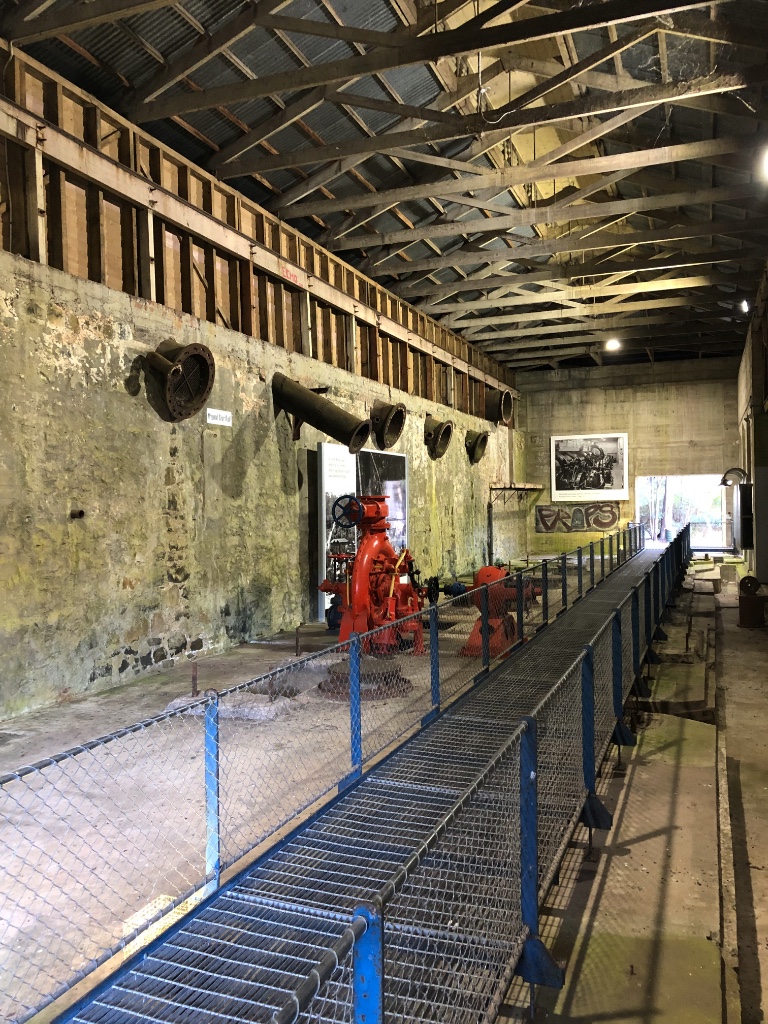
Even following the plants upgrade the increasing demand for electricity was greater than the plant could provide and by 1934 the City of Launceston was also purchasing electricity from the Tasmanian Hydro-Electric Commission. By the early 1950’s the Duck Reach station’s days were numbered and was eventually decommissioned in 1955 when it was superseded by the new Trevallyn Dam Power Station. With the turbines and pipework removed the building remained derelict for the next 40-years until, on the centenary of it first becoming operational, it was re-opened as a museum and interpretation centre for visitors to enjoy.
A Grand Day Out
There’s plenty to see and do at Cataract Gorge for the family and walkers alike. It is a great day out combining great scenery, history and exercise and even a little daring for those who prefer their bridges to stay stationary as they walk over them.
Located within Freycinet National Park, The Hazards are a mountain range on Tasmania’s east coast and gateway to one of the most famous beaches in the world.
Beauty in Pink
Anyone touring around Tasmania, and with the remotest interest in geology, will notice a change in the mountains on the Freycinet peninsula from the grey granite, black basalt, dolerite and sandstone of much of the state’s mountainous regions. As you approach the Hazards via Coles Bay you cannot help but notice their very distinct pink hue and more so in the evening under the setting sun.
Setting sun on the Hazards
Long, long Ago
The granite mountains, believed to have been named after African-American Whaler Captain Richard Hazard, are comprised of a mineral called Orthoclase – a pink form of feldspar that owes its colour to another mineral, iron.
The Hazards from Coles Bay
Around 60-million years ago volcanic activity beneath what is now Tasmania, pushed magma upward lifting the land hundreds of metres above sea level creating the Freycinet peninsula. During the same period the land to the west of the peninsula sank forming Great Oyster Bay. As the magma slowly cooled under pressure the Orthoclase formed into the large rectangular crystals that are typical of the rock, granite.
Over the following millions of years the softer ground above the granite eroded away exposing the rock to weathering by ice, rain and wind that has resulted in the giant rounded boulders that now litter the mountains. Today the Hazards stand at a shadow of their former height but still reach an impressive 485-metres above the sea.
Freycinet National Park
Much of the Freycinet peninsula falls within the bounds of Freycinet National Park* with the only access being via a single narrow, and not very well maintained road. Credit, though, is due for the excellent, and unusually large, National Park Visitor Centre, where a large number of park guides and leaflets about the region and activities can be found as well as a good selection of books, outdoor clothing, local crafts and souvenirs.
The distant Hazards Range from Swansea
Time for a Walk
We had been looking forward to exlploring the Freycinet region again following a previous visit in 2008. On that occasion the weather wasn’t in our favour with light rain and low cloud setting in just as we got to a major viewpoint. This time, however, the sun was shining and the sky was mostly clear, perfect walking weather despite the cool late autumn wind.
Our walk was the shortest within the park but with a view worth every step, and ache, up the often steep climb. In 2008 the same track between Mount Amos and Mount Mayson was best described as ‘rough’ with a steep climb on a slippery gravel path interspersed with sharp rocks ideal for tripping the unwary. Now, however, sturdy steps have evened out the steeper sections making the upward path easier, though still requiring a fair amount of effort. Several ‘new’ viewpoints have also been added looking back over Coles Bay towards the distant coastal town of Swansea.
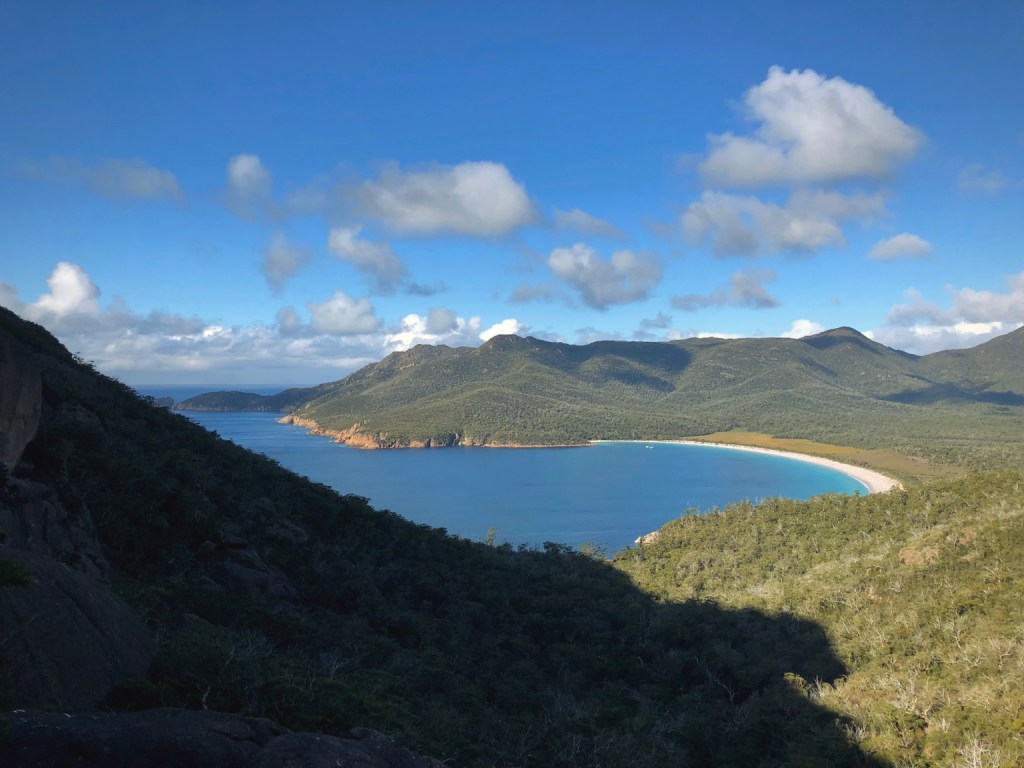
Wine Glass Bay from the Lookout
The higher you climb the larger the giant granite boulders become and in places you are walking among and between them towering over you. But there is a very worthy reward for the 45-minute climb when you reach the top of the pass – for this is the Wine Glass Bay Lookout Walk and from here, as the name suggests, you get the most amazing view of the world famous Wine Glass Bay. All the effort to arrive at the lookout weighed down by a heavy camera bag was worth every step. The lookout, too, had been updated with additional platforms giving greater access to the increasing number of walkers being attracted to the peninsula.
1,000 Steps Too Many
We had considered the extended walk that leads down to the white sand of Wine Glass Bay’s beach but we had second thoughts after reading more about the terrain. Access to the beach requires navigating a far steeper track and includes around 1,000 steps down and back to return to the viewpoint. At the end of the day it is just another of the many beautiful white beaches with turquoise water along the east coast of Tasmania and its ‘fame’ due to its curved shape and remote seclusion. So, after several photographs and a chat with a couple of fellow travellers, we headed back down the quite unique one-way track, which separates the freshly rested from the newly exhausted heading uphill.
People often ask, ‘what is the origin of the bay’s name?’, and no one is quite certain. The most preferred, and most pushed by marketeers, relates to the similarity of the bay’s shape to that of a wine glass, but there is a darker and more likely offering, a bloody one, which is where our whaling Captain Richard Hazard features once again.
In the early 1800’s whaling was a significant contributor to Tasmania’s fortunes and much of that was along the east coast of the state. Whaling stations were a common site where spotters would take to the high ground looking for the migrating whales, sending out the boats to harpoon any unfortunate passing whale and dragging them back to the shore-based stations for ‘processing’. The whale’s baleen was used to stiffen corsets and the rings of the fashionable British ladies’ dresses, while whale oil, extracted from the blubber powered the dim lights in Victorian houses and an extremely fine oil for lubricating clocks, watches and the machines driving the booming Industrial Revolution.
A Bloody Past
The more likely origin of Wine Glass Bay’s name, however, is related to the colour of the deeply blood stained water and beach during the whaling season rather than the shape of the bay. Imagine too the putrid stench of boiling blubber and the rotting carcass’s of whales. There could not be a greater contrast to how the pristine bay appears today.
*As with all National parks in Tasmania, a National Parks Pass is required for vehicles entering Freycinet National Park. Passes are available from all National Parks Visitor Centres in Tasmania as well as from the automated machines in Freycinet National Park’s car parks.
While planning our trip around Tasmania we saw two travel shows featuring a high-powered boat that ploughs its way through the waves along the eastern coast of the Tasman Peninsula. Passing sea caves, waterfalls, pinnacles and giant vertical cliffs, we decided it was a must do and what a ride it was.
The Yellow Boat
Bruny Island Cruises is just one of Robert Pennicott’s Tour options and part of Pennicott’s Tasmanian Wilderness Journeys. Our journey started at their Port Arthur office where we were advised to wear multiple warm layers and a beanie and to climb into the provided waterproof and wind proof full-length jacket once on the boat, a task easier said than done. Today the offshore wind was favouring a start from the small port of Pirates Bay so we all climbed aboard the Pennicott’s bus for the 15-minute drive north.
Doo Town
The jetty is accessed via the small and somewhat comically named settlement of Doo Town. In 1935 architect Eric Round unintentionally began a custom when he placed a name plate on his weekend property ‘Doo I’. His neighbour joined in with ‘Doo Me’ followed by ‘Doo Us’ from another neighbour. And it continues today with most homes being named in similar style. Among the many are; Doodle Doo, Wee Doo, Rum Doo, Doo Little and ‘Love Me Doo’.
Safety Briefing
We couldn’t have chosen a better day for a cruise with a clear blue sky and very little wind. We’d actually been keeping an eye on the weather and wind charts for a while and brought our booked trip forwards by two days for more favourable weather.
All Aboard
Our boat was one of two setting out on a 3-hour trip from Pirates Bay heading south along the coast, around the peninsula and then north through Maingon Bay up to Stewart Bay. Each boat seats 43-people and is powered by three 250hp outboard motors. That means these custom designed ‘Yellow Boats’ are quick, very quick, and can easily cut through heavy seas and a big swell. To ensure everyone onboard gets a good view the seats are tiered and safety belts on each ensure everyone stays onboard! Having a somewhat aged back and hips we were advised to sit right at the back for a smoother ride. It also meant we were right inline for the spray thrown by the boat when turning against the wind.
After a safety briefing we were off powering out to sea before turning south and following the coastline and the enormous vertical sea cliffs rising up to 300-metres above the sea. Much of the coastline is comprised of Jurassic Dolerite, one of the toughest known rocks, and splits into vertical columns rather than softly erode by the pounding action of waves. This allows sea caves to form and that is exactly where we next took a close-up view. On suitable days the boat can take you right into some of the caves but thankfully today wasn’t one of them – a recent rockfall made it unsafe.
Tasman Arch
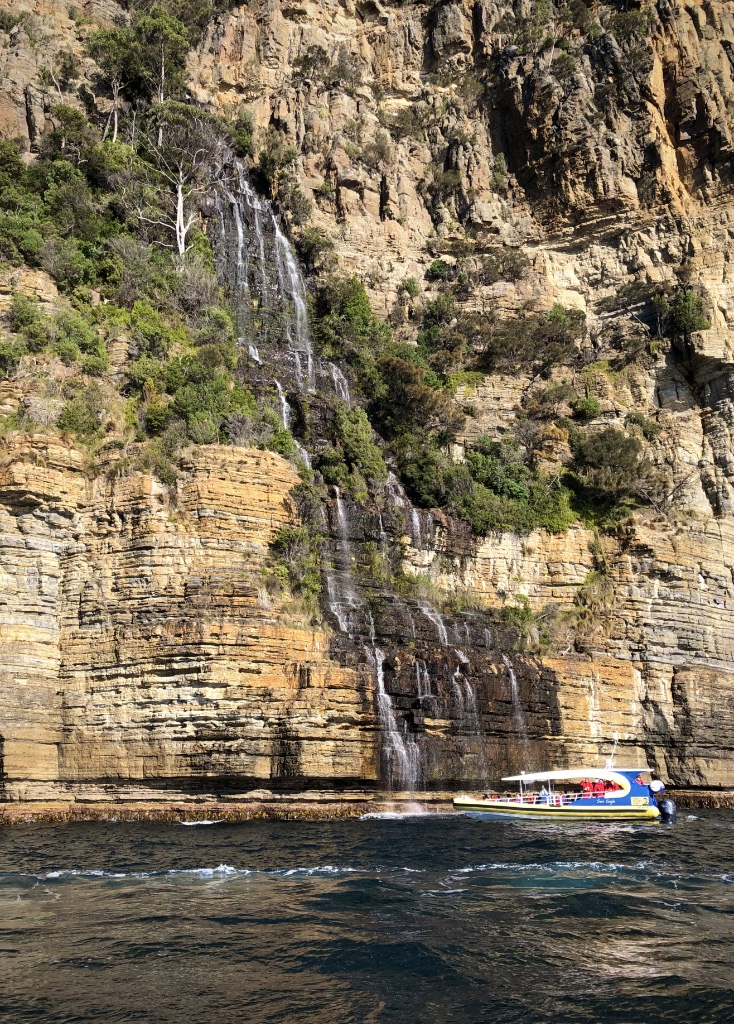
Waterfall Bay
Next up was the waterfall at Waterfall Bay cascading over 200-metres to the sea. At each stop our Captain, Ben, a maritime encyclopaedia, explained how each rock feature formed, the types of wildlife we could see, walks along the cliffs we could enjoy later and the Aboriginal history of the region. At each stop Ben keeps the boat turning to ensure everyone gets a clear view and the opportunity to take a photograph.
Waterfall Bay
Fortescue Bay
Part of Tasman National Park, Fortescue Bay, also known as Baje Dolomien, was once a site of timber milling in the early 1900’s and later as a sheltered port for fishing vessels. Today it is a popular camping destination but also a haven for the Australian Fur Seal once hunted for their skins. And it was for the seals we were stopping in the bay to take a closer at. Completely unfazed by our approach – taking just a quick inquisitive look while they enjoy the warmth of the sun.
Australian Fur Seal
Cape Hauy
Heading further south and racing across Fortescue Bay we approach Cape Hauy. The cape was named in 1802 by French botanist François Péron after the mineralogist Rene Just Hauy, who went on to establish the science of crystallography, a technique later developed to discover the structure of DNA.
Cape Hauy is home to several outstanding rock features jutting straight up from the Tasman Sea. Two giant Dolerite bluffs known as The Lanterns, narrowly separated by the sea, were once joined as a single peninsula. In more recent times, geologically speaking, they formed sea arches before collapsing to form what we see today. On land The Lanterns mark cape one of the Three Capes Walk, a 48-km, 4-day trek along the East coast of the Tasman Peninsula.
The Lanterns
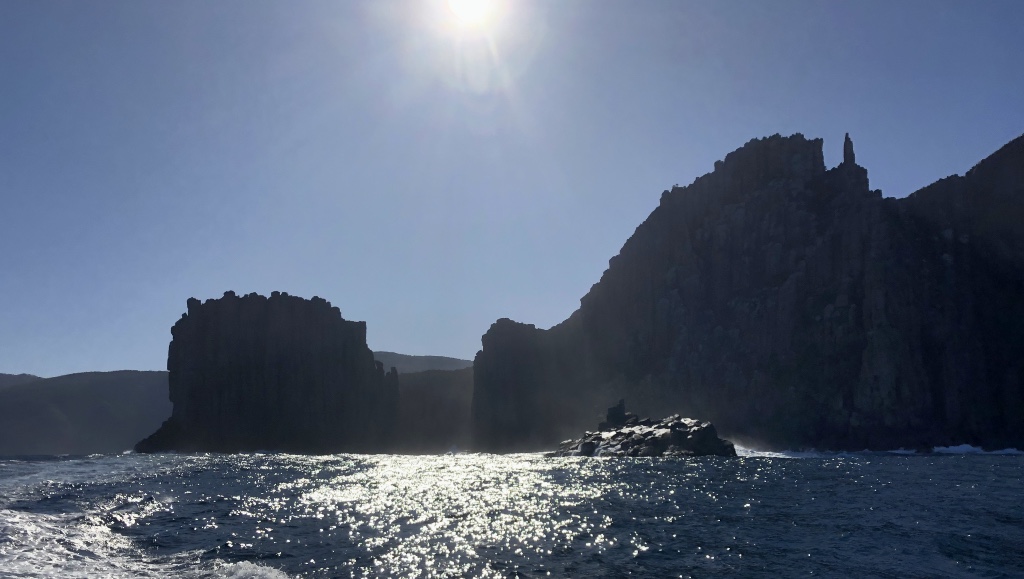
Partly obscured by the Lanterns are two further rock features – sea stacks – that come into full view after rounding Cape Hauy. Named by Tim Christie after climbing both stacks in 1965, the Candlestick is a huge column of Dolerite rock offering less of a challenge then its neighbour the Totem Pole but still an extreme climb with a serious swell waiting in the sea below for the unfortunate… and the real possibility of sharks approaching for a closer look. The 65-metre tall Totem Pole is by far the most serious of the climbs with a base just 4-metres across, judders when pounded by waves and for added discomfort, it sways in the wind. Unbelievably the Totem Pole can be climbed without the aid of ropes as was first demonstrated by American Mark Anderson in 1995.
The Candlestick and The Totem (left of image)
What makes Cape Hauy all the more impressive is the sheer height of the cliffs. At 300-metres these are not only the highest sea cliffs in Australia, they are the highest in the southern hemisphere.
Looking for Whales
Perhaps number one on most people’s lists is the opportunity to sight whales as they migrate along the coast. It was the right month for humpback whales heading north from the Antarctic but luck wasn’t with us on this day. Southern Right Whales are often sighted here too as are Killer Whales, Minkie Whales, Pilot Whales and an occasional ocean giant, the Blue Whale, at 33-metres the largest animal on earth.
Shortly after rounding Cape Hauy, flying right past us was an enormous seabird, a Shy Albatros* skimming the surface of the sea before wheeling high into the air and dropping back to skim the surface once more. It alerted everyone’s attention away from the towering cliffs to a disturbance in the water about 100-metres in front of us. Seabirds were swooping and diving into the water grabbing bait fish in a feeding frenzy. They were joined by flashes of silver in the sun as giant Blue Fin Tuna broke the surface chasing the bait while Shearwaters picked out those trying to escape. And flying among them were several Albatrosses hoping for an easy catch. It was an amazing sight that we were so fortunate to have had an encounter with. It would have been even better to see a whale today but we were happy to settle for this awesome display of nature.
Tasman Island and access winch
Skirting the southern most point of the Tasman Peninsula and rounding Cape Pillar, the final cape on the Three Capes Walk, we passed through Tasman Passage, which separates Cape Pillar and Tasman Island. It was here that we were most exposed to the winds sweeping all the way from the Antarctic and an increasing swell. The often wild seas here are the reason that a lighthouse was constructed 240-metres above the sea on top of Tasman Island.
Tasmania’s Alcatraz
The 29-metre light tower was constructed in 1905 from steel panels hauled to the top of the cliff and bolted together. It began operating the following year but soon became likened to ‘Alcatraz’ by the lighthouse keepers. It was a highly unpopular station due to its isolated position, regular storms and its difficult and dangerous access. During the days when the lighthouse was manned it was a challenge just to get from a boat onto land but that required a landing stage on a neighbouring rocky outcrop, a flying fox to cross to the island and then a hair-raising 200-metre winch to the top. Large swells often made the fortnightly deliveries impossible when supplies couldn’t be dropped off, which led the lighthouse keepers to grow their own vegetables in the highly fertile soil. They also kept cattle and sheep, which sustained the lighthouse keepers and their families.
The Tasman Island lighthouse is the highest still operating in Australia and the last to be built in Tasmania. The storms and winds were often so severe that the structure used to vibrate regularly destroying the delicate mantles and occasionally dislodging the highly toxic mercury on which the light’s optics floated. After 71-years as a staffed station, the lighthouse was automated in 1977 and then converted to use solar power in 1991.
Black Head
The last leg of our wilderness cruise saw us pounding through the waves and swell alongside the enormous sea cliffs of Black Head before entering the calmer waters of Port Arthur, past Point Puer with views over to the famous Port Arthur Historic Site, which was home to many of the convicts transported from the UK during the 1800’s.
Stewart Bay Harbour was the final stop where a fairly steep 500-metre walk leads back to Pennicott’s office, the point from where we started our adventure and where we said goodbye to our bright red waterproofs.
This was by far the most exciting experience of our trip around Tasmania to this point. The boats are fast and very stable, the scenery stunning and, although quite expensive, it was worth every cent and couldn’t be recommended more highly.
* The Shy Albatross is the only albatross that breeds in Australian waters and within the Australasian region. It is smaller than the Wandering Albatross with a wingspan of between 2 and 2.5-metres. Flying close to shore and often into bays and harbours, it wanders from subtropical to sub-Antarctic oceans.











 Discovery Down Under