The Humpbacks of Hervey Bay

It’s been a while since we hit the road with our caravan. So, following an amazing trip to Europe earlier this year, it was time to explore again, this time a little closer to home.

Just two hours drive north of us sits the expansive Hervey Bay, the annual stopover for the magnificent Humpback Whales after their long trip north from the Antarctic. Nestled between the Fraser Coast and the shelter of K’gari (Fraser Island) it provides the perfect resting place and training ground for newborn humpbacks as their mothers prepare them for long swim south to the colder waters of their feeding grounds. It’s also the ideal playground for the ‘teenagers’ to hang out as they learn new skills and develop relationships among the pods.

Whale Season

Living on the Sunshine Coast we regularly spot the humpbacks during the ‘Whale Season’ from July to October but for years we’ve been wanting to get a closer view. Having recently joined the local camera club now was the opportunity we had waited for with a group outing to the bay and an opportunity to get to know our fellow club members.

A quick visit to the Cistern Chapel

For those, like us, travelling north along Australia’s east coast, we would recommend taking a driving break in Maryborough just south of Hervey Bay. With its links to Mary Poppins it is worth an explore of some of its unusual and perhaps quirky experiences the town offers. I’ll just mention the public toilets in the Cistern Chapel as one such attraction. Trust me it’s worth a ‘visit’.

Fogged in

With the forecast weather looking grim for the weekend it appeared that conditions out in the bay weren’t going to be ideal but we were still likely to see the whales, though maybe not in the best light for a bunch of keen photographers. First light on Saturday morning confirmed the forecast. After days of blue skies we were now blanketed in a thick fog. Still, that wasn’t going to hold us back and by the time we arrived at the harbour the sun had burnt through the fog and things were looking up.

Finding a sheltered spot at the rear of the boat, we set-off only to be surrounded once more by fog. But it wasn’t long before we slowed and got our first sighting of a young whale ‘fin slapping’, though just too far off for a worthwhile photo. About 45-minutes later we arrived just off the northern tip of K’gari and with cameras at the ready, we waited. And then, as if pre-arranged, the fog lifted and the sun sparkled on the clear turquoise sea. This was looking much better. This was the weather we had hoped for.
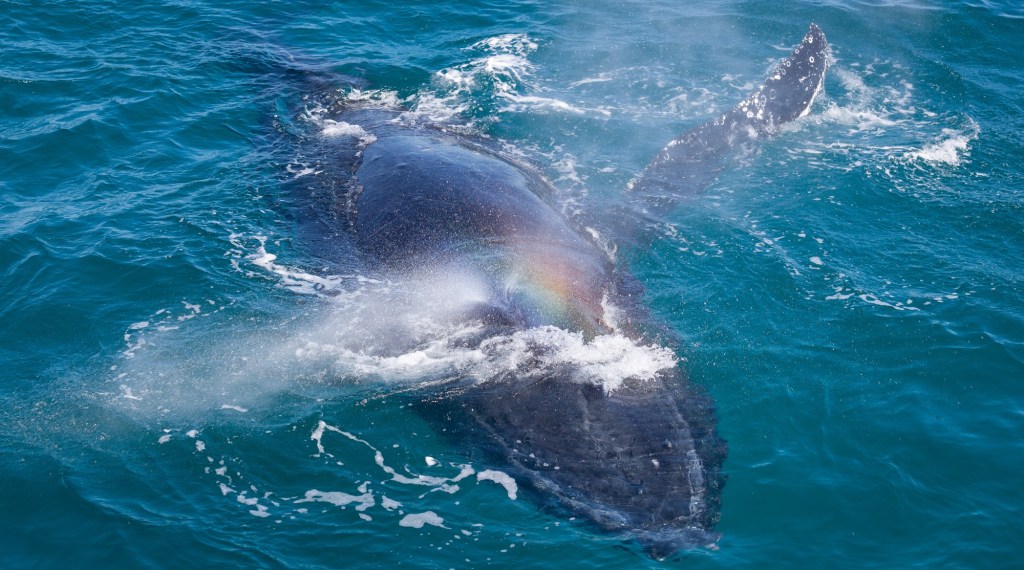
Approaching the boat

A sudden announcement on the ships’ speaker and everyone rushed over to the starboard side as three young humpbacks headed towards us. Whether out of curiosity or just enjoying an interaction, humpbacks are drawn to boats of all kinds. Certainly they appeared interested in our boat and gently cruised around from one side to the other and often diving and popping up with just their mouth above water. One whale appeared to interact by blowing bubbles each time one of the crew waved her arm in a circular motion. Whether the whales just see something interesting to play with or they’re being deliberately interactive, I guess we’ll never know.

We were treated by fin slaps, tail slaps and an intriguing creation of dead water, where the whales create a perfectly calm circle of water among the ripples of the ocean. Somehow it remains that way as it drifts along the surface. It is believed the technique allows the whales to see clearly without the distortion of the surface waves. We even got eye contact as one of the humpbacks rolled its body beside the boat. But this was just the start as more pods arrived for an inquisitive look. Such close interaction with so many whales is referred to as ‘mobbing’ and typical of humpbacks in their teenage years. We were certainly mobbed!

Eye Contact!

Listen Up

Briefly the captain stopped the engines and generator so a hydrophone could be dropped into the water to listen to the whales communicating. It is a haunting but beautiful sound and clearly indicated there were many more whales around than we could see. So many in fact that the spotters along the east coast had already observed 30,000 whales this season.

By now we should have been heading back to port but the whales had other ideas and seemed intent on hanging around a little longer. It did give us more time, though, to try and get that classic pre-dive raised tail photograph. Eventually, though, we had to make a move and slowly eased our way clear to head back 30-minutes later than we should. What an adventure and one we’ll never forget!! And I got the tail shot I was really hoping for!
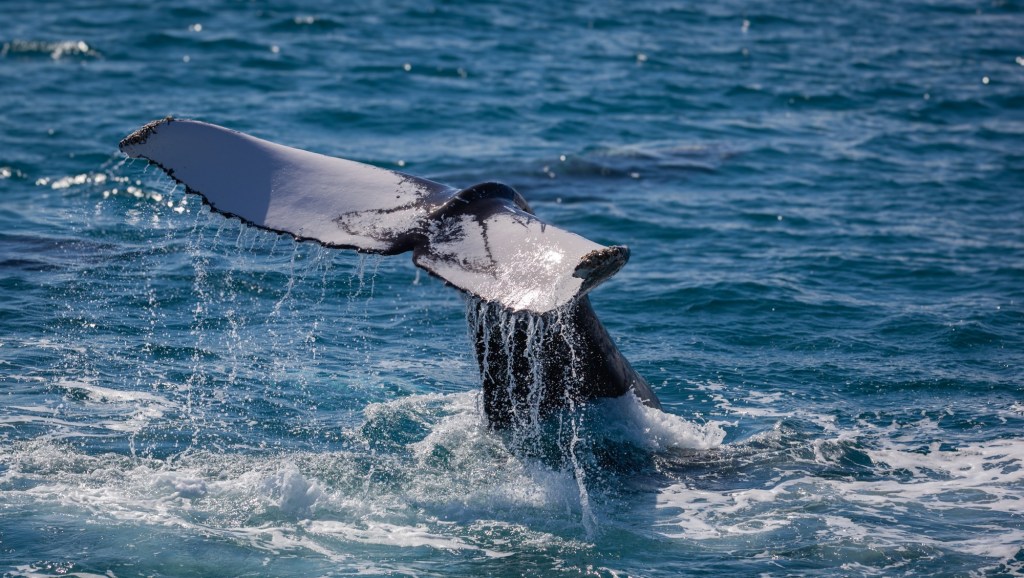
Tails up!

The arrival of the whales at Hervey Bay is celebrated each year and no doubt has been by the indigenous people of Australia for many thousands of years. Long may it continue.

For anyone wishing to book the same trip during the whale watching season we would highly recommend our hosts on their mid-sized custom-built ship Tasman Venture.

For keen photographers you’ll need more than a telephoto lens. The whales will approach right up to the boat and a wide-to-mid length zoom is required, unless you want to have close-up’s of the barnacles on the whale’s skin.

Bargara

Turning from the Bruce Highway once more, we’re heading cross-country to the coastal town of Bargara. Like Yeppoon this was a second visit for us but the first time on this route and there was something rather strange about it.

Now that’s genius!

I’m not sure if the people of Tableland Road, southeast of Miriam Vale, are concerned about some new form of pandemic virus being carried on mail and parcels delivered to their homes but a drive along Tableland Road for many, many kilometres shows a succession of microwave ovens on posts at the end of each property’s driveway. Now we’ve seen many repurposed objects used as letterboxes during our travels around Australia; recycled gas cylinders made to look like cute piglets, or cows, goats, crocodiles, frogs etc. but they all have one feature in common — they are a haven for spiders. Here, however, the humble microwave oven is multipurpose. It’s a novelty letterbox, a virus exterminator, it has a reasonably watertight door to keep out the rain and those unwanted critters. It even has a viewing window to see if your latest Amazon package has been delivered. It could also prove useful if you’re passing by and need to warm up a pie for lunch. Genius!

Rich and fertile

Passing through the town of Bundaberg towards Bargara, you can’t help but notice the fields of sugarcane, the smoke and steam from the sugar mill and the wildly coloured volcanic soil. A photograph only gives a slight impression of the rich red soil in the region. In reality it almost glows and is enhanced even more in the evenings as the sun sets low in the sky.

Deep red soil of the Bargara region

But it’s not just sugarcane that the region is known for, or its famous rum, it is also the tomato and macadamia nut capital of Australia and a major grower of zucchini, squash, cucumber, capsicum, chilli, sweet potato, strawberries, beans and snow peas. And not forgetting lychees, melons, citrus, stone fruit, pineapples and sunflowers.

Bargara Town

As seems to be a common trait among the small towns we have visited on this trip, Bargara isn’t the town’s original name. Inspired by the landscape, the European settlers chose to name the new town ‘Sandy Hills’. The present day name is a concatenation of two nearby localities – Barolin and Woongarra.

Bargara features all the usual shops, supermarkets and facilities required of a small town – mostly located just inland from the coast. That leaves the more attractive part of town towards Bargara Beach with cafes and restaurants lining Bauer Street under the shade of mature trees. And hidden just around the corner on See Street is the Windmill Cafe popular with the locals and those preferring somewhere a little quieter. It’s home to some freshly baked tasty treats made on the premises. And a good coffee too!

Following Bargara Beach along the coastline is the Esplanade and its weaving pathway providing a good walk beneath the shade of trees with views along the occasionally rocky beach. It is not the typical beach you come to expect on the east coast but, like Yeppoon, it is a volcanic region and with that goes the jet black volcanic rocks that divide sections of sandy beach often backed by mangroves.

Mon Repos

Just north of Bargara, along the beach, is a world renowned turtle conservation centre – The Mon Repos Conservation Park. It is the largest site of nesting marine turtles on the east coast of Australia and is home to the most significant population of loggerhead turtles in the South Pacific. Flatback, green and occasionally leatherback turtles also choose Mon Repos to nest. The turtles arrive to lay their eggs between November and March and hatching takes place at night around eight weeks later.

Surprisingly the area was once owned by the French Government between 1890 and 1925 after they laid the first undersea telegraph cable to New Caledonia. The cable came ashore on Mon Repos beach – hopefully not during nesting season but respect for nature during those years was a little different to now as was clearly illustrated below:

“No longer recommended practice” – said the turtle

Local Hero

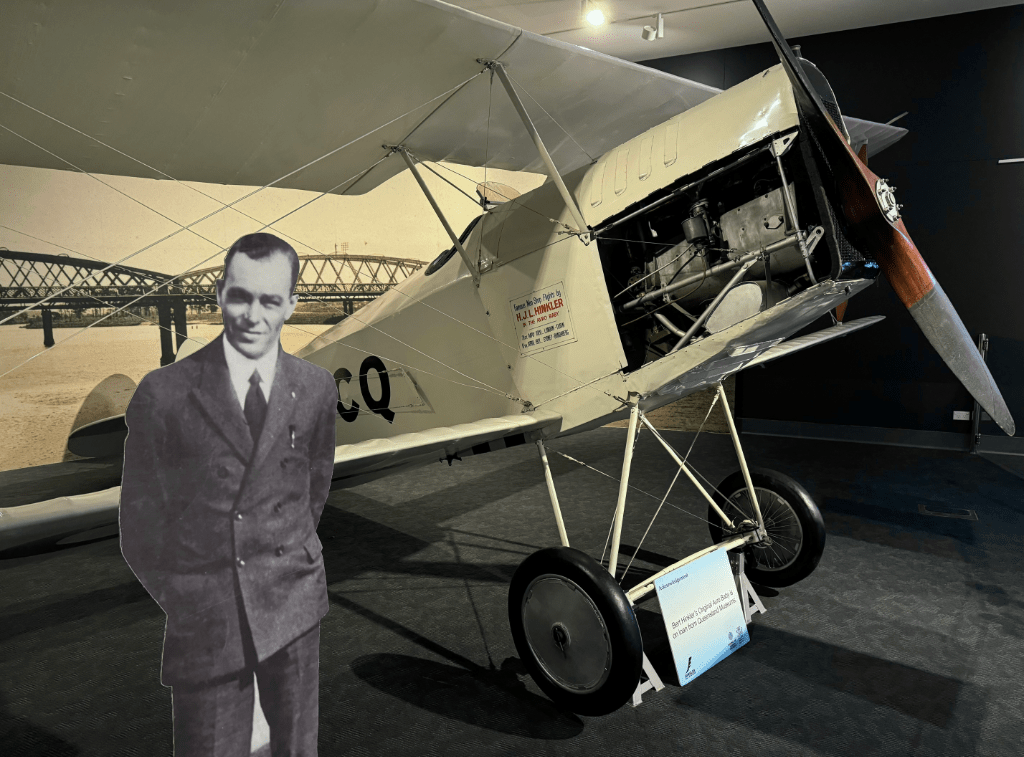
In nearby Bundaberg is a museum dedicated to an extraordinary gentleman with who we’ve been previously acquainted. A local man, he is a gentleman few people outside of Australia in the present day will have heard of. That gentleman is one Mr. Herbert (Bert) John Louis Hinkler and in the aviation world he is quite deservedly a legend.

Bert’s favourite the 30HP Avro Baby

Among the many medals and trophies that Bert was awarded he was the first person in Australia to fly using his homemade glider and in 1928 made the first solo flight from England to Australia.

NASA Shuttle ‘Challenger’ survivor

But on January 28th 1986, Bert had an unlikely link to the Shuttle Challenger tragedy. At the request of the Hinkler Foundation, a fragment of one of Bert’s gliders was flown on the space shuttle. Unbelievably, among the 15-tons of debris that was recovered following the explosion, Bert’s wooden glider relic survived and was later presented by NASA representatives to the City of Bundaberg.

More of Bert’s story can be read here: Hinkler Hall of Aviation

Big 4 ‘Classic’

Our stop for a few nights is the Big 4 caravan park located at the north end of Bargara’s Esplanade. We stayed here on our previous trip but since then it has been taken over by the Big 4 group. As we arrived we noticed the word ‘Classic’ following the Big 4 site’s name. It wasn’t a good omen. Classic, in these days of deceptive marketing, has several meanings and unfortunately in this case ‘Classic’ is best defined as ‘old’, ‘tired’, ‘unloved’ and ‘neglected’. Big 4 run some really good caravan sites around Australia but unfortunately this wasn’t one of them.

The roads around the caravan site are in a poor state – rough and crumbling away, especially towards the edges. It didn’t help that we ended up with our first tyre puncture in over 10-years. I’d picked up two nails among the rubble of the road that morning while walking around the site.

This did not bode well and the site we were allocated was no better being nothing more than a patch of drying mud with holes that looked like someone had previously got bogged and spun their wheels in a desperate attempt to escape. It wasn’t even wide enough for our caravan so we ended up parking on the cracked and uneven concrete slab – a no, no in the caravanning world, as we were reminded by a nosey neighbour. Despite booking months in advance this was described as an ‘overflow’ site normally reserved for last minute bookings. But adding to insult this was one of the most expensive sites we had stayed at on this trip. It’s grossly overpriced and what facilities there are are very dated – think remnants of the 1970’s.

It’s not just us

There were hundreds of caravans filling the site netting the owners thousands of dollars a day and nothing spent maintaining the site other than a quick whizz around with a mower. Looking at the comments on WikiCamps certainly confirmed our thoughts – complaint after complaint. Big 4 are doing Bargara a huge disservice, many saying they won’t return and that includes us.

The only thing good I can say about the Big 4 ‘Classic’ site is the location, which provides a good walk into town and its position beside the beach.

That’s all folks

And sadly that brings us to the end of this current adventure. Tomorrow will be the last leg of our drive home. We’ve experienced some outstanding scenery, visited many towns that were new to us and a few repeats. We’ve flown over the Great Barrier Reef, cruised around the Whitsundays, walked among granite mounds and tropical rainforests. We’ve wandered barefoot along pristine beaches and drunk in the views over the Coral Sea.

Altogether we’ve driven 3,918 kilometres amounting to 60-hours and 11-minutes on the road. At an average of $1.87 per litre we used 603-litres of diesel costing $1,130. Average fuel consumption towing the caravan was 14.8L/100KM with the car alone averaging a more reasonable 8.75L/100KM. Being a modern European diesel engine the twin-turbo 3Litre V6 Land Rover motor requires the use of AdBlue, an additive that substantially reduces exhaust emissions. Now almost as expensive as diesel fuel, 17-litres of AdBlue was required. Of course these costs don’t include the wear and tear on the car, the caravan and the eight tyres keeping us in contact with the rough Queensland roads.

So where next?

We missed northern South Australia during our Big Lap in 2020 due to excessive temperatures and the National Parks Service closing sites for safety reasons. We had already experienced bush fires in the south and took the safer option to cross over instead to Victoria. We want to explore Ikara (Flinders Ranges) and the surrounding area and possibly a flight over Lake Eyre. So a little planning to do.

We’d also like to return to Western Australia for the wild flower season, which we just missed in 2019, this time maybe by hiring a camper van to avoid the long drive to WA and back. Also on the list is Carnarvon Gorge, Queensland, and much closer to home. We’ll Keep you posted.

In the meantime Japan is calling. Jaa Ne!

Yeppoon

Following another long drive south on our homeward trek, we’ve reached the coastal town of Yeppoon. Sitting at the southern end of Farnborough Beach and enjoying views over the Coral Sea to the Keppel Islands, Yeppoon is both a popular beachside destination and a growing part of the commuter belt stretching 40KM northeast from Rockhampton – the unofficial capital of Central Queensland.

Familiar territory

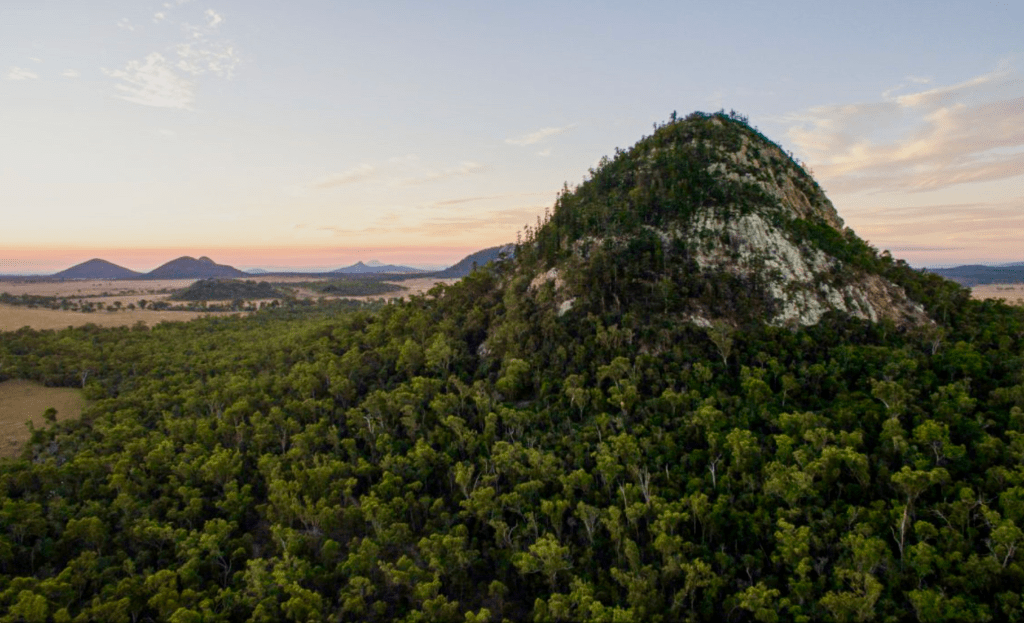
Yeppoon is a winding and undulating 35KM drive from the Bruce Highway and runs through what was once an active volcanic region. Enormous volcanic plugs, having survived tens of millions of years of weathering, rise high over the flat plain north of Baga National Park. Known collectively as the Mount Hedlow Trachyte they are reminiscent of the similar Glass House Mountains closer to home on the Sunshine Coast.

This is our second visit to Yeppoon after previously stopping here during our ‘Big Lap’ around Australia in 2019. Yeppoon is still growing as more families and retirees relocate from the southern states to enjoy the warmer climate of Queensland. And who can blame them?

Baga National Park – ©️State of Queensland

Yeppoon – What’s in a name?

Australia isn’t short of strange place names and for that we can thank the early settlers of the 19th century. You see, the Aboriginal people of Australia have no written language relying instead on vocal and pictorial story telling passed along through countless generations. Indeed Aboriginal rock paintings predate the earliest known written language by tens of thousands of years.

Throughout Australia the indigenous people have many regional and tribal languages, all of which would have stumped even the most educated of early settlers. So, based on the Aboriginal spoken word, the Europeans interpreted and anglicised place names making them both readable and relatively easy to pronounce. Even then, for the early settlers at least, local places often took on a more descriptive name and Yeppoon was no exception being previously known as ‘Bald Hills’. It was a fitting name given the volcanic domes of Mount Hedlow Trachyte and the two trachtyte plugs that form Double Head overlooking Rosslyn Bay Harbour. It wasn’t until 1868 that Yeppoon received its present day name believed to be based on the local Darumbal Aboriginal word meaning ‘the place where the waters meet’.

Farnborough Beach

Yeppoon is home to ten distinct beaches with Farnborough Beach being by far the largest at 17KM with long stretches of golden sand interspersed by rocky outcrops and views across the bay to the Keppel Islands – so named by Captain Cook while exploring the east coast of Australia in 1770.

Farnborough Beach, though, has quite a chequered past. In 1971 there was outrage when a Japanese syndicate under the leadership of Yohachiro Iwasaki, purchased thousands of hectares of beachfront land with the aim of building a coastal resort. Previous attempts to purchase the land by citizens of Australian had been blocked by the Queensland Government raising suspicions of corruption and backhanders. The land sale created an anti-Japanese campaign among locals and developers alike but the sale went ahead regardless of public opinion and objections. Local sentiment was so strong that on November 29th 1980 two men detonated a bomb at the resort coinciding with the day of the Queensland State elections. Comprised of sticks of gelignite, oil and petrol, the bomb caused an estimated A$1M in damage further delaying the opening of the resort. Both men were later aquitted. Originally known as the Iwasaki Resort, it was renamed the Capricorn International Resort and managed by Rydges until being taken over by the French owned Mercure Hotel group. In need of significant refurbishment it was abandoned in 2018.

Where is everyone… again?

Following a recent theme, even though this is supposedly peak season, the beaches are deserted and just awaiting the September school holidays. The sand is decidedly soft in places and not so easy to walk along following the turning tide. However, the receding tide has left behind thousands of tiny spiral shells each less than 15mm long. Known commonly as ‘screw shells’ or ‘tower shells’ or even Turritellas for the scientifically minded, they spend much of their life buried in sand on the ocean floor. Eventually, though, tides and storms deposit the empty shells onto the beaches along the Capricorn Coast.

Conveniently, there is a place to learn more about these molluscs and other marine and fossilised shells of the region. Situated in town at the Visitor Information Centre is Shell World Yeppoon with more than 20,000 shells on display from the tiniest to the giants of the sea.

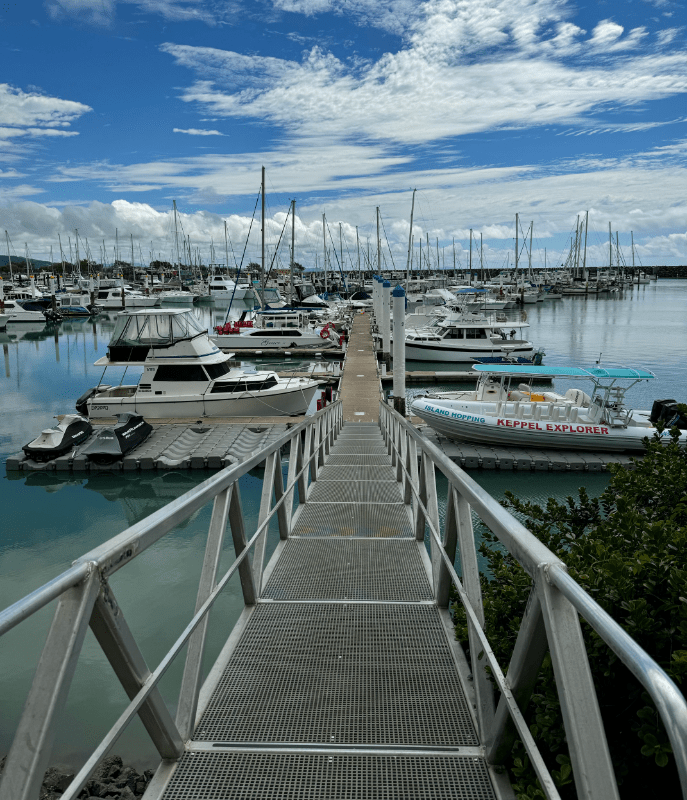
Rosslyn Bay Harbour – Yeppoon

While wandering along the Rosslyn Bar harbour jetty I noticed something quite large stirring just below the surface of the water. What at first appeared to be a large fish became immediately recognisable as it turned toward us and started munching on the seaweed growing on the jetty. We’ve seen turtles on many occasions but this was by far the closest yet – just centimetres from where we stood. Fortunately it stayed around just long enough to grab a photo.

Green Turtle – Rosslyn Bay Harbour

Freedom Fast Cats, based at Rosslyn Bay Harbour, run a regular ferry service to Great Keppel Island seven days a week – weather permitting. FFC also provide glass bottom boat tours to explore the coral reefs and adventure cruises among the islands.

Stingers

Between October and June it should be remembered that Yeppoon is still within the tropics and with that goes the annual ‘stinger’ season. The diminutive and highly venomous irukandji jellyfish, named after a northeastern Aboriginal tribe, measures only one to two centimetres in length but can have a devastating impact on your health should you be unfortunate to be stung by one. Known symptoms are intense shooting pains lasting upto 30-hours, extreme anxiety, brain haemorrhaging and fluid in the lungs. Potentially fatal, the irukandji jellyfish sting sends on average 50-100 people a year to hospital. There is no antivenin at present but applying vinegar to the affected skin can help minimise the pain. Wearing a stinger suite, similar to a Lycra wetsuit, will provide some protection if you really feel the need to swim in the sea during this time of year.

To entertain the little ones all year round, the Keppel Kraken waterpark straddles the foreshore situated among shady trees on Anzac Parade. And a safer place to swim during stinger season is Yeppoon Lagoon just a little further along the foreshore.

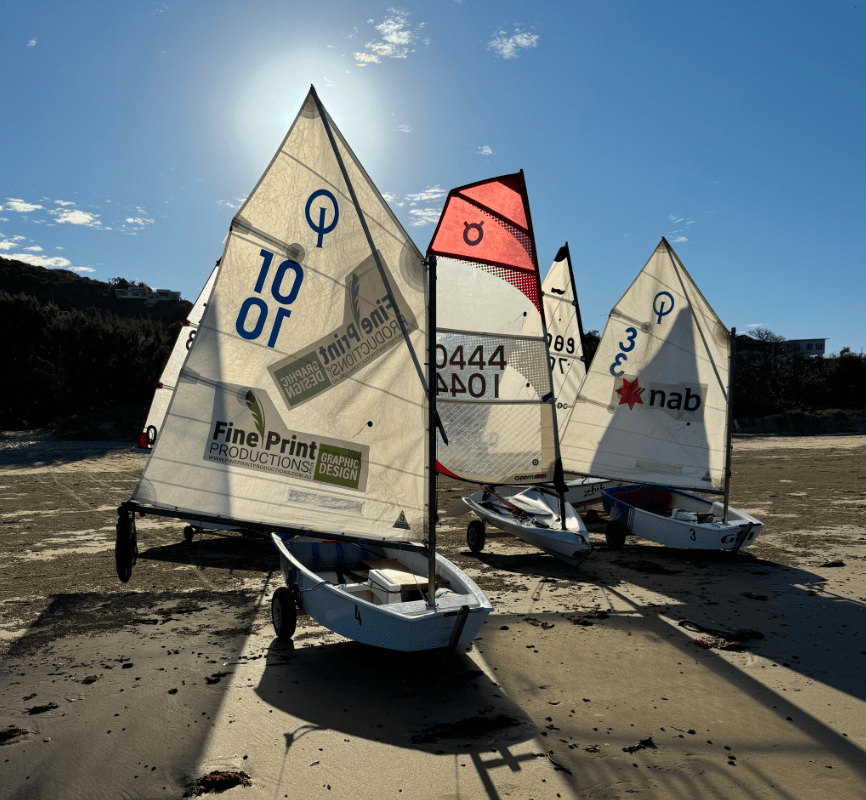
Farnborough Beach – Ready to sail

What is that?

Walking along Farnborough Beach we came across the most peculiar looking fish recently beached by the receding tide. Measuring about 500-600mm in length with a bulbous dull grey body and ferocious looking teeth, nether of us had a clue what it was. Despite researching we’re still none the wiser.

Giant scary fish

Cyclone Marcia

Still within cyclone territory, though less prone than Far North Queensland, Yeppoon felt the full force of category 5 Cyclone Marcia in February 2015. Over 60,000 homes in Yeppoon and neighbouring Rockhampton and Bundaberg were left without power with roofs torn off and walls collapsing leaving a repair bill estimated at A$750 million. Unusually Queensland and the Northern Territory were hit simultaneously by two cyclones, Marcia and Lam (NT) both making landfall within hours of each other.

Moving on

Getting closer to home, our final stop on this trip is Bargara and another 350KM drive south along the coast.

Bowen

A longer drive south today brought us to the coastal town of Bowen and what a hidden little gem this place is. From deserted beaches to rocky lookouts and expansive bays, Bowen is a bit of a mystery.

Where is everyone?

For some reason Bowen gets bypassed in favour of the well known towns further north. A study showed only 6% of the one million travellers on the Bruce Highway divert to Bowen. It doesn’t help that the highway almost approaches Bowen, skirts around the airport and then continues north away from the town. But Bowen had a plan…

The Big Mango

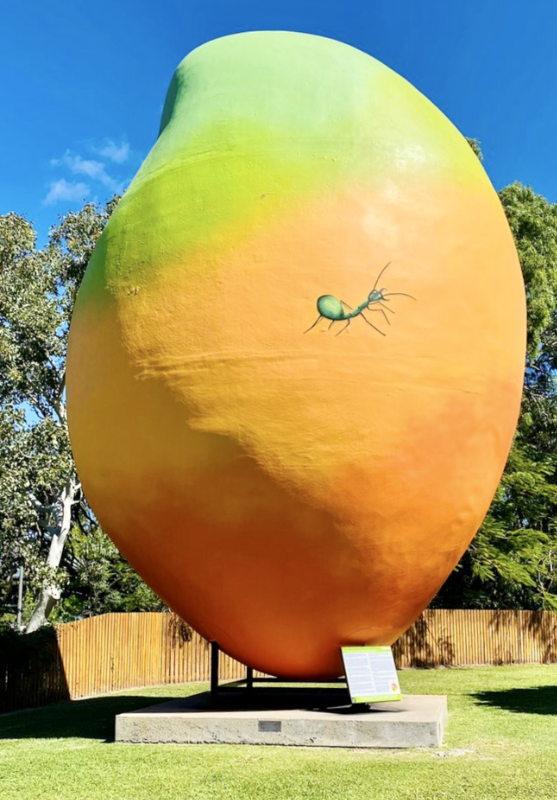
The ‘big thing’ is a common feature used to attract passing trade for many small towns around Australia and Bowen is no exception with its ‘Big Mango’. Costing $90,000 and a mere $60,000 over budget, it was set on its plinth in 2002 beside the Bowen Tourist Information Centre on the Bruce Highway. Measuring an oversized 10-metres tall it weighs seven tonnes. Not attracting enough attention itself, Bowen boldly claimed “The Big Mango has been stolen!” as a publicity stunt. It was ‘returned’ on the 2nd of March, no doubt to the great relief of the towns folk. At least it hadn’t gone far, it was hidden under a tarp behind the Information Centre. However, one article in the ‘Senior’ newspaper suggests it was ‘pinched’ by the food chain ‘Nando’s’ to publicise the launch of its new mango and lime sauce.

The Big Mango of Bowen

The Big Mango does have a valid reason for being in Bowen, though, besides attracting trade. The Kensington Pride mango, on which the Big Mango was modelled, was first grown in Australia in Bowen. It is believed to have been brought to Australia from India when the region once traded horses with the Asian subcontinent.

For some of the ‘big things’ during our travels around the country, we have stopped to take a closer look but it was very easy to pass this one by. Besides, I’m not a big fan of mangoes.

Why the Green Ant?

The last time the Big Mango received a fresh coat of paint it also had a green ant emblazoned upon its substantial girth. Common in northern Queensland, the green ant builds its nests in trees where they curl and ‘glue’ leaves together to form a rounded nest. The ants are extremely protective of their environment and will readily attack predators such as the mango leaf hopper – one of the pests that most affects the commercial mango industry.

So, encouraging green ants to take up home in the mango trees helps the grower and protects the crop. Scientific studies have shown that using green ants as a form of biological pest control is as effective or more effective than the use of chemical agents. There is a downside though, the ants will try and protect the tree during harvest and show no mercy in biting the fruit pickers. But scientific study came up with a solution. Noticing that green ants retreat to their nests whenever it rains, simply spraying the trees with water, just before picking, allows the pickers to do their job without being bitten.

Folks you’re missing something special

What so many people are missing are the beautiful sandy and rocky bays that line the eastern peninsula and the 5KM but deserted Queens Beach to the north. There are eight very peaceful beaches around the peninsula where sea temperatures reach a very pleasant 28C during summer and 22C during the winter.

Horseshoe Bay

Among the best; Horseshoe Bay, probably the prettiest with white sand and a reef perfect for snorkelling, Grays Bay with large shady trees, Coral Bay (clothing optional), the secluded Murray Bay, Rose Bay with its fringing reef, Front Beach on the Main Street and the sweeping Queens and Kings Beaches.

Murray Bay and Gloucester Island

The area is also well supplied with walks from a gentle beach stroll to a more energetic climb over and around large granite boulders to one of several lookout points with views out over the Coral Sea and the outlying islands.

Bowen Murals

Even the centre of town has something worth exploring with 27 murals depicting the early history of Bowen as well as modern artwork. One mural was painted by the well known Australian artist Ken Done.

Bowen at War

The town also had a part to play during WWII when it was a maintenance and service base for Catalina flying boats and a location for a radar station monitoring the sea and sky for enemy ships and aircraft. Little is left of the radar station but a plaque has been laid on the lookout to honour the history of the radar station and flying boat base.

Lookout… twice

Talking of lookouts it is well worth while climbing up to the Rotary Lookout and the WWII Radar site for the expansive views they provide as well as a chance to spot passing whales. One thing we didn’t expect to see, though, and still find it hard to believe, from the radar lookout we could clearly see the enormous Lucinda Jetty that we visited just a couple of days ago. We had driven directly from Lucinda to Bowen, a distance of 340KM by road, yet there it was clearly visible on the horizon. It goes to show just how much effort was needed in the day to build a road that had to weave across the landscape, cross multiple rivers and all the while following the natural lay of the land. These days explosives, mechanised machinery and concrete make following the shorter path much easier.

A Tornado?

Although there is little information still available, on February the 22nd 1876 an F5 tornado ripped through Bowen. Little survived.

Moving on

Continuing south once more, our next stop – Mackay.

Sweet, sweet Lucinda

Our time in Cairns has sadly come to an end and today we start the long trek south. We leave after a week of glorious weather in the tropics, the epic rainforest scenery and some great food.

It’s all about the sugar

It’s impossible to miss Far North Queensland’s connection with sugar. Huge fields planted with sugarcane are the most common form of crop grown in the region and they’re everywhere. During harvest time, between July and November, each major town has a sugar mill in operation. Clearly visible are the white clouds of steam set against the dark green of the forested mountains and occasionally smoke billowing from an adjacent chimney stack. Queensland produces over 95% of Australia’s sugar and between 80-85% of it is exported by sea. And that brings us neatly to the location of our next stop, the little town of Lucinda.

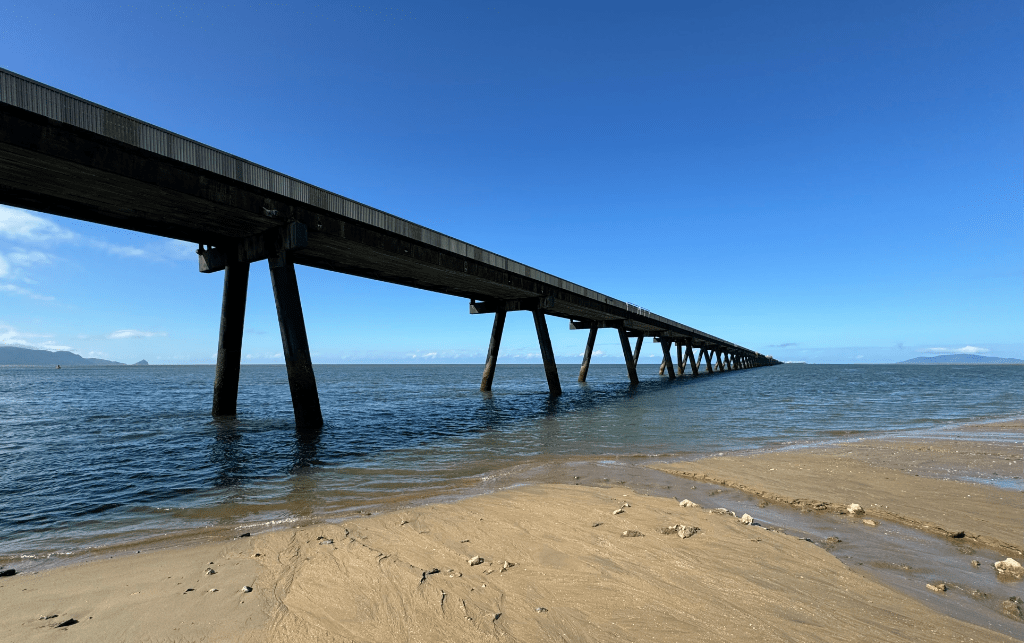
Just a small section of Lucinda Jetty

Lucinda sits at the southern end of the World Heritage listed Hinchinbrook Island and is the location of the Lucinda Bulk Sugar Terminal. Not such an interesting place you may think, however, apart from the three enormous sugar storage sheds there is something quite unique, not just for Australia but the whole of the southern hemisphere. With a very shallow bay there is no way for large ships to reach the port – even during high tides. So a jetty was constructed along with the terminal buildings in 1979. It was no ordinary jetty.

It’s big, really big!!

Big enough that it visibly curves from end-to-end following the curvature of the earth, the Lucinda jetty is 5.76KM long (that’s 3.6-miles!!) and supported by more than 660 concrete and steel pylons. A conveyor belt carries the raw sugar along the covered jetty until it reaches the ship loader, which then runs forwards and backwards along the length of each ship delivering 1,400-tonnes of sugar per hour. An average of twenty shipments take place each year with the terminal able to handle ships as large as 50,000-tonnes.

Lucinda Jetty from the air

The only way to get a true idea of just how long the jetty is, is to take a look from above. Fortunately, for the terminal workers, a single roadway provides access to the distant loader.

Along the shore

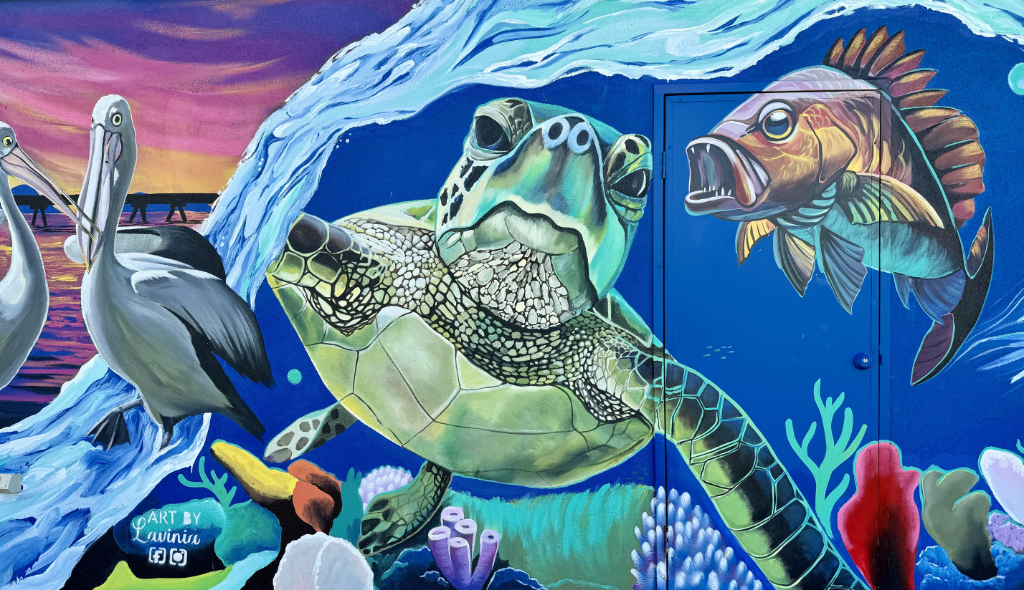
Parallel to the jetty Lucinda council have created a weaving pathway along the shore and parkland featuring sculptures related to the area as well as a memorial to an American WWII airplane that crashed nearby. But most impressive is the artwork painted on the walls of the park’s facilities building depicting the wildlife that calls the Lucinda region home. It’s well worth a closer look to admire the skill of artist Lavinia.

Artwork in the park

Cyclone Yasi… again

On 3 February, 2011 in the early hours of the morning, category 5 Tropical Cyclone Yasi crossed the North Queensland coast bringing measured peak wind gusts of 185KM/hour at Lucinda. At the height of the storm, waves surged over the top of the jetty destroying the shiploader along with the Lucinda Jetty Coastal Observatory. The Observatory was situated at the end of the jetty delivering valuable data regarding local coastal waters and atmospheric conditions.

Sustaining extensive damage from the cyclone, repairs costing an estimated $50 million and 18-month’s work was required to get the terminal operational again.

Escaping Winter

Today, Lucinda is a popular destination for those that like to cast a line as well as retirees wanting to escape the colder winters of New South Wales, Victoria and South Australia. It’s easily evidenced by the number and variety of vehicle registration plates and fishing boats parked around the caravan site. And who can blame them.

Next stop, as we continue south, the coastal town of Mackay.