Heart Reef

Our second day at Airlie Beach and it is an extra special one as we take to the air flying over two famous landmarks and the possibility of sighting whales.

Wasabi

Flying from Whitsunday Airport, just 8-minutes from Airlie Beach, our flying adventure is onboard the Australian designed and built GippsAero GA8 Airvan delightfully named ‘Wasabi’. Unlike commercial passenger planes, Wasabi is designed for short flights with maximum visibility for those onboard. Little legroom, noisy, a low ceiling and certainly no reclining seats on these flights but that just adds to the experience of the real sensation of flying in small aircraft – turbulence and all. As with all aircraft, though, safety is the priority and our pilot Sam took us through the emergency procedures including wearing and operating our life jackets as we were to fly over water.

Our aircraft – the eight-seater ‘Wasabi’

Turbulence

It should be noted that the location of the airfield in a narrow valley is known to experience strong and gusty winds and that was certainly the case as we took-off and made our first turn. It soon settled, though, as we headed out over water with great views along the coast to Airlie Beach and the islands that make up the Whitsundays.

Scenic flight route through the Whitsundays

We were soon flying past Daydream Island and south along the tip of Long Island with the largest of the islands, Whitsunday, to our left. Then passing over Hamilton Island known amongst others riches for the famous Hamilton Island Race Week, which attracts ‘yachties ’ and spectators from all over the world. Next was one of the main sights we were looking forward to on this trip, Hill Inlet, surely amongst the most spectacular views in Australia if not the world. The weather wasn’t quite on our side, though, with some low cloud and rain in the distance but it was expected to clear further off the coast.

Hill Inlet from 2000ft with Hamilton Island just beyond

Throughout the flight Sam gave us a comprehensive commentary about the European’s first discovery of the Whitsundays and the Ngaro people’s 9,000-year history of the region. The Ngaro, also known as the ‘Canoe people’, travelled between the islands using sturdy canoes made from lengths of Ironbark timber held together by fibrous roots. In addition to the myriad forms of tropical reef fish calling the waters of the Whitsundays home, sharks, manta rays, stingrays, dolphins, migrating humpback whales and Dugongs* can also be sighted. The dugongs take advantage of the sea grasses that grow around the islands and protected marine parks.

Whitehaven Beach

A very popular day trip from Airlie Beach is the 7KM long Whitehaven Beach. Known for its 98% pure silica bead sand, which has the advantage of staying cool even on hot sunny days and so fine it can be used as a polish.
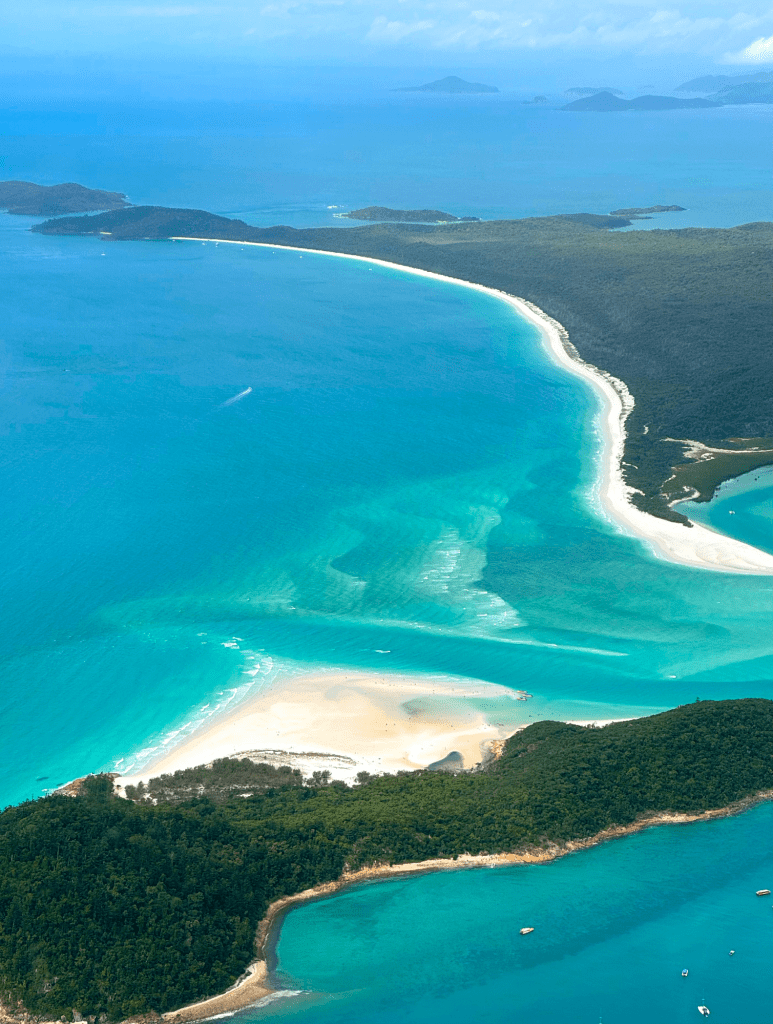
The sweeping Whitehaven Beach

It can get busy at times and especially during peak season when multiple day trips coincide. However, with such a long beach it’s easy to find a patch of your own to just sit and watch the gentle lapping waves and remind yourself what a magnificent place you are experiencing.

Whales!

Our flight continued further out to sea and we were now spotting numerous humpback whales breaching and ‘fin slapping’, several appearing to be mother and newborns. It wasn’t that long ago that the hunting of whales had reduced the humpback population to the low hundreds. Now protected, recent observations show a dramatic increase and it is now believed 30-40,000 humpbacks populate the migration route between the Antarctic and far north Queensland.

Over the Reef

Five minutes later, just as the sun appeared through light cloud, we were flying over the inner reef and dropping to 500ft tracking the most stunning coral formations surrounded by clear turquoise-blue water.

The inner Great Barrier Reef

Then came a countdown from Sam with cameras ready as we were about to fly low over our target – the perfectly descriptive Heart Reef. First sighted in the 1980’s the reef has become the emblem of the Whitsundays and is now probably the most photographed coral formation in the world. And finally, there it was.

Heart Reef

Not wanting to miss getting the photograph during our fleeting path over the reef I opted to record video and grabbed the best frame. To ensure passengers on both sides of the plane got a good view Sam did a second pass in the opposite direction.

Climbing once again we headed back to the airport spotting further migrating whales along the way. Final approach to the runway presents just as much of a challenge as takeoff and sitting right behind our pilot it was clear just how much counteracting the gusty wind was required to bring the plane safely onto the runway.

A fantastic trip and scenery we will never forget. The highlight of our trip… so far.

For more information and booking options, checkout Ocean Rafting Scenic Flights

*Also known as Sea Cows or Manatees in other countries.
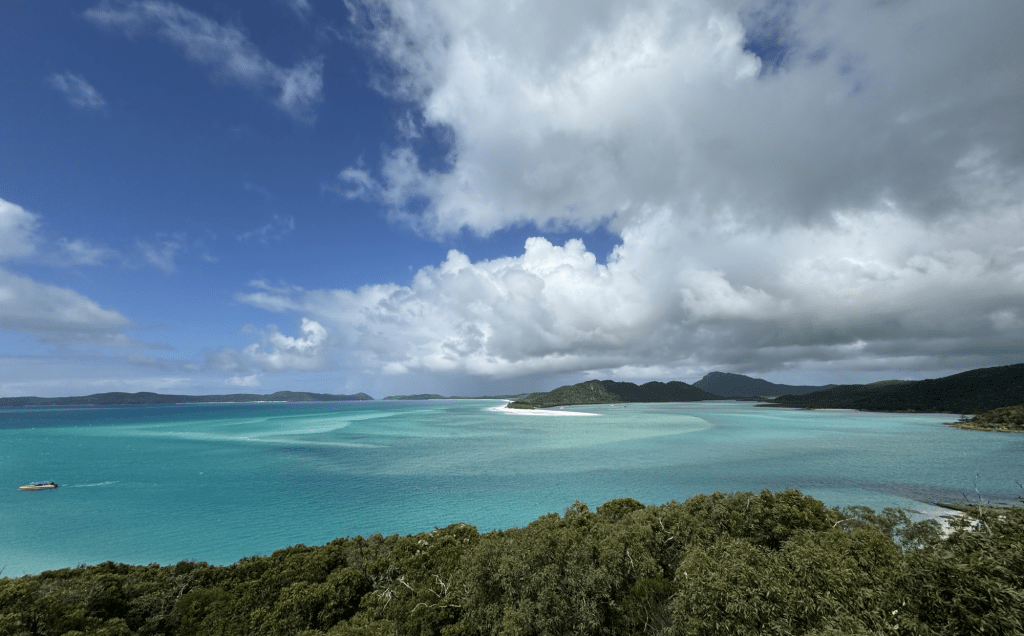
Airlie Beach – The Whitsundays

Famous as the yachting home of the Whitsunday Islands in Tropical North Queensland, its turquoise water, pure white beaches and its proximity to the Great Barrier Reef.

Airlie Beach and the Whitsundays has been on our bucket list for many years and we’re finally here. It is everything we believed it to be and much, much more.

Hill Inlet tidal patterns

Why so Blue?

The water around the Whitsundays is the most beautiful shade of blue bordering on turquoise and glistens in the intense sun. Although stunning it’s not, as you would expect, crystal clear. In fact it’s positively murky. It is by no coincidence that the sea here is the same shade of blue as a glacial lake and for the very same reason. Glacial water owes its colour to the crushed, powdery rock particles suspended in the water and reflects the light that falls upon it in all directions. In the case of the Whitsundays it is near pure silica that sits suspended giving it a milky look but which has even greater reflective properties.

Pioneer Bay – Airlie Beach

A little error in history

Captain James Cook sailed through the Whitsunday Islands in 1770 naming the route between the islands as the Whitsunday Passage and one of the islands in the group Pentecost Island. His journey through the islands was made during the feast of Pentecost, which is traditionally the seventh Sunday (50th day) after Easter. The passage was named after Whit Sunday, meaning ‘White Sunday’ referring to the white gowns worn during the feast of Pentecost. However… on the day Cook named the passage he mistakenly believed it was the Sunday known in the Christian calendar as Whit Sunday when it was in fact a Monday. The Mondays or the Monday Islands just wouldn’t have quite the same ring to it.

Activity Central

Once a small timber, sugar cane and fishing town, Airlie Beach soon became popular as a major Queensland tourist destination. Sugar cane is still a major crop in the region and grown all year round, but Airlie is now the centre for the many active leisure pursuits available to visitors whether on land, sea or in the air. Bushwalking, sailing, kayaking, jet skiing, small boat cruising, body boarding, wind surfing, skydiving and scenic flights are all available for the adventurous. And for those that prefer to soak up the sun the stunning Whitehaven Beach is just a boat ride away.

Day Trippin’

We pre-booked three trips knowing we would be at the mercy of the weather but being peak season we wanted to make sure we got a place on each adventure. First off was a Sunset Cruise on the twin masted, timber hulled ‘Gentleman’s Ketch’ the Lady Enid. Built in 1961 she has competed in five Sydney to Hobart races as well as fifteen Brisbane to Gladstone challenges and was first across the line in the inaugural Sydney to Brisbane Race in 1964.

Lady Enid – Airlie Beach

High winds had delayed the Lady Enid’s return from its daytime cruise, which meant our sunset cruise was late setting sail. It was worth the wait, though, and not just for the included cocktail and antipasto platter as we cruised in near silence with just a single sail set. It wasn’t long, though, before the cool sea breeze sent a reminder that a warm, windproof jacket is very much recommended.

Sunset Cruise onboard Lady Enid

The sunset didn’t disappoint, though, as it passed behind the mountains while creating some beautiful golden reflections on the rippling water. Due to the late departure our return to the harbour was completed in darkness but our skipper did a great job of navigating around the moored boats in the outer harbour and performed a perfect ‘reverse park’ back at the marina.

Lady Enid runs four different tours in and around the Whitsundays and is also available for charter hire. More information and booking details available here: IconicWhitsunday.com.au

Tomorrow we take to the skies and head out to the Great Barrier Reef.

We’ve Started… and we’ve Stopped again

Not quite the way we had intended to head north.

We’re leaving the Sunshine Coast with stopovers at Maryborough, known amongst other things for Mary Poppins, Tannum Sands and Barracrab at Clareview. After a leisurely start, and just 7KM up the road, we came to a grinding halt. Several cars had flashed headlights at us indicating trouble, or a mobile speed camera ahead. It was worse. Traffic was coming to a stop and queuing as far ahead as we could see.

A passing driver, who had just turned around, advised us that a truck had tipped-over its trailer hit a car and completely blocked the road. Fortunately no one was injured but the blockage wasn’t expected to be cleared for at least 3-hours, setting us, and every other vehicle, a long way back. With the road not wide enough to turn around, it was time to setup the chairs, sit it out and top up the suntan.

The long wait

All clear… for now

Fortunately just 2-hours and 30-minutes later we got an all clear in both directions after the truck and trailer had been dragged to a clear space a little further up the highway. It was then we realised just how many southbound vehicles had been held up too after we had driven many kilometres further north where traffic was still waiting to get going again.

Now behind time we were going to be late arriving at our destination of Airlie Beach for the next week. With the sun setting later in the day the further north we travelled we were hoping not to have to setup our caravan in the dark.

As we have found through much of the drive north on the Bruce Highway, so far, the roads were not in the best of shape. Partly due to the previous season’s bad weather and equally the slow process of road repairs, pot holes, dips and rough surfaces were the norm. Bad enough to pull a caravan through, the road surface could be lethal for motorcycles. At least the department responsible for highway repairs made the effort to erect permanent signs indicating rough sections of roadway. It’s a pity equal effort was lacking in fixing the surface. A cynical person may see the permanent signs as a means of avoiding vehicle damage claims.

A very, very close shave

After a brief stop to refuel in Mackay, we continued along the A1 taking a northwesterly track towards Airlie Beach on the coast of the beautiful Whitsundays. Shorty after passing through the small settlement of Bloomsbury we heard on the UHF radio that an accident had taken place in Bloomsbury between a truck and a 4WD vehicle. Expecting the worse we kept a close look ahead for slowing traffic but all we saw were police cars, two ambulances and a fire engine heading in the opposite direction. Somehow the accident must have occurred just behind us as we passed through Bloomsbury. We were hoping it wasn’t a bad one and no one injured.

Airlie Beach at last

After four days of driving with the caravan in tow and a much delayed final stretch, we made it to Airlie Beach by late afternoon and got our first glimpses of the stunning turquoise waters that the Whitsunday’s region is known for.

Airlie Beach… in Winter

In the News

Catching the evening news brought unexpected news. The accident at Bloomsbury was serious. Initial police investigations stated that ‘at approximately 2.50pm, a white 2014 Toyota Landcruiser utility was travelling north along the Bruce Highway when it crossed onto the opposite side of the road and struck a white 2017 Isuzu truck before hitting a white 2018 Cx5, travelling behind the truck.

The driver of the Landcruiser, a 21-year-old Kelso man, and the driver of the Cx5, a 72-year-old Clifton Hill man, sustained serious injuries and were airlifted to Townsville Hospital for treatment.

The passenger of the Landcruiser, a 34-year-old Mundingburra man, the driver of the Isuzu, a 61-year-old Sarina man, and the passenger of the Cx5, a 69-year-old Clifton Hill woman, sustained minor injuries and were transported to Mackay Base Hospital.’

According to the log on our car we had missed the accident by just minutes. At worse we could have been caught up in the collision and at the very least stuck in another delay while the accident is cleared.

We sincerely hope those that were injured have a speedy recovery and suffer no long term effects from the collision.

Tomorrow our adventure in Tropical North Queensland begins!

We’ve Moved!

After many years in Sydney, New South Wales, we’ve moved north – a long way north.

In April 2019 we began our Big Lap of Australia searching for new adventures, scenery, experiences and a future place to call home. Cut short by a family bereavement in the UK just as Covid began to take hold and then dumped by Qantas leaving us stranded for ten months – long enough to experience all four seasons from cold through to cold again.

Hello Queensland

During our first few weeks exploring Queensland we stopped on the Sunshine Coast and very quickly fell for its unspoilt scenery, laid-back style, friendly people and, of course, great coffee. Unknown to us at the time we would be returning and on a more permanent basis.

New State, New Home

In 2021 we started seriously to consider moving north to somewhere warmer during the winter, cooler during the summer and closer to the coast. And the first place we thought of was the happy times we had spent on the Sunshine Coast in 2019.

We had long thought of building a new property in the classic ‘Hamptons’ style and began researching designs and builders settling on a GJ Gardner design that was on display at one of their regional show home sites near Sydney.

And so began the search for land to build on…

Not a Good Start

In early February 2022 we went to collect our Jayco Silverline Outback caravan from covered storage only to be greeted with dismay. Mold was growing on every plastic surface inside the van, in and around the skylights and along the ceiling joints. Then we discovered the doona and mattress was soaking wet. Puzzled, we noticed a sizeable rusty hole in the roof of the storage shed directly over the rear skylight. How water had got in to the van was a mystery. The caravan had been out in pouring rain with no issue apart from a small leak around the fridge roof vent in 2019. It had previously been in the same storage location for months with frequent severe weather events and no leaks.

We had already booked overnight stops in New South Wales and Queensland and we couldn’t hang around. So several hours of cleaning followed by a fruitless complaint with the caravan storage owners saw us heading back to our house to start loading-up for a six-week trip.

A bit of Luck

Heading north, our first overnight stop at Bateau Bay brought us a bit of good luck. The mattress was far too wet to sleep on but it was slowly drying and coincidentally right next to us was a caravan repair agent, who was working on the site during the season. He climbed up onto the roof and immediately saw the issue. Some mindless caravan builder at Jayco had put screws right through the water barrier that secures the skylights to the roof panel. Luck had prevented any earlier leaks with heavy rain running right off the roof but a persistent drip was all that was required to allow water to penetrate. Fortunately a spread of silicone sealant was all that was required to fix the problem, for now.

Unable to sleep in the caravan overnight we had to resort to one of the site’s cabins to give the mattress longer to dry out.

Popcorn

Okay, not the edible variety, popcorn in this case was just one sign of the damage the leak had caused. The roof panels of the caravan are a sandwich of glass fibre, solid foam and plywood coated in a vinyl textured liner similar to wallpaper. The water had travelled down the skylight screws through the foam layer and settled on the plywood causing it to expand. The result was a pitted surface in the vinyl reminiscent of, and unpopularly known in America as a popcorn ceiling. At least we were covered by insurance… or so we thought! More on that in a later post.

The Search Begins

A few more stops on the way at Forster, Sawtell and Lennox Heads before we finally arrived 1,026km later on the Sunshine Coast.

We met with one of GJ Gardner’s very knowledgeable agents to walk through the house plans and Queensland’s building process. All up we were to expect an 8-month build – much quicker than we had expected. All we had to do now was to find a large enough, level lot for a single storey house with good views and a space to store the caravan. How hard can that be?

Well, as it happened much harder than we had hoped. Yes there was land available and in some lovely areas too, some with sea views some looking over fields or the plains and some among the Sunshine Coast Hinterland nestled in recently cleared forests. But all came with issues.
The Sunshine Coast is a mix of volcanic mountains, steep hills, open plains, marshland and forested National Parks. Many of the established settlements would have been a challenge for the caravan and our legs when cycling. A couple of lots we later discovered had known issues with the site engineering leaving properties subject to potential landslides. Nothing we saw really met with our wishlist or were not level enough, massively overpriced or not the right area for the style of the property we were intending to build.

We spoke with real estate agents, checked the property listings in the local papers and searched the Internet. We looked at options for newly built homes but were either not of a style we liked, too near to main roads or schools or too far from shops and cafes. While admiring the sea views in an area we explored on our earlier ‘around Australia’ adventure, we spotted an interesting, very modern house that we had seen on the Internet. Initially Catherine wasn’t too keen to take a look but a little persuasion and a quick call to the real estate agent and we were hooked. Nothing like the style we had intended, metal clad, on a steep hill and very industrial with lots of concrete but it had everything we were looking for; plenty of space for the caravan, low maintenance build and gardens, a pool, a big garage, a cinema room and views over Noosa National Park to the sea.

We had a lot to think over. Buying an existing house was never part of our plan. Initially we were looking to at least a year before we moved to Queensland – plenty of time to get our house in Sydney on the market and sold. A second visit the following day, an offer accepted and the owners agreeable to a 45-day settlement left us searching for a local solicitor. Ever efficient as the Australian State’s system is, we needed to enlist a Queensland-based solicitor for the purchase and a New South Wales solicitor for the sale requiring communication between the two. In the end we were lucky and worked with two excellent solicitors who made sure we were aware of the intricacies of buying and selling between two different states.

Get your Skates On!

We were now left with a big problem compounded by a recent deluge the likes of which the locals had never before seen here. We urgently had to get back to Sydney to get our house on the market and achieve a sale within 45-days – a tall order at the best of times and the main route to Sydney closed for 160km as a result of storm damage. Our only option was to head back cross-country and hope the roads were clear. They weren’t and we spent 4-hours waiting for the road to open at xx with the bridge underwater. Not the best way to spend your 60th birthday!

Sold!

What followed was perhaps the most stressful time of our lives. But we did get a buyer for our house just as property prices in Sydney were about to take a downward path. Despite further delays and complications with our buyer’s solicitor we finally made the long drive north to settle into our new home and now call ourselves Queenslanders.

We’re at the start of a brand new adventure.

Remembering Mr Hinkler

I have to admit, being from the UK, I’d never heard of Bert Hinkler but the more I discovered today at the Hinkler Hall of Aviation the more I was surprised his name is not better known outside of Australia and Italy.

Born in Bundaberg in 1892, Herbert John Louis Hinkler worked briefly in the sugar mills and foundry at Bundaberg but his real passion lay in aviation, which, despite its dangers, had been actively encouraged by his mother from an early age. He took a correspondence course in mechanics giving him the grounding he needed to build his own aircraft.

Hinkler Hall of Aviation

Bert built two gliders, the second of which was based on his personal study of the Ibis, a common long-billed bird here in Australia. This led to his first successful flight from the beach now called Mon Repos, just 7KM from our site of Bargara. This short flight was the first recorded manned flight of an aircraft in Australia.

In 1913 Bert moved to England and found work with Sopworth Aircraft who had just started to build biplanes for military use. Shortly after he joined the Royal Naval Air Service. From his service with the Navy, where he first learnt to fly powered aircraft, he soon transferred to the Royal Airforce and was stationed in Italy for the remainder of the First World War. In February 1928 Bert made the first solo flight from England to Australia in just 16-days and breaking five aviation records on the way.

Following years saw Bert as a leading test pilot in England working for an experimental division of A.V. Roe, manufacturer of the famous Lancaster Bomber, before moving to Canada where he began planning a light aircraft flight around the world. In the meantime he attempted a second England to Australia flight leaving Heathrow during the Winter of 1933. It is believed mechanical failure or bad weather resulted in a crash in the Appenine mountains of Italy. He survived the initial impact but died shortly after at the scene. His body wasn’t discovered until the Spring during the snow melt. He was buried in Florence with full military honours on the order of Mussolini.

Space Shuttle Survivor

He received numerous medals, awards and prizes during his flying career but the thing that really amazed me was an event that took place on January the 28th 1986, long after his death.

Space Shuttle Challenger

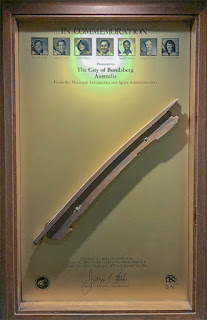
You may wonder what NASA’s Space Shuttle has to do with our Mr Hinkler. It is a little convoluted but stick with me. The Hinkler House Memorial Museum and Research Association invites guest speakers to present a lecture to the Association’s members. In 1985 one such speaker was NASA Astronaut Don Lind, having just flown as Mission Specialist and Payload Commander on Space Shuttle Challenger flight STS-51-B. As a thanks for the lecture the Association presented Don with a small wooden section of wing spar from Bert’s 1911 glider.

Now, Don Lind was a friend of fellow Astronaut, Shuttle Pilot and later Shuttle Commander, Dick Scobee. As Dick was due to fly as Shuttle Commander the following January on flight STS-51-L, Don had asked Dick to carry the glider fragment into space to honour the memory of Bert Hinkler’s aviation achievements and contribution to human flight. As fate had it, flight STS-51-L was launched with the knowledge that the icy conditions were unprecedented and may cause issues with the gas seals on the solid rocket boosters. Lind, on his first and only space flight, and Scobee, had flown previously on Challenger but this flight, Scobee’s second, was to end in tragedy. Just 73-seconds after lift-off, Challenger suffered a catastrophic failure exploding 46,000ft above the South Atlantic Ocean. None of the seven crew onboard survived. The fragment of Bert’s glider never made it into space. But that wasn’t the end of the story.

A Survivor

Incredibly, the fragment of glider survived the explosion and was discovered among the 15-tons of wreckage recovered from the ocean. In 1987 Dr June Scobee, Dick Scobee’s wife, visited Australia on behalf of NASA and presented the mounted fragment of Bert’s glider to the Association from where it began. It is now on display at the Hinkler Hall of Aviation in Bundaberg.

Bert’s UK House – in Bundaberg

Bert Hinkler’s name lives on in aviation having his name carried on one of Qantas’ Airbus A380 aircraft. In fact so strong is Queensland’s admiration for Mr Hinkler that his entire UK house was demolished brick by brick and transported half way around the world and rebuilt in the Bundaberg Botanic Gardens where the Hinkler Hall of Aviation now stands.

Regarding the house relocation, I have to confess, this one puzzles me.