Port Douglas

60KM north of Cairns and bordering on two UNESCO World Heritage listed sites, Daintree Rainforest and the Great Barrier Reef, is the coastal town of Port Douglas – another town in Queensland established following the discovery of gold in 1877.

What’s in a name… or several?

Named after the former Premier of Queensland, John Douglas, Port Douglas’ development was largely based on the mining industry with timber cutting playing a part along the Daintree River. Unusually Port Douglas wasn’t the port’s first name, nor the second. It was previously known as Terrigal, Island Point, Port Owen and Salisbury.

Driven by tourism

These days Port Douglas is largely driven by tourism thanks to its location close to the Daintree Rainforest, 4-Mile Beach, Hartley’s Crocodile Adventures, Cape Tribulation and fast boat access to the inner and outer regions of the Great Barrier Reef. But it wasn’t until the 1980’s that tourism took-off following construction of the Sheraton Mirage Port Douglas Resort. Now the Mirage is just one of the many hotels and resorts that Port Douglas has to offer as well as holiday apartments, caravan sites and private accommodation.
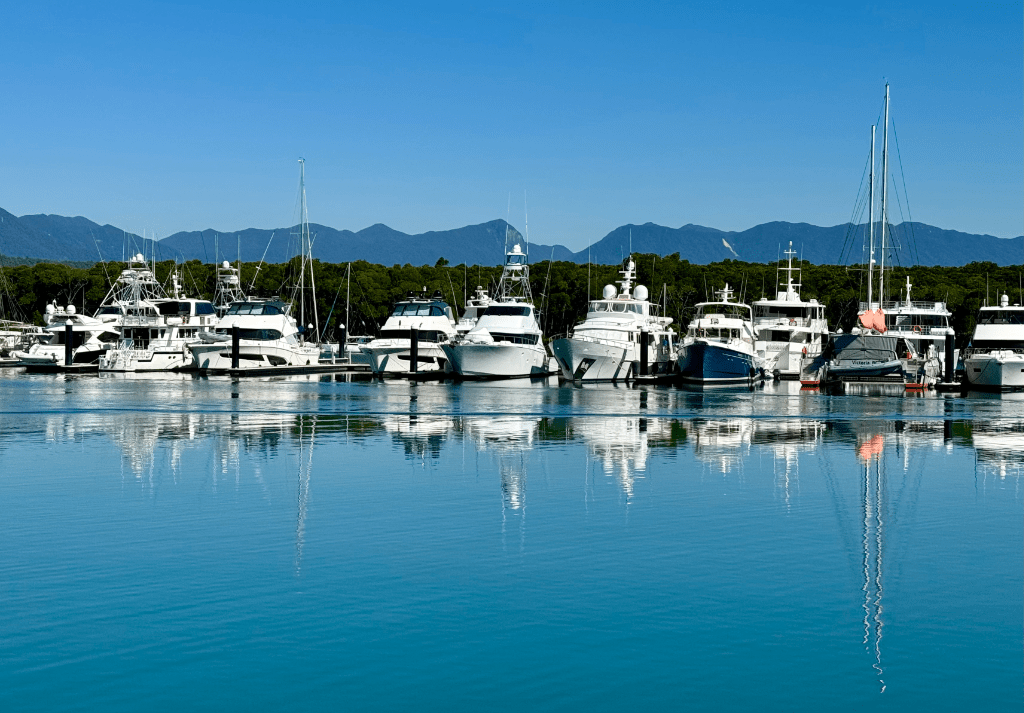
Port Douglas Harbour

While staying in Cairns this week we decided to spend Sunday in Port Douglas, specifically to visit the Sunday Market located on the foreshore. It was our third visit to the Port in 18-years and likely not the last.

Port Douglas Sunday Market

The market is open from 8am to 1.30pm at ANZAC Park and features locally made products including jewellery, clothing, crafts and artwork as well as food and the all important coffee and pastry stalls.

The market backs onto the beach and one of the classic Port Douglas photo spots – the Sugar Wharf.

The Sugar Wharf

Saint Mary’s by the sea

Another popular photography location and adjacent to the market is the cute timber clad Saint Mary’s by the sea – a non-denominational chapel. Initially constructed in the 1880’s as Saint Mary’s Roman Catholic church, it was destroyed by the cyclone of 1911 and rebuilt between 1913 and 1914. Saint Mary’s is now a popular wedding chapel available for hire as is the Sugar Wharf for wedding receptions.

Saint Mary’s by the sea

Since our last visit the once immaculate chapel is now clearly in need of a fresh coat of paint. However, a peek inside will impress with a lofty vaulted ceiling and a window directly behind the alter providing a stunning view over Trinity Bay towards the Daintree Rainforest in the distance.

Cyclone Yasi

No different to all coastal towns in Far North Queensland, Port Douglas is not immune to the seasonal cyclones. To date the Cairns and Port Douglas region has felt the impact of 53-cyclones since 1876 with the worst for Port Douglas being on March 16th 1911 when only 7 of the 57-properties remained standing with two lives lost. More recently, in December 2023, cyclone Yasi made landfall. It wasn’t the wind that devastated the area but the weather events that followed with more than 3.2-metres of rain falling in less than a week – that’s more than 2-year’s average rainfall. Over 100-land slips and rockfalls caused widespread damage with severe flooding, houses destroyed and some communities isolated as a result of collapsing coastal roads. Almost a year later and road repairs are still ongoing with many sections of the Cairns to Port Douglas road affected. And up in the mountains the scars of landslips will remain visible for a great many years to come.

Balancing Stones

Something we first spotted along the coast of the South Island of New Zealand is the art of stone balancing. Seemingly something of a bit of a hobby for our New Zealand cousins, stacking round stones has spread across the ditch and nowhere better displayed than on the rocks beside the Cairns to Port Douglas road.

Balancing Stones

There’s parking available for a few cars to pullover and explore the many stacks that have been built. Maybe even have a go yourself.

The Crocodile Hunter

In 2006 Port Douglas hit the international news when Steve Irwin, the ‘Crocodile Hunter’, was tragically killed by a stingray, ironically, during filming of the documentary ‘The Ocean’s Deadliest’ on nearby Batt Reef. Steve’s death came as a shock and was so unexpected for someone who had spent most of his life working with some of the most deadly creatures on this planet. His wildlife warrior legacy continues with his family – Terri, Bindi and especially his son, Robert, who has stepped into Steve’s shoes with the same infectious enthusiasm as his father.

Australia Zoo, based in Beerwah, Southeast Queensland, is dedicated to Steve’s quest to better understand and protect wildlife wherever it exists anywhere in the world.
Cairns – a City in a garden

Often described as a city in a garden, it’s easy to see why – lush, tropical and colourful.

For over a century following Captain Cook’s 1770 voyage, Cairns was simply known as Trinity Bay. In 1876 following the discovery of gold to the west of the tablelands, a port was constructed as an export facility and the area surrounding the new port was named Cairns in honour of Sir William Cairns the then Governor of Queensland.

Cairns is now a large coastal town supporting a diverse agricultural region as well as a major international tourism centre with lots to offer the visitor. Wether it be its close proximity to the Great Barrier Reef and its many adventure tours from the harbour, its position sat between the Coral Sea and the dominating mountains or its ancient Daintree Rainforest, there is something here for everyone. For travellers it even has its own international airport just minutes from the city centre.

Mud, glorious mud

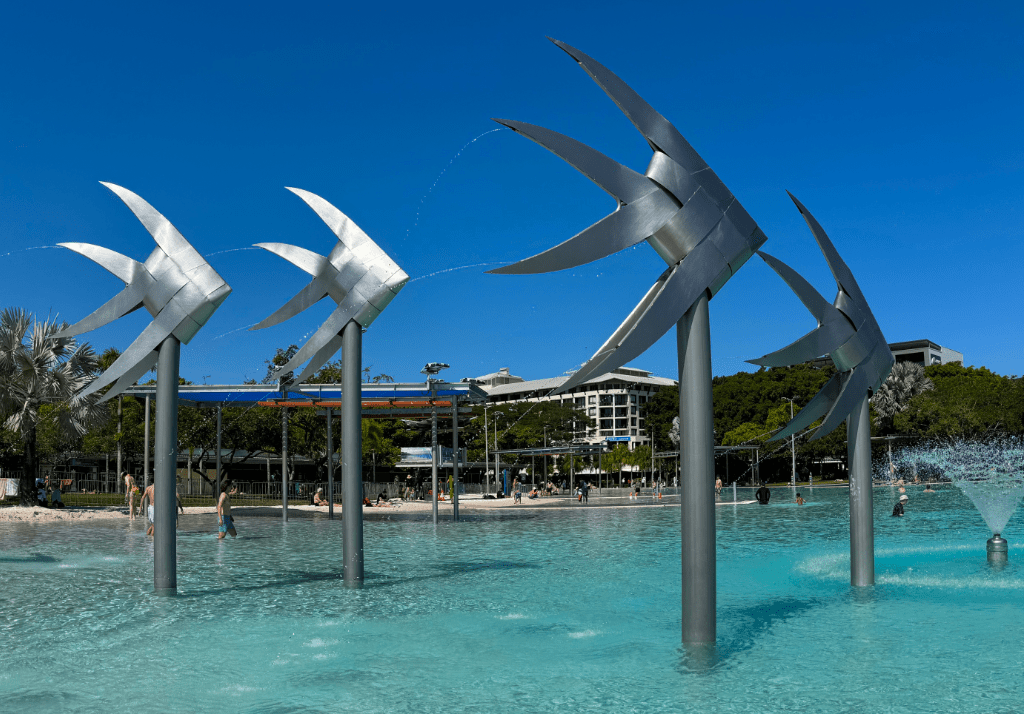
Shaded by giant figs and native almond trees is the Esplanade, a winding pathway along the coastal front providing a relaxing walk sheltered from the sun. A large pool known as the Lagoon takes centre stage, which is hugely popular with locals and visitors alike, surrounded by lawns to sit and enjoy a picnic or just catch a few rays.

The Cairns Lagoon

Cafes and restaurants line the inner esplanade providing everything from fresh seafood to delicious gelato. On the coastal side, when the tide is out, unfortunately, is a very large expanse of mud – not the most picturesque of views. That said, this is crocodile country so keeping away from the sea isn’t such a bad idea. And with the large pool and children’s playground there’s plenty to keep the little, and not so little, ones amused.

Cairn’s muddy Waterfront

Esplanade Closed

The evening before we arrived in Cairns we heard reports that a helicopter had crashed into a hotel in the early hours of the morning. It didn’t seem to make sense. Why would a helicopter be flying so low, so fast – according to witnesses, and at night. Suspicion was confirmed the following day. The helicopter had been taken from Cairn’s airport and crashed into the Double Tree Hilton Hotel on the Esplanade shortly after. An elderly couple, in the room immediately below the crash, had been taken to hospital and were being treated for shock. The crash had completely collapsed the windows of their hotel room. Later in the day it was confirmed that the New Zealand helicopter pilot working for Nautilus Aviation in Cairns, had been out celebrating his promotion with colleagues and, afterwards at around 1.50AM, had accessed the General Aviation area of the airport, entered the company’s office, took the keys to the helicopter and decided to go for a ride. The short flight ended in a fiery crash in which he was killed. It was an unauthorised flight and he was not licensed to fly in Australia.

We saw the crash site as we walked along the Esplanade a couple of days later after the area had been reopened following investigations by the Australian Transport Safety Bureau.

Palm Cove

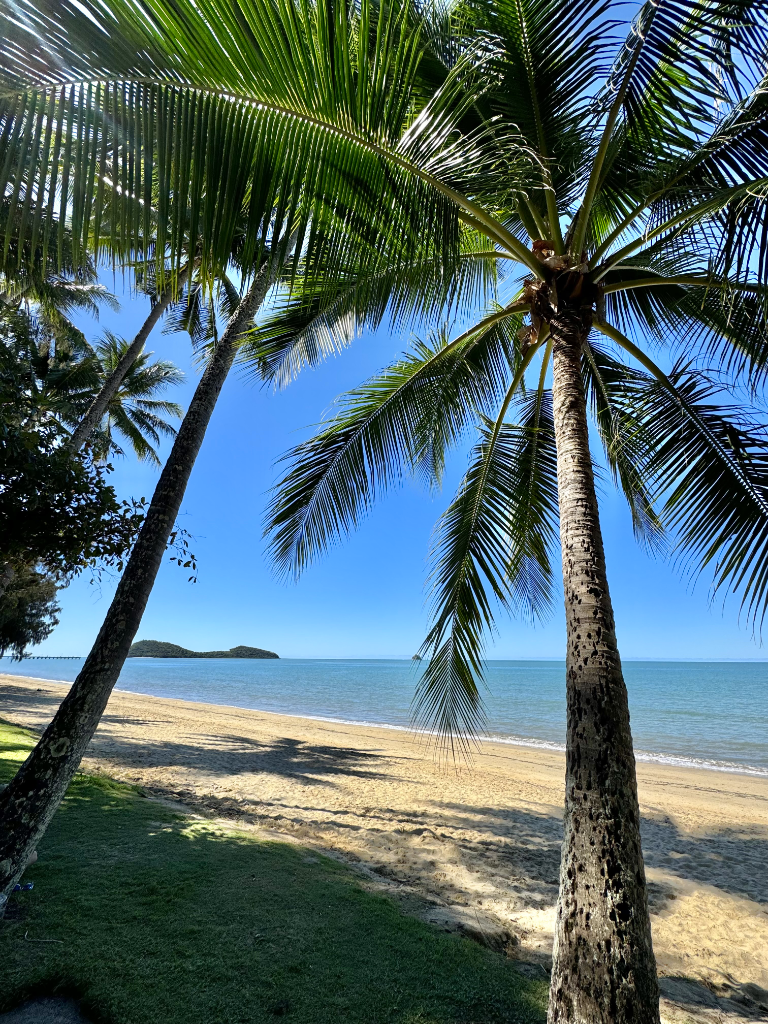
On a lighter note and just 30-minutes north of Cairns is the popular beachside resort of Palm Cove featuring a glorious beach backed by countless coconut palms and 500-year old paperbark trees. Being so picturesque it is no surprise that Palm Cove is one of Australia’s most popular wedding destinations and also the nation’s Spa capital.

Palm Cove beach

Palm Cove is also well provided with eateries including several fine dining restaurants with views out to Double Island. We can certainly vouch for Vivo after a superb meal we had there on our day visit from Cairns. Just as well provided are the options for accommodation ranging from boutique hotels to caravan and camping sites.

Vivo Restaurant – Palm Cove

Parking during peak times may be a challenge so arriving early is recommended. Even during the peak holiday period when we visited the beach was almost deserted… or maybe everyone was still trying to find a parking space?

Coconuts

Big 4 Ingenia Holidays Cairns Coconut Resort has been our home while in Cairns and we can highly recommend it. Known simply as ‘Coconuts’ the resort is fully featured with lush tropical planting (and yes that includes coconut palms) caravan, camper van, trailer and tent sites as well as many villas, two pools, children’s playgrounds, tennis, volleyball and basketball courts, outdoor cinema, a spa, cafe, bar… the list goes on. It is in a great location too just off the highway and only 7KM from the centre of town. Transport is just as good. Rather than take the car it’s easier, and much cheaper, to take a bus to the city. Just introduced in Queensland, as part of the cost of living relief, is the 50-cent fare on buses and trains. And with the bus stop just a few minutes walk from Coconuts you would be nuts to drive yourself.

Tomorrow we reach the furthest point north in our trip to Far North Queensland – Port Douglas.

Skyrail Rainforest Cableway

We’ve finely reached our most northerly destination on this trip – Cairns in Far North Queensland (FNQ). And where better to get an overview of the city than from up above.

Up in the Air

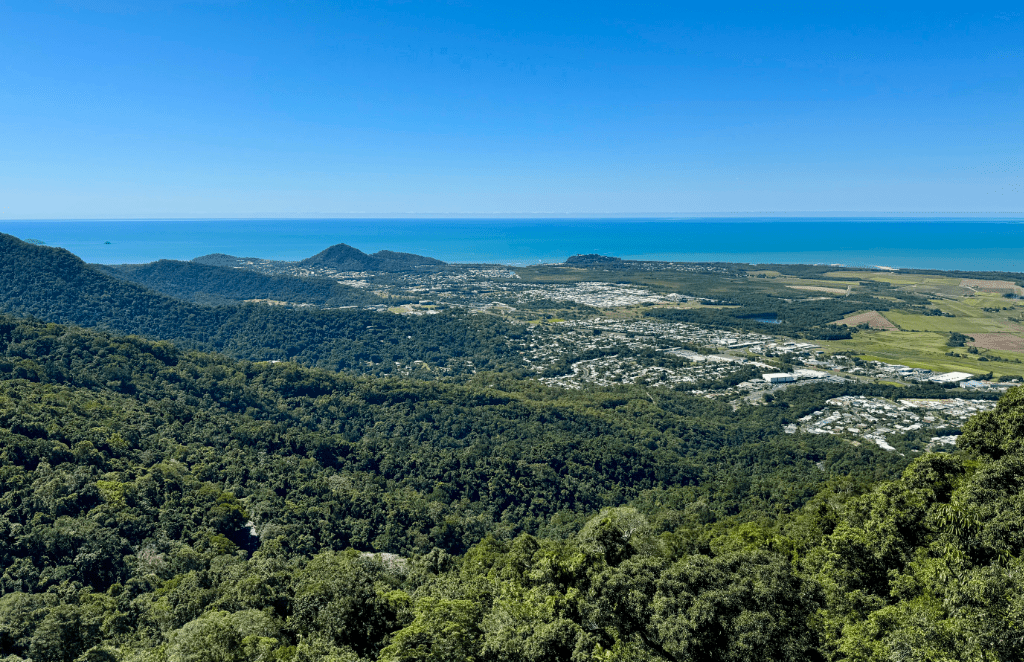
A great place to get an overview of Cairns is to climb onboard Skyrail’s 7.5km Rainforest Cableway – a cable car with a dramatic view and once the longest cableway in the world. Located just 15-mins north of Cairns at Smithfield within the UNESCO World Heritage Listed Barron Gorge National Park.

Cairns from above

Free parking is provided directly in front of the Smithfield terminal and serves both the Skyrail and Kuranda Scenic Railway. For those booking Skyrail to Kuranda in one direction and the train in the other, a courtesy bus, stopping in front of the Skyrail terminal, takes guests to and from Freshwater Train Station. Alternatively the train can be caught in Cairns directly.

Bookings Essential

It should be noted that during peak periods, this currently being one of them, it is essential to pre-book tickets. Each car seats six people and you may be required to share with others. Look on it as being an opportunity to meet like minded people and share travel adventures – we did.

Boarding is a little slow at this time of year but we were soon setting-off on the first section of the cableway. The steep 10-minute ride climbs to the 545-metre summit of Red Peak with expansive views over the city and beyond before descending a little over the rainforest to Red Peak Station. A change of car is required for the next span, by far the longest, but the opportunity to take a short break to explore along the signed boardwalk at Red Peak is recommended. Time permitting, there is still the option to take-in the walk on the way back if returning by Skyrail.

Riding over the Rainforest

The cableway then traverses the spectacular tropical rainforest for another 20-minutes giving the opportunity, if you’re brave enough, to look down below at the diversity of trees, shrubs and vines and potentially the Ulysses butterfly as its iridescent blue wings standout against the backdrop of tree foliage. As an extra paid option the Skyrail Diamond car is available with a transparent floor if the standard car is not scary enough for you or the little ones.

Barron Falls

The next stop is Barron Falls, a huge rocky ravine where the Barron River falls over granite rock as it descends from high in the Atherton Tablelands towards Cairns.

Barron Falls in Winter

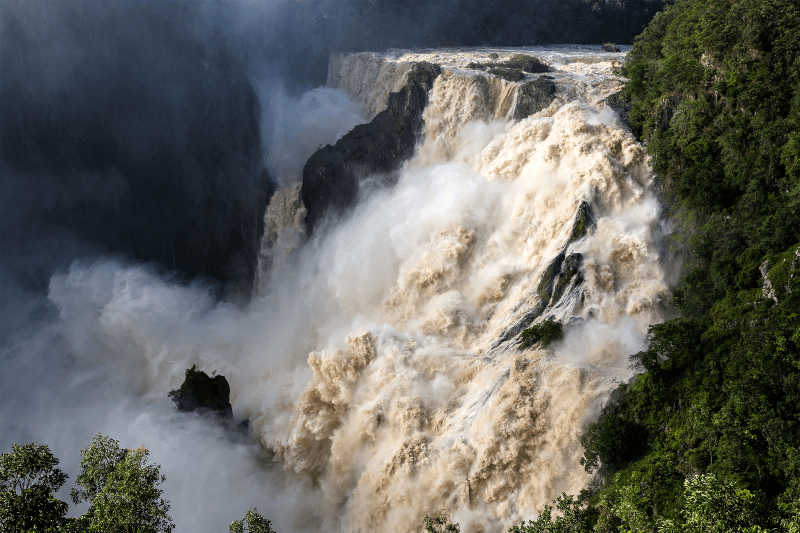
In the ‘Dry’ season (April to October) the falls still flow, and more so following rain, but during the ‘Wet’ (November to March) you can witness the falls at their best where the torrential tropical downpours create a boiling, seething maelstrom of water and spray as it crashes down into the gorge. A good viewpoint is the Edge Lookout opened in 2019, which, incidentally, has a glass floor to make the drop of 160-metres to the gorge all the more enjoyable! It’s highly recommended to stop here and take the short walk to the cantilevered lookout before rejoining the next available car for the 15-minute ride to the final stop at Kuranda Station.

Barron Falls in Summer. Credit: Tourism Tropical North Queensland

Kuranda

Originally settled by the Djabugay indigenous people around 10,000-years ago and whose relatives continue to this day, Kuranda was later settled by Europeans in the mid 1880’s taking up farming in the area and producing timber, dairy cattle and eventually coffee. During the ‘Flower Power’ and anti-Vietnam War period of the mid-1960’s, hippie communes developed seeking a simple, self-supporting, laid-back lifestyle. Today the hippie influence is still very much in evidence as is the drifting scent of incense, especially in the ‘Kuranda Original Rainforest Markets’. Sadly the market has lost its once popular craft and food scene and looks increasingly neglected as new stores open on the main streets selling cheap tourist junk. To us, and since our last visit more than a few years ago, Kuranda has lost its edge. It’s not cheap to get here and apart from the picturesque Kuranda Scenic Railway Station and the Butterfly Sanctuary the journey here is now the highlight and no longer the destination.

Kuranda by Rail

For those not having the stomach for a swinging cable car, there is an alternative option. The Kuranda Scenic Railway can be caught in Cairns or Freshwater Station and provides views of the surrounding landscape on its winding climb up to Kuranda Station with a brief stop at Barron Falls to get the best photo opportunity.

The train can also be combined, for those choosing a little more variety, to go up to Kuranda by train and return on the cable car or vice-versa. We have done both and the two are equally recommended.

Construction of the 37KM long railway started in 1887 and reached Kuranda in 1891. The railway required 15-tunnels, which were dug by hand and 37-bridges. It wasn’t until 1936 that the railway was opened to tourism.

Kuranda Scenic Railway Station

How do you build in a protected Rainforest?

Think for just a minute about all the indigenous people of the region, save the trees campaigners, the political activists and those that genuinely want to protect natural forests for future generations, and you have to wonder how Skyrail got permission to build a 7.5km cable car through a rainforest, a World Heritage listed one at that. Well, certainly there were protests both from locals, environmentalists and the indigenous people. It was regularly in the press and on TV and in radio reports. It gained worldwide attention not only for the proposed development within a pristine and ancient environment but also for the precedent that it would set for other developments around the world in highly sensitive environments. Should it get approval the proposal would be the first ever commercial development in a World Heritage listed area.

And, remarkably, it did! It would give people the opportunity to see and experience this ancient rainforest without any erosion causing foot traffic. After much debate and negotiations a compromise by the developer was reached requiring construction of the cableway to be made from the air, the concrete, steel gantries and the construction teams – all delivered by helicopter. And so it was, Skyrail opened to the public in August 1995. Today Skyrail is so busy during the peak season that, as we have mentioned, pre-booking is essential.

Booking options and further details available on Skyrail’s website

The Hazards of Freycinet

Located within Freycinet National Park, The Hazards are a mountain range on Tasmania’s east coast and gateway to one of the most famous beaches in the world.

Beauty in Pink

Anyone touring around Tasmania, and with the remotest interest in geology, will notice a change in the mountains on the Freycinet peninsula from the grey granite, black basalt, dolerite and sandstone of much of the state’s mountainous regions. As you approach the Hazards via Coles Bay you cannot help but notice their very distinct pink hue and more so in the evening under the setting sun.

Setting sun on the Hazards

Long, long Ago

The granite mountains, believed to have been named after African-American Whaler Captain Richard Hazard, are comprised of a mineral called Orthoclase – a pink form of feldspar that owes its colour to another mineral, iron.

The Hazards from Coles Bay

Around 60-million years ago volcanic activity beneath what is now Tasmania, pushed magma upward lifting the land hundreds of metres above sea level creating the Freycinet peninsula. During the same period the land to the west of the peninsula sank forming Great Oyster Bay. As the magma slowly cooled under pressure the Orthoclase formed into the large rectangular crystals that are typical of the rock, granite.

Over the following millions of years the softer ground above the granite eroded away exposing the rock to weathering by ice, rain and wind that has resulted in the giant rounded boulders that now litter the mountains. Today the Hazards stand at a shadow of their former height but still reach an impressive 485-metres above the sea.

Freycinet National Park

Much of the Freycinet peninsula falls within the bounds of Freycinet National Park* with the only access being via a single narrow, and not very well maintained road. Credit, though, is due for the excellent, and unusually large, National Park Visitor Centre, where a large number of park guides and leaflets about the region and activities can be found as well as a good selection of books, outdoor clothing, local crafts and souvenirs.

The distant Hazards Range from Swansea

Time for a Walk

We had been looking forward to exlploring the Freycinet region again following a previous visit in 2008. On that occasion the weather wasn’t in our favour with light rain and low cloud setting in just as we got to a major viewpoint. This time, however, the sun was shining and the sky was mostly clear, perfect walking weather despite the cool late autumn wind.

Our walk was the shortest within the park but with a view worth every step, and ache, up the often steep climb. In 2008 the same track between Mount Amos and Mount Mayson was best described as ‘rough’ with a steep climb on a slippery gravel path interspersed with sharp rocks ideal for tripping the unwary. Now, however, sturdy steps have evened out the steeper sections making the upward path easier, though still requiring a fair amount of effort. Several ‘new’ viewpoints have also been added looking back over Coles Bay towards the distant coastal town of Swansea.

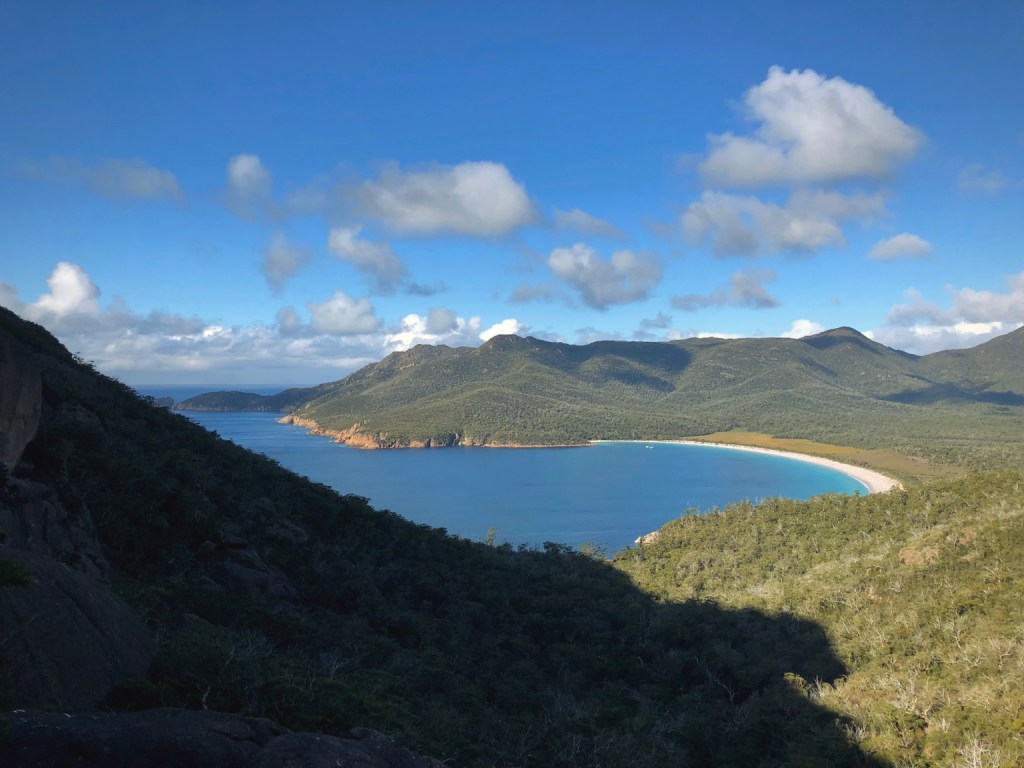
Wine Glass Bay from the Lookout

The higher you climb the larger the giant granite boulders become and in places you are walking among and between them towering over you. But there is a very worthy reward for the 45-minute climb when you reach the top of the pass – for this is the Wine Glass Bay Lookout Walk and from here, as the name suggests, you get the most amazing view of the world famous Wine Glass Bay. All the effort to arrive at the lookout weighed down by a heavy camera bag was worth every step. The lookout, too, had been updated with additional platforms giving greater access to the increasing number of walkers being attracted to the peninsula.

1,000 Steps Too Many

We had considered the extended walk that leads down to the white sand of Wine Glass Bay’s beach but we had second thoughts after reading more about the terrain. Access to the beach requires navigating a far steeper track and includes around 1,000 steps down and back to return to the viewpoint. At the end of the day it is just another of the many beautiful white beaches with turquoise water along the east coast of Tasmania and its ‘fame’ due to its curved shape and remote seclusion. So, after several photographs and a chat with a couple of fellow travellers, we headed back down the quite unique one-way track, which separates the freshly rested from the newly exhausted heading uphill.

People often ask, ‘what is the origin of the bay’s name?’, and no one is quite certain. The most preferred, and most pushed by marketeers, relates to the similarity of the bay’s shape to that of a wine glass, but there is a darker and more likely offering, a bloody one, which is where our whaling Captain Richard Hazard features once again.

In the early 1800’s whaling was a significant contributor to Tasmania’s fortunes and much of that was along the east coast of the state. Whaling stations were a common site where spotters would take to the high ground looking for the migrating whales, sending out the boats to harpoon any unfortunate passing whale and dragging them back to the shore-based stations for ‘processing’. The whale’s baleen was used to stiffen corsets and the rings of the fashionable British ladies’ dresses, while whale oil, extracted from the blubber powered the dim lights in Victorian houses and an extremely fine oil for lubricating clocks, watches and the machines driving the booming Industrial Revolution.

A Bloody Past

The more likely origin of Wine Glass Bay’s name, however, is related to the colour of the deeply blood stained water and beach during the whaling season rather than the shape of the bay. Imagine too the putrid stench of boiling blubber and the rotting carcass’s of whales. There could not be a greater contrast to how the pristine bay appears today.


*As with all National parks in Tasmania, a National Parks Pass is required for vehicles entering Freycinet National Park. Passes are available from all National Parks Visitor Centres in Tasmania as well as from the automated machines in Freycinet National Park’s car parks.