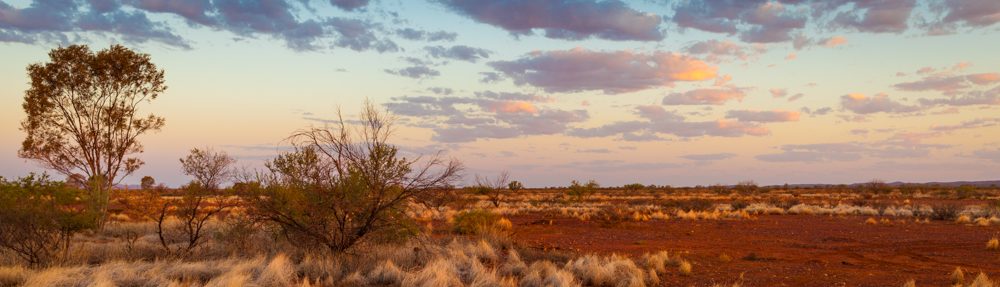
Turning from the Bruce Highway once more, we’re heading cross-country to the coastal town of Bargara. Like Yeppoon this was a second visit for us but the first time on this route and there was something rather strange about it.
Now that’s genius!
I’m not sure if the people of Tableland Road, southeast of Miriam Vale, are concerned about some new form of pandemic virus being carried on mail and parcels delivered to their homes but a drive along Tableland Road for many, many kilometres shows a succession of microwave ovens on posts at the end of each property’s driveway. Now we’ve seen many repurposed objects used as letterboxes during our travels around Australia; recycled gas cylinders made to look like cute piglets, or cows, goats, crocodiles, frogs etc. but they all have one feature in common — they are a haven for spiders. Here, however, the humble microwave oven is multipurpose. It’s a novelty letterbox, a virus exterminator, it has a reasonably watertight door to keep out the rain and those unwanted critters. It even has a viewing window to see if your latest Amazon package has been delivered. It could also prove useful if you’re passing by and need to warm up a pie for lunch. Genius!
Rich and fertile
Passing through the town of Bundaberg towards Bargara, you can’t help but notice the fields of sugarcane, the smoke and steam from the sugar mill and the wildly coloured volcanic soil. A photograph only gives a slight impression of the rich red soil in the region. In reality it almost glows and is enhanced even more in the evenings as the sun sets low in the sky.

But it’s not just sugarcane that the region is known for, or its famous rum, it is also the tomato and macadamia nut capital of Australia and a major grower of zucchini, squash, cucumber, capsicum, chilli, sweet potato, strawberries, beans and snow peas. And not forgetting lychees, melons, citrus, stone fruit, pineapples and sunflowers.
Bargara Town
As seems to be a common trait among the small towns we have visited on this trip, Bargara isn’t the town’s original name. Inspired by the landscape, the European settlers chose to name the new town ‘Sandy Hills’. The present day name is a concatenation of two nearby localities – Barolin and Woongarra.
Bargara features all the usual shops, supermarkets and facilities required of a small town – mostly located just inland from the coast. That leaves the more attractive part of town towards Bargara Beach with cafes and restaurants lining Bauer Street under the shade of mature trees. And hidden just around the corner on See Street is the Windmill Cafe popular with the locals and those preferring somewhere a little quieter. It’s home to some freshly baked tasty treats made on the premises. And a good coffee too!
Following Bargara Beach along the coastline is the Esplanade and its weaving pathway providing a good walk beneath the shade of trees with views along the occasionally rocky beach. It is not the typical beach you come to expect on the east coast but, like Yeppoon, it is a volcanic region and with that goes the jet black volcanic rocks that divide sections of sandy beach often backed by mangroves.
Mon Repos
Just north of Bargara, along the beach, is a world renowned turtle conservation centre – The Mon Repos Conservation Park. It is the largest site of nesting marine turtles on the east coast of Australia and is home to the most significant population of loggerhead turtles in the South Pacific. Flatback, green and occasionally leatherback turtles also choose Mon Repos to nest. The turtles arrive to lay their eggs between November and March and hatching takes place at night around eight weeks later.
Surprisingly the area was once owned by the French Government between 1890 and 1925 after they laid the first undersea telegraph cable to New Caledonia. The cable came ashore on Mon Repos beach – hopefully not during nesting season but respect for nature during those years was a little different to now as was clearly illustrated below:

Local Hero
In nearby Bundaberg is a museum dedicated to an extraordinary gentleman with who we’ve been previously acquainted. A local man, he is a gentleman few people outside of Australia in the present day will have heard of. That gentleman is one Mr. Herbert (Bert) John Louis Hinkler and in the aviation world he is quite deservedly a legend.
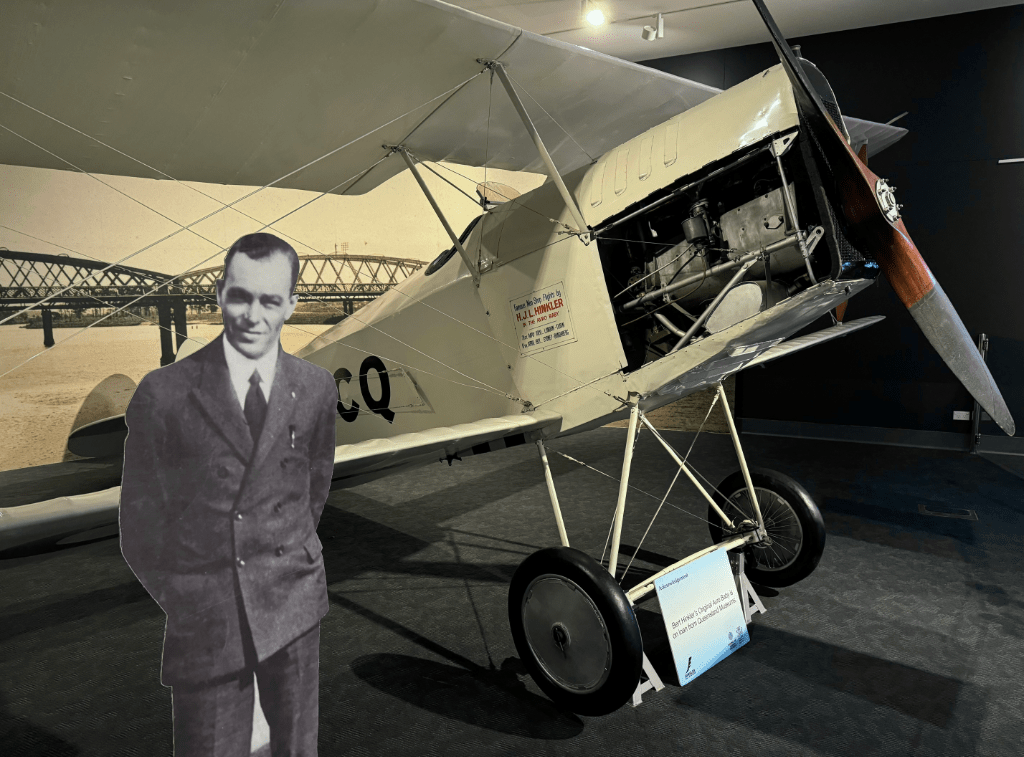
Among the many medals and trophies that Bert was awarded he was the first person in Australia to fly using his homemade glider and in 1928 made the first solo flight from England to Australia.

But on January 28th 1986, Bert had an unlikely link to the Shuttle Challenger tragedy. At the request of the Hinkler Foundation, a fragment of one of Bert’s gliders was flown on the space shuttle. Unbelievably, among the 15-tons of debris that was recovered following the explosion, Bert’s wooden glider relic survived and was later presented by NASA representatives to the City of Bundaberg.
More of Bert’s story can be read here: Hinkler Hall of Aviation
Big 4 ‘Classic’
Our stop for a few nights is the Big 4 caravan park located at the north end of Bargara’s Esplanade. We stayed here on our previous trip but since then it has been taken over by the Big 4 group. As we arrived we noticed the word ‘Classic’ following the Big 4 site’s name. It wasn’t a good omen. Classic, in these days of deceptive marketing, has several meanings and unfortunately in this case ‘Classic’ is best defined as ‘old’, ‘tired’, ‘unloved’ and ‘neglected’. Big 4 run some really good caravan sites around Australia but unfortunately this wasn’t one of them.
The roads around the caravan site are in a poor state – rough and crumbling away, especially towards the edges. It didn’t help that we ended up with our first tyre puncture in over 10-years. I’d picked up two nails among the rubble of the road that morning while walking around the site.
This did not bode well and the site we were allocated was no better being nothing more than a patch of drying mud with holes that looked like someone had previously got bogged and spun their wheels in a desperate attempt to escape. It wasn’t even wide enough for our caravan so we ended up parking on the cracked and uneven concrete slab – a no, no in the caravanning world, as we were reminded by a nosey neighbour. Despite booking months in advance this was described as an ‘overflow’ site normally reserved for last minute bookings. But adding to insult this was one of the most expensive sites we had stayed at on this trip. It’s grossly overpriced and what facilities there are are very dated – think remnants of the 1970’s.
It’s not just us
There were hundreds of caravans filling the site netting the owners thousands of dollars a day and nothing spent maintaining the site other than a quick whizz around with a mower. Looking at the comments on WikiCamps certainly confirmed our thoughts – complaint after complaint. Big 4 are doing Bargara a huge disservice, many saying they won’t return and that includes us.
The only thing good I can say about the Big 4 ‘Classic’ site is the location, which provides a good walk into town and its position beside the beach.
That’s all folks
And sadly that brings us to the end of this current adventure. Tomorrow will be the last leg of our drive home. We’ve experienced some outstanding scenery, visited many towns that were new to us and a few repeats. We’ve flown over the Great Barrier Reef, cruised around the Whitsundays, walked among granite mounds and tropical rainforests. We’ve wandered barefoot along pristine beaches and drunk in the views over the Coral Sea.
Altogether we’ve driven 3,918 kilometres amounting to 60-hours and 11-minutes on the road. At an average of $1.87 per litre we used 603-litres of diesel costing $1,130. Average fuel consumption towing the caravan was 14.8L/100KM with the car alone averaging a more reasonable 8.75L/100KM. Being a modern European diesel engine the twin-turbo 3Litre V6 Land Rover motor requires the use of AdBlue, an additive that substantially reduces exhaust emissions. Now almost as expensive as diesel fuel, 17-litres of AdBlue was required. Of course these costs don’t include the wear and tear on the car, the caravan and the eight tyres keeping us in contact with the rough Queensland roads.
So where next?
We missed northern South Australia during our Big Lap in 2020 due to excessive temperatures and the National Parks Service closing sites for safety reasons. We had already experienced bush fires in the south and took the safer option to cross over instead to Victoria. We want to explore Ikara (Flinders Ranges) and the surrounding area and possibly a flight over Lake Eyre. So a little planning to do.
We’d also like to return to Western Australia for the wild flower season, which we just missed in 2019, this time maybe by hiring a camper van to avoid the long drive to WA and back. Also on the list is Carnarvon Gorge, Queensland, and much closer to home. We’ll Keep you posted.
In the meantime Japan is calling. Jaa Ne!
 Discovery Down Under