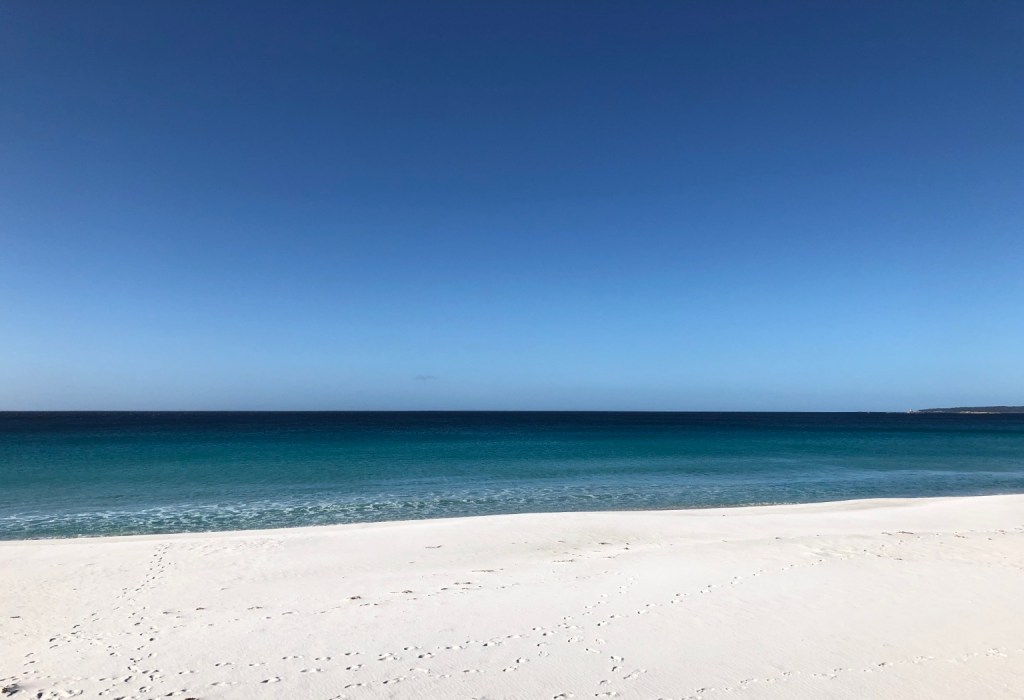
Situated on the Northeast coast of Tasmania and stretching from Eddystone Point to Binalong Bay, the Bay of Fires is a stunning mix of turquoise water, powdery white beaches and orange tinted granite boulders.
Named by British Captain Tobias Furneaux* in 1773 after observing fires lit by aboriginal people along the coast. Furneaux’s ship, HMS Adventure, was sailing as part of Captain Cook’s second exploration of the pacific before becoming separated.
Bring on the Colour
The orange colour is caused by lichen** from the Hymeneliaceae family. It is a common occurrence on the granite rocks and boulders in the northeast of Tasmania, but is particularly vibrant within the Bay of Fires region.
Lichen coated boulders – Bay of FiresThe Gardens – Bay of Fires
Parking is limited along the Bay of Fires coastline with the largest parking area situated at The Gardens. There are small areas where you can pull-off the narrow road but we’d recommend getting there early.
For photography, the early morning and late evening light is best when the orange lichen appears to glow.
Binalong Bay
The powdery white beach between The Gardens and Binalong is perfect for a gentle walk. Humpback Whales can be spotted here from May to July as they head north to warmer waters and again between September and November when they return south to the Antarctic.
Turquoise waters of Binalong Bay
*Tobias Furneaux was one of the first men to circumnavigate the world in both directions.
** Lichens are a combination of algae and fungus that live in a symbiotic relationship. The algae gathers energy from the sun by photosynthesis providing food for the fungus, while the fungus creates a protective environment for the algae to thrive.
You just can’t get enough of tall trees in this part of the world. If your neck has recovered from craning skywards after visiting the majestic tall trees in The Tarkine and Mount Field National Park, prepare yourself for the real giants here at Styx Tall Trees Conservation Area.
Finally Protected from Felling… for now
A long and bitter campaign by the Wilderness Society and Greenpeace to stop the continued felling of native trees within the conservation area was, thankfully, successful and in 2013 part of the Styx valley, where the largest and most ancient trees still grow, was added to the Tasmanian Wilderness World Heritage Area. However, successive Tasmanian governments have worked hard to reverse this hard fought protection for the benefit, not of mankind but the forestry industry.
Not ‘coincidentally’ the government agency ‘Forestry Tasmania’, trying to show its new, environmentally friendly concern for the ancient forests, has renamed itself ‘Sustainable Timber Tasmania’.
The ‘Bigger Tree’ – Tasmanian Mountain Ash
Remote Access
There are several walks within Styx Tall Trees Conservation area – none of them too challenging, but getting here we’d recommend a 4-WD or a car that you don’t mind receiving a few scratches here and there, possible punctures, wrecked shock-absorbers and a good coating of mud.
The turn-off from Gordon River Road leads to the 18km stretch of Styx Road, which is unsealed, winding and with plenty of potholes to navigate, as are possible fallen trees. Although Tasmania Parks & Wildlife Service does make regular inspections the road is actually maintained by the logging companies.
It should be noted that this is a remote location and there is no mobile phone reception. So be prepared in case of an emergency, leave a note to inform someone of your planned walk and expected return time and carry a snake/spider bite kit.
Styx Tall Trees Walk
The start of this walk is close to the signpost announcing you have arrived in the Big Tree Forest Reserve. A small area suitable for parking is available and gives the easiest access to see the ‘Big Trees’.
Eucalyptus regnans – 90-metres and still growing
A 1km loop over mostly flat ground. A partial board walk takes you past an enormous felled giant Mountain Ash tree (Eucalyptus regnans) covered in moss, as are most of the trees on this walk. The Mountain ash is the largest flowering plant in the world and by a long way – some exceeding 90-metres in height, a girth in excess of 20-metres and some more than 500-years old.
You will find some of the largest trees on this walk around the halfway point. Among them are two in particular, one named ‘The Big Tree’, being the tallest measured at that time but was later followed by one even taller and aptly named ‘The Bigger Tree’.
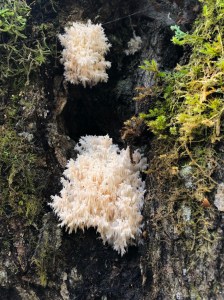
Lion’s Mane Fungi – Hericium Erinaceus
Among the decaying timber and ground cover of moss are many varieties of fungi and well worth a closer look as you follow the walk among ancient tree ferns. Keep an eye out too for several of the older trees that have some unusual fungi growing from them such as the Lion’s Mane mushroom.
Record Breakers
There is one tree further south, known as Centurion, that has reached the lofty height of 100.5-metres and continues to grow. It is the third tallest tree in the world and the tallest known hardwood tree on earth. It’s exact location has been kept quiet to protect it from trampling feet. Exceeded only by the giant Redwood Trees of the Californian coast of North America at 116-metres, the Mountain Ash is the tallest species of tree in the Southern Hemisphere.
Hygrocybe pseudograminicolor
Styx River Walk
Originally named ‘Sticks River’ by early settlers due to the jumble of fallen trees and branches obscuring views of the river, it was renamed ‘Styx River’ during an 1826-28 period of formalising names by the government.
The Styx River walk, though pleasant, is among less dense and less ancient growth leading down to the tumbling Styx River. Although several large Mountain Ash trees are visible on the track they are less impressive if you have already taken the Tall Trees Walk and less accessible to photograph. There is, however, a good undercover of Myrtle and tree ferns. It is a much drier walk underfoot but suitable footwear is still advisable, especially when wet.
Cortinarius metallicus
The Chapel Tree
Not the easiest Tree to find. The Chapel Tree is accessed 4km further along Styx Road from the Tall Trees Reserve where you then need to take a right turn and continue for a further kilometre to a fork in the road. Take the right fork and continue along the narrowing track for a final kilometre. From here look for a handmade sign pointing into the bush where a barely visible track leads. Follow the pink tape markers through bracken, low hanging branches and boulders placed among wetter patches and you’ll arrive at the Chapel Tree.
What makes this giant unique is the enormous base of the trunk. Years of decay has created an open cavity inside the trunk large enough, apparently, to hold fifteen people. It’s a brave person that stands inside the trunk of such an enormous tree knowing what is left of the tree’s decaying base is supporting such a staggering weight. But, of course, in the name of science adventure, I took a quick look.
The Chapel Tree
Hopefully being a little more remote, the Chapel Tree will be less visited and continue to grow for many, many more years.
If you are ever in this part of the Tasmanian Wilderness, this is a must visit to see some of the tallest trees in the world in their unspoilt habitat. Just don’t be off put by the few kilometres of destroyed forest that has been clear-felled as you drive along Styx Road into the Styx Valley.






 Discovery Down Under