Port Douglas

60KM north of Cairns and bordering on two UNESCO World Heritage listed sites, Daintree Rainforest and the Great Barrier Reef, is the coastal town of Port Douglas – another town in Queensland established following the discovery of gold in 1877.

What’s in a name… or several?

Named after the former Premier of Queensland, John Douglas, Port Douglas’ development was largely based on the mining industry with timber cutting playing a part along the Daintree River. Unusually Port Douglas wasn’t the port’s first name, nor the second. It was previously known as Terrigal, Island Point, Port Owen and Salisbury.

Driven by tourism

These days Port Douglas is largely driven by tourism thanks to its location close to the Daintree Rainforest, 4-Mile Beach, Hartley’s Crocodile Adventures, Cape Tribulation and fast boat access to the inner and outer regions of the Great Barrier Reef. But it wasn’t until the 1980’s that tourism took-off following construction of the Sheraton Mirage Port Douglas Resort. Now the Mirage is just one of the many hotels and resorts that Port Douglas has to offer as well as holiday apartments, caravan sites and private accommodation.
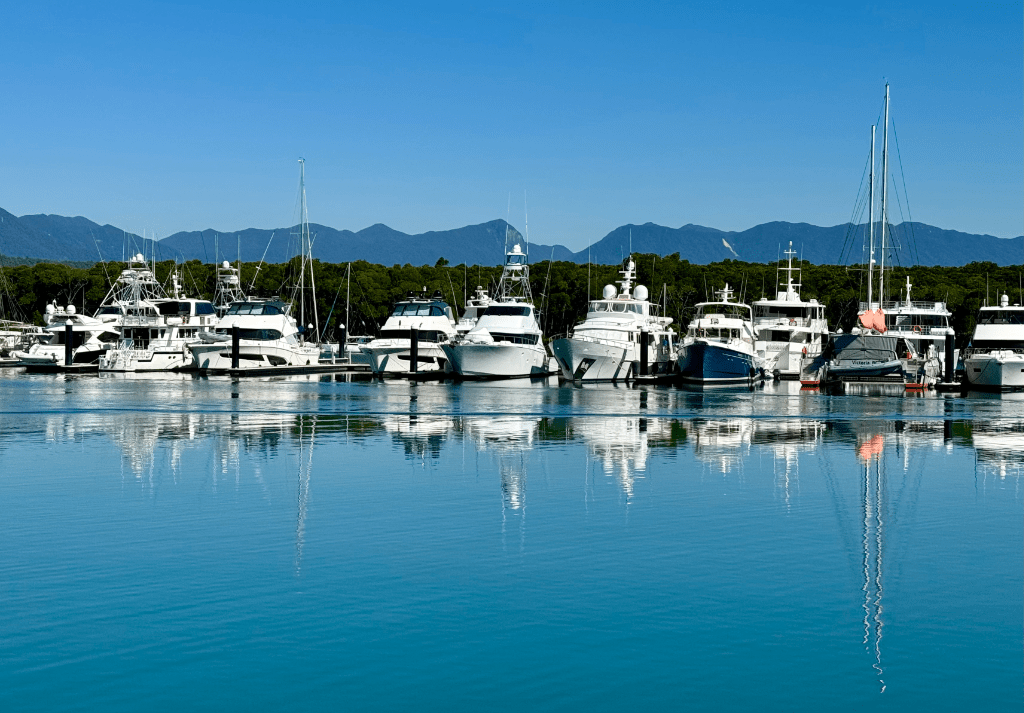
Port Douglas Harbour

While staying in Cairns this week we decided to spend Sunday in Port Douglas, specifically to visit the Sunday Market located on the foreshore. It was our third visit to the Port in 18-years and likely not the last.

Port Douglas Sunday Market

The market is open from 8am to 1.30pm at ANZAC Park and features locally made products including jewellery, clothing, crafts and artwork as well as food and the all important coffee and pastry stalls.

The market backs onto the beach and one of the classic Port Douglas photo spots – the Sugar Wharf.

The Sugar Wharf

Saint Mary’s by the sea

Another popular photography location and adjacent to the market is the cute timber clad Saint Mary’s by the sea – a non-denominational chapel. Initially constructed in the 1880’s as Saint Mary’s Roman Catholic church, it was destroyed by the cyclone of 1911 and rebuilt between 1913 and 1914. Saint Mary’s is now a popular wedding chapel available for hire as is the Sugar Wharf for wedding receptions.

Saint Mary’s by the sea

Since our last visit the once immaculate chapel is now clearly in need of a fresh coat of paint. However, a peek inside will impress with a lofty vaulted ceiling and a window directly behind the alter providing a stunning view over Trinity Bay towards the Daintree Rainforest in the distance.

Cyclone Yasi

No different to all coastal towns in Far North Queensland, Port Douglas is not immune to the seasonal cyclones. To date the Cairns and Port Douglas region has felt the impact of 53-cyclones since 1876 with the worst for Port Douglas being on March 16th 1911 when only 7 of the 57-properties remained standing with two lives lost. More recently, in December 2023, cyclone Yasi made landfall. It wasn’t the wind that devastated the area but the weather events that followed with more than 3.2-metres of rain falling in less than a week – that’s more than 2-year’s average rainfall. Over 100-land slips and rockfalls caused widespread damage with severe flooding, houses destroyed and some communities isolated as a result of collapsing coastal roads. Almost a year later and road repairs are still ongoing with many sections of the Cairns to Port Douglas road affected. And up in the mountains the scars of landslips will remain visible for a great many years to come.

Balancing Stones

Something we first spotted along the coast of the South Island of New Zealand is the art of stone balancing. Seemingly something of a bit of a hobby for our New Zealand cousins, stacking round stones has spread across the ditch and nowhere better displayed than on the rocks beside the Cairns to Port Douglas road.

Balancing Stones

There’s parking available for a few cars to pullover and explore the many stacks that have been built. Maybe even have a go yourself.

The Crocodile Hunter

In 2006 Port Douglas hit the international news when Steve Irwin, the ‘Crocodile Hunter’, was tragically killed by a stingray, ironically, during filming of the documentary ‘The Ocean’s Deadliest’ on nearby Batt Reef. Steve’s death came as a shock and was so unexpected for someone who had spent most of his life working with some of the most deadly creatures on this planet. His wildlife warrior legacy continues with his family – Terri, Bindi and especially his son, Robert, who has stepped into Steve’s shoes with the same infectious enthusiasm as his father.

Australia Zoo, based in Beerwah, Southeast Queensland, is dedicated to Steve’s quest to better understand and protect wildlife wherever it exists anywhere in the world.
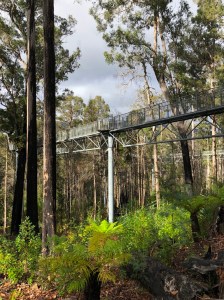
Tahune Adventures AirWalk

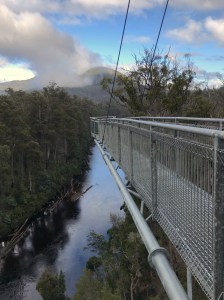
Imagine walking among some of the tallest trees on earth, not at ground level but in the lower canopy high above the forest floor – and still straining to see the top of the trees. That is exactly what you can do at Tahune Adventure’s AirWalk deep in the Southern Tasmanian Wilderness.

Among the Ancient Giants

Tahune Adventures AirWalk

Tahune Adventures is surrounded by the southern hemisphere’s tallest forests and one of the few places where the famous ancient Huon pines and giant Mountain Ash trees grow together. Unlike the Mountain Ash the Huon Pine requires a permanent source of water and is more usually found near rivers as is the case here, and, appropriately, it is the Huon River.

Walking the Walk

The AirWalk is a 600-metre elevated walkway 30-metres above the mosses and bracken of the forest floor and high among the trees giving close-up views of Myrtle and Leatherwood and the trunks of the giant Mountain Ash. The AirWalk culminates in a cantilevered platform 50-metres above the Huon River.

AirWalk Cantilever

Far more sturdy than you would expect, the walkway gives excellent views of the confluence of the Huon and Picton rivers as well as the number of ancient trees gathered along the river banks swept downstream during successive flood events.

Forest Fire

Something unfortunate, however, makes this place quite unique and that is the effect of a major fire that took place in 2019. Much of the ground cover was destroyed through to the Huon River and a number of the giants seriously damaged, some later felled for safety. This means the view of the trees and surrounds are far less obscured and new growth, in all shades of green, can be clearly seen.

Fallen Giant

The AirWalk received some damage during the fire and, along with several of the walks around the area, access was restricted for many months while safety inspections took place. The only sign of damage now visible is the charred bark of many of the trees contrasting with the recently replanted landscaping around the visitor centre and the 104-steps leading to the start of the AirWalk.

Swinging Bridge

In addition to the AirWalk two additional walks allow exploration of the forest. The Huon Pine Walk gives the opportunity to see, touch and smell these ancient trees along the short 20-minute loop. The 3km Swinging Bridges Walk offers more of a challenge. Rope bridges here provide a safe but swinging crossing of both the Huon and Picton rivers. Far less stable than the AirWalk platform it is only a few metres above each of the rivers.

And there’s more

There are two additional activities here; River Rafting and the Eagle Hang Gliding experience that glides 400-metres from the treetops across the Huon river. No experience is required – the hang glider is suspended by wire similar to a flying fox ride.

Drive with care

Being in the wilderness it is not too surprising that this location is quite remote. Access is via a sealed but winding road and a 30-minute drive from Geeveston, the nearest town. This is a logging road and great care should be taken when logging trucks are active.

For more information including booking details check the Tahune Adventures website.

Land of the Giants

You just can’t get enough of tall trees in this part of the world. If your neck has recovered from craning skywards after visiting the majestic tall trees in The Tarkine and Mount Field National Park, prepare yourself for the real giants here at Styx Tall Trees Conservation Area.

Finally Protected from Felling… for now

A long and bitter campaign by the Wilderness Society and Greenpeace to stop the continued felling of native trees within the conservation area was, thankfully, successful and in 2013 part of the Styx valley, where the largest and most ancient trees still grow, was added to the Tasmanian Wilderness World Heritage Area. However, successive Tasmanian governments have worked hard to reverse this hard fought protection for the benefit, not of mankind but the forestry industry.

Not ‘coincidentally’ the government agency ‘Forestry Tasmania’, trying to show its new, environmentally friendly concern for the ancient forests, has renamed itself ‘Sustainable Timber Tasmania’.

The ‘Bigger Tree’ – Tasmanian Mountain Ash

Remote Access

There are several walks within Styx Tall Trees Conservation area – none of them too challenging, but getting here we’d recommend a 4-WD or a car that you don’t mind receiving a few scratches here and there, possible punctures, wrecked shock-absorbers and a good coating of mud.

The turn-off from Gordon River Road leads to the 18km stretch of Styx Road, which is unsealed, winding and with plenty of potholes to navigate, as are possible fallen trees. Although Tasmania Parks & Wildlife Service does make regular inspections the road is actually maintained by the logging companies.

It should be noted that this is a remote location and there is no mobile phone reception. So be prepared in case of an emergency, leave a note to inform someone of your planned walk and expected return time and carry a snake/spider bite kit.

Styx Tall Trees Walk

The start of this walk is close to the signpost announcing you have arrived in the Big Tree Forest Reserve. A small area suitable for parking is available and gives the easiest access to see the ‘Big Trees’.

Eucalyptus regnans – 90-metres and still growing

A 1km loop over mostly flat ground. A partial board walk takes you past an enormous felled giant Mountain Ash tree (Eucalyptus regnans) covered in moss, as are most of the trees on this walk. The Mountain ash is the largest flowering plant in the world and by a long way – some exceeding 90-metres in height, a girth in excess of 20-metres and some more than 500-years old.

You will find some of the largest trees on this walk around the halfway point. Among them are two in particular, one named ‘The Big Tree’, being the tallest measured at that time but was later followed by one even taller and aptly named ‘The Bigger Tree’.

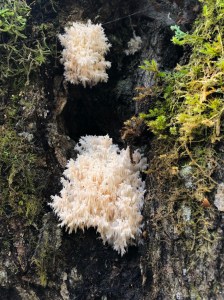
Lion’s Mane Fungi – Hericium Erinaceus

Among the decaying timber and ground cover of moss are many varieties of fungi and well worth a closer look as you follow the walk among ancient tree ferns. Keep an eye out too for several of the older trees that have some unusual fungi growing from them such as the Lion’s Mane mushroom.

Record Breakers

There is one tree further south, known as Centurion, that has reached the lofty height of 100.5-metres and continues to grow. It is the third tallest tree in the world and the tallest known hardwood tree on earth. It’s exact location has been kept quiet to protect it from trampling feet. Exceeded only by the giant Redwood Trees of the Californian coast of North America at 116-metres, the Mountain Ash is the tallest species of tree in the Southern Hemisphere.

Hygrocybe pseudograminicolor

Styx River Walk

Originally named ‘Sticks River’ by early settlers due to the jumble of fallen trees and branches obscuring views of the river, it was renamed ‘Styx River’ during an 1826-28 period of formalising names by the government.

The Styx River walk, though pleasant, is among less dense and less ancient growth leading down to the tumbling Styx River. Although several large Mountain Ash trees are visible on the track they are less impressive if you have already taken the Tall Trees Walk and less accessible to photograph. There is, however, a good undercover of Myrtle and tree ferns. It is a much drier walk underfoot but suitable footwear is still advisable, especially when wet.

Cortinarius metallicus

The Chapel Tree

Not the easiest Tree to find. The Chapel Tree is accessed 4km further along Styx Road from the Tall Trees Reserve where you then need to take a right turn and continue for a further kilometre to a fork in the road. Take the right fork and continue along the narrowing track for a final kilometre. From here look for a handmade sign pointing into the bush where a barely visible track leads. Follow the pink tape markers through bracken, low hanging branches and boulders placed among wetter patches and you’ll arrive at the Chapel Tree.

What makes this giant unique is the enormous base of the trunk. Years of decay has created an open cavity inside the trunk large enough, apparently, to hold fifteen people. It’s a brave person that stands inside the trunk of such an enormous tree knowing what is left of the tree’s decaying base is supporting such a staggering weight. But, of course, in the name of science adventure, I took a quick look.

The Chapel Tree

Hopefully being a little more remote, the Chapel Tree will be less visited and continue to grow for many, many more years.

If you are ever in this part of the Tasmanian Wilderness, this is a must visit to see some of the tallest trees in the world in their unspoilt habitat. Just don’t be off put by the few kilometres of destroyed forest that has been clear-felled as you drive along Styx Road into the Styx Valley.