Just 20-minutes by ferry from the Tasmanian mainland, Bruny Island is a wild and remote place with white sand beaches, turquoise water, magnificent sea cliffs and abundant wildlife. The island is marketed as a foodies paradise – so where’s the food?
Artisans
We had been greatly looking forward to our visit here following numerous TV travel and food shows highlighting the artisan cheese makers, bread bakers, wine makers, beer brewers, the artists, the writers and, of course, the unspoilt natural landscape. That list, however, didn’t include the tarmac road builders – much of the island’s roads are dirt roads, dusty when dry and muddy when wet.
The Neck
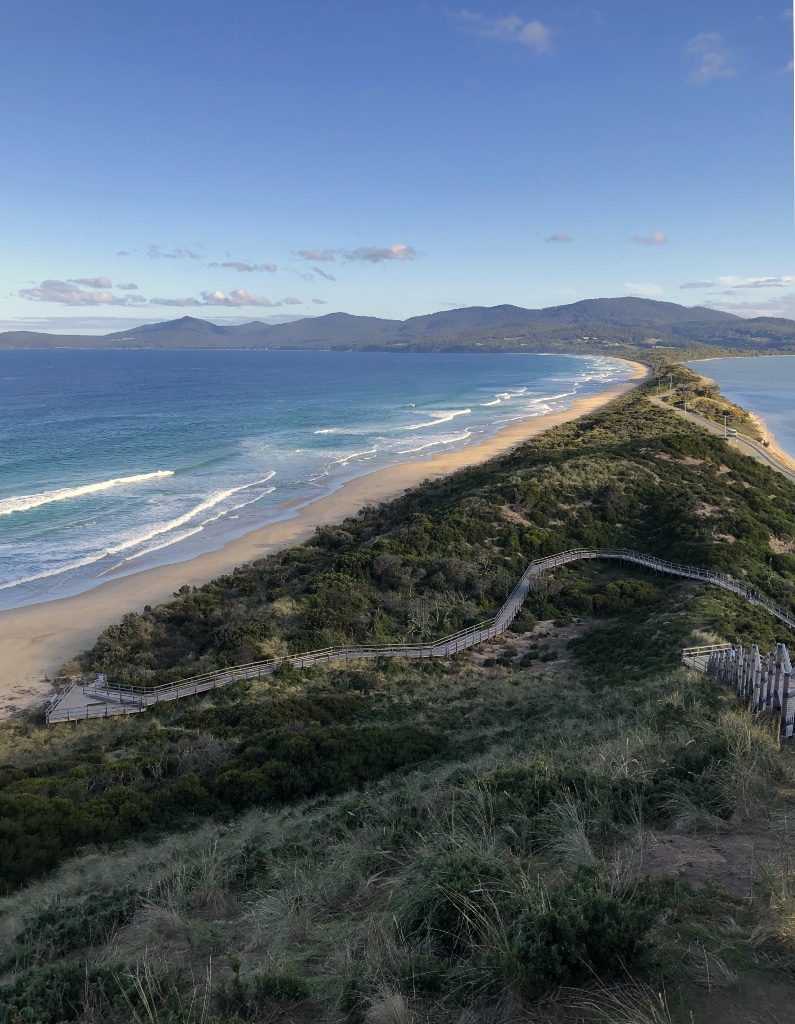
The island is split into two – the North and South Islands are linked by a very narrow isthmus known as the Bruny Island Neck. The majority of accommodation and activities are located on the South Island, which includes our caravan site at Adventure Bay.
Truganini Lookout
Giving views of both the north and south islands as well the Tasmanian mainland, Truganini Lookout sits above the middle of Bruny Island Neck. Reached by 279 timber steps, the lookout is named after the Aboriginal woman Truganini (1812-1876) reportedly the last full-blooded aboriginal person to die in Tasmania. Believing she was the last of her pure race, she once declared, ‘I know that when I die the Museum wants my body’.
Prior to her death in Hobart, Truganini pleaded to the authorities for a respectful burial and asked that her ashes be scattered in the D’Entrecasteaux Channel, a region of great significance to her people, fearing that her body would be mutilated for scientific purposes just as her late husband had been.
Contrary to her request she was buried at the old female penitentiary. Her remains were later exhumed by the Royal Society of Tasmania, which was authorised by the government to take possession of her skeleton. However, it was on condition that her remains were not to be exposed to public view but ‘decently deposited in a secure resting place accessible by special permission to scientific men for scientific purposes’.
Despite Truganini’s wishes and in violation of the government’s conditions, her remains were displayed in the Museum of Tasmania from 1904 to 1947. It wasn’t until 1974 that her wishes were finally honoured and her cremated remains were scattered in the D’Entrecasteaux Channel.
Her story is a sad one and highlights just how appallingly the Europeans treated the Aboriginal people of lunawanna-alonnah (Bruny Island). In memory of Truganini and the Nuenonne speaking people of the southeast, a cast bronze memorial was placed at the top of the lookout with a 360-degree view of what was rightfully their land.
Adventure Bay
To the east and south of the Neck is the sweeping Adventure Bay. It has more than a few connections with the famous early explorers and first off is Abel Tasman who first sighted the bay in 1642 and tried to make land in his ship the Heemskerck. Abel’s ship was driven back by an offshore storm but in memory of his attempted landing, Abel named the bay ‘Storm Bay’. In 1773 Captain Tobias Furneaux anchored in the bay for five days and took the opportunity to rename the bay ‘Adventure Bay’ after the name of his ship HMS Adventure. Furneaux had been sailing alongside Captain Cook’s ship, HMS Resolution on Cook’s second voyage in search of The Great Southern Land – Australia, when he became separated from Cook. Furneaux noted the bay was ideal for resupplying ships with fresh water, fish and timber from the giant gum trees.
In 1777 Cook, in his ship Resolution, stopped to take on fresh water and eleven years later the infamous Captain Bligh* moored in the bay to resupply HMS Bounty. Having survived the famed mutiny on the Bounty, Bligh once again stopped in 1792 to resupply his latest ship HMS Providence. And in 1798 Matthew Flinders tried without success to enter the bay in his ship ‘Norfolk’.
Taking advantage of the largely sheltered bay, Europeans soon began to arrive and setup several whaling stations and sawmills forming a fledgling timber industry.

Two Tree Point, which sits within Adventure bay, is still a source of fresh water and was used by Cook, Bligh and Furneaux to replenish their water supplies. Using the name of Cook’s ship, Bligh named the water source ‘Resolution Creek’. It is believed the two large eucalyptus trees that can be seen today are the same trees sighted in the late 1700’s and in a painting by Bligh’s 1792 Expedition’s Principal Artist, Lieutenant George Tobin.

Today Adventure Bay is a quiet tourist destination with access to several walks within South Bruny National Park, a well stocked general store, the Bligh Museum detailing Bligh’s association with the bay and Mary Bruny Cafe for a good coffee and great food.
Cheese and Beer
One of the few foodie retailers and artisans can be found at the Bruny Island Cheese Co. and Bruny Island Beer Co. both located at Great Bay. We tried the cheese tasting plate with three cheeses served with fresh crusty sourdough bread baked on-site and a delicious relish. Each cheese is hand made in the traditional way from the milk of their own cows in Huonville.
- O.D.O. – a simple curd cheese that is just One Day Old
- 1792 – a pungent washed rind aged on Huon pine – strong and smoky
- SAINT – a mild white mould cheese, our favourite
We didn’t try the beer tasting plate – it was tempting but we were still driving.
Bruny Island Chocolate Co.
Hidden behind a dense line of trees on Main Road at Alonnah, Bruny Island Chocolate Co. is a curious place. Hand made chocolates and fudge apparently made on-site but with no sign of any manufacturing, no tasting options and a clear preference to upsell by putting chocolates in decorated metal boxes and lining nearly every available shelf. By all appearances it is just a shop. We did buy a few covered bars and later discovered none of them were labeled.
And there’s More
There is a winery, a whisky distillery and the restaurant called Get Shucked on Bruny Island for those with a taste for Oysters. But we were expecting more for somewhere classed as a ‘foodies paradise’.
* The HMS Bounty was categorised by the Admiralty as a ‘Cutter’, the smallest form of warship, and as such it did not require the full rank of a post-Captain. Instead the ship and her crew were commanded by a Lieutenant, the only commissioned officer onboard, which meant Bligh was not the Captain of the Bounty as is often quoted. His conspirator and leader of the mutiny was acting-Lieutenant Fletcher Christian.
The ‘Cutter’ class of warship also did not require the usual attachment of Royal Marines whose role was to maintain order, a fact that Mr Christian clearly took advantage of.
 Discovery Down Under