The Humpbacks of Hervey Bay

It’s been a while since we hit the road with our caravan. So, following an amazing trip to Europe earlier this year, it was time to explore again, this time a little closer to home.

Just two hours drive north of us sits the expansive Hervey Bay, the annual stopover for the magnificent Humpback Whales after their long trip north from the Antarctic. Nestled between the Fraser Coast and the shelter of K’gari (Fraser Island) it provides the perfect resting place and training ground for newborn humpbacks as their mothers prepare them for long swim south to the colder waters of their feeding grounds. It’s also the ideal playground for the ‘teenagers’ to hang out as they learn new skills and develop relationships among the pods.

Whale Season

Living on the Sunshine Coast we regularly spot the humpbacks during the ‘Whale Season’ from July to October but for years we’ve been wanting to get a closer view. Having recently joined the local camera club now was the opportunity we had waited for with a group outing to the bay and an opportunity to get to know our fellow club members.

A quick visit to the Cistern Chapel

For those, like us, travelling north along Australia’s east coast, we would recommend taking a driving break in Maryborough just south of Hervey Bay. With its links to Mary Poppins it is worth an explore of some of its unusual and perhaps quirky experiences the town offers. I’ll just mention the public toilets in the Cistern Chapel as one such attraction. Trust me it’s worth a ‘visit’.

Fogged in

With the forecast weather looking grim for the weekend it appeared that conditions out in the bay weren’t going to be ideal but we were still likely to see the whales, though maybe not in the best light for a bunch of keen photographers. First light on Saturday morning confirmed the forecast. After days of blue skies we were now blanketed in a thick fog. Still, that wasn’t going to hold us back and by the time we arrived at the harbour the sun had burnt through the fog and things were looking up.

Finding a sheltered spot at the rear of the boat, we set-off only to be surrounded once more by fog. But it wasn’t long before we slowed and got our first sighting of a young whale ‘fin slapping’, though just too far off for a worthwhile photo. About 45-minutes later we arrived just off the northern tip of K’gari and with cameras at the ready, we waited. And then, as if pre-arranged, the fog lifted and the sun sparkled on the clear turquoise sea. This was looking much better. This was the weather we had hoped for.
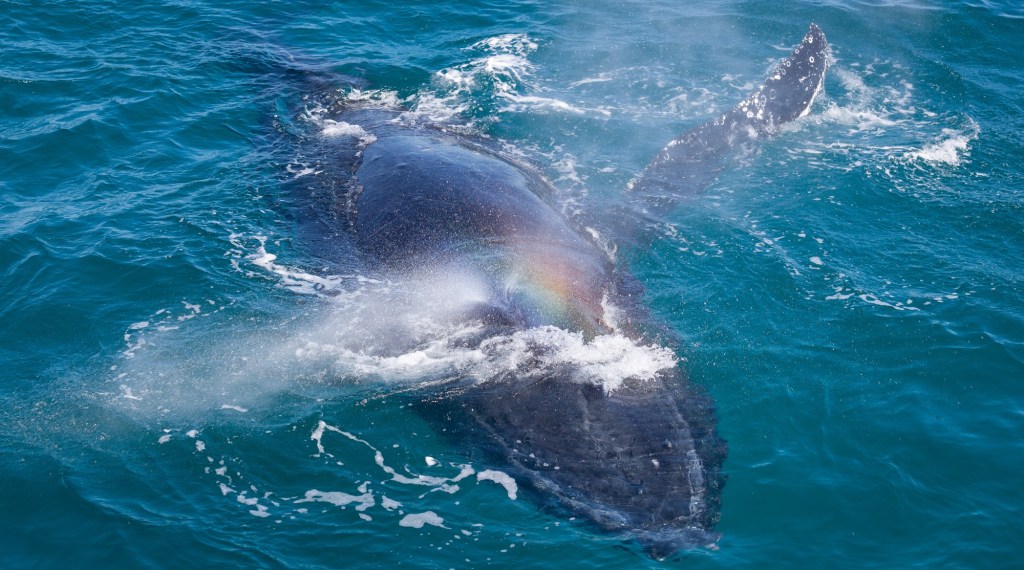
Approaching the boat

A sudden announcement on the ships’ speaker and everyone rushed over to the starboard side as three young humpbacks headed towards us. Whether out of curiosity or just enjoying an interaction, humpbacks are drawn to boats of all kinds. Certainly they appeared interested in our boat and gently cruised around from one side to the other and often diving and popping up with just their mouth above water. One whale appeared to interact by blowing bubbles each time one of the crew waved her arm in a circular motion. Whether the whales just see something interesting to play with or they’re being deliberately interactive, I guess we’ll never know.

We were treated by fin slaps, tail slaps and an intriguing creation of dead water, where the whales create a perfectly calm circle of water among the ripples of the ocean. Somehow it remains that way as it drifts along the surface. It is believed the technique allows the whales to see clearly without the distortion of the surface waves. We even got eye contact as one of the humpbacks rolled its body beside the boat. But this was just the start as more pods arrived for an inquisitive look. Such close interaction with so many whales is referred to as ‘mobbing’ and typical of humpbacks in their teenage years. We were certainly mobbed!

Eye Contact!

Listen Up

Briefly the captain stopped the engines and generator so a hydrophone could be dropped into the water to listen to the whales communicating. It is a haunting but beautiful sound and clearly indicated there were many more whales around than we could see. So many in fact that the spotters along the east coast had already observed 30,000 whales this season.

By now we should have been heading back to port but the whales had other ideas and seemed intent on hanging around a little longer. It did give us more time, though, to try and get that classic pre-dive raised tail photograph. Eventually, though, we had to make a move and slowly eased our way clear to head back 30-minutes later than we should. What an adventure and one we’ll never forget!! And I got the tail shot I was really hoping for!
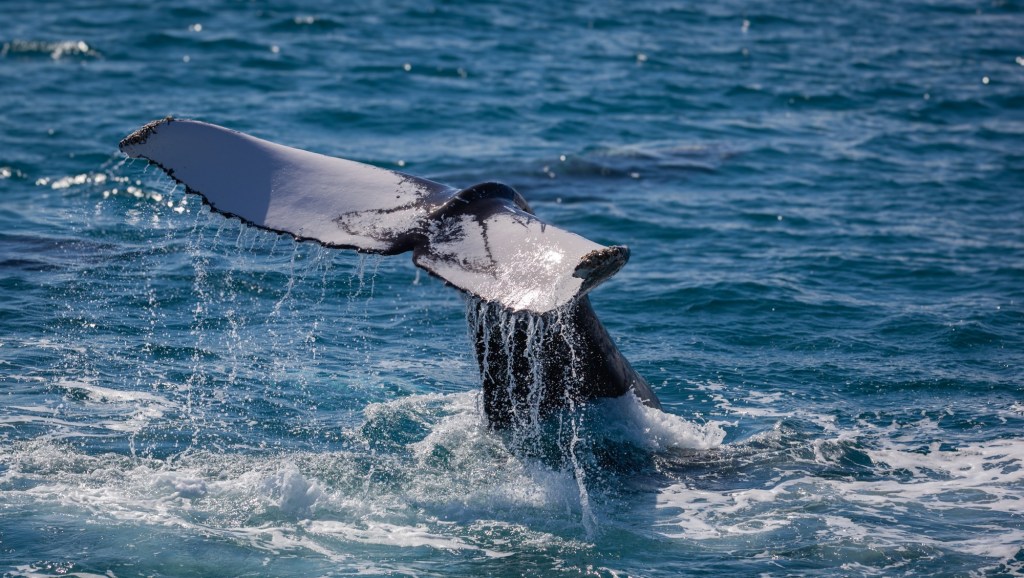
Tails up!

The arrival of the whales at Hervey Bay is celebrated each year and no doubt has been by the indigenous people of Australia for many thousands of years. Long may it continue.

For anyone wishing to book the same trip during the whale watching season we would highly recommend our hosts on their mid-sized custom-built ship Tasman Venture.

For keen photographers you’ll need more than a telephoto lens. The whales will approach right up to the boat and a wide-to-mid length zoom is required, unless you want to have close-up’s of the barnacles on the whale’s skin.

Mackay

Leaving Bowen and its near deserted beaches, we headed south once more between the ever present sugarcane fields and forested mountains to the port town of Mackay (pronounced ‘Mac eye’) our stop for the next two nights. It turned out to be a more entertaining drive than expected.

Mackay the sweet producer

As a casual observer you wouldn’t realise that Mackay is actually the centre of the Australian sugarcane industry and the largest sugar producer in Australia, but it is it’s coastal location and one of the world’s largest deep water bulk-handling facilities that allows Mackay to claim its title. The port allows Mackay to export approximately 700,000 tonnes each year of raw and refined sugar. Over 80% of the 3-4 million tonnes of sugar produced in Australia, year-on-year, is exported to countries throughout the world generating an annual income of $1.5 to $2.5 billion. And it’s not just sugar but also coal, grain, 90% of the country’s tomato crop grown in open fields and petroleum in the form of ethanol distilled from… you guessed it, sugar.

So where is everyone?

Now, with all this industrious activity you would expect Mackay to be quite a busy town. Well, we certainly did but even on a weekday the town was almost deserted. We had absolutely no idea where everyone was. The beaches were as deserted too with just the occasional couple walking their dog and a lonely fisherman casting a line hopefully into the surf. And this was peak tourist season. It was a mystery. Maybe the folks of Mackay are nocturnal?

Deserted Blacks Beach – Mackay

There was, however, some evidence of life judging by the numerous painted murals around town. Sixteen talented local and five visiting artists from around Queensland have turned a once less than desirable laneway into an outdoor gallery. Fifth Lane’s wall art won Australia’s ‘Best Street Art Laneway’ award in 2021 and that is quite an achievement when you consider how renown Melbourne is for street art. Bringing art into the digital world, seven of the artworks have adjacent QR codes to scan, which can trigger augmented reality experiences on mobile devices.

Green turtle – Fifth Lane
Anyone remember Spirograph?

Blacks Beach

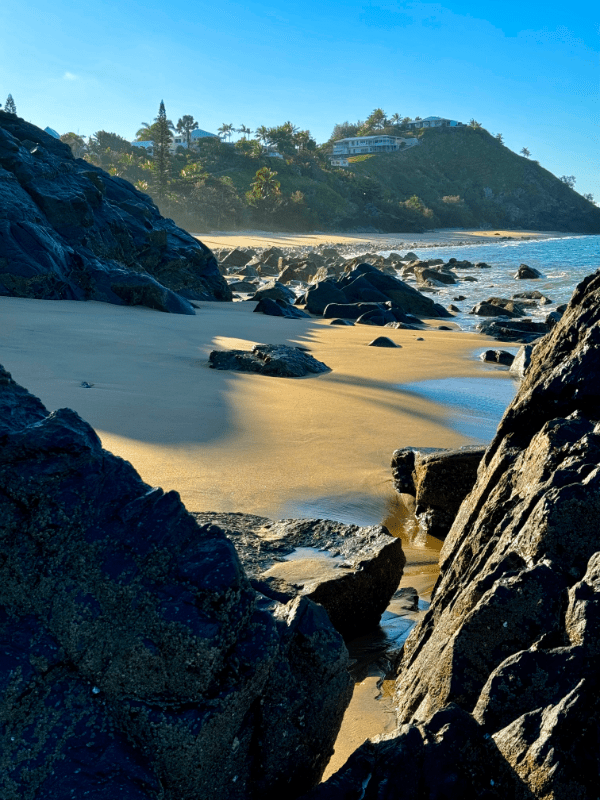
Our caravan site was located right beside Blacks Beach – a deserted, sweeping, shallow bay with cliffs rising to the north, black volcanic rocks running down to the surf and some impressive cliff-top properties looking out over the Coral Sea.

Volcanic rocks – Blacks Beach

Towards the south along the beach is a prominent water tower sitting on top of Slade Point. A closer look shows it hasn’t escaped the artist’s brush. Featuring several enormous humpback whales wrapped around the supporting base and another breaching under a pink sunset sky as a red tailed black cockatoo watches on.

Completed during 2019 by artists Scott Nagy and Cara Sanders (aka Owlet), the mural depicts the Humpback whale’s northward migration along the coast between June and August.

It is a very worthwhile short drive out of town but be courteous and bear in mind the local residents whose properties sit astride the tower and have to contend with all the visitors wanting a closer look. The road is sign posted as ‘Local Traffic Only’ presumably, and understandably, at the request of the affected residents. Access ends at the foot of the tower forming a turning circle with little space to park. From here a short walk makes its way down to a quiet but quite rocky beach.

Mackay Water Tower

Just a couple of hundred metres along the coastal road is Lamberts Lookout, which is a popular spot for whale watching during the migration season. Binoculars have thoughtfully been provided to bring the whales and the outlying Cumberland Islands closer in to view. There are onsite parking facilities available but on the busy day we visited none were free.

Safety is a priority… for some it seems

Travelling along the worsening state of the road known as the Bruce Highway is no fun – especially towing a large caravan. Always eager to get past caravans in the most dangerous places on the highway, and no doubt adding to the dreadful carnage this road is unfortunately known for, locals and tradies sit right on the back of your caravan constantly weaving in and out of view desperate to get a break in the oncoming traffic. Then, at an overtaking section, they’ll crawl past forcing you to brake hard as the merge point approaches. Just brainless, selfish idiots with no care for anyone else’s safety. Admittedly there are more than a few caravaners driving dangerously slow on the highway causing frustration and long tailbacks. These are the folks giving other caravan drivers a bad name.

Roger, copy that

Something all slower traffic should do, where safe, is to use the UHF radio to advise those behind that you’ll ease-off at the next overtaking section to let them pass safely. Usually you’ll receive an ‘Okay mate’, or, on occasion, nothing at all. Following behind us on our way south was a coach and a large Linfox truck and trailer. Being a considerate driver I put out a call to say I’ll ease-off shortly to let both vehicles pass. However, the driver of the coach responded, “no mate, you’re okay, you’re keeping up a good speed. Happy to follow behind”. Was that a compliment? Well that began an interesting conversation as we started to form a small convoy. Shortly after the Linfox truckie joined in and for many, many kilometres we chatted between the three of us, all very pleasant and lighthearted. Now ‘truckies’ tend to communicate in profanities interspersed with the occasional helpful warning of ‘slow traffic ahead’ or ‘cow on the road’… or both. And, admittedly the truckie did regularly drop the ‘F-bomb’… a lot actually, but it was enlightening to know more about what life on the road is really like from some of our country’s long distance drivers.

Eventually, though, it was time for us to part company as we left the Bruce Highway heading towards Mackay and exchanged thanks, ‘safe travels ahead’ and gave each other a friendly wave. It certainly made the long drive far more pleasant… and entertaining too.

Next stop Yeppoon as we continue our journey south.

Heart Reef

Our second day at Airlie Beach and it is an extra special one as we take to the air flying over two famous landmarks and the possibility of sighting whales.

Wasabi

Flying from Whitsunday Airport, just 8-minutes from Airlie Beach, our flying adventure is onboard the Australian designed and built GippsAero GA8 Airvan delightfully named ‘Wasabi’. Unlike commercial passenger planes, Wasabi is designed for short flights with maximum visibility for those onboard. Little legroom, noisy, a low ceiling and certainly no reclining seats on these flights but that just adds to the experience of the real sensation of flying in small aircraft – turbulence and all. As with all aircraft, though, safety is the priority and our pilot Sam took us through the emergency procedures including wearing and operating our life jackets as we were to fly over water.

Our aircraft – the eight-seater ‘Wasabi’

Turbulence

It should be noted that the location of the airfield in a narrow valley is known to experience strong and gusty winds and that was certainly the case as we took-off and made our first turn. It soon settled, though, as we headed out over water with great views along the coast to Airlie Beach and the islands that make up the Whitsundays.

Scenic flight route through the Whitsundays

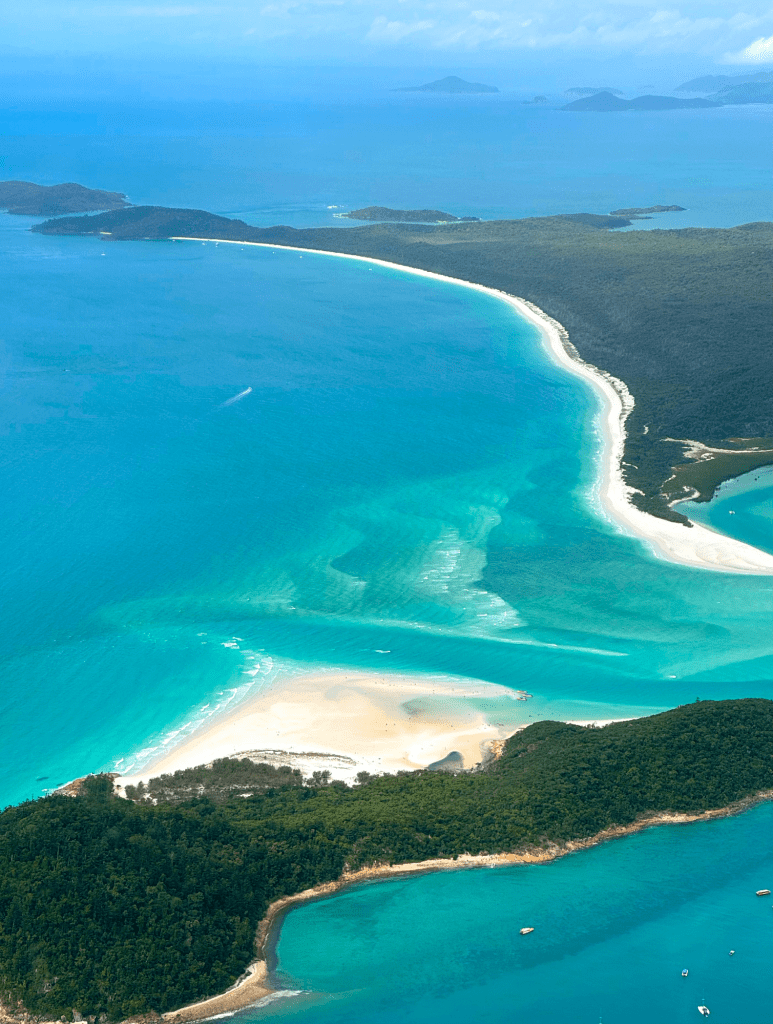
We were soon flying past Daydream Island and south along the tip of Long Island with the largest of the islands, Whitsunday, to our left. Then passing over Hamilton Island known amongst others riches for the famous Hamilton Island Race Week, which attracts ‘yachties ’ and spectators from all over the world. Next was one of the main sights we were looking forward to on this trip, Hill Inlet, surely amongst the most spectacular views in Australia if not the world. The weather wasn’t quite on our side, though, with some low cloud and rain in the distance but it was expected to clear further off the coast.

Hill Inlet from 2000ft with Hamilton Island just beyond

Throughout the flight Sam gave us a comprehensive commentary about the European’s first discovery of the Whitsundays and the Ngaro people’s 9,000-year history of the region. The Ngaro, also known as the ‘Canoe people’, travelled between the islands using sturdy canoes made from lengths of Ironbark timber held together by fibrous roots. In addition to the myriad forms of tropical reef fish calling the waters of the Whitsundays home, sharks, manta rays, stingrays, dolphins, migrating humpback whales and Dugongs* can also be sighted. The dugongs take advantage of the sea grasses that grow around the islands and protected marine parks.

Whitehaven Beach

A very popular day trip from Airlie Beach is the 7KM long Whitehaven Beach. Known for its 98% pure silica bead sand, which has the advantage of staying cool even on hot sunny days and so fine it can be used as a polish.

The sweeping Whitehaven Beach

It can get busy at times and especially during peak season when multiple day trips coincide. However, with such a long beach it’s easy to find a patch of your own to just sit and watch the gentle lapping waves and remind yourself what a magnificent place you are experiencing.

Whales!

Our flight continued further out to sea and we were now spotting numerous humpback whales breaching and ‘fin slapping’, several appearing to be mother and newborns. It wasn’t that long ago that the hunting of whales had reduced the humpback population to the low hundreds. Now protected, recent observations show a dramatic increase and it is now believed 30-40,000 humpbacks populate the migration route between the Antarctic and far north Queensland.

Over the Reef

Five minutes later, just as the sun appeared through light cloud, we were flying over the inner reef and dropping to 500ft tracking the most stunning coral formations surrounded by clear turquoise-blue water.

The inner Great Barrier Reef

Then came a countdown from Sam with cameras ready as we were about to fly low over our target – the perfectly descriptive Heart Reef. First sighted in the 1980’s the reef has become the emblem of the Whitsundays and is now probably the most photographed coral formation in the world. And finally, there it was.

Heart Reef

Not wanting to miss getting the photograph during our fleeting path over the reef I opted to record video and grabbed the best frame. To ensure passengers on both sides of the plane got a good view Sam did a second pass in the opposite direction.

Climbing once again we headed back to the airport spotting further migrating whales along the way. Final approach to the runway presents just as much of a challenge as takeoff and sitting right behind our pilot it was clear just how much counteracting the gusty wind was required to bring the plane safely onto the runway.

A fantastic trip and scenery we will never forget. The highlight of our trip… so far.

For more information and booking options, checkout Ocean Rafting Scenic Flights

*Also known as Sea Cows or Manatees in other countries.