Eighty Mile Beach

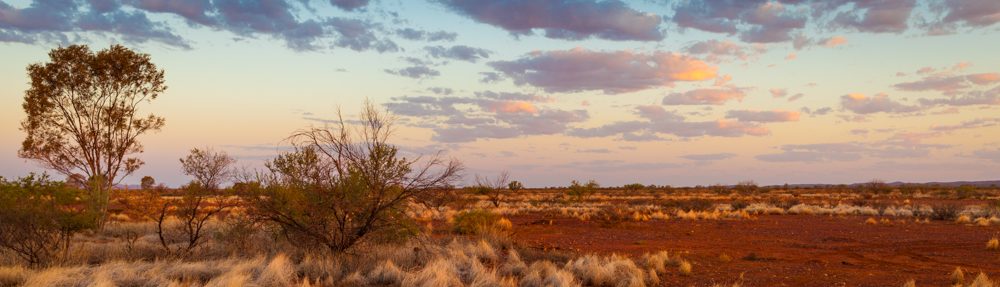
We were not quite sure what Eighty Mile Beach had in store for us other than a 9KM dirt access road. Sandy and quite heavily rutted at that but it’s something we’re becoming accustomed too up here in the Kimberley along with all the red dust.

Several narrow gates protect the livestock from drifting onto the highway, which means someone, ie. Catherine needs to jump into the dust to hold the gate open as I drive carefully through. Several raised ridges covering underground pipes also need negotiating… s l o w l y. As we were braking for one of the ridges an alarming grating sound from under the car made itself noticed. And then again at the next one. No obvious reason why – we had the suspension set for high-clearance, which would easily take the front of the car clear of any obstacles, which there weren’t. It hasn’t occurred since but we have since discovered a scrape on the underside plastic trim.

The last push of the road brings you to the top of a hill and all of a sudden on went the brakes. Sat right before us was the most incredible view. Not just green grass, which we hadn’t seen for a while, but the most perfectly coloured ocean. Deep blue in the distance and vivid turquoise towards the brilliant white beach fringed with palm trees. We decided right then and there that we liked this place… a lot.

Parking our caravan wasn’t the easiest experience, our allocated site was too small really and a large hump by the roadway meant unhitching required the full extension of the air suspension to free the car from the van. Still, we were parked close to our good friends, which meant Happy Hour was always close by. We were all eager to see the ocean up close, which was accessed by a very sturdy raised deck and steps complete with seats and a tiered stand. Clearly this was a popular spot to watch the setting sun.

Shell spotting

As for the beach, we don’t think we’ve ever seen so many shells. The majority of the ‘sand’ is crushed shells, which get finer as you walk closer to the water until it becomes almost powder. It’s this very fine sand and and shallow water that is responsible for the stunning colours we saw as we first took sight of the ocean.

The beach is a native turtle breeding ground and access along the shore by 4WD vehicles is soon to be blocked to prevent the sand from being compacted by the heavy vehicles. Not only do the newly hatched turtles struggle to break through the hard sand but they also struggle to climb over the ridges created by tyres.

Someday in the future we would love to return to watch the hatchlings make their way to the beach. Actually we’d be happy to return at any time.

Eighty Miles?

The beach continues on for many miles in both directions, expectedly 80-miles in total but no. It was originally named Ninety Mile Beach but that title had already been claimed by a beach in South Australia. And so through no sense of logic whatsoever it was changed to Eighty Mile Beach. Clever eh? Well, no again – if you would care to measure it, it is actually 140-miles long!

Beach Fishing

Sharing the very high tides of the North Western shoreline, Eighty Mile Beach is a big draw for fishermen on the fast rising incoming tides. All along the beach you will sea fishing rods casting beyond the waves for whatever comes along.
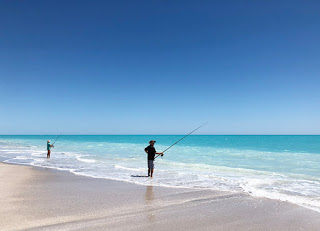
Fishing for lunch

While we were there Blue Nose Salmon appeared to be quite popular, a tasty white-fleshed fish with its eyes located further forward than looks natural. Our friends spent several days feeding them before eventually snagging one for dinner.

Shark!!


A small shark made its way onto the beach but closer inspection showed it had a large chunk of it chewed away by something much larger than itself.

Stoke’s sea snake

And a Stoke’s sea snake washed up and struggling to get back to the water. We kept well clear, apparently they are one of the grumpiest of sea snakes. And then there were all the birds; kites, oyster catchers, plovers, terns, crested pigeons – the place was alive. Only one thing missing though, and very gladly – rubbish. Not a single bit of waste anywhere along the beach, it truly is pristine.

Whale Spotting

On one of our days wandering along the beach watching all the fishermen I happened to mention to Catherine that I hadn’t yet seen any whales or dolphins. And then, at that second, I spotted a giant splash as a huge Humpback lifted itself halfway out of the water and crashed back into the ocean. And then another and another. And not to be outdone along swam a pod of dolphins through the waves. I still can’t believe it now, they must have heard me. They even appeared in the right order!

Hot afternoons were the perfect time to visit the well-stocked camp shop/cafe for an ice cream as we chatted about the fish that got away and later, during Happy Hour, tales of the ones that got away. Actually Happy Hour wasn’t strictly 60-minutes but would last until our crisps and cheese and biscuits, beer or wine ran out. In Derby where there was little else to do it could be stretched several hours or more.

Happy Hour – just watching the sunset

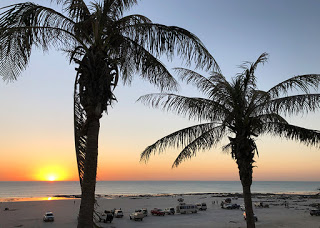
Just as fishing is a highly popular activity here, so too is watching the sunset into the Indian Ocean from the tiered seats overlooking the bay. And if that coincides with Happy Hour, as it did for us, often, then all the better.

There is so much more we could describe about this wonderful place but you really have to be here to see it and experience it for yourself. It is one of our most favourite destinations on our Big Lap so far. We’ll be sad when we head out on the dirt road again but will stop to take one last look of that stunning ocean view before heading off towards our next adventure.

Barn Hill Station

We’re taking a break from the road for a couple of nights at Barn Hill Station Stay, situated within the 500,000-acre Thangoo Station and providing access to 50KM of pristine coastline.

Access to Barn Hill is via a signed 9KM dirt road from the Great Northern Highway and 132KM southwest of Broome. Suitable for most 2WD and all 4WD vehicles and caravans/campervans though be prepared for a few bumps along the way… and plenty of dust during the dry season.

At the end of the dirt road is a small oasis with grass, large trees, the camp kitchen and shop, a bowling green and a ramp down to the beach. As we arrived at the end of August much of the grass was dry with a good covering of leaf litter but the grass around the entertaining area still showed signs of life.

Coffee and Cakes!

For those camping off-grid coffee is available from the shop along with Barn Hill’s fresh homemade speciality – Vanilla Slice. Get in early though it sells out quickly. Pies and pizzas made to order can also be purchased.

Red Cliff – Barn Hill Station

There’s little chance of being hemmed-in here with wide, open sites though watch out for the low-laying tyres marking out the road – they’re easily caught while manoeuvring. Be aware also of the wildlife. Snakes are active in the area and best to keep to the marked pathways.

Loo with a View

The facilities can best be described as rustic in a charming way. Mostly open-air toilets and showers allow you to view the Milky Way at night while enjoying a cooling breeze – at least during the dry season. During the wet season you could combine both activities!

Beach access is just a couple of hundred metres away over a low sand dune with views stretching to the horizon right along the coast. On the beach heading northeast is a small cliff comprised of bright orange rusted sandstone peppered with quartzite which glows in the setting sun. And continuing on an easy twenty minute stroll takes you to a series of towering weathered pinnacles, which are well worth exploring.

Pinnacles – just along the beach

Such is the size of the station’s coastline you could literally walk all day and still be on their property with hardly anyone in sight.

There’s plenty to do here without Internet access: talking with each other, walking, swimming, snorkelling, fishing, exploring the red cliffs or just relaxing and watching the sun set over the Indian Ocean during Happy Hour.

For more information contact: Barn Hill Station

Broome – Mind the Camels

After not having a lot to say about Derby, Broome is a complete contrast – alive, thriving and comfortably welcoming.

We are staying at the RAC Cable Beach Holiday Park, one of two caravan parks with the same Cable Beach name. Ours is right across the road from the sand dunes leading to the enormous beach that seems to stretch in either direction to the distant horizon.

Broome is divided into distinct regions of industrial, local trades and the main shopping and cafe area – all divided right down the middle by the International airport. It’s very common to be sitting enjoying a peaceful coffee as a seaplane, helicopter or jet airliner swoops just a hundred feet overhead. But, surprisingly, it’s not noisy. The aircraft traverse so quickly from the sea approach that you only hear and see just a brief passage. The only slight annoyance is the larger helicopters that ferry the oil rig workers to their platform out at sea early in the morning.

Broome was built to service the pearl industry but not quite as expected, at least by us. For many years the mother of pearl from the oyster shell was the chief export used for jewellery and decoration but mostly for buttons. The pearl itself was extremely rare with just one in ten thousand oysters containing the gem and naturally grown they were seldom the smooth round pearl of favour. Even so Broome was at the heart of the industry with a large Chinese workforce, which is evidenced today by China Town – Broome’s shopping and cafe centre, which still has that oriental feel.

Broome’s reliance on mother of pearl was hit by a downturn in the market as other forms of button materials such as plastics, took hold. But as we will later explain, the pearl industry was about to change thanks to the Japanese, the very same country that attacked Broome repeatedly during the Second World War.

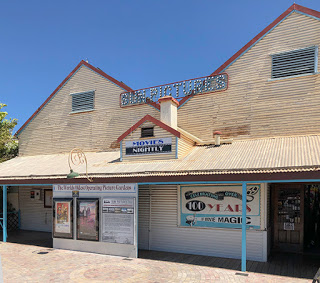
The town is home to the Sun Pictures cinema first opened in 1916 and the oldest, still operating, open air cinema in the world. Situated on Carnarvon Street it continues its long tradition of deckchair seating. It’s worth a browse even if you don’t have a spare evening to watch one of the latest films. Just remember to take a light jacket or sweatshirt as it gets cool at night during the dry season… or an umbrella and waterproofs during the Wet!

Sun Pictures – Carnarvon Street

Also on Carnarvon Street is Broome Gallery and the studio of James Down. Here you will see some excellent, and highly amusing, acrylic paintings of the region and its wildlife. Bright bold colours is exactly what this part of the Kimberley is known for and equally reflected in James’ paintings.

In need of a coffee

If you are looking for a great location and a good eat then we heartily recommend the Dragonfly Cafe on Carnarvon Street. You can’t miss it’s corner location – it’s always busy. Great meals, cakes and good coffee too.

Markets

Broome hosts regular markets and the best by far is the Saturday market at the Old Court House, which also happened to be the terminal point for the first international undersea cable from Australia to Indonesia providing telegraphic communication with the rest of the world.

The market has plenty to see in the form of artworks but also coffee, tasty hot and cold food, fresh fruit and vegetables stalls.

One artist in particular stands out and that is Tom Montgomery and his stunning watercolour paintings of local birds and reptiles. The detail and life he puts into each painting is truly remarkable. So impressed were we that we bought two of his images to remind us of what the Kimberley has to offer.

Cable Beach

Broome’s Cable Beach stretches as far as the eye can see and is a highly popular spot to sit and watch the sun set over the Indian Ocean, walk or collect shells. In the early evening 4×4’s make their way along the beach to find the ideal spot for happy hour as the sun sinks below the horizon. But here you will also find another form of locomotion and a more natural one at that – camels.

Cable Beach – Happy Hour

Each day a team of camels takes tourists on a ride up and down the beach and with palm trees dotted along the sand dunes you could easily mistake this place for some distant Arabian desert. Australia, surprisingly, has the largest herd of camels in the world. There are so many that a control programme has been introduced to limit the numbers in an effort to reduce the damage to farmland. Some are captured and exported to Arabian countries, though their preference for what are known as ‘pretty’ ones is a little, er… puzzling.

Camels on Cable Beach

Camels however are not a native to this country. They were brought into Australia from India, Arabia and Afghanistan and led by the Afghan camel teams who helped explore and open up the harsh territory of central Australia and transport goods and equipment to the teams building the overland telegraph line from Adelaide to Broome. Once the work was complete the camels were let loose and in the wild they just did what came naturally. Now their population is estimated at over a million and doubling every 8-9 years.

Prior to the camels, and by a long, long way – around 130-million years ago – were dinosaurs when this region formed part of an ancient river estuary. Though hard to identify, Sauropod and Theropod tracks can be found in the Cable Beach sandstone slabs exposed at low tide. An identification and location chart is available from the Broome Information Centre.

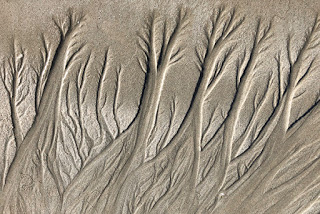
Sand Trees

As the tide goes out, unusual patterns appear on the beach – some caused by sand crabs but a more unusual one caused by channeling water as it drains down the shallow beach. The patterns resemble the Boab trees common in Western Australia.

Sand Trees – Cable Beach

Gantheaume Point

Further south is Gantheaume Point and it’s steel towered lighthouse. Just a short stroll along the pathway will have you looking at a view that resembles the surface of planet Mars. The iron rich sandstone displays all the shades from deep red through yellow to orange. Giant slabs of rock mix with volcanic vents stained with sulphur and all backed by the turquoise Indian ocean. As a photographer you could spend hours here especially leading up to sunset.

Gantheaume Point

For those more interested in fauna than rocks and boulders, take a close look at the tower and you may get to see nesting Ospreys. And looking out to the ocean keep an eye out for whales and dolphins.

There is plenty to see and do in and around Broome and if you’re on a Big Lap like us it makes a great resting point before heading out into the wilderness of the Pilbara.

For more information, the staff of the Broome Tourist Information Centre opposite Woolworth’s are very helpful. Coffee available most days too!

Horizontal Falls

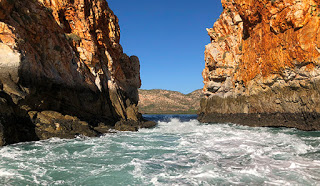
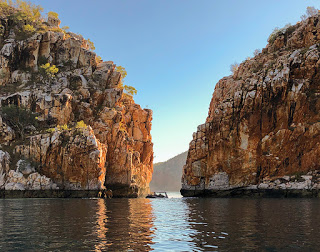
A curious name indeed for a pair of waterfalls. But then these aren’t quite your everyday, ordinary falls. Comprised entirely from saltwater, not only do they drop from sea level to sea level but they also flow in both directions – every six hours. You see, these waterfalls are tidal and the result of the second highest tides in the world.

Located in Talbot Bay in the Kimberley region of Western Australia, Horizontal Falls is a spectacular natural wonder created by the tidal sea being squeezed through narrow ravines between vertical rocky outcrops. And at high tide the result is a raging wall of water as much as 5-metres high… and we’re going to ride it!

Adventure calls

Our day started predictably early with a 5.30am pickup to get us to the nearby Broome Airport. Checked-in, weighed and safety briefed, we were boarding our Cessna 208 Caravan Seaplane and airborne just after 6am as the sun was starting to make an appearance and casting long shadows across the bush.

Early start at Broome Airport

We were lucky to be the last to board our plane and rewarded with the greatest legroom of the rear bench seat with clear views from each of the large windows. Climbing slowly to 9,500ft our one hour and thirty-minute flight took us northeast across the Dampier Peninsula with few signs of life among a seemingly endless and flat wooded landscape. Only a few long and dead-straight dirt roads gave any indication of habitation. This was a place where the inexperienced adventurer would very quickly disappear.

Ben, our pilot, pointed out features of the landscape, the location of our last stop of Derby in King Sound and a little of the history of the region. And before long we were over the milky blue waters of the Timor sea and among the islands of the Buccaneer Archipelago islands turning east for an overpass of the Horizontal Falls in Talbot bay. From above the whirlpools and churning water created by the falls don’t appear that dramatic but we were soon to find, on the surface, things are very, very different.

Buccaneer Archipelago

A smooth water landing took us to the Horizontal Falls Pontoon where our next adventure would depart. And following a brief refreshment we were strapping-on our life jackets and taking our seat at the front of the Full Throttle boat skippered by Christo.

Four enormous outboard motors developing a combined 1,200-horsepower gave an indication of what we were to expect, but what an underestimation that was about to be. Just after we stepped from our plane onto the pontoon, one of the other seaplanes was having a race along Talbot Bay with a second boat and the boat was winning.

After a gentle push from the pontoon the engines were let loose giving a huge kick in the back and were still nowhere near full throttle. I had the DJI OSMO Pocket in my hand as we approached the first of the two falls surrounded by angry, frothing, swirling water pushing the boat left and right. That was until the engines were set free and we launched headlong into the rush of water squeezing through the 20-metre wide channel and straight into the 1.5-metre wall of water trying to hold us back.

Horizontal Falls – a 1.5-metre vertical wall of water

No words can adequately describe the experience, the power of the water or the relief when we got to the other side. It is an enormous adrenaline rush and we had only just started.

Expecting to head straight to the second and narrower fall was soon countered as the engines raced, turned us through 180-degrees and launched us straight back through the falls, this time literally flying over the drop and landing hard into the churning water.

A short wait for a second boat to pass through and we were heading for the wall of water again. This time we continued straight to the next fall and with some careful manoeuvring we propelled through the narrower 7.5-metre channel with an even more dramatic push through the raging water. What a rush! And then we turned around spraying water everywhere and raced through again in the opposite direction, and then once more for good measure.

Horizontal Falls – 7.5-metre wide channel

We turned and headed back one final time and over to the first fall expecting one last ride before returning to the pontoon for breakfast. But after a couple of photo opportunities we were off again through the wider falls a couple of times before, finally heading back. What an absolutely amazing experience!

Feeding Time

A welcome breakfast of egg and bacon rolls, baked beans and mushrooms onboard the pontoon and it was still only 8am. It was then time for another feeding but this time it was sharks that were being fed and Catherine was going to be in the water right next to them.

Feeding Time with Sharks

We had seen a couple of large sharks circling the pontoon earlier but as soon as our guide jumped into his feeding six sharks appeared as if on queue along with lightning fast Travelly. These are wild Tawny Nurse sharks with over 200-teeth, very poor eyesight but equipped with an amazing sense of touch and smell.

Rather than tear its prey apart, these sharks have huge muscles around the head that allows them to suck prey into their disproportionately small mouths. They are also unique among sharks in that they can pump water through their gills while stationary allowing them sleep settled on the seabed. They aren’t the only sharks in Talbot Bay though, Bull sharks and Tiger sharks are also present and one of the reasons people in the water are protected by an open cage while the sharks are being fed. Cyclone Bay Time for boarding Full Throttle again but at a slower pace as we headed to nearby Cyclone Bay, a small bay surrounded by high hills, which provides shelter for boats, the floating Horizontal Falls hotel and the pontoon during the wet season. Just around the corner are some dramatic rock formations of King Leopald Sandstone, clays and conglomerates deeply contorted by the enormous geological pressure created as the Kimberley region pushed into the Western Australia land mass some 600-million years ago.

Saltwater Crocodile at Poulton Creek

Following the path of the Poulton Creek we spotted a 3-metre Saltwater Crocodile swimming along, which didn’t seem too bothered with us circling it briefly. If that wasn’t enough we had more adventure ahead of us as we turned back towards the pontoon and another blast through both of the falls… several times! And as a demonstration of just how powerful these boats were we entered the fall backwards this time against the current while Christo held our position as the water raged beneath us at 20-knots before the huge motors launched us again through the wall of water.

Could this day get any better? Well, yes and it did.

That’s me – in the front seat!

All Aboard

Returning to the pontoon we handed in our life-jackets and were waiting to board our plane when Ben, our pilot, called out, “Richard, jump into the front with me”. I had been invited to sit in the co-pilot’s seat with the best view on the aircraft and what a view it was as we took to the air on a 30-minute flight towards the north of the Dampier Peninsula. Despite being a little ‘bumpy’ at times as we crossed land, the view was amazing. You don’t get much of a forward view at the front with the cockpit instruments but you do get the best view to the side of any seat on the aircraft and you get to see just how much work is involved in flying the Cessna Caravan. And, of course, you get to have a chat with the pilot. Just hoping he doesn’t have a blackout and I have to land this thing!

Our flight turned steeply around and landed on a dirt runway that didn’t look anywhere near level… or long enough.  And there we were, surrounded by nothing but trees, red soil and silence.

Touchdown on a dirt strip

It was eerily quiet as we waited for our 4WD bus pickup to take us to our next location a short distance away.
What an experience this has been! It’s not a cheap trip by any means but you will always regret giving this one a miss if you happen to find yourself nearby. Half and full day adventures from Broome or Derby.
More details from Horizontal Falls Seaplane Adventures.

Cape Leveque

A site of significant importance to the local aboriginal people, Cape Leveque is a place of seemingly staggering beauty. Bright red cliffs fringed with white sand and an azure blue sea combine to make this location one of the most stunning natural sights you’ll ever see.

The spectacular cliffs of Cape Leveque

Cape Leveque has been on our must see list since we started planning our Big Lap of Australia. It is very remote and accessible only by 4WD vehicles or aircraft, which means it is off the day-trippers list, for now, and the beach remains crowd free. It is, however, possible to camp here or ‘Glamp’ for those in need of more creature comforts, and the reward is the evening sun setting on the cliffs causing them to glow even more than our early afternoon visit.

This is definitely a place to return to in the future. Sadly our time here was limited giving time only for a few photographs before heading further south this time on a larger 4WD bus to take in some additional passengers.

Cape Leveque Cliffs

It would be the perfect spot for an aerial photograph but yet again there was an airfield within 5.5KM preventing drone flights above 100-grammes. This has been a source of frustration for months but understandable for safety reasons when airfields are often sited next to such remote locations.

Punishing dirt road

Our drive back towards Broome was on 95KM of temporary dirt road while the main dirt ‘highway’ was being rebuilt in advance of the next wet season. Fortunately I managed to sleep through much of it with the exception of a brief diversion at Beagle Bay to visit the Sacred Heart Church, internally decorated with inlaid mother-of-pearl.

It had been a long day (12-hours door to door) but the highlight of our trip around Australia to date.Expensive for sure but worth every cent. A huge adrenaline rush on the falls, stunning scenery at Cape Leveque, sharks a plenty, a salty crocodile and two seaplane flights over the Buccaneer Archipelago. Wow. And to top off the day, drinks with great friends as we watch the sun set into the Indian Ocean.

That is going to take some beating… but then we’ve only just started our Western Australia coastal journey.