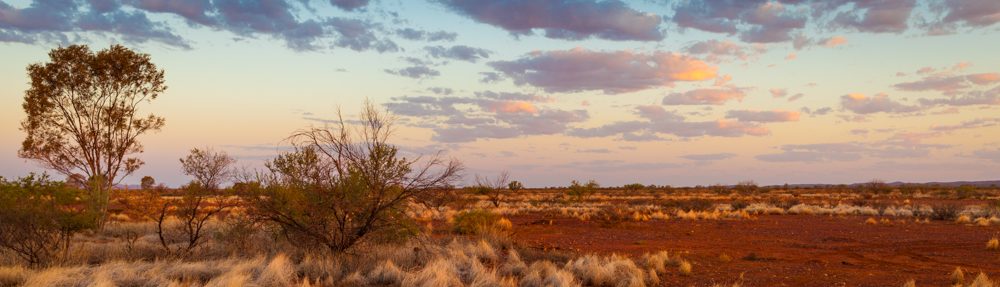
Being a major grain supplier to the world means Western Australia, South Australia, Victoria, New South Wales and Queensland are littered with giant grain silos. Highly visible from the road and railways and a feature of the Wheatbelt, these bland concrete structures are in need of a makeover. Time then to get the paints out.
The Silo Art Trail
After 3-months in Tasmania we’re back on the Mainland and on the trail of Silo Art. We saw our first painted grain silo back in 2017 on an edition of Australia’s TV show MasterChef. The show’s contestants faced the challenge of cooking outdoors for invited diners beneath a giant mural painted on Brim’s grain silo in country Victoria.
It started in the West
What began as a series of painted silos at CBH Northam Grain Terminal in Western Australia in 2015 soon started a trend attracting Australian and international artists to create these immense works of art across the country. And it wasn’t long before communities and regional councils realised the potential of attracting tourists to their small towns putting them on the map as a destination rather than a town to pass through on the way to somewhere else. And there began the Silo Art Trail.
Back on the Trail
During our Big Lap of Australia in 2019 we stopped at many of Western Australia’s Silo Art locations as we headed south and again after crossing the Nullarbor into South Australia. A family emergency overseas meant we had to skip the many silos of Victoria but now, heading back from Tasmania to our home in Queensland has given us the opportunity to visit many of Victoria’s silos, two in New South Wales and one in Queensland.
Silo Art – Victoria
Horsham – Although not the first silo to be painted in Victoria, Horsham Silo was the first on our trail. Painted by artist Sam Bates (aka ‘Smug’) in May 2022, it depicts the western Victorian aboriginal man, Yanggendyinanyuk, who was one of a team of 13 indigenous cricket players who formed the first Australian cricket team to tour England.

To the left of the silo, and partly obscured by a steel fence, is another highly detailed mural by Sam Bates, this time of a Red-Tailed Black Cockatoo. Many people were unaware of the second mural and so Sam returned to paint the wall in front of the silo in May 2023 to link both murals together while giving the visitor a rare close-up view of the stunning detail of the artwork.
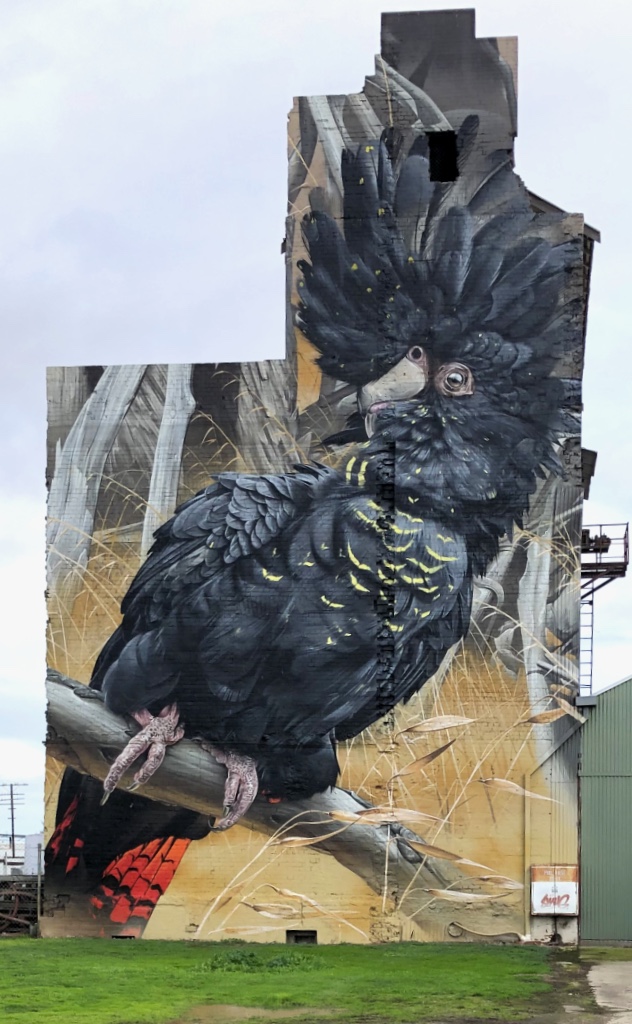
Murtoa – Better known for the incredible Stick Shed, Murtoa has also received the painted silo treatment by Sam Bates. Situated in the town adjacent to the railway line and a series of rusting silos, Sam’s artwork has to compete with the graffiti decorated rail cars. The painting highlights 29 species of bird that can be found in the Mallee region and a radiant bird said to represent the one in 30 Australians who experience a Bipolar condition.

Rupanyup – Next stop on the trail travelling northwards is the twin silos at Rupanyup. Here a convenient visitor shelter has been constructed opposite the silos detailing the many crops grown in the region.

Created by Russian artist Julia Volchkova in 2017, Rupanyup’s twin silo artwork features local residents and sports members, Ebony Baker and Jordan Weidemann.
Sheep Hills – One of the more remotely located but accessible silos is the GrainCorp Silos at Sheep Hills. Painted by mural artist Matt Adnate in 2016, it features Wergaia Elder, Uncle Ron Marks and Wotobaluk Elder, Auntie Regina Hood, looking toward the two young indigenous children, Savanah Marks and Curtly McDonald.

What sets these silos apart are the vibrant colours Matt chose, the detail in the children’s faces and the deep violet of the sunset blending into the deep-black star-trail sky.
Brim – Completed in January 2016 by Australian mural artist Guido van Helten. The GrainCorp silo in the township of Brim was the first silo to be painted in Victoria and only the second to be painted in Australia. It marked the beginning of the silo art trail of Victoria.
The murals depict four hardy, weather-beaten farmers who share the typical resilience needed to farm in the Wimmera Mallee region.

Guido, a talented mural artist, had been looking for a silo to paint and, working with the help of Juddy Roller Art Management, the owners GrainCorp and the Brim Active Community Group, Guido got the go ahead to create a mural on Brim’s silo. But the weather made the task far from easy with extreme heat, strong winds, a dust storm and lightning. Guido often took a break during the afternoons to escape the worst of the heat before returning to continue during the cooler evenings.

Rosebery – Created by Melbourne artist ‘Kaff-eine’ and completed in 2017, the Rosebery Silos are said to depict the region’s past, present and future. The left silo shows the future with the stylishly dressed young female sheep farmer wearing turned-down cowgirl boots, jeans and cotton work shirt. By contrast the right silo displays the current and the past with a contemporary horseman dressed in an Akubra hat, Bog boots and oilskin vest.
Lascelles – Another of the monochromatic style murals, this time in the settlement of Lascelles 26KM northeast of Hopetoun. Painted by Melbourne-based artist, Rone and completed in mid-2017. Deliberately using muted colours similar to the existing concrete so as not to distract from the environment.
Local farming couple, Geoff and Merrilyn Horman were chosen as Rone’s subjects for their family’s four generations as local farmers in Lascelles. Pictured below is just one of the two images.
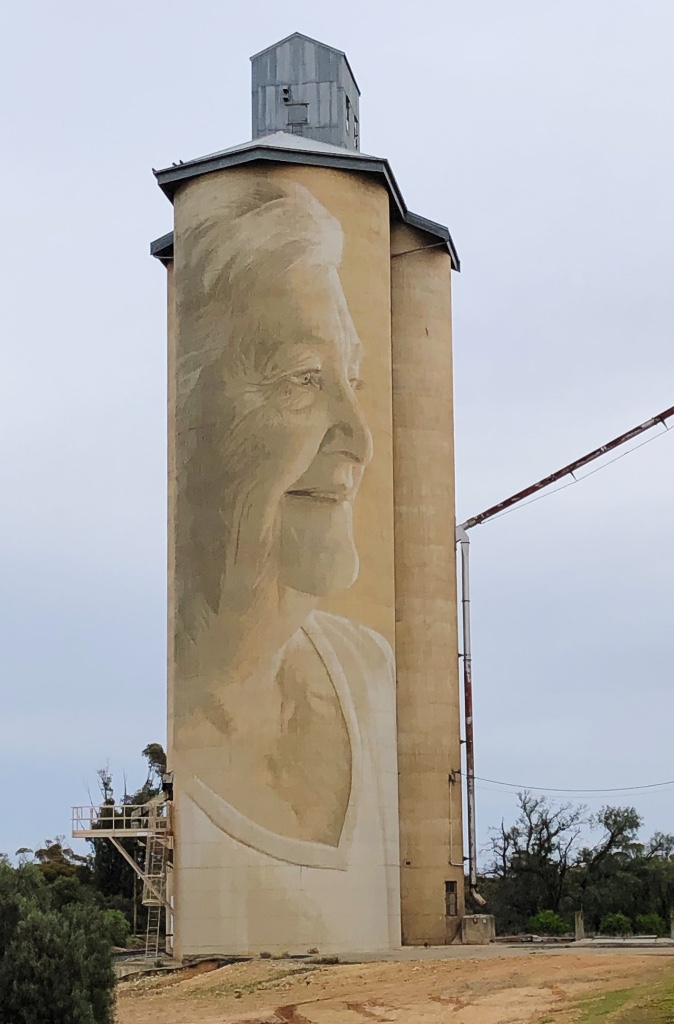
For photographers, access to the site is difficult due to private land and the adjacent railway.
Patchewollock – Another highly detailed mural featuring local character Nick ‘Noodle’ Hulland. Painted by Brisbane artist, Fontana Magee in 2016 who had spent time in the local pub looking for a suitable subject. According to Magee, Noodle was a rugged, no-nonsense and lanky character ideally suited to the narrow 35-metre twin silos. With his squinting gaze and sun-bleached hair, Noodle was a reflection of the harsh and challenging environment of the Wimmera Mallee.

Silo Art – New South Wales
Not to be outdone New South Wales has got in on the silo painting act too and has begun commissioning artists to paint both grain silos and water towers to entice tourists and passing trade in an effort to boost the local economies.
Weethalle – Artist ‘Heesco’ completed painting the silo in July 2017 as a tribute to the agricultural heritage of the small town of Weethalle and the surrounding communities of Bland Shire.
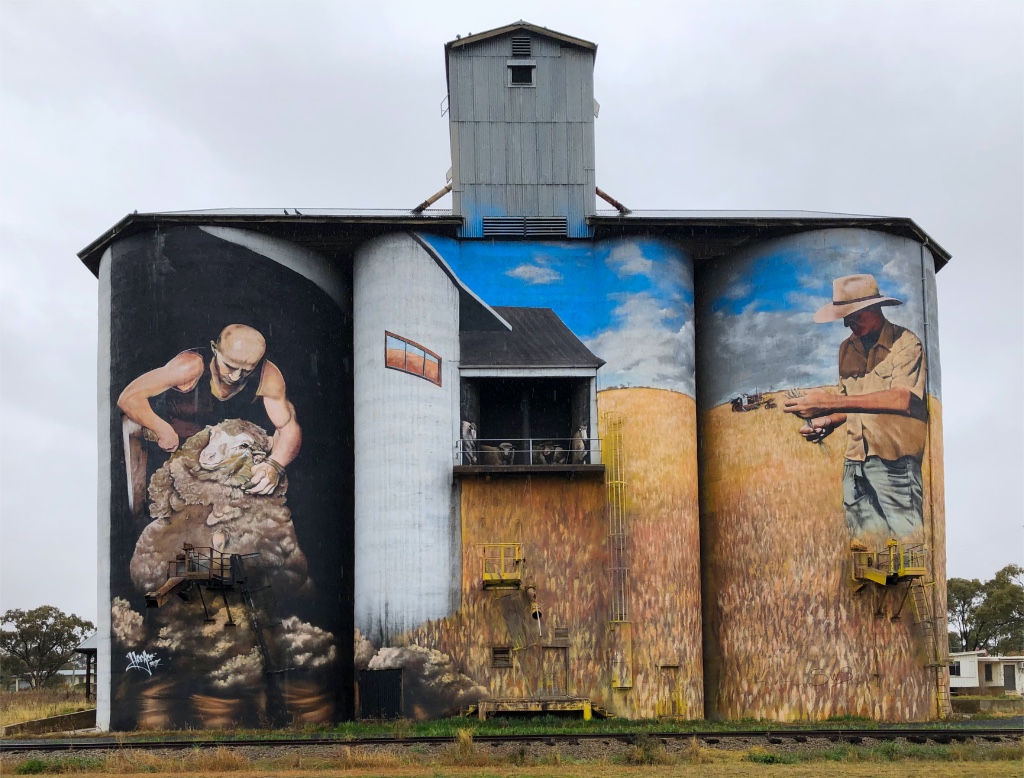
Depicting a typical farming community, Heesco’s image displays the annual task of shearing sheep, a farmer checking the grain readiness for harvest and, curiously, a small flock of sheep standing high on a balcony looking out and enjoying the view.
A dedicated car park with ample space for caravans has been provided to encourage passers-by to stop for a while.
Hay – Like many small country towns in Australia the First and Second World Wars took their toll on the young who took up arms to protect the nation and join the raging wars in Europe and the Pacific. In recognition and memory of those brave soldiers and nurses from the town of Hay in New South Wales, artist Matt Adnate was commissioned to paint five of the veterans from among the hundreds who answered the call. Those selected were Private William ‘George’ Cannon, Corporal Cliff Farlow, Private Norman Flack, Australian Army nurse, Lieutenant Lorna Margaret Whyte and indigenous soldier Private Victor George Murray. Display boards at the site tell the unique story of each of the individuals.

Although water towers and not silos, the towers form part of the Australian Silo Art Trail.
Silo Art – Queensland
Yelarbon – Closer to home and the last silo on our homeward bound trip. Another of GrainCorp’s silos and one of the largest groups of painted silos. Painted in two stages between 2018 and 2020 by artists Jordache Castillejos and Jordon Bruce from the artist collective, Brightsiders along with Steve Falco of ProcreatiV.

The mural is titled ‘ When the rain comes’ and depicts a young child sailing a paper boat as it crosses the nearby Yelarbon Lagoon and traverses the six smaller silos. The boat is said to have been made from old newspaper cuttings found in the town’s historic jail and symbolises the history of the region.
There’s more to come
There are many, many more painted silos across Australia and the number is set to continue in the years to come. To date we have visited just a small collection of what is surely the world’s largest outdoor gallery.




 Discovery Down Under