Bring on the Silo Art

Being a major grain supplier to the world means Western Australia, South Australia, Victoria, New South Wales and Queensland are littered with giant grain silos. Highly visible from the road and railways and a feature of the Wheatbelt, these bland concrete structures are in need of a makeover. Time then to get the paints out.

The Silo Art Trail

After 3-months in Tasmania we’re back on the Mainland and on the trail of Silo Art. We saw our first painted grain silo back in 2017 on an edition of Australia’s TV show MasterChef. The show’s contestants faced the challenge of cooking outdoors for invited diners beneath a giant mural painted on Brim’s grain silo in country Victoria.

It started in the West

What began as a series of painted silos at CBH Northam Grain Terminal in Western Australia in 2015 soon started a trend attracting Australian and international artists to create these immense works of art across the country. And it wasn’t long before communities and regional councils realised the potential of attracting tourists to their small towns putting them on the map as a destination rather than a town to pass through on the way to somewhere else. And there began the Silo Art Trail.

Back on the Trail

During our Big Lap of Australia in 2019 we stopped at many of Western Australia’s Silo Art locations as we headed south and again after crossing the Nullarbor into South Australia. A family emergency overseas meant we had to skip the many silos of Victoria but now, heading back from Tasmania to our home in Queensland has given us the opportunity to visit many of Victoria’s silos, two in New South Wales and one in Queensland.

Silo Art – Victoria

Horsham – Although not the first silo to be painted in Victoria, Horsham Silo was the first on our trail. Painted by artist Sam Bates (aka ‘Smug’) in May 2022, it depicts the western Victorian aboriginal man, Yanggendyinanyuk, who was one of a team of 13 indigenous cricket players who formed the first Australian cricket team to tour England.

Horsham Silo – Victoria

To the left of the silo, and partly obscured by a steel fence, is another highly detailed mural by Sam Bates, this time of a Red-Tailed Black Cockatoo. Many people were unaware of the second mural and so Sam returned to paint the wall in front of the silo in May 2023 to link both murals together while giving the visitor a rare close-up view of the stunning detail of the artwork.
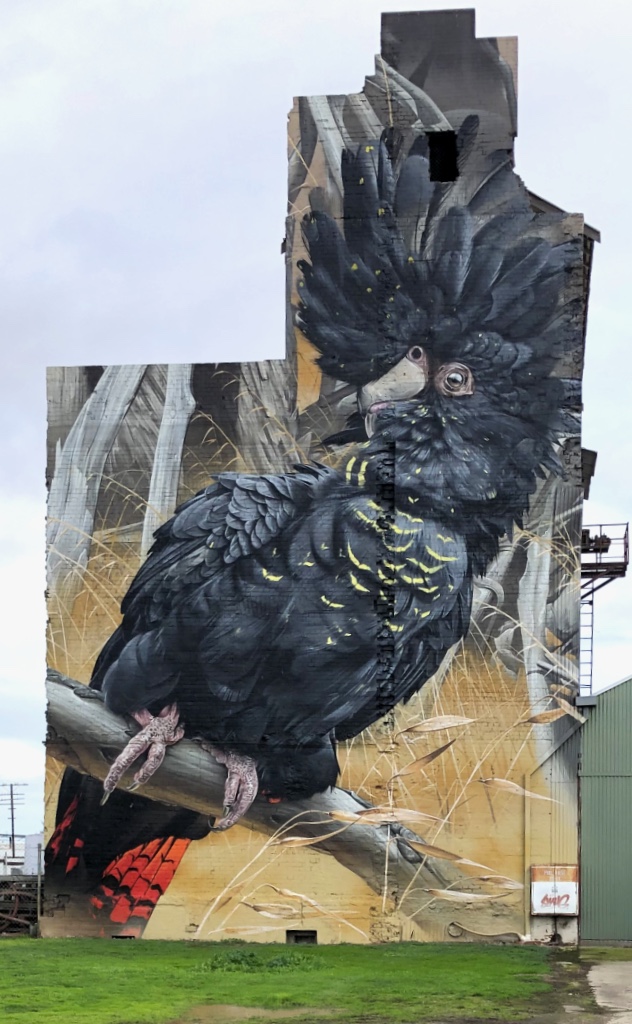
Red-tailed Black Cockatoo – Horsham

Murtoa – Better known for the incredible Stick Shed, Murtoa has also received the painted silo treatment by Sam Bates. Situated in the town adjacent to the railway line and a series of rusting silos, Sam’s artwork has to compete with the graffiti decorated rail cars. The painting highlights 29 species of bird that can be found in the Mallee region and a radiant bird said to represent the one in 30 Australians who experience a Bipolar condition.

Murtoa Silo by artist Sam Bates – aka ‘Smug’

Rupanyup – Next stop on the trail travelling northwards is the twin silos at Rupanyup. Here a convenient visitor shelter has been constructed opposite the silos detailing the many crops grown in the region.

Rupanyup Silo – Victoria

Created by Russian artist Julia Volchkova in 2017, Rupanyup’s twin silo artwork features local residents and sports members, Ebony Baker and Jordan Weidemann.

Sheep Hills One of the more remotely located but accessible silos is the GrainCorp Silos at Sheep Hills. Painted by mural artist Matt Adnate in 2016, it features Wergaia Elder, Uncle Ron Marks and Wotobaluk Elder, Auntie Regina Hood, looking toward the two young indigenous children, Savanah Marks and Curtly McDonald.

Sheep Hills Silo – Victoria

What sets these silos apart are the vibrant colours Matt chose, the detail in the children’s faces and the deep violet of the sunset blending into the deep-black star-trail sky.

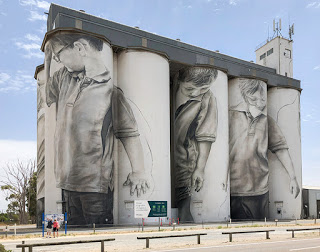
Brim – Completed in January 2016 by Australian mural artist Guido van Helten. The GrainCorp silo in the township of Brim was the first silo to be painted in Victoria and only the second to be painted in Australia. It marked the beginning of the silo art trail of Victoria.

The murals depict four hardy, weather-beaten farmers who share the typical resilience needed to farm in the Wimmera Mallee region.

Brim Silo – Victoria

Guido, a talented mural artist, had been looking for a silo to paint and, working with the help of Juddy Roller Art Management, the owners GrainCorp and the Brim Active Community Group, Guido got the go ahead to create a mural on Brim’s silo. But the weather made the task far from easy with extreme heat, strong winds, a dust storm and lightning. Guido often took a break during the afternoons to escape the worst of the heat before returning to continue during the cooler evenings.

Rosebery Silo – Victoria

Rosebery – Created by Melbourne artist ‘Kaff-eine’ and completed in 2017, the Rosebery Silos are said to depict the region’s past, present and future. The left silo shows the future with the stylishly dressed young female sheep farmer wearing turned-down cowgirl boots, jeans and cotton work shirt. By contrast the right silo displays the current and the past with a contemporary horseman dressed in an Akubra hat, Bog boots and oilskin vest.

Lascelles – Another of the monochromatic style murals, this time in the settlement of Lascelles 26KM northeast of Hopetoun. Painted by Melbourne-based artist, Rone and completed in mid-2017. Deliberately using muted colours similar to the existing concrete so as not to distract from the environment.

Local farming couple, Geoff and Merrilyn Horman were chosen as Rone’s subjects for their family’s four generations as local farmers in Lascelles. Pictured below is just one of the two images.
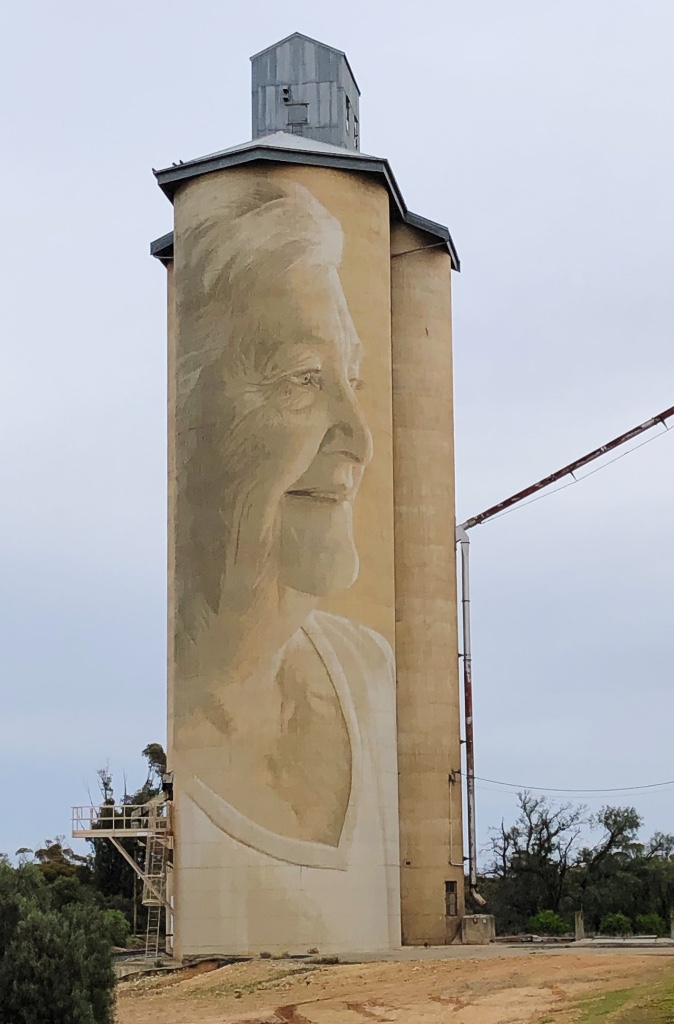
Lascelles Silo – Victoria

For photographers, access to the site is difficult due to private land and the adjacent railway.

Patchewollock – Another highly detailed mural featuring local character Nick ‘Noodle’ Hulland. Painted by Brisbane artist, Fontana Magee in 2016 who had spent time in the local pub looking for a suitable subject. According to Magee, Noodle was a rugged, no-nonsense and lanky character ideally suited to the narrow 35-metre twin silos. With his squinting gaze and sun-bleached hair, Noodle was a reflection of the harsh and challenging environment of the Wimmera Mallee.

Patchewollock – Victoria

Silo Art – New South Wales

Not to be outdone New South Wales has got in on the silo painting act too and has begun commissioning artists to paint both grain silos and water towers to entice tourists and passing trade in an effort to boost the local economies.

Weethalle – Artist ‘Heesco’ completed painting the silo in July 2017 as a tribute to the agricultural heritage of the small town of Weethalle and the surrounding communities of Bland Shire.
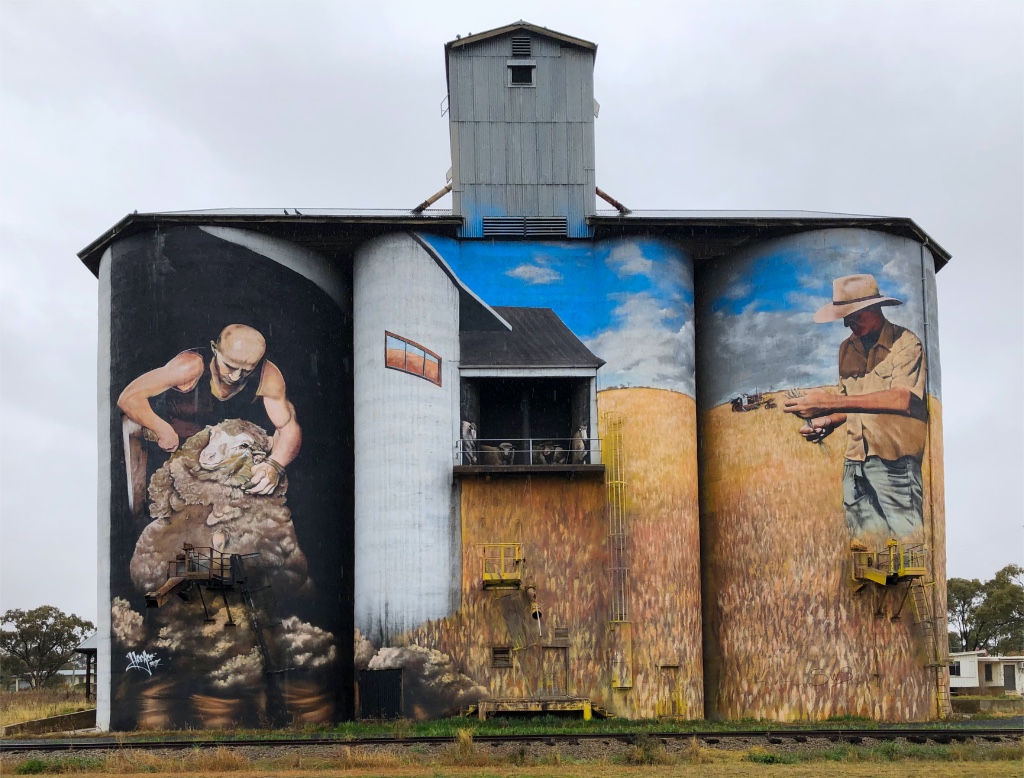
Weethalle Silo – New South Wales

Depicting a typical farming community, Heesco’s image displays the annual task of shearing sheep, a farmer checking the grain readiness for harvest and, curiously, a small flock of sheep standing high on a balcony looking out and enjoying the view.

A dedicated car park with ample space for caravans has been provided to encourage passers-by to stop for a while.

Hay – Like many small country towns in Australia the First and Second World Wars took their toll on the young who took up arms to protect the nation and join the raging wars in Europe and the Pacific. In recognition and memory of those brave soldiers and nurses from the town of Hay in New South Wales, artist Matt Adnate was commissioned to paint five of the veterans from among the hundreds who answered the call. Those selected were Private William ‘George’ Cannon, Corporal Cliff Farlow, Private Norman Flack, Australian Army nurse, Lieutenant Lorna Margaret Whyte and indigenous soldier Private Victor George Murray. Display boards at the site tell the unique story of each of the individuals.

Hay Water Towers – New South Wales

Although water towers and not silos, the towers form part of the Australian Silo Art Trail.

Silo Art – Queensland

Yelarbon – Closer to home and the last silo on our homeward bound trip. Another of GrainCorp’s silos and one of the largest groups of painted silos. Painted in two stages between 2018 and 2020 by artists Jordache Castillejos and Jordon Bruce from the artist collective, Brightsiders along with Steve Falco of ProcreatiV.

Yelarbon Silo – Queensland

The mural is titled ‘ When the rain comes’ and depicts a young child sailing a paper boat as it crosses the nearby Yelarbon Lagoon and traverses the six smaller silos. The boat is said to have been made from old newspaper cuttings found in the town’s historic jail and symbolises the history of the region.

There’s more to come

There are many, many more painted silos across Australia and the number is set to continue in the years to come. To date we have visited just a small collection of what is surely the world’s largest outdoor gallery.

Sinkholes and Volcanoes

Mount Gambier

Building upon the slopes of a dormant volcano is perhaps not the first location you would choose when establishing a new city but that is exactly where Mount Gambier in South Australia began. But it is there for one very good reason.

Vital to life in this hot and dry country is fresh water and Mount Gambier has it to excess. Mount Gambier is both a town and the name of the volcano from which it takes its name. Having last erupted approximately 5,000-years ago, the Mount Gambier volcano formed above a ‘hot spot’ in the earth’s crust with magma melting its way up through the limestone bedrock of the region’s Limestone Coast.

Blue Lake – Mount Gambier

Being porous, ground water was able to seep into the volcano’s magma channels resulting in steam driven explosive eruptions, a sight that was witnessed by the local Bungandidj aboriginal mob who named the volcano, Willum-a-weenth, meaning place of fire. The Bungandidj people of post volcanic activity often referred to the volcanoes as their ‘camp ovens’, which may have indicated the ground was still hot but they were fearful of rumbling sounds that they attributed to the ‘moaning bird spirit’ and left the area.

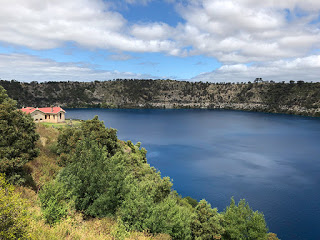
By the time the volcanic activity had ceased an enormous cinder and ash cone with a crater measuring over 1.6KM wide and 192-meters high had formed. But the volcano has one unique feature – the base of the crater sits below the water table resulting in a near permanent supply of fresh, limestone filtered water to a depth of 70-metres and containing approximately 36,000,000,000 litres.

The Blue Lake

The resulting lake, known as Blue Lake, is one of four formed by the volcano but by far the largest and most dramatic. It takes its name from the colour of the water that undergoes a change during the warmer summer months becoming a deep sky-blue but reverting to more of a grey during winter. In reality the water itself does not change but the presence of microscopic calcite crystals react with sunlight to diffract light entering the water, much like a prism, and reflect back to the viewer just the visible shades of blue.

Blue Lake and Pump House

Below the surface large freshwater stromatolites have been growing for tens of thousands of years before being discovered by divers researching the depths of the lake. These ancient life forms, normally found in shallow waters around the planet, are believed to be the originator of most of the oxygen present in the atmosphere of the early Earth.

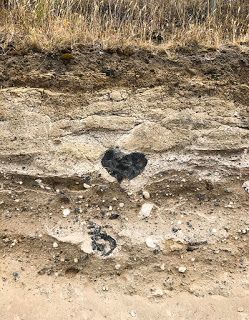
Far above the ground a footpath, and road, runs around the entire rim of the crater and is just as popular with locals exercising as it is for tourists taking in the view. In several places around the top of the crater the ash from the eruptions is clearly visible as are large chunks of solidified magma and limestone. Some rocks that were blasted clear of the crater weigh up to 20-tonnes.

Ash and volcanic bombs

Blue Lake is the primary source of water for the city and the very reason Mount Gambier was chosen as the early settlement. Currently 3,600 million litres of water are extracted each year and over the past 25-years the level of the lake has dropped by only 2-metres though water has been pumped from the lake since 1884. It has been calculated that the entire 36-billion litres of the lake is replaced on a cyclic basis by natural processes every 10-years.

A Sinking feeling

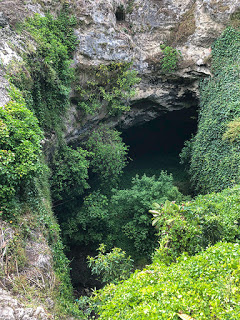
Mount Gambier, the city, is also home to another geologic process that has had a significant impact on the region. The limestone dissolving action of acidic water has produced many caves in the region some of which have collapsed forming large sinkholes – right in the middle of the city! Fortunately these sinkholes have been around longer than the founding of the city and are just two of a known fifty in the region…but how many more are yet to appear?

Both sinkholes became major attractions during Victorian times and, as was popular at the time, the sinkholes were ‘beautified’ with flower gardens. Both are impressive and highly unusual – especially considering their modern day location. This act of beautifying a natural feature of scientific importance would be considered gross vandalism these days and most probably illegal, but how much better is it for it? Would people still be drawn to a hole in the ground in the same numbers as present? I very much doubt it.

Cave Garden

Cave Garden

Situated just behind the City Hall, Cave Garden was once the original water source for the first settlers. During periods of rain a waterfall still forms providing a dramatic view as it descends into the remaining cave structure.

During our visit many of the flowers around the rim of the sinkhole were being removed as the spring flowers were dying back so it wasn’t at its best. From photographs that we have seen, autumn appears to be the most colourful time to visit.

A viewing platform overhanging the rim gives a good opportunity to peer down into the depths and each evening a light show projects Aboriginal Dreamtime stories on the wall of the sinkhole.

Umpherston Sinkhole

But the most spectacular is the huge Umpherston Sinkhole located opposite the Mount Gambier Visitor Information Centre. This sinkhole was made into a sunken garden by James Umpherston in 1886. A descending pathway and timber steps lead down through concealed viewpoints and among terraced gardens to reach the base where, originally, a small lake gave people the opportunity to view the gardens by row boat from a different angle. The water table has since dropped leaving the base of the sinkhole mostly dry.

Umpherston Sinkhole

Planted with hydrangeas, tree ferns and agapanthus, the walls of the sinkhole, though, are the most impressive being draped with hanging ivy. Sadly much of the grass between the terraces was well trodden despite notices to KEEP OFF THE GRASS.

As we visited the sinkhole was full of people enjoying the warm weather, which made taking a decent photograph tricky. Fortunately there was plenty of greenery to hide people behind.

During the evenings people gather to feed the resident possums that come out of hiding for an easy feed.

A tough climb

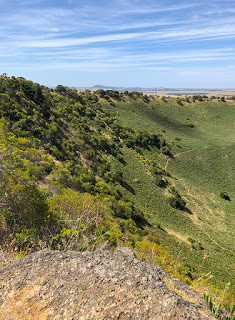
18KM south of Mount Gambier and visible from Mount Gambier’s volcanic rim is a second significant volcano named Mount Schank standing 158-metres high from base to rim. This volcano has had far less human intervention with just a very narrow and exposed path running around the rim of the cone. For those steady on their feet there is a weaving path that drops down to the centre of the volcano’s base allowing further exploration.

Mount Schank Crater

There is, however, one very noticeable work of skilled hands. Leading from just above the parking area to the top of the cone are 1,035 limestone steps. Unusual in their placement, they certainly make the very steep climb up and down the volcano safer and gives good footing to admire the impressive views across the surrounding plains. It is not a walk for the unfit or unsteady, and it is tough going, but the view from the top looking down into the crater is every bit worth the hard slog.

Make sure to take plenty of water especially if you plan to add the drop into the crater part of your experience here.

Where’s the Coffee?

As anyone following our adventure will know, we can often be found exploring the best coffee shops we can find and Mount Gambier has one of the best we have experienced since our trip began in April 2019. The Metro Bakery on Commercial Street is an interestingly quirky place with its Steampunk wall art but it serves an excellent latte and the cakes are an equal to anything you would see in the best French Patisserie. Hot meals, snacks and even a bar is provided for those of a less sugary taste. Very highly recommended!

Coonalpyn Silo

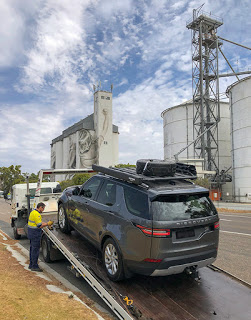
Our plan today was to head 220KM south from Adelaide on the Prince’s Highway for an overnight stop at the town of Keith. This was our first move back on the road since our Christmas break in Adelaide but our Land Rover Discovery 5 car had other plans and we now find ourselves back in Adelaide.

Here we go… again!

Oh, not again!

We had managed to drive 120KM south and just overtaking a very slow moving car and caravan when the engine decided to go into ‘Performance Restricted’ mode… again. It couldn’t have picked a worse place – in an overtaking lane with vehicles behind us and oncoming traffic not far ahead. The only thing we could do was hope the car didn’t slow down too quickly so we could try and pull off from the road.

Fortunately we had built-up just enough speed to continue overtaking and move over onto a gravel strip. Almost certainly the same turbo valve issue that had caused us much grief the very first day we set-off on our Big Lap last April and from discussions with fellow Disco owners and a Land Rover technician – a known issue.

Towed again

So, we ended-up having both the caravan and car towed back to Adelaide and waiting on the Land Rover dealership to fix the issue once and for all. And this comes just days after the car had been serviced and the valve issue notified to them. Full marks to our tow assistant, though, who not only got us safely back to Adelaide but managed to reverse our caravan back onto the site – uphill, at an angle and with the car still onboard.

Coonalpyn Silo

By coincidence…

However, all was not lost. The small roadside town of Coonalpyn, where we had waited to be towed, just happened to be the place we had intended to stop on the way to Keith for a break from driving and for a coffee and bite to eat at the Silo Cafe.

Not by chance the Silo Cafe is located directly opposite the silos and a good spot to take a photograph without having to cross the busy road.

The cafe was certainly a good choice having just been extended and serving excellent coffee too. Highly recommended and very friendly staff.

Coonalpyn Silo

In the same way that many country towns are choosing to paint their local grain silos to attract passing trade, Coonalpyn took the decision following the double financial hardship of the millennium drought and the global financial crisis of 2007/8. And it appears to be paying-off with the Silo Cafe at least, which opened in March 2017 on completion of the artwork and has just opened its latest extension to the property.

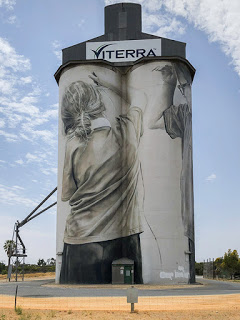
The silo painting is unusual in being black and white in an amazing hand-drawn style. It looks almost as if drawn with charcoal or pastel but on a gigantic scale.

Painted by artist Guido van Helten using 200 cans of spray paint, it depicts five local primary school children but, instead of more typical portraits, it has been created with a sense of movement as if the children are interacting and exploring their way around the silos.

Looking to the future

Guido designed the artwork under the banner of ‘Hope for the Future’. It is hope for the future of these young children and the hoped for rejuvenation of the town.

Guido’s still painting

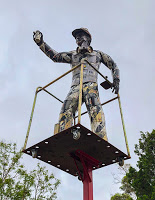
Just across the road and next to the Silo Cafe is a statue easy to miss and more so if you don’t look upwards.

Guido still at work

Using many of the LoopColour spray paint cans, Guido himself has been turned into a work of art and stands raised on a platform as if still painting the silos. It’s a pity he hasn’t been placed in a more prominent location closer to the silos.

Warribara Silo Art

As we’ve mentioned more than once before, small towns around Australia are creating something of interest or unique to attract passing trade in the hope they will spend some money and help the local community. Times are tough right now and no more so than in our farming regions suffering from an extended drought. So what better way than create works of art on some of the largest buildings that’ll you’ll see dominating the countryside – giant grain silos.

Wirrabara Silos

And so, with local government investment from Mount Remarkable District Council, the town of Warribara in South Australia commissioned a Silo Art painting by Australian born artist Smug (aka Sam Bates). It is by far the most impressive we’ve seen so far on our journey around the country. This was Sam’s first silo painting having earlier made his name as a wall mural artist. He now lives in Glasgow, Scotland and is creating quite a stir with his stunning, photo-realistic paintings throughout Europe.

Like several we have seen to date, a car park and a safe viewing area have been constructed. With travellers in mind too the car park is big enough to handle those like ourselves that are towing caravans.
Smug’s Warribara Silo shows amazing detail from the creases in the farmer’s skin, the texture in his shirt and the intricate delicate feathers of the Robin. Bearing in mind these silos are 28-metres tall, nearly all the work was carried out from a cherry-picker platform and painted entirely by hand over a three week period.

Aerial view

Though it was a little windy on the day we visited the silo we were able to take a photograph from our drone to get a better angle on the painting. Wide-angle lenses make tall buildings appear to tilt backwards but the drone can hover half-way up the silo and show the structure as it really appears.

Wirrabara Silo by Drone

And there’s more

There are plenty more silos, water towers and street art to see and the list keeps growing – currently 35 silos alone. Whenever we now pass by a plain white silo we usually comment ‘that one needs painting’.

We’d highly recommend adding a Silo Art Trail to your travels wherever you area around Australia. There are several websites listing the trails and locations. The best we have found so far is: Australian Silo Art Trail Check it out, you won’t be disappointed.

Kimba Silo Art

Another one of our stops along the Silo Art Trail and our Big Lap of Australia brings us to the Yorke Peninsula town of Kimba sitting as it does at the midway point between the East and West coasts of Australia. So what better place for another Silo Art painting.

Kimba Silo art

Kimba Silo

Australian artist Cam Scale certainly lives up to his name with this colossal painting stretching 60-metres across five and a half silos and reaching 25-metres skywards. The image of a young girl standing in a wheat field known simply as ‘Nelly’ was completed in September 2017 and is Scales* first silo painting. His latest silo painting in Devenish, South Australia, is an ANZAC tribute to nurses of war past and present.

Unlike most of the Silo Art we have seen so far, Cam Scale uses a mix of hand brush painting along with an industrial scale aerosol spray gun.

Location

Although a viewing area has been created by the side of the highway it isn’t possible to get a clear view of the entire painting due to trees and shrubs. It’s even harder to get a good photograph from ground level and it’s clear from footprints that many people choose to stand on one of the tables the community has installed.

‘Nelly’ among the wheat fields

For anyone wanting to get the best possible photograph late afternoon is by far the best time. Any earlier and the sun is on the wrong side of the silos and the colours just seem muted in the shade.

It would have been good to use our drone’s camera to capture an image from a better viewpoint but the silo is too close to the road, buildings and the local Police Station! A decent viewing platform is definitely needed here.

Getting picky

Having seen several amazing paintings so far, one noticeable difference with the Kimba silos is the poor casting of the concrete when they were originally constructed leaving a pretty rough and uneven surface, which shows through the paint. We’re starting to get picky now!

If you happen to be waiting for the sun to move around or just happen to need a bite to eat or a great coffee, we can highly recommend Eileen’s Cafe just off the high street.

The Giant Galah

Flamin’ Galah’s

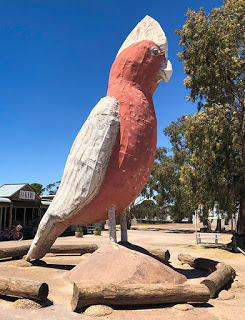
This isn’t Kimba’s first attempt to attract passing trade. Just across the railway line sits a rather oversized Galah. It looks as though it has seen better days but it joins the cast of many giants around Australia though their days may seem numbered now that Silo Art is the theme of the Wheatbelt towns in the southern regions of the country.

Halfway between here and there

The official halfway marker lays just beyond the silos and provides a large area to park and signboards to read about the early pioneers who traced a path across the country and ventured from Adelaide through the centre of Australia to Darwin.

* Cam Scale’s website shows many of his mural installations across Australia, which he has been creating since the year 2000.