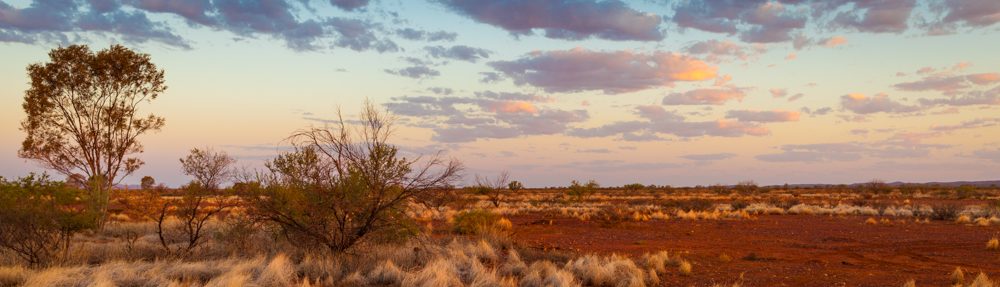
Our drive today takes us out of Emerald and 328KM further west into the Central Queensland Outback. We thought we had seen straight roads but these were something else. As far as the eye can see the road continues into the distance.

This is termite territory and all along the roadside and into the bush are termite mounds and some a little out of the ordinary. It appears a local pastime involves dressing termite mounds as if they are people sitting by the road. Maybe it’s the summer heat or something in the water? At least it gave us something to look at as we drove along.
Soon the trees and termites gave way to open fields and then tree covered mountains as we started the climb into the Drummond Range, which seems to go on forever. Just as we reached a crest another one appeared further on, and then another. A lookout provides a good view back along the range and gives an idea of how high we had already climbed. I also gave us a welcome break from the road and a chance to stretch our legs.

Finally reaching the top of the pass and before us a long, long, straight road downhill before levelling out to a flat plain. Gone was the greenery of the mountains to be replaced with dusty dry fields and cattle ranges. The only break in the road being a sweeping bend as we drove into the small town of Alpha and then more straight road before yet another sweeping bend but this time it marks the end of the Great Dividing Range that we have been crossing for many days. To the East of the Great Dividing Range, rain water runs towards the Coral Sea but falling to the West and it winds its way southwest to the seasonal Lake Eyre. Just beyond is the very small town of Jericho and on again, straight ahead for many more kilometres before another sweeping right and left bend for no apparent reason. Maybe the early settlers had drifted off or had a few too many the night before. Either way it helps keep you alert.
The controversial Cube
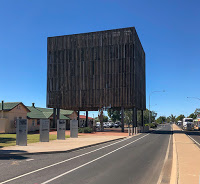
And finally in the distance was our stop for the next few nights – Barcaldine and what on earth is that beside the road? Called a monstrosity by some and a work of art by others, this is the Tree of Knowledge… or what’s left of it… and then some.
It all began long ago
In 1890 sheep shearers were being divided between union and non-union labour. The union were trying to prevent non-union staff working with those within the union. On January the 5th 1891 union members went on strike demanding protection of wages and workers rights. When non-union shearers continued to work, conflicts began leading almost to civil war in Barcaldine with the strikers taking up arms and building camps surrounding the town. The army was brought in to protect the working shearers and many strikers were arrested – some of who became politicians after release from jail.
The A.L.P
On May the 1st, while the strike was still in effect, a march of union members took place with 1340 men parading through Barcaldine. Within the same month the now penniless and hungry strikers realised the strike had failed. But witness to all the events was the Tree of Knowledge, which became a symbol to the strikers efforts for a fair deal. And from this small town the seed was sown for what is now the Australian Labour Party.
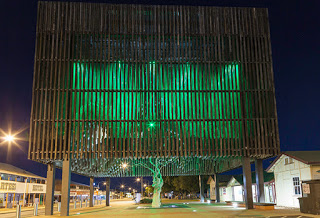
Having survived for more than a century in the harsh outback conditions, the tree was poisoned in 2006 by an unknown person. The dying tree was removed and sent to Brisbane to be preserved and when it returned, rather than build a simple shelter to protect the tree, the town went into overdrive and what resulted was a $5 million 18-metre square cube. But not just any cube, this one has a glass roof from which 3,600 timer beams have been strung to recreate the tree’s original canopy. Free to move in the breeze they also create a haunting sound. At night the ‘cube’ lights up to represent the green leaves of the canopy. And sat, suspended through a glass panel, are the preserved remains of the tree and its roots lit from below. It’s certainly a curiosity and if you get the chance it’s worth waiting until dark to take a photograph.
It may not be obvious at first but eventually you will catch-on that Barcaldine’s roads are all named after types of tree.



 Discovery Down Under