Digging up the Past

Today we’re heading for the high ground – something not so easy to do on the endless, flat plains surrounding Winton. But the exception here is a range of mesas that are composed of harder rock than the surrounding land leaving a chain of flat-topped hills almost 100-metres above the plains. We’re in Central West Queensland and in the middle of fossil country. We’re here to see dinosaurs!

Australian Age of the Dinosaurs
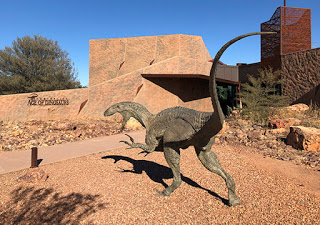
Australian Age of Dinosaurs Museum

Australia, not the first country that comes to mind when you think of dinosaurs. It’s a massive, sparsely populate country and not the easiest place to explore away from the cities and regional towns. So it’s not that surprising that few dinosaur bones have been found here. There are plenty of fossils of plants, fish, seashells and just a few sites with small fragments of dinosaur bones. But nothing significant… until now. Australia has hit the world stage of dinosaur sites.

Chance Discovery

Pastoral farmer David Elliot, found what he thought may be dinosaur bones while mustering sheep on his outback station in 1999. And what appeared to be large boulders laying on the ground were indeed dinosaur bones, bones from a previously unknown dinosaur. Any new discovery always attracts attention and it wasn’t long before an organised dig was taking place on David’s station. But nothing was found. The bones he had found were identified as belonging to a Cretaceous sauropod, a plant eating dinosaur from around 95-million years ago and later nicknamed ‘Wade’.

Waiting to be revealed

David thought long about this chance discovery. He knew his land and the soils it was comprised from. He also knew of an unusual black soil that often appeared on the surface of his land. He decided to dig deeper and it wasn’t long before he discovered more bones. He also discovered an unusual soil cycle.

As soil dried and cracked during the dry season it provided a path for subsequent rain to filter down to the black soil layer. The black soil would dissolve and over many years rise towards the surface bringing small bone fragments with it. Heavier objects remained buried relying instead on erosion to expose them.

…And there was more

Preparing the fossils

In 2005 David discovered bones in a new site at Belmont and uncovered one of Australia’s most complete dinosaurs. A further dig at Elderslie Station, near Winton, revealed two dinosaur skeletons together – Matilda, an enormous plant eating sauropod and Banjo, a razor-clawed meat eating theropod. Both were named in honour of local man Andrew ‘Banjo’ Paterson and his Waltzing Matilda song.

David was the driving force in getting a museum built to display and provide facilities for fossil preparation in Winton. In 2006, 1,400 hectares of land was donated by Peter and Carol Britton. The land included the ‘Jump-Up’, or mesa, and provided the ideal place for a natural museum overlooking the very fields where the dinosaurs we being unearthed. And with the aid of many donations, public, private and government supported, the Australian Age of Dinosaurs Museum opened to the public in April 2012. Five years later, with further expansion, Dinosaur Canyon was opened.

Scientific Names

So far three new species of dinosaur have been discovered here including Wade (Sauropod Wintonotitan wattsi, Matilda (Sauropod Diamantinasaurus matildae) and Banjo (Theropod Australovenator) and these are what is creating a big stir in the dinosaur scientific community. And would you believe there is also one named Qantassaurus intrepidus.

A must visit

I don’t want to spoil anyones future visit to the Australian Age of Dinosaurs by describing what we saw and experienced while there. All I would say is this is an absolute must when visiting this region. If you only have time to visit one place while near Winton, this has to be it.
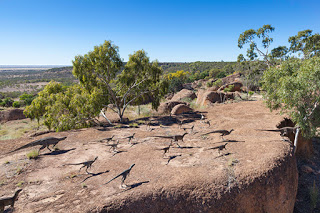
Stampede!!

And if you really enjoy what you see and want to take part in a dinosaur dig yourself or help to prepare real dinosaur bones, you can. Australian Age of Dinosaurs welcomes volunteers. You may even get a new dinosaur species named after you!

We’re both tempted to have a go when we’re back in the region again.
Waltzing in Winton

After a cold night, today started out quite windy for our 180KM drive on the Matilda Highway from Longreach to Winton. And Matilda is a clue to what is celebrated at our next destination.

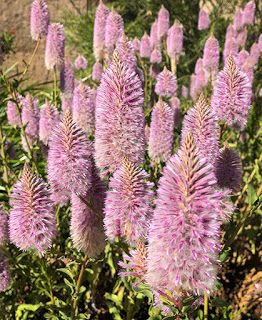
Purple Foxtails

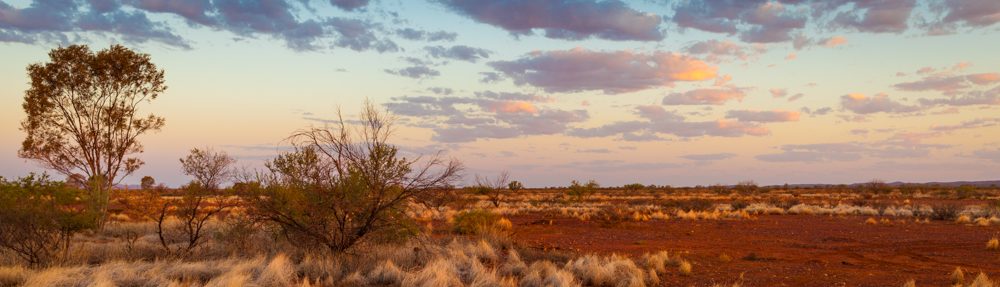
Heading deeper into the Central Queensland outback brings with it even drier conditions. There is very little sign of greenery, the grass is blonde, the tree leaves a grey/olive colour and the soil red. Occasional patches of pale purple flowers line the roadside but even they soon disappear as the landscape opens out into just scrub. It’s a very barren place and any sign of a distant farmstead or windmill comes as a surprise. However, this is a busy road compared to many that we have driven on within the Queensland outback.

Road Trains

This is a major transport link to the East with more road trains than we have seen anywhere else on our trip to date. We were advised that the road trains would affect the stability of our caravan as they passed but even coming barreling straight towards us on the narrow sections of the highway hasn’t had any impact, which I have to say happily surprises us. Maybe our rig is either very stable or the anti-sway controls of the car and caravan work better than expected. In most cases where the road is narrow, drivers do the right thing and keep left as far as possible. It’s appreciated by us towing a large caravan and the truckies too.

A large section of the highway is being reconstructed at the moment but we were fortunate to be driving at the weekend when the only restrictions were a slightly reduced speed and a short 40-KMH section as we were diverted between lanes. The highway surface isn’t in the best condition right now and we suspect a combination of the heavy road trains and the effects of floods during the Wet.

Winton

Before long we could see the mesas just south of Winton appear on the horizon – a stark contrast to the expanses of flat scrub up until now and the appearance of signboards by the roadside indicate you are approaching an outback town. A couple of turns from the highway and we were at our latest site – Pelican Fuel Stop and Caravan Park. Pelican was the original name and town location but repeated floods led to the growing township being moved to higher ground and named Winton.

Winton is the birthplace of Qantas and the centre of Australia’s dinosaur discoveries, which we will be exploring further.

Waltzing Matilda

Waltzing Matilda is often described as the unofficial National Anthem of Australia, so much so it was played in error at the medal presentation ceremony during the Montreal Olympics in 1976. Written by bush poet Andrew Barton ’Banjo*’ Patterson, the song has become Synonymous with Australians wherever they travel. It’s a song described as ‘being able to bring a tear to any Australian away from home’.

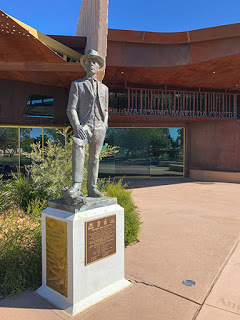
Banjo Patterson Statue

Winton has had a much loved and celebrated Waltzing Matilda Centre since 1998 but in June 2015 an electrical fire destroyed the building. Local residents joined fire crews to try and save the building and as many of its artefacts and paintings as possible but little was left untouched. The Winton Shire Council contracted a team of Brisbane architects who set to work designing the unusual, contemporary, some say ugly, building, which opened in April 2018 at the staggering cost of $22-million. It’s a mix of concrete, Cor-Ten steel and what looks like mud-based render peppered with stones. It’s equally unusual inside too being spacious but very angular and more a case of design over function as anyone trying to find the doorways will discover.

Entry fees at the time of our visit were $30, which seemed a bit excessive but for some reason we must have appeared older than we are and were charged only the concession rate. Included with the admission fee is a self-guided tour with a headset, which plays audio descriptions as you move from exhibit to exhibit… if you’re lucky, it’s not very reliable and often plays the wrong audio in the wrong place.

Entering the main museum gallery and you’re confronted with a huge, curved floor to ceiling screen made of hundreds of perspex rods with light projected onto them. What this represents I have no idea. Every so often a video is projected on the screen along with thunder and a voiceover but it’s far from clear what the video image is meant to be.

Being the Waltzing Matilda Centre you would be forgiven for thinking that that is what this museum is all about but far from it. Just one small corner is reserved for the story about ‘Banjo’ Patterson’s song. I can only assume most of the exhibits were destroyed in the fire. What remains is a collection of artefacts from the period the song was written but there is a lack of descriptions. Instead ‘technology’ has been used to show a map of each exhibit and you’re supposed to click on the one you want to read about. Why? Only one person can read it at a time. Labels beside exhibits are far more readable, they’re cheap, they don’t go wrong and can be read by many at the same time. It’s technology for the sake of it.

Wool Bale Stencils

Outside is a collection of old farm and industrial equipment, again mostly without any description. One area of interest that has clearly had some thought put in is a corrugated steel wall with mounted wool bale stencils. Every bale of wool was legally required to bear the name of its station of origin. 

Some personal collections are a little more interesting but just consigned to what feels like a shipping container. It’s a very odd, disjointed place.

There is one positive note, however, and that is the video presentation of Waltzing Matilda in the cinema. It explains the meaning and story behind the song in a creative way. Oh, and the Tuckerbox Cafe crafts a good coffee.

*Banjo, by the way, was the name of Andrew’s favourite horse.

Stockman’s Hall of Fame

One of the must do’s while in Longreach is a visit to the Stockman’s Hall of Fame situated opposite the Qantas Founders Museum. It’s a building that cannot be missed with its huge Comet Windmill clearly visible as you drive into town along the Lansborough Highway.

The Aboriginal Stockman

The Stockman’s Hall of Fame pays due homage to the early Aboriginal men and women who helped pioneer pastoral farming this far inland. Huge stations needed skilled horsemen to help drive sheep and cattle enormous distances on a seasonal basis and were ultimately responsible for many of the ‘stock’ routes we use today to cross Australia’s outback. The stations also needed domestic help with cooking, cleaning and child care and many Aboriginal women are acknowledged for the important part they played.

Flying Doctor Service – Beech Twin

Many of Australia’s famous stockmen are paid tribute around the impressive building as well as those people who have made significant contributions in opening up and helping in the development of Australia’s interior.

This also includes the Royal Flying Doctor Service of Australia with a display showing the history of the service, its founder: Rev. John Flynn and even one of their retired twin-engined Beech Aircraft hanging from the ceiling – far removed from the original DH50 biplanes provided as part of the initial contract with Qantas.

Rural Development

The displayed history of the rural development of the outback begins with the Aboriginal people going back as far as 60,000-years, the arrival of the British and the great explorers. Later grazing and mining and the many industries that serve, and have developed from, them.

Examples of early settlers timber houses, implements, wagons and clothing are displayed as well as farm machinery, wool balers, shearing tools, horse saddles, whips among many others and historical documentation that has survived the years.

Communications


Over distances as vast as the Australian outback, the ability to communicate is essential and the Hall of Fame has a display showing forms of messaging from the early morse-code telegraph, through to the manual and automatic telephone systems, radio and today’s computers and smartphones.

Transportation

Just like forms of communication over the years, technological progress has had a major impact on transport. From the early days of settlement when the only transport options were by foot or horse, bullocks, wagons and trains, all played their part in moving goods, cattle and wool but eventually the road train became king being faster, cheaper and more efficient in transporting over long distances. Normally a road train pulls 3-trailers with a length of up to 53-metres but the longest ever assembled, though not at all practical, combined 79-trailers, measured 1,018-metres and weighed a mighty 1,072.3-tonnes. The single prime mover pulled the trailers just 8KM but would have been impossible to navigate anything but straight roads. 

A show with a difference

Jigsaw the Brahman bull

Perhaps the best experience, though, is the live display that takes place in the arena behind the museum. Here the highly entertaining, educational and amusing show takes you through the life of a stockman, his horses, donkeys, cattle dogs and a Jigsaw. The highly experienced and multi-talented stockman, entertainer, singer and comedian, Lachie Cossor and his wife, provide an excellent introduction to the hardworking life of an outback stockman/woman and his/her animal companions.

Highly recommended for all ages and the chance to meet the stars of the show up close. And where else are you going to see a singing, guitar playing stockman riding a huge brahman bull… saddled?

And yes, the bull’s name really is Jigsaw and he likes nothing more than being stroked right between the eyes… honestly.

QANTAS Founders Museum

From small beginnings

Qantas is the second oldest airline in the world, the longest running and to date has the safest record of any airline company. It’s only crash occurred when one of its first aircraft was being delivered from the UK and, having just been built, crashed shortly after take-off on the way to Australia while still in England. Pieces of this aircraft frame are on display at the museum as well as details of the pilot who sadly died in the accident.

The Qantas story starts with the need for an air service to provide mail and transport services for Queensland and the Northern Territory and it’s from there that its name is derived – Queensland and Northern Territory Aerial Services Ltd. Originally formed in the outback town of Winton, Qantas moved to Longreach, which was more central to its intended service region. Its first passenger carrying aircraft, the Avro 504K was manufactured by AV Roe in the UK, makers of the famous WWII Lancaster Bomber, and went into service in January 1921. The two passengers sat in an open cockpit with goggles and a leather helmet while the pilot sat in front. It wasn’t until the 22nd of November the following year that the first scheduled service took place.

Dehavilland DH50 with ‘Passenger Cabin’

In 1924 Qantas started using the larger Dehavilland DH50 biplanes. With an enclosed ‘passenger cabin’, passengers no longer needed to wear a helmet and goggles but the pilot still remained exposed to the elements. Then in 1924 Qantas started building their own DH50 aircraft under license, examples of which are on display in the Hangar Museum.

1928 saw the world’s largest Aerial Medical Service form and from the beginning Qantas signed a contract to provide on-demand flights. The service is better known as ‘The Flying Doctor Service’.

In 1929 Qantas moved its expanding business operations to Brisbane but moved again in 1935 to its current location in Sydney. And from there the company grew from strength to strength introducing its first international flight to Singapore in 1935. A year earlier Qantas created a joint venture with British Imperial Airways to provide the first England to Australia route. Using the huge Short Empire Flying boats under the Qantas Empire Airways banner and based in Rose Bay – Sydney, Qantas’ first England to Australia flight touched down in Sydney on Christmas Eve 1937.

The Jet Age

Generations of larger propeller driven aircraft continued to carry the increasing number of passengers until 1957 when Qantas placed an order for seven Boeing 707-138 aircraft, which marked the start of the Jet Age in Australia. These were the first Boeing Jet aircraft to go into service outside of the USA. The 707 jets arrived 2-years later. The first service from Australia to the USA (San Francisco via Fiji and Honolulu) began in July the same year and was quickly followed by the first Australia to England flight via New York. In October a second route to London began, this time via India.

Boeing 707 – make an offer

The first Qantas Boeing 707

With a long flight history and several owners, Qantas’ first Boeing 707 is on display and forms part of the Jet Tour that we were taking part in. This aircraft was used by the Jackson 5 after being sold by Qantas but later left to rot before the museum purchased it for the princely sum of 1-pound and 1-pence. It had once been valued at $50-million after a refit for a Saudi oil sheik.

Bring on the Jumbo

With 21 Boeing 707’s still in operation, Qantas placed its first order for the Boeing 747 ‘Jumbo Jet’ in 1967 and the first 747 service began in September 1971. Further orders were placed and in 1989 Qantas’ first 747-400 set a world distance record with a non-stop flight from London to Sydney in just over 20-hours and 18,001KM.

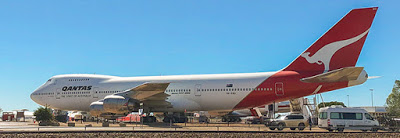
The QFM Boeing 747-200 Jumbo Jet

This Boeing 747-200, retired from the fleet, was donated to the museum. During its lifetime it had flown the equivalent of ten continuous years in the air. Though normally needing a 10,000ft runway, free of passengers the aircraft was just able to land and stop before reaching the end of the 8,000ft Longreach runway. The runway is too short for the aircraft to take-off and will never take to the skies again.

Then in 2008, Qantas took delivery of its first Airbus A380 aircraft – the world’s largest passenger carrying jet aircraft, which touched Australian soil for the first time on the 21st of September 2008.

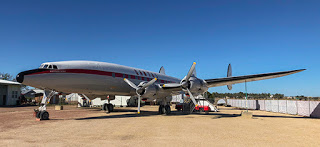
Aircraft also on display at the museum are one of Qantas’ DC3’s a mid-war Catalina and the beautiful ‘Connie’ Super Constellation, which is currently being prepared for display. Qantas has provided, engineers, painters and fitters to help restore this aircraft.

Connie – being prepared for display

The museum’s internal display traces the airlines history with artefacts on show including a replica of the very first Qantas plane, an Avro 504K. Several aircraft engines as well as the famous Rolls Royce RB211 Turbofan engine are also displayed.

The Jet Tour is in addition to the museum entry fee but well worth it. It gives you close-up access to the aircraft on static display, an explanation of many of the external features of the 747 not normally seen – and lavatory waste is not dumped while the plane is in-flight!! A tour of the First Class cabin – a Qantas first, Business and Economy as well as the rear of the aircraft where the ‘Black Boxes’ are located – an Australian invention and they’re not black – and finally the flight deck and long-haul crew bunks. A similar tour of the Boeing 707 follows, which really goes to show how far things have changed compared to today’s modern aircraft.

Wing Walking with a difference

An additional tour option will see you sitting in the Captain’s chair on the 747 followed by a wing walk… safely secured of course. And, unlike the airshow wing walkers, you wont be taking-off on this one!

Barcaldine to Longreach

Always time for a coffee

Today started as our shortest trip so far, probably less than 100-metres. The reason? Our campsite for the past two nights has a delightful cafe serving great coffee. So, once on the road we pulled straight over for a morning brew.

Heading further West

Refreshed, we set-off for our next stop of Longreach in Central West Queensland and even deeper into the Queensland Outback. As we joined the Lansborough Highway we checked the road conditions warning sign. The sign indicates if the roads are open or not and in our case OK with Caution. It’s not that long since the Wet closed many of these roads and it was good to see things had cleared significantly. The Caution warning ahead now related to the condition of the road surface.

What lay ahead of us on this relatively short drive was some of the longest, straightest roads we have seen. And what a change in scenery, dead flat in every direction, anything green has now become a rarity, all grasses are brown, the soil is red and there’s very little sign of life other than the sad sight of roadkill kangaroos. And it was one large roo on the road in the opposite direction that got us onto the VHF radio to warn oncoming traffic. Hitting that would have done some serious damage. Strangely, despite the straight roads they weren’t that flat instead undulating and more so on the floodways that regularly caused the road to dip.

What really surprised us was the number of trees. We’re really into the Western Queensland Outback but it’s not as baron as you might expect. Apart from the occasional road train and an increasing number of caravans, mostly heading east, there was little traffic on the road. What we were seeing more of, though, were the aerobatic Black Kites that fly around the roadsides looking for fresh roadkill.

A Mile of Machinery

The Machinery Mile

Before long we were arriving at the tiny town of Ilfracombe and, like most towns in the outback, there was a reason to stop. The attraction this time was the Great Machinery Mile. It’s actually 1KM long but hey. This unusual collection of historic tractors, diggers, bulldozers, earth movers and carts were all recovered from within a 100-mile radius of town. They show the technological progress from the earliest mechanised machines used as the region was developed since the mid-1800s.

Someone’s legless

Opposite the attraction is the Wellshot pub, a great place for a bite to eat and look around the bar – especially the barstools!

The last short leg brought us to the outback town of Longreach – somewhere I have been wanting to visit for a long time. Longreach is home to the Qantas Founders Museum and you certainly cannot miss it on arrival in town – a 747-800 ‘Jumbo’ jet is sat right next to the road with its six-story high Kangaroo tail towering high above.

So many trees

Just like Barcaldine’s penchant for naming roads after types of tree, Longreach isn’t missing out on the game but has stepped it up a level. All roads are named after birds – waterbirds for east-west and land birds for north-south roads.

But more about Longreach tomorrow…