Finally we’re on the Road

After a restless sleep last night we made the final preparations for our trip. The spare tyre for the car had to be loaded and strapped-down onto the roof rack. Fortunately we had checked the clearance under the garage doorway in advance and realised we’d have to load the tyre once the car was on the drive. That could have been a highly embarrassing faux pas on my part!

Why the spare tyre?

We already have a full-size spare wheel easily accessible and slung under the car so why a second spare? Having an additional tyre ensures we can keep on the move just about anywhere on the road and not have to wait for a replacement to be shipped. We originally thought of taking a spare wheel but have you tried lifting a 20-inch wheel onto the roof rack of a large SUV? Certainly not something we wanted to do. Knowing the tyre would be exposed to the full sun throughout the next year we decided to wrap it in black film, the type used in freight packaging. As well as protection from the damaging effects of UV light from the sun, it keeps out the rain, dust and helps reduce drag too.

We’re finally ready to go

We were both exhausted from the amount of last minute preparations we had to do, and it wasn’t without a few tears, but we finally had the car and caravan ready to go. It had taken us much longer than expected and we were leaving several hours later than planned.

We were hoping for no delays on the road to Orange and needed to arrive onsite before the sun set – now an hour earlier. But just 30-mins later, while on the motorway, Catherine realised she hadn’t loaded her laptop. To return meant we would have to drive partially in the dark and that is not a sensible thing to do on country roads with wildlife about. But with little option we turned around and collected the laptop and headed-out again, this time over the Blue Mountains to try and save some time despite the steep uphill climb and tight turns.

Lithgow

We reached the town of Lithgow with hot van brakes following the steep decent back down from the mountains and stopped briefly to check all was well. We certainly noticed the drop in temperature since we left Sydney but something we knew we needed to get used to moving inland and with increasing altitude.

We passed-by the Land Rover 4WD Driving Experience location on the outskirts of Lithgow as we continued on towards Bathurst. With the sun already lowering in the sky we were starting to think we should stop here overnight but we were booked-in to the caravan site at Orange and we’d already had to change dates after yesterday’s false start.

Outback Country

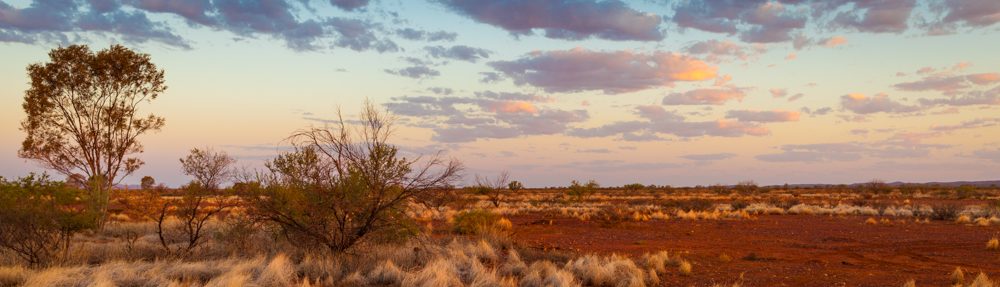
The setting sun was quite a sight as we drove through hilly countryside with stunning views of silhouetted trees against an orange sky. We would have loved to stop and take some photographs but a large combination vehicle like this wouldn’t be safe to pull-over to the side of the road.

Mount Panorama

We had made it to Bathurst in the dark and had previously hoped to drive around the famed Mount Panorama race circuit but we needed to get to Orange before 7pm and there was still 54Km to go on dark, open roads. And then fate intervened.

Just 14Km out of Bathurst, and with no warning, we were in a heap of trouble. It looked like the early transmission issue with the car had returned and the car dropped into ‘Restricted Performance Mode’ known commonly as ‘limp mode’ where the car limits speed and gear availability. Again the same noticeable smell of something hot seeping into the cabin. And this just as we were starting to climb a small hill in an area known as The Rocks – notorious, as we later learned, as a high risk driving area. Limp mode towing a caravan uphill basically means you are going to stop no matter how much you press the accelerator, and that is precisely what happened with just enough time to pull-off the road.

Fortunately we had just entered an overtaking area leaving room for the huge trucks following not to far behind to pass-by. On the tow training course Graham had shown us a few tricks to get the car moving briefly when in limp mode and this gave us just enough time to reach a large gravelled area right at the peak of the hill and to safely clear the road.

Land Rover Assistance

One of the great features of the Land Rover Discovery 5 is a direct line from the vehicle to Land Rover’s roadside assist service using the car’s inbuilt SIM – yes, the care has its own phone and can pass details of the car, its location and diagnostic data to the JLR support centre. In our case, though, the most likely requirement was going to be a tow back to a Land Rover service centre. An NRMA service engineer was assigned and not surprisingly on arrival he decided there was nothing he could do and had no prior experience with Land Rovers.

Back to Bathurst

Now bitterly cold we opted to try and get back to Bathurst after allowing the engine to cool with the NRMA engineer following behind while Catherine called ahead to find somewhere to stay overnight. And so we ended-up stopping overnight at the Bathurst Showground wondering what we were going to do and having very serious doubts about this car. There was no way we could trust taking it any further away from home and had now completely lost our confidence in it.

An angry email was now on the way to Trivett Jaguar Land Rover and some serious action on their part was called for or we would seriously contemplate rejecting the car outright. Needless to say we were both bitterly disappointed, and this was just the first day on the road!
We’re off… almost

Today should have been the first day on the road of our Big Lap of Australia. We have spent over a year planning the trip making notes of places to visit (and some to avoid), buying and gathering the things we needed for our caravan and a couple of ‘essentials’ – a coffee machine and a DVD/disk recorder to catch-up on over 80-episodes of the UK TV series ‘Heart Beat’ that we’ve been building up for over a year.

Hold everything

Well it just wasn’t to be. For some unknown reason the caravan’s battery decided to fail just as we got the van home from storage and no amount of charging would resuscitate it. Of more concern, and the reason that the failed battery was a serious concern, Jayco no longer fit an independent battery for the the caravan’s electric brakes. Now the house battery provides the backup source of power. The battery was covered under warranty but we didn’t have the time to go to Jayco to have it tested or replaced before we needed to head off. So it was off to the local Battery World for a replacement – two actually. We were under the impression when we bought the van that it had two batteries installed but only one had been fitted and that wasn’t enough for what we anticipated we were going to need. We should be thankful, though, that we were at home when the battery failed and that was only after the battery monitor alerted the fact to us.

And so here we are having lost two days packing and loading and now having to delay the start of our trip until tomorrow..

For anyone contemplating a Big Lap or even an extended road trip, this is probably the most stressful few days you’ll have preparing you car and caravan for the road.

Land Rover 4WD Experience Day

Today would be the first time we’ve driven our new Discovery 5 off-road. I have to admit to being a little apprehensive but Graham, who we did the tow training with, assured us we won’t damage the car. And he should know – he is also one of the 4WD trainers.

The course is complimentary for new Land Rover owners and designed to demonstrate firsthand what their cars are capable of. Our nearest course location was just outside Lithgow in New South Wales.

So it was an early start again to drive over the Blue Mountains to be at the training site for 8.45am, but the roads were quiet and we arrived with plenty of time to spare. Julie, our host, had laid out drinks and snacks and fIrst order of the day was to grab a much needed coffee while we waited for the other attendees to arrive.

We had met Julie previously when we booked our Tow course but Julie and her husband John are also the creators and presenters of the Australian Towing Guide DVD supplied with the course.

As the remaining trainees arrived it was quite a sight to see so many new Land Rovers gather in their natural bush surroundings. Range Rovers, Velars, Evoques and Discovery’s, all so clean and shiny, at least for now!

Meeting the Team

Our trainers for today were Tim & Truskie and they introduced themselves and the objectives of the course as we all gathered around. Part of the course was to be held on John & Julie’s bushland property and the remainder in Marrangaroo National Park just a short drive away.

First off was an introduction to Land Rover’s typical features common across the range along with many useful tips such as the correct ‘command position’ for the driver for maximum safety, changes to the hand position on the steering wheel to prevent severe injury from airbag deployment and keeping windows fully open or fully closed when off-road to prevent sideward head injury. An unknown to us was the way the car adapts to the way it is driven over time, so if something ‘feels’ different from when we first drove the car then it probably really is different.

Terrain Response 2

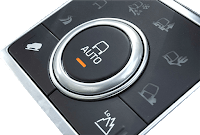
Terrain Response 2 is the name given to Land Rover’s all surface traction control system, which enables the vehicle to drive over just about any type of surface whether it be gravel, sand, snow, mud, rock or, of course, the black stuff.

Each of the terrain modes were explained to us, what to expect when selected and when to use them. Left in the Auto position the car’s electronics will switch to whatever mode it decides is most suitable for the current road or track conditions. But switching manually is more engaging for the driver and won’t lead to any surprises if the throttle response unexpectedly becomes more aggressive as it does for sand. Hill Decent mode would become useful later with automatic brake control allowing us to concentrate on steering the car downhill on slippery or loose gravel tracks. And perhaps most importantly was Truskie’s advice for using Low-Range transmission, which would provide the torque when needed at lower wheel speeds over difficult terrain.

It was time to hit the dirt

Tim had ‘parked’ the Velar on a hump leaving one of the rear wheels high in the air and joked that it was to change a wheel – I’m not sure that would be a good idea!! We hadn’t realised we would be ‘wheel-up’ on the course, at least so soon, but we were up for the adventure and knew the car was designed for this kind of terrain. This was just the first obstacle of the course we were about to tackle. Tim and Truskie took us through each obstacle as we walked around the circuit; entry and exit angles speed and Terrain Response modes.

One foot in the air

We had all been issued with a UHF radio that Truskie used to guide us through each circuit trying out different Terrain modes, which were far more noticeable than expected but gave good practical experience of the effects of each. Some modes would alter the throttle response while others would increase the ride height or lock the centre differential.

On each circuit we became more confident and tried differing approach angles to confirm just how good the clearance was on each of our vehicles. The Range Rovers and Velars had noticeably less suspension articulation than the new model Discovery’s that tended to tip a little more over some of the humps but none of the cars ‘bottomed out’ at any point.

One last test was Hill Decent control as we headed down a small incline back to our meeting point at the house. You could feel the brakes working to keep the car’s speed down with a little scrubbing of the tyres. The Cruise Control works in conjunction with the decent control system to set the required downhill speed. Another feature to add to the many to remember.

Back at the house and Julie had prepared us a delicious spread and homemade cakes – not forgetting the apple pie and ice cream!!

Heading off-road

In the afternoon we left the property for a short drive to the Marrangaroo National Park to put all this morning’s training into practice.

Land Rover Convoy

Just within the park boundary we pulled over while Truskie explained what we were about to do and to be sure we keep in contact with the vehicle behind to make sure they followed the same route. We soon saw just how easy it would be to lose your way with tracks heading-off in all directions and no clear view through the trees.

We started on a crushed limestone road, which soon narrowed to a dirt track and becoming increasingly bumpy. Our Discovery handled the road with ease and remained surprisingly smooth despite keeping the tyres at standard road pressure. This was the ideal track that changed surface as we progressed giving us plenty of opportunity to try out each of the Terrain Control modes.

Off-road puncture repair

First Casualty

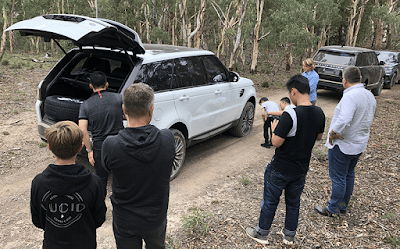
Fitting larger wheels with low-profile tyres may not have been the best option for use off-road and a branch flicked-up from the track proved a point – a sharp one! It would be an expensive one with an unrepairable puncture for the Range Rover.

Tim wandered off into the bush and returned with a straight stick, which he placed alongside the passenger-side front wheel arch. He was checking the height with the good tyre to compare with the spare, the factory standard wheel and tyre. Mismatched tyres and wheels can lead to issues with the car’s terrain control system. Dissimilar sizes results in different wheel rotation speeds, which can indicate that the faster wheel is slipping when in reality it isn’t. When a wheel slips the terrain control system will apply more power to the opposite wheel, in this situation not what you want.

Back in action we took several turns through the park with each providing a different challenge for us; narrow gaps between rocks or trees, descents that got the traction control system going and climbs along a ridge-line where many large trees had fallen during a recent storm. Truskie advised that there was plenty of room to pass between the trunks but they looked much closer than they must have been.

Volunteers anyone?

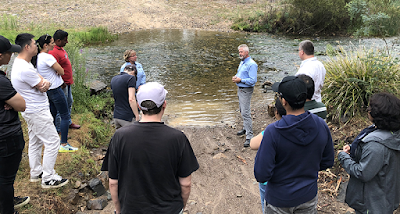
Then came our first of two water crossings over the Cox’s river. Tim and Truskie explained the correct procedure to approach water, ideally wading across checking the current, depth and hidden obstacles that could leave the car stranded. The new Discovery had the advantage among the convoy of the greatest wading depth of 900mm but it wasn’t required on this crossing. Tim advised that water does not compress and entering the water at speed could easily damage the front of the vehicle. Slow and steady was the safe method and stopping briefly on the opposite bank lets any water drain from the underside.

Pondering our first water crossing

Shortly after was our second crossing, again not deep but wider and deeper sections to the right, which needed to be avoided. The remainder of the track varied between gravel, loose rock and ruts of various depths giving us a good mixture of surfaces to gain experience on – nothing too severe even for complete novices.

Re-grouping we joined the main track in and out of the park while Truskie advised we should switch out of low-range and back to road height ready to head back. We were sorry to leave the track and would happily have gone around again but a cup of tea and cakes were waiting for us at the training centre and a recap of today’s event.

We shared our experiences with several of our fellow trainees swapping email addresses. Who knows we may bump into each other at some point on our adventures. We all gave a big thank you to our hosts John and Julie and our trainers Tim and Truskie for an excellent fun, educational and very memorable day.

Recommendations? Absolutely! Although the course is complementary for new Land Rover owners it is also available for purchase via Land Rover’s website. Give it a go, you won’t regret it.

Tow Training – Part Two

So here we are again back at the Sydney Equestrian Centre for our second Tow Training course with Getabout Training and hoping this time that the Discovery allows us to complete the day’s activities. Land Rover were confident that the gearbox overheat issue had been resolved but today would be our first opportunity to test it. Certainly there were no unusual smells this time after we exited the motorway.

Preparing to reverse

Graham was again our trainer. He had been in contact with Jaguar Land Rover since the last course to assist with the circumstances leading to the transmission problem and was interested to know what the solution was.

This time the weather was ideal – hot and sunny and sure to give the gearbox a good workout.

Straight line reversing

Straight line reversing was accomplished with ease as was the troublesome reverse-drive circle that had previously triggered the gearbox warning. Ninety-degree reverse parking also created no issues in low or hi-range.

The fix was looking positive and was certainly starting to restore our confidence in the car.

Another test is just a few days away where we will be attending the Land Rover 4WD Experience day in Lithgow – NSW, coincidentally also run by Getabout Training.


Tow Training – Part One

How many first time caravan owners hit the road without any prior training, especially reverse tow training? I suspect the majority.

You must pass a test, both theoretical and practical before you get a car driving license and nothing in that process prepares you for towing a trailer or caravan. Even then you have to display provisional plates to warn other road users that you are inexperienced.

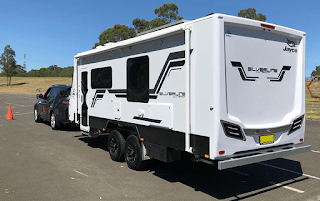
So how can you just hitch a 2-tonne plus caravan and take-off without any experience? Well, simply, it’s just not a legal requirement in Australia and no amount of reading books, magazines or Googling can prepare you for the reality of towing a rig on the open road for the first time. That’s where professional training is the sensible solution and one that should be compulsory just as it is throughout Europe.

I’ve towed a long trailer previously but that was forty-years ago with a slow farm tractor on private land. And I could see clearly behind and over the top of the trailer. Knowing our lack of experience we had pre-booked a training course for January with Getabout Training Services who run the Tow Ed training courses around Australia.

On with the Training Wheels

It was an early start to be at the Sydney Equestrian Centre at Horsley Park for 8.15am and something wasn’t quite right with our 10-day old Land Rover Discovery 5. Exiting the M7 motorway we both noticed a strong ‘hot’ smell inside the car and not the type of odour normally associated with a new vehicle. Something somewhere was hot but the engine temperature showed normal and no warnings were displayed on the instrument panel. So we continued on with a close eye on all the gauges. And the smell, whatever it was, soon cleared. Shortly after we arrived at the training site to be greeted by Graham our trainer and the other two couples who had just arrived.

A little Theory

Supplied in advance of the training course is the Australian Practical Guide to Towing and the Practical Guide to Modern Towing DVD, which explains everything you need to know to get you going; all the abbreviations for weight measurements, how to balance the load between tow vehicle and caravan, hitching your trailer, reversing, parking, safety, laws and regulations and much, much more. This was now reinforced with a short introduction and quiz with Graham and our fellow trainees.

Next came a practical walkthrough explaining how to safely reverse the tow vehicle up to the caravan hitch and how to connect, and in what order, the chains and cables making sure all the lights, turn indicators and brake lights are operating correctly – and what to do if they aren’t. Something we weren’t aware of other than for practical reasons is the need to have all blinds in the caravan lowered – to allow police to check if anyone is riding in the van.

A change in weather and it’s all backwards

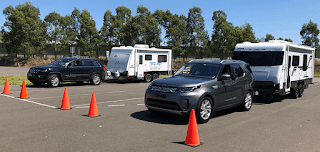
The forecast had been for rain and we had escaped it… up until now. However, not letting the heavy rain put us off, Graham’s clear instructions soon had us each reversing 50-metres or so between cones in a straight line… or as close as we could without turning the cones into fresh roadkill. This turned out to be much easier than we had anticipated and certainly a confidence boost.

The Reverse Procedure

Watching the back of the caravan through the driver’s side extended mirror, not so easy when it’s covered in rain, and looking for more or less of the van to appear would guide us to which way we should apply correction. If more of the van starts to appear on the driver’s side then simply steering briefly to the right corrects the drift and to the left if the van moves more in the opposite direction. That is, steer into the error.

Taking it slowly is the key as is making sure your travel partner is keeping an equally close eye on the surroundings and giving clear instructions but remembering the driver is the person in charge of the vehicle combination. Whether you find it easier to take steering instructions from your partner or steer based on the direction you see the van move is your choice – whichever works for you. It’s also a good idea to have your hazard lights active while reversing on a caravan site.

Smooth Arcs

Next up was turning the car and van in a smooth arcing circle. The idea being to start and end a full circle in exactly the same position. Full lock to the right then backing-off half a turn was all that was required – no further steering input was needed no matter how unintuitive it felt and you really do feel like you need to straighten the steering wheel but don’t be tempted. One circle completed as described and now the same but in reverse – it should be as simple but again unintuitive, at least that was the plan.

Reverse selected and gently pressing the accelerator and… nothing. No matter what I did with the right foot the car and van would not move. We were on a very slight incline but certainly nothing the car should remotely struggle with. Even as Graham advised, selecting low-range made no difference. It was then that I noticed a warning appear on the instrument panel and it wasn’t encouraging, ‘Gearbox Overheat’.

Now the Discovery is a seriously capable 4WD vehicle that should have absolutely no problem pulling or pushing a 2.8-tonne caravan. Whatever was happening was far from normal. It was a good opportunity at this point to break for lunch and let the transmission cool down.

Lunchtime sheltering from the rain was a good opportunity to chat with Graham and the other trainees, share experiences and ask questions about the morning’s training.

Reverse parking made simple(r)

90-degree reverse parking was what the training this morning had been preparing us for. Catherine took the lead, and following Graham’s instructions, performed a perfect 90-degree park – first time around, and then another and another. How could it be this easy? Surely some dark magic is going on here.

Well that magic is explained by correctly positioning the caravan to start with. The rear of the caravan should align with a position two strides out and three strides at 90-degrees to the point you want the van to align with, remembering to extend the start point if you need to leave extra space for a slide-out. Starting with a full lock to the right and backing-off a half turn, reverse until close to the jackknife point and stop. Then full lock to the left, reverse until you reach the opposite jackknife point and you should now be aligned and backing straight into your site. Any final adjustments are made exactly as you would at the beginning of the day’s training – straight line reversing.

On larger twin-axle vans you may get to a position where you cannot correct the turn in the remaining space available. In which case drive forwards and the caravan magically straightens itself. Practice of course makes perfect and throughout our upcoming trip we will certainly get plenty of opportunity.

A little tense

An important point to remember once reverse parked is the tension built up in the suspension of twin-axle caravans. Unhitching the van in this state can cause the drawbar to jump sideways as the tension is released. All the more reason to use chocks and keep the chains attached while unhitching. This is also the cause of loosening wheel nuts, which should be checked every time the vehicle has been reverse parked.

One of Graham’s many helpful tips to identify the point prior to a jackknife is to apply a tape marker on the front of the van at a point the driver can just see in the driver’s mirror along the line of the car to the rear. The same process applies for the opposite jackknife point.

Computer says I’m too hot

So now it was my turn and having cooled the transmission down a little it started well with my first 90-degree park with just a few adjustments but then it all came to a halt – ‘Gearbox Overheat’. We were using low-range as advised by Land Rover but something was clearly wrong and the car, again, refused to move. Our only option was to allow the transmission to cool further and call it a day as far as the training was concerned.

How were we going to drive around Australia like this? The car was only 10-days old and it couldn’t cope with an unloaded caravan.

We didn’t know if we were going to be able get the van home so Graham helped arrange for us to leave the caravan on-site for a couple of days while we got the car back to Land Rover.

Press here for Help

A great feature of the Discovery and several other models is Land Rover Assistance. A button in the car calls the Assistance service using an inbuilt SIM that uploads diagnostic data from the car and opens a phone line to a support operator. It wasn’t possible to identify the fault directly but the fact that the radiator fan had never operated during the day was a clue. Land Rover offered to have the car towed but we managed to get home without the van in-tow.

The following day a loan vehicle was provided while Land Rover got to work trying to find out what was wrong.

The caravan was towed back to our storage site thanks to Jayco Sydney and assisted by Jaguar Land Rover.

Two weeks later and we received the call we had been waiting for. Land Rover believed they had identified and fixed the fault following advice from the UK manufacturer. The suspicion was a failure with the thermostat in the transmission oil cooling system requiring the radiator and associated components to be replaced.

The best way to confirm a fix and complete our training would be to attend the Tow-Ed course again and gratefully Jaguar Land Rover agreed to cover the cost. We’ll have to wait a few weeks now for the next available slot on the course.

… to be continued.