Bring on the Silo Art

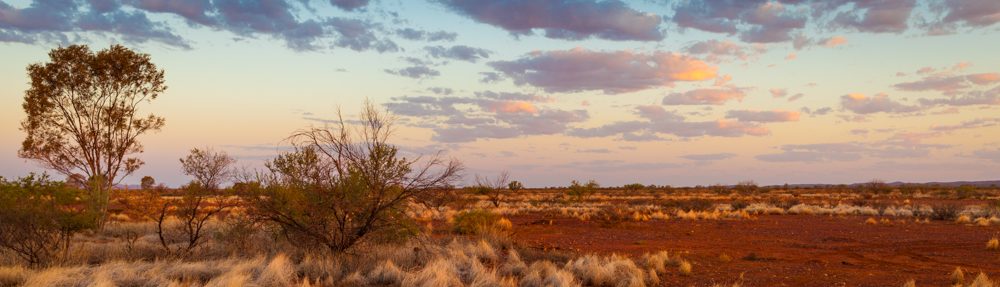
Being a major grain supplier to the world means Western Australia, South Australia, Victoria, New South Wales and Queensland are littered with giant grain silos. Highly visible from the road and railways and a feature of the Wheatbelt, these bland concrete structures are in need of a makeover. Time then to get the paints out.

The Silo Art Trail

After 3-months in Tasmania we’re back on the Mainland and on the trail of Silo Art. We saw our first painted grain silo back in 2017 on an edition of Australia’s TV show MasterChef. The show’s contestants faced the challenge of cooking outdoors for invited diners beneath a giant mural painted on Brim’s grain silo in country Victoria.

It started in the West

What began as a series of painted silos at CBH Northam Grain Terminal in Western Australia in 2015 soon started a trend attracting Australian and international artists to create these immense works of art across the country. And it wasn’t long before communities and regional councils realised the potential of attracting tourists to their small towns putting them on the map as a destination rather than a town to pass through on the way to somewhere else. And there began the Silo Art Trail.

Back on the Trail

During our Big Lap of Australia in 2019 we stopped at many of Western Australia’s Silo Art locations as we headed south and again after crossing the Nullarbor into South Australia. A family emergency overseas meant we had to skip the many silos of Victoria but now, heading back from Tasmania to our home in Queensland has given us the opportunity to visit many of Victoria’s silos, two in New South Wales and one in Queensland.

Silo Art – Victoria

Horsham – Although not the first silo to be painted in Victoria, Horsham Silo was the first on our trail. Painted by artist Sam Bates (aka ‘Smug’) in May 2022, it depicts the western Victorian aboriginal man, Yanggendyinanyuk, who was one of a team of 13 indigenous cricket players who formed the first Australian cricket team to tour England.

Horsham Silo – Victoria

To the left of the silo, and partly obscured by a steel fence, is another highly detailed mural by Sam Bates, this time of a Red-Tailed Black Cockatoo. Many people were unaware of the second mural and so Sam returned to paint the wall in front of the silo in May 2023 to link both murals together while giving the visitor a rare close-up view of the stunning detail of the artwork.
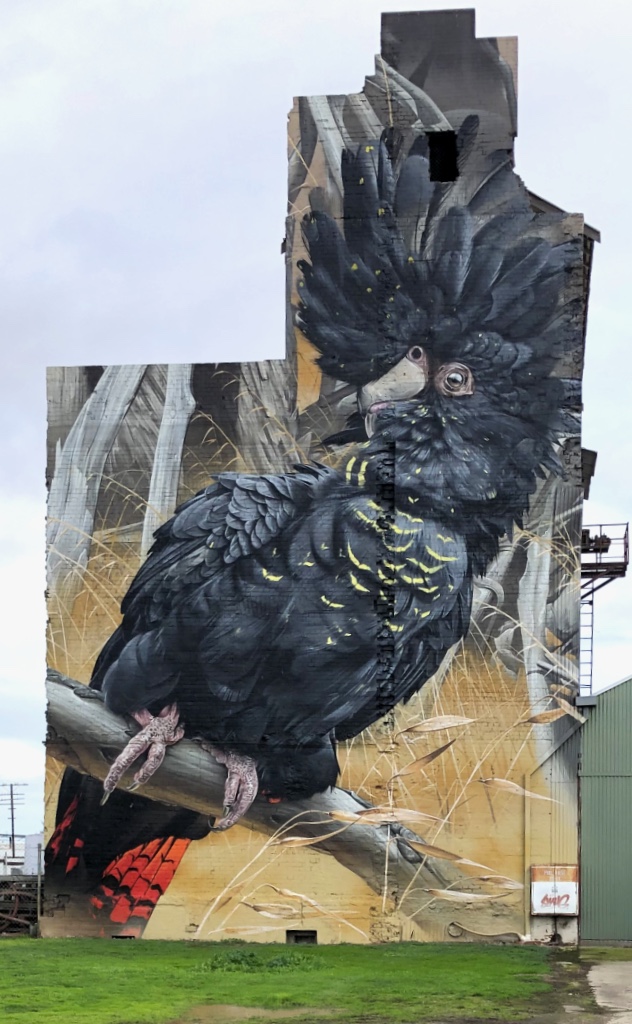
Red-tailed Black Cockatoo – Horsham

Murtoa – Better known for the incredible Stick Shed, Murtoa has also received the painted silo treatment by Sam Bates. Situated in the town adjacent to the railway line and a series of rusting silos, Sam’s artwork has to compete with the graffiti decorated rail cars. The painting highlights 29 species of bird that can be found in the Mallee region and a radiant bird said to represent the one in 30 Australians who experience a Bipolar condition.

Murtoa Silo by artist Sam Bates – aka ‘Smug’

Rupanyup – Next stop on the trail travelling northwards is the twin silos at Rupanyup. Here a convenient visitor shelter has been constructed opposite the silos detailing the many crops grown in the region.

Rupanyup Silo – Victoria

Created by Russian artist Julia Volchkova in 2017, Rupanyup’s twin silo artwork features local residents and sports members, Ebony Baker and Jordan Weidemann.

Sheep Hills One of the more remotely located but accessible silos is the GrainCorp Silos at Sheep Hills. Painted by mural artist Matt Adnate in 2016, it features Wergaia Elder, Uncle Ron Marks and Wotobaluk Elder, Auntie Regina Hood, looking toward the two young indigenous children, Savanah Marks and Curtly McDonald.

Sheep Hills Silo – Victoria

What sets these silos apart are the vibrant colours Matt chose, the detail in the children’s faces and the deep violet of the sunset blending into the deep-black star-trail sky.

Brim – Completed in January 2016 by Australian mural artist Guido van Helten. The GrainCorp silo in the township of Brim was the first silo to be painted in Victoria and only the second to be painted in Australia. It marked the beginning of the silo art trail of Victoria.

The murals depict four hardy, weather-beaten farmers who share the typical resilience needed to farm in the Wimmera Mallee region.

Brim Silo – Victoria

Guido, a talented mural artist, had been looking for a silo to paint and, working with the help of Juddy Roller Art Management, the owners GrainCorp and the Brim Active Community Group, Guido got the go ahead to create a mural on Brim’s silo. But the weather made the task far from easy with extreme heat, strong winds, a dust storm and lightning. Guido often took a break during the afternoons to escape the worst of the heat before returning to continue during the cooler evenings.

Rosebery Silo – Victoria

Rosebery – Created by Melbourne artist ‘Kaff-eine’ and completed in 2017, the Rosebery Silos are said to depict the region’s past, present and future. The left silo shows the future with the stylishly dressed young female sheep farmer wearing turned-down cowgirl boots, jeans and cotton work shirt. By contrast the right silo displays the current and the past with a contemporary horseman dressed in an Akubra hat, Bog boots and oilskin vest.

Lascelles – Another of the monochromatic style murals, this time in the settlement of Lascelles 26KM northeast of Hopetoun. Painted by Melbourne-based artist, Rone and completed in mid-2017. Deliberately using muted colours similar to the existing concrete so as not to distract from the environment.

Local farming couple, Geoff and Merrilyn Horman were chosen as Rone’s subjects for their family’s four generations as local farmers in Lascelles. Pictured below is just one of the two images.
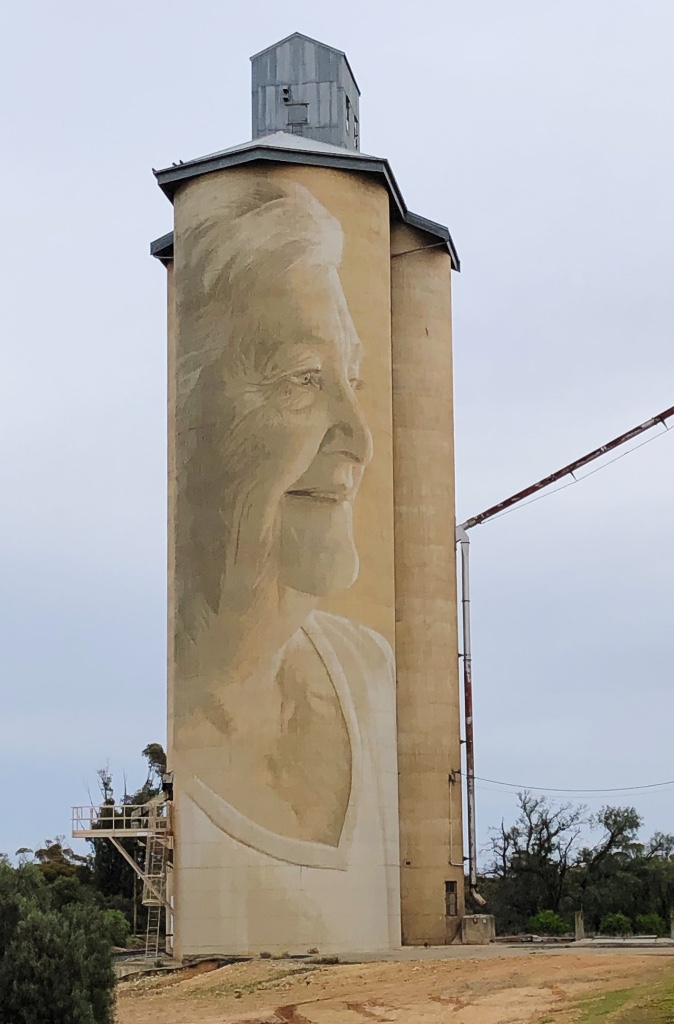
Lascelles Silo – Victoria

For photographers, access to the site is difficult due to private land and the adjacent railway.

Patchewollock – Another highly detailed mural featuring local character Nick ‘Noodle’ Hulland. Painted by Brisbane artist, Fontana Magee in 2016 who had spent time in the local pub looking for a suitable subject. According to Magee, Noodle was a rugged, no-nonsense and lanky character ideally suited to the narrow 35-metre twin silos. With his squinting gaze and sun-bleached hair, Noodle was a reflection of the harsh and challenging environment of the Wimmera Mallee.

Patchewollock – Victoria

Silo Art – New South Wales

Not to be outdone New South Wales has got in on the silo painting act too and has begun commissioning artists to paint both grain silos and water towers to entice tourists and passing trade in an effort to boost the local economies.

Weethalle – Artist ‘Heesco’ completed painting the silo in July 2017 as a tribute to the agricultural heritage of the small town of Weethalle and the surrounding communities of Bland Shire.
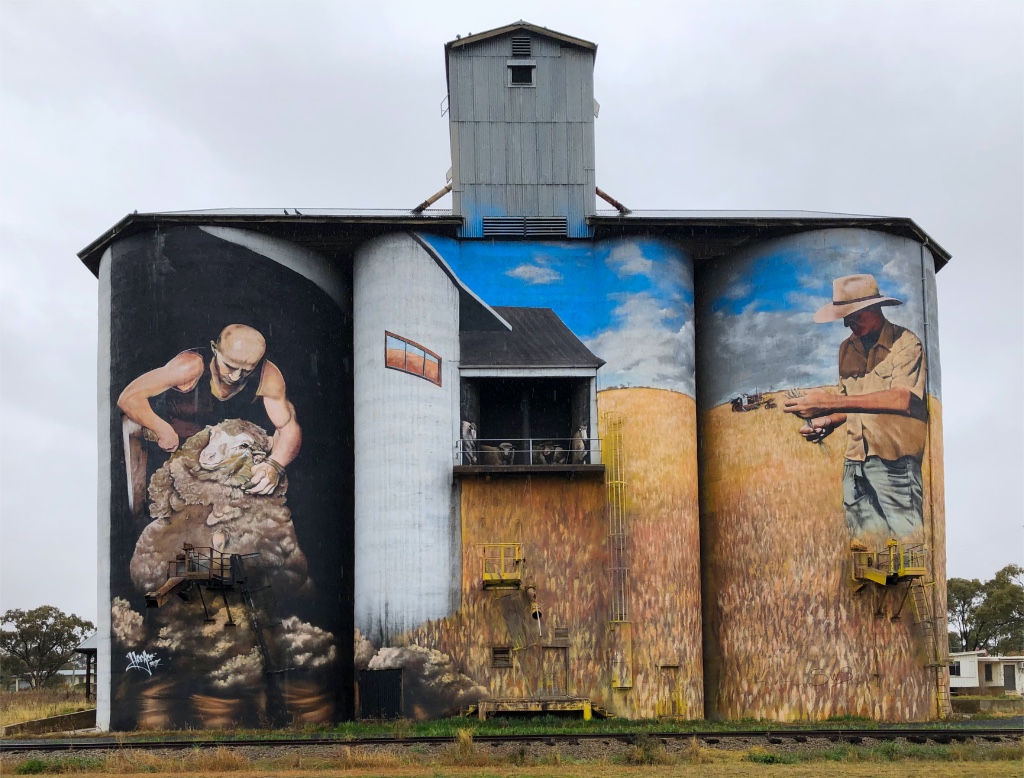
Weethalle Silo – New South Wales

Depicting a typical farming community, Heesco’s image displays the annual task of shearing sheep, a farmer checking the grain readiness for harvest and, curiously, a small flock of sheep standing high on a balcony looking out and enjoying the view.

A dedicated car park with ample space for caravans has been provided to encourage passers-by to stop for a while.

Hay – Like many small country towns in Australia the First and Second World Wars took their toll on the young who took up arms to protect the nation and join the raging wars in Europe and the Pacific. In recognition and memory of those brave soldiers and nurses from the town of Hay in New South Wales, artist Matt Adnate was commissioned to paint five of the veterans from among the hundreds who answered the call. Those selected were Private William ‘George’ Cannon, Corporal Cliff Farlow, Private Norman Flack, Australian Army nurse, Lieutenant Lorna Margaret Whyte and indigenous soldier Private Victor George Murray. Display boards at the site tell the unique story of each of the individuals.

Hay Water Towers – New South Wales

Although water towers and not silos, the towers form part of the Australian Silo Art Trail.

Silo Art – Queensland

Yelarbon – Closer to home and the last silo on our homeward bound trip. Another of GrainCorp’s silos and one of the largest groups of painted silos. Painted in two stages between 2018 and 2020 by artists Jordache Castillejos and Jordon Bruce from the artist collective, Brightsiders along with Steve Falco of ProcreatiV.

Yelarbon Silo – Queensland

The mural is titled ‘ When the rain comes’ and depicts a young child sailing a paper boat as it crosses the nearby Yelarbon Lagoon and traverses the six smaller silos. The boat is said to have been made from old newspaper cuttings found in the town’s historic jail and symbolises the history of the region.

There’s more to come

There are many, many more painted silos across Australia and the number is set to continue in the years to come. To date we have visited just a small collection of what is surely the world’s largest outdoor gallery.

Trouble near the Border

After a brief overnight stay, and a very cold one at that, we set off towards Toowoomba, our next stop for a few days. Taking advantage of the nearby Caltex we fuelled up ready for whatever lay ahead but, with hindsight, we should have stayed where we were. But being surrounded by places such as Stonehenge, Dundee, Diehard and Bald Nob it was time to go.

It was a varied mix of driving today along the A15 starting with kilometres of parched farmland before arriving at the big climb of the day through the twisting hills of Bolivia. It was a little challenging along the narrow road and made even narrower due to roadworks but the dramatic scenery to our left as we crossed Bolivia Hill was rewarding enough. The landscape opened out a little after the hills and followed the low point in the valley with many long, straight sections along the New England Highway before arriving in the town of Tenterfield and time for lunch.

As is becoming the norm on our trip we have another recommendation on the food front and this time it’s The Corner Cafe with its delicious cakes and hot meals. Not just a cafe though but also a clothing, footwear and gift shop – well worth an explore.

Hello Queensland!

Back on the road and some of the longest straight stretches of tarmac so far. This was the Darling Downs and we had just crossed the border into Queensland. Coincidentally it appeared the border also required properties be built on stilts. It started as a bit of a joke but more and more the houses, barns and sheds were raised off the ground. The Queensland border also marked a change of landscape and we were now being surrounded by countless orchards among rolling hills – the region producing the majority of Queensland’s apple crop from over 1-million trees. And then trouble struck yet again.

Once more and for no apparent reason our car decided to choose the start of a moderate hill climb to go into ‘Restricted Performance Mode’ and just after we had overtaken a crawling truck. Again no prior warning. We managed to limp to the top of the hill and continue to a safe point to pull over. Our old issue was back and it looked like the transmission temperature again. After restarting the engine, though, we managed to drive into Warwick and parked up to let the transmission cool down. It was also a good opportunity for a wander around the CBD and take a coffee break though, this time, nothing to recommend.

We had been stopped for over an hour but that was clearly not enough for the car to do what it was designed to do and just 24-KM later we were stopped again with the same Restricted Performance Mode. This time, however, a local mechanic kindly stopped to assist and made a point of the transmission radiator being much hotter than it should. By comparison the engine coolant radiator was cool to the touch. We were concerned with the failing daylight and really needed to get to Toowoomba before dark, if it was possible, to avoid the wildlife straying onto the road. Fortunately a 30-minute stop to cool appeared to be enough and we made it to our caravan site 54-KM later and just before the sun set.

Needless to say we have now lost any remaining confidence in this car, a vehicle designed to tow up to 3.5-tonnes that cannot cope towing our 2.8-tonne caravan. At this point in time we could never recommend anyone buy a Land Rover Discovery 5. It simply is not worth the anxiety and stress knowing your very expensive car could let you down at anytime without warning. Back to Jaguar Land Rover… yet again.  

At least this time, after 4-weeks on the road, we got to do a 90-degree park… and nailed it first time!

Scaling the Moonbi’s

We’re on the move again after four lovely days with friends in Kootingal and heading for an overnight stop at Glen Innes, the self proclaimed Celtic capital of Australia.

After refuelling our first challenge was to scale the Moonbi’s – a high range of hills and a dual-stage steep climb out of the Tamworth valley. We we’re a little apprehensive after one of the guides at the Dubbo Information Centre said it was quite a tough climb, especially with a caravan in tow, but fortunately it was nowhere near as bad as we had been led to believe and we were soon over the top and descending down into a comparatively lush valley.


An interesting drive compared to those of late with a winding road following up and down hills before levelling out at the town of Urulla, which was a good place to stop for lunch. You will have got the idea by now that we enjoy looking out for good coffee shops and, of course, today was no different with the Pie Mechanic being our choice of the day. And we weren’t disappointed – excellent coffee, toasties, roasted carrot and feta roll and a cherry custard tart. Give it a try, you won’t find better in town.


Our final leg took us through more farmland lined with poplar trees glowing yellow in the afternoon sun. Good roads, small hills, great views and little traffic and we were soon pulling into our overnight stop.


Glen Innes


Depending on how you look at it we were fortunate to have just missed the Glen Innes Celtic Festival, which took place over the weekend. It’s a big event drawing large crowds to see everything Scottish and centred around the Celtic Standing Stones. Having come from a country with genuine, ancient stone circles I have to view this one with a little smile, may be even feeling a little smug. It’s perhaps best that you make your own decision on this one but leaving the bore holes from the drill used to extract the rock still visible is a little questionable.


The town itself has a long, wide main street with many old buildings lining the road but spoilt a little by the bright colours of Mitre 10 and the relatively modern Woolworths supermarket.

Glen Innes – Main Street

It looks as though we’re in for a cold night again with the temperature expected to fall to 4C. At least we now have the gas heater working and we can look forward to warmer nights as we head towards Queensland tomorrow.

Great times in Kootingal

This weekend we are visiting friends in Kootingal just to the northeast of Tamworth – The Country Music Capital of Australia.

We made a brief visit to the Tamworth Country Music Hall of Fame, which displays the long history of Australian country music but there was surprisingly little for more recent artists such as the hugely popular Keith Urban. It was also looking quite dated and for such a major music capital it deserves better.


Just a short stroll away is the main street of Tamworth and the usual shops, cafes and supermarkets common to most of the country towns that we have visited so far. It was a good opportunity for me to get a flu jab while for Catherine an absentee vote was in order for the federal elections coming up soon.


Kootingal is a farming community and, like much of New England, is still suffering the effects of drought. Hopefully the overnight rain on Friday will help and signal the arrival of more rain to follow
.

Kootingal Countryside

An early morning walk by the river was a good reason to rise on Saturday and fortunately the rain had cleared. We followed the path of the well attended Tamworth Park Run held each week. And of course our treat was breakfast and coffee at the Hopscotch cafe by the river.

Another early start on Sunday saw us at the Tamworth Marsupial Park, not just an excellent place to take the children with its own playground but also educational for all ages. It’s a lovely spot in a narrow valley surrounded by trees with the only noise coming from the many native birds on display, especially the Sulphur Crested Cockatoos and their many spoken phrases. And not just a ‘Hello’ but ‘Who are you?” and “What are you doing?”. Even a Galah got in on the act.


Of course it wouldn’t be a good weekend without a good pub lunch with friends. It also happened to coincide with a very well attended village market at Currabubula, many of who also had the same idea as us to drop into the local pub for a beer and a bite to eat.

Walking in the Warrumbungle

We’re heading out to the Warrumbungle National Park today. Located 36km west of Coonabarabran and 550km northwest of Sydney, it is unique in being the only Dark Sky Park in Australia and the reason Siding Springs Observatory was located right here in the park.

The Warrumbungle mountain range shares a volcanic history with a string of extinct volcanoes from Queensland down and through New South Wales. Caused by a hot spot beneath the earth’s crust and pushing through weaker rock, the volcanoes formed in a north to south chain as Australia slowly moves northwards. The hot spot currently sits below the Bass Strait and someday may re-appear breaking back through to the surface in Tasmania.

A massive fire in 2013 caused major damage covering 90% of the national park and has left very clear evidence with blackened tree trunks everywhere but equally impressive new growth as the forest re-establishes itself. Its affect on the local fauna and flora is still being measured and visitors are encouraged to send photographs from key locations to enable scientists to measure changes over the ensuing years.

It’s a very enjoyable drive leading into and through the national park but visitors are advised to be aware of rockfalls and fallen trees still affected by the fire. It feels almost as if you are entering a recent disaster zone with fallen trees, branches and rocks right beside the road and sometimes on it. One positive side to the fire is the views that have been created where trees have been stripped of their leaves and in places whole trees have burnt or fallen.

Whitegum Lookout

Our aim today was to do a couple of walks, get some fresh mountain air and enjoy the scenery. The first stop was the at the Whitegum Lookout. Just a short walk, the path leads to a platform overlooking the volcanic skyline that was active between 13 and 17-million years ago. Much of the softer volcanic rock has weathered away over the eons to leave volcanic plugs and dykes protruding from the surrounding landscape. It was a shame the clouds were preventing the sun breaking through and showing the rock formations at their best.

A little further into the park is the new and very impressive visitor centre just recently opened. It’s a modern architect designed building with a fantastic stone wall frontage. The design and display inside is just as impressive and educational. The new centre replaces the original destroyed in the 2013 fire. Of all the visitor centres we’ve visited over the years, both in Australia and overseas, this easily rates as one of the best.

Our second walk took us on a looping path around the surrounding land of the visitor centre and down along a dry creek before returning back to the centre. We saw our first kangaroos in the park, way after they had already spotted us and sat upright, ears pointed keeping an eye on us. I used the DJI gimbal camera for the first time following Catherine along the path and then filming four kangaroos that were startled as we turned a corner past a rocky outcrop. It was great to see wildlife at such close quarters.

Grey Kangaroo

Heading further into the park we followed another circular walk – the Wambelong Nature Track, again watched by mobs of kangaroos, along a dry riverbed and over a steep path up a rocky slope leading to an overview of the valley and the surrounding mountains. Just as we started to descend we heard a noise in the bush but could see nothing. And then I spotted an Echidna trying its best to hide under a fallen branch much smaller than its spiny body. It would have been great to photograph but best to leave alone and let it carry on hunting for food.

Dry riverbed – Wambelong Nature Tack

We had only walked for a few hours at most but it was very enjoyable, the scenery very diverse, plenty of wildlife and a great drive through a very special national park. Probably the best day of our trip so far.