Sitting on the far northwest coast of Tasmania is Rocky Cape National Park. Though smaller than many National Parks in Tasmania, Rocky Cape NP more than makes up for its size with striking coastal rock formations, caves and a rich Aboriginal heritage.
Jagged Rocks – Mary Ann Cove
Ancient Rocks
The rocks around the cape are believed to be among the oldest in Australia. Dated to Precambrian times (4.6-billion years to 540-million years ago) it was a time when life was beginning to form with soft multicellular organisms, algae and jellyfish. Also living during this time, and still to this day, are the Stromatolites that we first saw at Hamlin Marine Nature Reserve, Western Australia. Over the aeons the rock has been uplifted and folded to form the jagged rocks we see today.
Mind the Wasps
For some reason large native wasps and bees are attracted to the bright white paint of the lighthouses along the coast and Rocky Cape Lighthouse was no exception. Among the many creatures to be found here are the graceful but noisy Yellow-tailed Black Cockatoos, White-bellied Sea Eagles, Wallabies and Pademelons, Tasmanian Devils, Spotted-tail Quolls, Echidnas and Bandicoots.
Rocky Cape Lighthouse
Midden Caves
Many caves have formed within the cape region and among those are North Cave, which can be easily spotted from the lighthouse. For a closer view follow the path among coastal heath to the viewing platform. Access into the cave is not permitted as it has significant Aboriginal cultural importance.
North Cave
South Cave at Burgess Cove is amost filled with shells, bones and other artefacts. The mound of remains, known as a midden, are often associated with a long Aboriginal occupation and a gathering place where mobs would eat and discard the shells and bones from their meals.
Wet Cave at Sisters Beach, a little further along the coast, provides a short scramble along the rocky beach and up through banksia groves to an observation platform. There’s not much to see here, though, as no access into the cave is provided – not that it dissuaded a couple of youths that showed no respect to the Aboriginal community.
Just a short trip along the coast today but tomorrow we head to the famous wilderness of Cradle Mountain National Park, one of the big highlights of our adventures in Tasmania.
As we continue to head south towards southern Victoria, our next stop-off is the town of Naracoorte and we’re here for one specific reason – to visit the UNESCO World Heritage Listed Naracoorte Caves.
The first discovery by Europeans was Blanche Cave in 1845, located in what is now the Naracoorte Caves National Park, but it is just one of 28 caves so far discovered. At present only four caves: Alexandra, Blanche, Stick-Tomato and Victoria Fossil Cave, are currently open to the public with most of the remainder reserved for scientific research and requiring greater protection. A few further caves are accessible but only through Naracoortes Adventure Cave Tours.
Limestone Coast
Naracoorte sits upon massive limestone deposits left exposed by the rise and fall of sea levels 200-million and 20-million years ago. The caves complex formed from fracturing of the Kanawinka Fault allowing water to enter via cracks and fissures. Over time rain and ground water leaching through surface vegetation created a weak acid, which, to this day, continues to dissolve the limestone beneath. In places the subterranean cave ceilings have collapsed creating sinkholes and traps for unsuspecting wildlife to fall into but often also forming ideal habitats for bats.
Marsupial Lion
The Naracoorte Caves, believed to have formed some 500,000-years ago, are particularly known for what fell into them over a period of hundreds of thousands of years. Soil and sediment that has built-up on the cave floor, 20-metres deep in places, has created a layered history of the species of plant and animal that existed at that time including creatures that are unique to Australia, creatures such as the giant short-faced kangaroo and marsupial lion – the so called Megafauna. Of international significance is Victoria Fossil Cave, which is rated among the ten most important fossil sites in the world.
Alexandra Cave
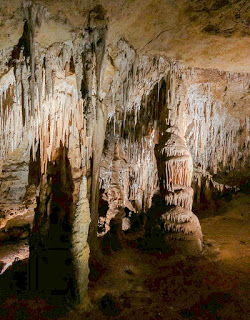
Discovered by William Reddan in June 1908 and named after Queen Alexandra, wife of King Edward VII. When first explored Alexandra Cave was largely filled with soil and silt, which had fallen or been washed into the cave over a period in excess of 100,000-years. The infill was painstakingly removed by hand to reveal some spectacular caverns, stalactites, stalagmites and helictites.
Just a year after discovery the cave was officially opened to the public with 2,000 people in attendance. Reddan, acting as caretaker of the cave, led the official party through the cave using the brilliant light of magnesium lamps. It is not known how much scientific discovery was lost as the cave was excavated but more recent core samples taken in the remaining sediment have unearthed over 100,000-years of evidence of life in the past including plant, pollen, insects and mammal bones. The search into the past continues in other caves in Naracoorte Caves National Park.
Alexandra Cave Stalactites & Stalagmites
A regular tour schedule is available during school holidays with a 30-minute guided tour dropping up to 30-metres and 240-metres along the cave where the noticeably humid air remains at a constant 17C year round. Twenty-five steps lead down to the mostly level cave floor that is largely compressed soil with up to 9-metres of sediment still remaining.
Stone Straws
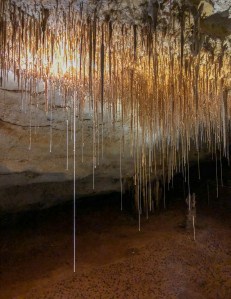
We’ve been spoilt by some of the spectacular caves we have visited in Western Australia and it is hard for Alexandra Cave to compare. That’s not to say it isn’t impressive – far from it, it has some stunning examples of straw stalactites growing just 1mm per year on average making the longest examples many thousands of years old.
Stone Straws
Each straw is formed by calcium-rich water dripping through the centre rather than along the sides of a stalactite. The straws are extremely delicate and hard to believe they are so old and have survived for so long. It would take just one wayward bat or an inquisitive child to destroy them. It is for that reason everyone is constantly reminded not to touch any of the decorations throughout the duration of the tour.
Mirror Mirror
One feature, and one of the highlights, is the mirror reflection in a small pool of water in the main chamber. The complete absence of drafts or vibration gives a perfect reflection of the stalactites hanging from the roof of the cave. You have to look twice to figure which is the reflection and which the real stalactites. However, impressive though it is, it is a man made feature created shortly after the cave was opened to the public.
Flow Stone
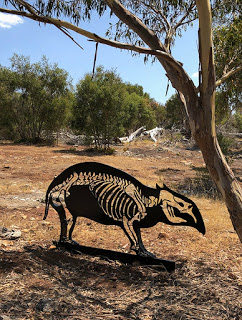
Above ground is a 900-metre walk that, in places, follows the path of the below ground caves as well as passing several other show cave entrances such as the large Blanche Cave and the protected Bat Cave. And giving an idea of the many extinct megafauna that used to roam around this area are steel sculptures in the shape of each creature with the fossil bone structure shown in relief. It’s a clever idea and fun for children (okay, some adults too) to spot as they wander along the pathway.
Victoria Fossil Cave
Given time a visit to Victoria Fossil Cave is recommended to view many of the reconstructed skeletons of creatures that entered the cave but never found a way out. With hindsight we should have visited this cave too if we had known more about it. The available literature at the Visitor Information Centres and online is poor in explaining what there is to see and, unusually, very few photographs too. I guess they don’t want to give too much away.
Ancient Creatures
Entry to each cave is charged on an individual basis but a discount is offered if you want to visit more than one cave on a single day. And for those a little more adventurous there is an option for an Adventure Cave Tour to get down on your hands and knees and crawl. Overalls and safety gear are provided. Bookings are essential.
Somewhere to stay?
You could easily spend a couple of days exploring the Naracoorte Caves National Park and a campground is provided for those wishing to stay close by.
The town of Naracoorte lays just 28KM to the north and provides a number of popular camping and caravan sites including the conveniently located campsite at Naracoorte Showground where we stayed.
You may be forgiven, reading this, that we have all of a sudden become troglodytes trying to escape the current cooler weather in the southwest of WA. But, again, we’re heading deep underground to explore one of nature’s relatively young but spectacular caves.
Karri Tree formation
Stalactite overload
We thought Ngilgi Cave was pretty special but Jewel Cave is something altogether different. Situated close to the town of Augusta on Caves Road (where else?), Jewel Cave is the most recently developed of the Cape’s caves open to the public.
Windy Hole
In the early 1900’s a hole in the ground was known about where wind appeared to be emanating from deep below. But it was not formally ‘discovered’ until Cliff Spackman chanced upon a strong upward blast of air from the ground while exploring the area in 1957. The narrow hole had been formed initially by tree roots penetrating the limestone but later widened by the action of water. Cliff’s fellow explorers lowered him by rope through 12-metres of rock to find himself surrounded by a staggering collection of stalactites, stalagmites, pendulums, flowstones and the more unusual, and peculiar, helictites, a crystal formation that Jewel Cave is especially renowned for worldwide.
The following year Cliff, Lloyd Robinson and Lex Bastian returned to further explore the cave, which continued for more than 2KMs and reached down to a depth of 42-metres. And there were more than a few surprises in store. Hidden beneath a layer of soil was uncovered the skeleton of a now extinct Thylacine – a Tasmanian Tiger that must have fallen into the pitch black cave with no means of escape.
The age of the remains are unknown but radio dating of one of the cave’s crystals has put a date on the cave formation at a minimum of 466,000-years and the limestone it sits within a geologically young 1-million years old.
Cliff and his team spent a year developing the show cave as a tourist attraction installing steps, suspended platforms and lighting before opening to the public on Boxing Day 1959.
Hundreds and hundreds of Stalactites
Defying Gravity
The cave is absolutely crammed with every type of decoration, as the crystal features are known, but a few take on some quite peculiar shapes twisting randomly, often growing horizontally and even turning right around and growing back upwards as if defying gravity.
Known as Helictites they start as a straw-like formation – a hollow tube. Normally the straw will continue to grow downwards but under certain conditions the dripping water from the cave roof settles more to one side of the straw than the other. With each new layer the direction the straw takes depends on how the calcite’s crystal structure forms.
Giant straws
Among the very special decorations in Jewel Cave is an incredibly delicate straw stalactite just millimetres thick but an enormous 5.43-metres long – the longest found, so far, in any cave in Australia and believed to be at least 10,800-years old.
Delicate Pendulums
Pendulums
A few similar straws have developed bulbous nodules that look like pendulums. It’s hard to imagine how such a delicate straw can support the weight of these growing crystals. Studies have shown that the crystal formations in the cave grow on average 0.5mm each year. Just one slight touch and they could snap and fall destroying tens of thousands of years growth.
Karri Tree Formation In the main cavern is a large flow formation that, when observed more closely, resembles a forest of Karri trees.
Carbon Dioxide
As was the case with Ngilgi Cave the level of carbon dioxide in the air is higher than on the surface above. This is a result of the chemical process that forms the cave’s decorations, a process that has existed for hundreds of thousands of years. Though perfectly safe it does reduce your energy levels while in the cave and requires a little more effort climbing the steps back up to the surface. But it is absolutely worth the effort to be rewarded with such a spectacular example of nature and something a very, very long time in the making.
Previously known as Yallingup Cave due to its proximity to the nearby town, it was later changed to Ngilgi Cave, pronounced ‘Neelglee’, to reflect is Aboriginal name. Ngilgi Cave is one of a series of Karst Limestone caves in the southwest of Western Australia. Surprisingly it has had a lot of influence on the development of the region and unusual in that for a visitor it is largely a self guided tour.
Though known for thousands of years by the local Wardandi Aboriginal mob, it was first ‘discovered’ in 1899 by European settler Edward Dawson while searching for lost horses. His chance encounter was a life changing event as he became the resident cave tour guide for the next 37-years.
Stalactites and Stalagmites
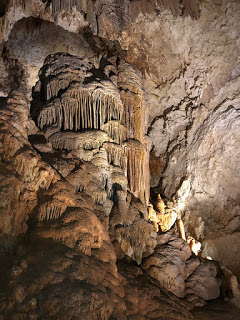
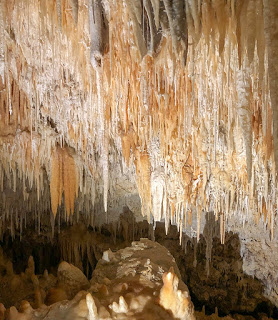
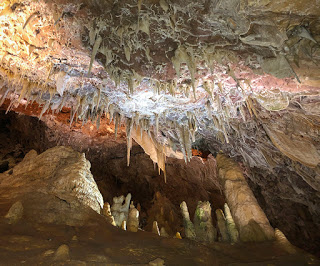
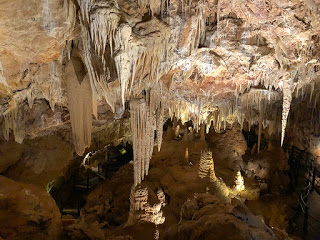
Ngilgi Cave is like no other cave we have seen. Stalagmites and stalactites appear as soon as you begin to descend the steep staircase. Here the crystals take on a dull grey colour due to atmospheric exposure and dust but within metres you are standing in a small amphitheater surrounded by every type of crystal structure from straw-like pipes, wavy shawls, cascades as well as the more common stalactites and stalagmites. Every where you look there is something to see.
Karst Limestone
The cave was formed tens of thousands of years ago by a process that continues to this day. Rain passing through the atmosphere absorbs carbon dioxide forming a weak carbonic acid. The acid then intensifies as it passes through carbon dioxide rich soil and begins to dissolve the limestone beneath. Eventually small cracks appear accelerating the erosion and increasing the flow of water through the rock. In the case of Ngilgi Cave the downward passage of water eventually formed a river deep underground that worked its way out to the sea.
39-metres below
Free to wander
Our tour guide, Andre, explained the story of the cave including the discovery of bones from long extinct animals that fell into the shaft of the cave and evidence of Aboriginal habitation dating back 45,000-years. From here you are free to wander deeper into the cave guided by a well constructed path, steps and handrails. Considerable care is needed as the path is often narrow, the cave roof low and the steps steep – and often all three together.
It requires a certain level of fitness made all the more difficult as the humidity and carbon dioxide levels increase the further you descend into the cave.
The path takes you through multiple chambers often with large cracks in the ceiling and huge chunks of rock locked together as they fell but still forming an alarming looking roof directly above. Andre advised us that as well as friction holding the structure in place, secondary cementation by dissolved limestone bonds the rocks together. It certainly looks precarious but it has been this way for thousands of years. Still, you feel as though it could give way at any time or one of the thousands of needle-sharp stalactites may break free and pin you to the ground.
Cascading Stalactites
As you descend deeper the crystals become increasingly white and eventually clear enough for light to pass through. Several have lights behind them showing bands of colour formed by tannins leached from the vegetation above ground.
Taking it all in
The highlight of the cave is a large, circular cavern decorated over its entire surface with thousands of crystal structures. It really is an awesome sight and the place you’ll likely spend most of you time looking and wandering around. Andre had arranged a collection of crystals to look at showing how the colour changes by depth and an opportunity to hold them and realise just how heavy they are. Here is a spot to just admire what nature has created or ask any questions that may come to mind before heading back up the hundreds of steps to the surface. Hidden Treasure
As you begin the accent one last feature will catch your eye. Known as the Jewel Casket, nestled in the cave wall is a miniature grotto with small stalactites that have spiky crystal structures radiating from their tips. These are Dog Tooth Crystals that form where a pool of supersaturated calcium bicarbonate exists. They’re certainly unusual and with the attached stalactites they resemble some form of medieval weapon used to disable your opponent.
The Jewel Casket
The climb back to the cave entrance was much easy than expected, likely a result of the increasingly fresh air, and we were soon back among the scrub where you would have little knowledge that such an amazing sight exists just metres below your feet.
It’s a MUST see
A visit to Ngilgi Cave is very highly recommended but if you are a photographer note that tripods are not allowed in the cave but you are free to use a flashgun. All the photographs here were taken with an iPhone 8 and only the Jewel Casket needed a flash.
Access is suitable for most people including children as long as you are comfortable with confined spaces and a lot of steps.







 Discovery Down Under