Bass Strait Crossing

We were both a little apprehensive before boarding the Spirit of Tasmania not knowing what to expect on the crossing. We needn’t have been concerned, at least at first.

Although over an hour late boarding the whole process was very efficient and professional. Truck trailers were loaded first and lashed to the deck followed by cars, small vans and motorcycles, the later also requiring tie-downs. Two rows of caravans, camper trailers and motor homes were next. We were at the front of row two but to our surprise we were first to board and via a steep boarding ramp. I was almost considering switching to four-wheel drive as the ramp was wet from earlier rain but it wasn’t needed.

The loading team guided us right to the rear of the ship, partly through a very narrow set of barriers, and pulled-up beside one of the many trailers that had been loaded using specialised ‘roro tractors’. We are assuming ‘roro’ is an abbreviation for ‘Roll-on, Roll-off.

Is that a Cabin or a Cell?

It wasn’t long before we had locked-up and headed up to our cabin for the crossing, two-decks higher. For anyone making the same overnight crossing we would heartily recommend a cabin rather than try and sleep upright in a chair. Some may compare the cabins to prison cells without bars and indeed the twin-bed cabins are small, very small, but the beds are reasonably comfortable, there’s a functional shower room and a large, square window to view our departure from Geelong and arrival into Devonport, Tasmania.

Rock and Roll

We finally departed a little past midnight on the 10-hour sail across the Bass Strait – notorious for rough seas. The Spirit of Tasmania ferries are large and we were hoping for a smooth crossing but it wasn’t to be. No sooner had we reached the open sea than the rocking and rolling started with the ferry following the swell and the waves crashing into the hull. And it continued throughout the night with interrupted sleep. We were fortunate, though, that the ‘Strait’ wasn’t delivering one of its regular storms and what we experienced was comparatively mild.

Tasmania – We’ve arrived!

Not long after the sun had risen we could see land in the distance but it was another two hours on an increasingly calmer sea before we finally sighted the enormous Mount Roland towering above Devonport and another thirty minutes before the ferry was expertly steered sideways into position at the terminal.

Arrival in Devonport – Tasmania

We had expected a longer wait before we were called on the tannoy to say time to go to your vehicles and an even longer wait for unloading to start but shortly after we were in the car we got the go ahead to move and we were the first to head out and touch tarmac on Tasmania’s roads.

A short drive through town took us to the raised promontory known as Mersey Bluff and our base for the next four nights at the appropriately named Mersey Bluff Caravan Park overlooking the beach.

Mersey Bluff Beach

After nine days on the road we were finally in Tasmania and excited to start our latest adventure.

The Adventure Continues!

We’re finally underway on our next big adventure!

For those that followed our ‘Big Lap’ around Australia in 2019/20, you’ll remember that family illness meant we had to cut our trip short in Victoria, race back to Sydney and fly over to the UK – only to get stuck there for 10-months due to Covid and inbound passenger restrictions thanks to the Morris government. Well, since then we’ve moved to the Sunshine Coast in Queensland to escape the ever increasing traffic and the spread of the big city.

Now enjoying living just minutes from the sea with hot and humid days and warm nights, surrounded by national parks and a pool warm enough to swim in, thoughts slowly turned to travel. Do we risk heading overseas not knowing how Covid could evolve or explore more of our own country and complete our Big Lap. That answer came unexpectedly when catching-up with our Coffs Harbour travel buddies as we brought our caravan north to Queensland.

“We’re thinking of going to Tasmania, would you like to join us?”. We didn’t need to think, “Sure, we’d love to!”. Now Tasmania had never been on our Big Lap plans but was certainly on the radar. We both had been there on several occasions but not with a caravan in tow and then only for a couple of weeks at a time for work or holidays. This time it would be for longer… much longer!

How Long??

What followed was a flurry of text messages, emails and phone calls. Checking for availability on the Spirit of Tasmania ferry brought a surprise. No problem booking outbound but the earliest return ferry was three months later, which meant we’d still be there as winter sets in. Was there really that much to do in Tasmania to keep us occupied for so long? Research soon confirmed there certainly was. We’d need to wrap-up on the colder days and chilly nights but it would be a welcome relief from the unusually persisting humidity that this summer delivered back home.

Heading South

The day of departure finally arrived and after essential caravan preparations, full tanks and all of our necessary belongings loaded it was time to head south.

Underway and the long drive soon become monotonous as were the poor state of the motorways but happily interspersed with fruit pies from Heatherbrae’s, overnight stops along the way and the occasional very average coffee. Eight days and 1,956km later, our final overnight stop at Barwon River Holiday Park beside a busy highway, found us in Geelong just a few kilometres from the ferry terminal.

What a load of bollards

The Geelong Bathers

I have few memories of my first visit to Geelong in 2000 as we took a long coastal road trip from Sydney to the Grampians National Park. I do remember it being hot and the car free from the luxury of air conditioning but especially the painted figure bollards along the Waterfront. And perhaps the best was the bunch of misfits from Geelong Baths Swimming Club, and they’re still here along with 94 other figures all the work of artist Jan Mitchell. Apparently a carnival atmosphere prevailed along the bay during early Geelong Regatta’s and the greasy pole competition may go some way to explain the black eye and the odd looks of the crew.

The Spirit of Tasmania

There are three ways to get to Tasmania, by ferry, by air or a long swim. The latter is not recommended due mainly to the cold temperature of the Bass Straight separating Australia from Tasmania, and sharks. As we were taking along our caravan the Spirit of Tasmania ferry seemed the better option.

Our travel buddies had booked the daytime ferry but we opted for the overnight to at least try and get some sleep in a reasonably comfortable cabin bed. We will also have the luxury of a porthole so we can get to see land as we reach the island assuming no fog, snow or pouring rain.

All Aboard

Lined up ready for boarding

So here we are lined up ready for departure and bio-security checks. Pets, depending on what type, are permitted but no fruit, vegetables, plants, honey, seeds and soil… and absolutely no ferrets! Yes, ferrets. Why these are banned in particularly we are not certain.

The Spirit of Tasmania ferry website says honey that contains no ‘bits’ is permitted but we have been told otherwise, so beware.

Tomorrow our Tasmanian adventure begins.

We’ve Moved!

After many years in Sydney, New South Wales, we’ve moved north – a long way north.

In April 2019 we began our Big Lap of Australia searching for new adventures, scenery, experiences and a future place to call home. Cut short by a family bereavement in the UK just as Covid began to take hold and then dumped by Qantas leaving us stranded for ten months – long enough to experience all four seasons from cold through to cold again.

Hello Queensland

During our first few weeks exploring Queensland we stopped on the Sunshine Coast and very quickly fell for its unspoilt scenery, laid-back style, friendly people and, of course, great coffee. Unknown to us at the time we would be returning and on a more permanent basis.

New State, New Home

In 2021 we started seriously to consider moving north to somewhere warmer during the winter, cooler during the summer and closer to the coast. And the first place we thought of was the happy times we had spent on the Sunshine Coast in 2019.

We had long thought of building a new property in the classic ‘Hamptons’ style and began researching designs and builders settling on a GJ Gardner design that was on display at one of their regional show home sites near Sydney.

And so began the search for land to build on…

Not a Good Start

In early February 2022 we went to collect our Jayco Silverline Outback caravan from covered storage only to be greeted with dismay. Mold was growing on every plastic surface inside the van, in and around the skylights and along the ceiling joints. Then we discovered the doona and mattress was soaking wet. Puzzled, we noticed a sizeable rusty hole in the roof of the storage shed directly over the rear skylight. How water had got in to the van was a mystery. The caravan had been out in pouring rain with no issue apart from a small leak around the fridge roof vent in 2019. It had previously been in the same storage location for months with frequent severe weather events and no leaks.

We had already booked overnight stops in New South Wales and Queensland and we couldn’t hang around. So several hours of cleaning followed by a fruitless complaint with the caravan storage owners saw us heading back to our house to start loading-up for a six-week trip.

A bit of Luck

Heading north, our first overnight stop at Bateau Bay brought us a bit of good luck. The mattress was far too wet to sleep on but it was slowly drying and coincidentally right next to us was a caravan repair agent, who was working on the site during the season. He climbed up onto the roof and immediately saw the issue. Some mindless caravan builder at Jayco had put screws right through the water barrier that secures the skylights to the roof panel. Luck had prevented any earlier leaks with heavy rain running right off the roof but a persistent drip was all that was required to allow water to penetrate. Fortunately a spread of silicone sealant was all that was required to fix the problem, for now.

Unable to sleep in the caravan overnight we had to resort to one of the site’s cabins to give the mattress longer to dry out.

Popcorn

Okay, not the edible variety, popcorn in this case was just one sign of the damage the leak had caused. The roof panels of the caravan are a sandwich of glass fibre, solid foam and plywood coated in a vinyl textured liner similar to wallpaper. The water had travelled down the skylight screws through the foam layer and settled on the plywood causing it to expand. The result was a pitted surface in the vinyl reminiscent of, and unpopularly known in America as a popcorn ceiling. At least we were covered by insurance… or so we thought! More on that in a later post.

The Search Begins

A few more stops on the way at Forster, Sawtell and Lennox Heads before we finally arrived 1,026km later on the Sunshine Coast.

We met with one of GJ Gardner’s very knowledgeable agents to walk through the house plans and Queensland’s building process. All up we were to expect an 8-month build – much quicker than we had expected. All we had to do now was to find a large enough, level lot for a single storey house with good views and a space to store the caravan. How hard can that be?

Well, as it happened much harder than we had hoped. Yes there was land available and in some lovely areas too, some with sea views some looking over fields or the plains and some among the Sunshine Coast Hinterland nestled in recently cleared forests. But all came with issues.
The Sunshine Coast is a mix of volcanic mountains, steep hills, open plains, marshland and forested National Parks. Many of the established settlements would have been a challenge for the caravan and our legs when cycling. A couple of lots we later discovered had known issues with the site engineering leaving properties subject to potential landslides. Nothing we saw really met with our wishlist or were not level enough, massively overpriced or not the right area for the style of the property we were intending to build.

We spoke with real estate agents, checked the property listings in the local papers and searched the Internet. We looked at options for newly built homes but were either not of a style we liked, too near to main roads or schools or too far from shops and cafes. While admiring the sea views in an area we explored on our earlier ‘around Australia’ adventure, we spotted an interesting, very modern house that we had seen on the Internet. Initially Catherine wasn’t too keen to take a look but a little persuasion and a quick call to the real estate agent and we were hooked. Nothing like the style we had intended, metal clad, on a steep hill and very industrial with lots of concrete but it had everything we were looking for; plenty of space for the caravan, low maintenance build and gardens, a pool, a big garage, a cinema room and views over Noosa National Park to the sea.

We had a lot to think over. Buying an existing house was never part of our plan. Initially we were looking to at least a year before we moved to Queensland – plenty of time to get our house in Sydney on the market and sold. A second visit the following day, an offer accepted and the owners agreeable to a 45-day settlement left us searching for a local solicitor. Ever efficient as the Australian State’s system is, we needed to enlist a Queensland-based solicitor for the purchase and a New South Wales solicitor for the sale requiring communication between the two. In the end we were lucky and worked with two excellent solicitors who made sure we were aware of the intricacies of buying and selling between two different states.

Get your Skates On!

We were now left with a big problem compounded by a recent deluge the likes of which the locals had never before seen here. We urgently had to get back to Sydney to get our house on the market and achieve a sale within 45-days – a tall order at the best of times and the main route to Sydney closed for 160km as a result of storm damage. Our only option was to head back cross-country and hope the roads were clear. They weren’t and we spent 4-hours waiting for the road to open at xx with the bridge underwater. Not the best way to spend your 60th birthday!

Sold!

What followed was perhaps the most stressful time of our lives. But we did get a buyer for our house just as property prices in Sydney were about to take a downward path. Despite further delays and complications with our buyer’s solicitor we finally made the long drive north to settle into our new home and now call ourselves Queenslanders.

We’re at the start of a brand new adventure.
Remembering Mr Hinkler

I have to admit, being from the UK, I’d never heard of Bert Hinkler but the more I discovered today at the Hinkler Hall of Aviation the more I was surprised his name is not better known outside of Australia and Italy.

Born in Bundaberg in 1892, Herbert John Louis Hinkler worked briefly in the sugar mills and foundry at Bundaberg but his real passion lay in aviation, which, despite its dangers, had been actively encouraged by his mother from an early age. He took a correspondence course in mechanics giving him the grounding he needed to build his own aircraft.

Hinkler Hall of Aviation

Bert built two gliders, the second of which was based on his personal study of the Ibis, a common long-billed bird here in Australia. This led to his first successful flight from the beach now called Mon Repos, just 7KM from our site of Bargara. This short flight was the first recorded manned flight of an aircraft in Australia.

In 1913 Bert moved to England and found work with Sopworth Aircraft who had just started to build biplanes for military use. Shortly after he joined the Royal Naval Air Service. From his service with the Navy, where he first learnt to fly powered aircraft, he soon transferred to the Royal Airforce and was stationed in Italy for the remainder of the First World War. In February 1928 Bert made the first solo flight from England to Australia in just 16-days and breaking five aviation records on the way.

Following years saw Bert as a leading test pilot in England working for an experimental division of A.V. Roe, manufacturer of the famous Lancaster Bomber, before moving to Canada where he began planning a light aircraft flight around the world. In the meantime he attempted a second England to Australia flight leaving Heathrow during the Winter of 1933. It is believed mechanical failure or bad weather resulted in a crash in the Appenine mountains of Italy. He survived the initial impact but died shortly after at the scene. His body wasn’t discovered until the Spring during the snow melt. He was buried in Florence with full military honours on the order of Mussolini.

Space Shuttle Survivor

He received numerous medals, awards and prizes during his flying career but the thing that really amazed me was an event that took place on January the 28th 1986, long after his death.

Space Shuttle Challenger

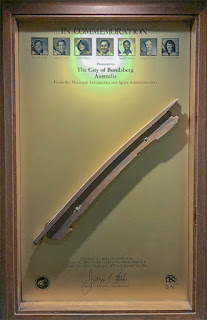
You may wonder what NASA’s Space Shuttle has to do with our Mr Hinkler. It is a little convoluted but stick with me. The Hinkler House Memorial Museum and Research Association invites guest speakers to present a lecture to the Association’s members. In 1985 one such speaker was NASA Astronaut Don Lind, having just flown as Mission Specialist and Payload Commander on Space Shuttle Challenger flight STS-51-B. As a thanks for the lecture the Association presented Don with a small wooden section of wing spar from Bert’s 1911 glider.

Now, Don Lind was a friend of fellow Astronaut, Shuttle Pilot and later Shuttle Commander, Dick Scobee. As Dick was due to fly as Shuttle Commander the following January on flight STS-51-L, Don had asked Dick to carry the glider fragment into space to honour the memory of Bert Hinkler’s aviation achievements and contribution to human flight. As fate had it, flight STS-51-L was launched with the knowledge that the icy conditions were unprecedented and may cause issues with the gas seals on the solid rocket boosters. Lind, on his first and only space flight, and Scobee, had flown previously on Challenger but this flight, Scobee’s second, was to end in tragedy. Just 73-seconds after lift-off, Challenger suffered a catastrophic failure exploding 46,000ft above the South Atlantic Ocean. None of the seven crew onboard survived. The fragment of Bert’s glider never made it into space. But that wasn’t the end of the story.

A Survivor

Incredibly, the fragment of glider survived the explosion and was discovered among the 15-tons of wreckage recovered from the ocean. In 1987 Dr June Scobee, Dick Scobee’s wife, visited Australia on behalf of NASA and presented the mounted fragment of Bert’s glider to the Association from where it began. It is now on display at the Hinkler Hall of Aviation in Bundaberg.

Bert’s UK House – in Bundaberg

Bert Hinkler’s name lives on in aviation having his name carried on one of Qantas’ Airbus A380 aircraft. In fact so strong is Queensland’s admiration for Mr Hinkler that his entire UK house was demolished brick by brick and transported half way around the world and rebuilt in the Bundaberg Botanic Gardens where the Hinkler Hall of Aviation now stands.

Regarding the house relocation, I have to confess, this one puzzles me.

What is Discovery Down Under?

www.discoverydownunder.com is our travel blog in words and pictures, recording our Australian adventure in a Land Rover Discovery 5. But it’s not just about us, it’s about the car too – as yet we don’t know of anyone else taking the latest Disco around Australia. But, of course, if you hear of anyone, let us know.

Share our adventure with us, the discoveries, the lessons learnt and the mistakes we will be sure to make as newbies.