How many first time caravan owners hit the road without any prior training, especially reverse tow training? I suspect the majority.
You must pass a test, both theoretical and practical before you get a car driving license and nothing in that process prepares you for towing a trailer or caravan. Even then you have to display provisional plates to warn other road users that you are inexperienced.
So how can you just hitch a 2-tonne plus caravan and take-off without any experience? Well, simply, it’s just not a legal requirement in Australia and no amount of reading books, magazines or Googling can prepare you for the reality of towing a rig on the open road for the first time. That’s where professional training is the sensible solution and one that should be compulsory just as it is throughout Europe.
I’ve towed a long trailer previously but that was forty-years ago with a slow farm tractor on private land. And I could see clearly behind and over the top of the trailer. Knowing our lack of experience we had pre-booked a training course for January with Getabout Training Services who run the Tow Ed training courses around Australia.
On with the Training Wheels
It was an early start to be at the Sydney Equestrian Centre at Horsley Park for 8.15am and something wasn’t quite right with our 10-day old Land Rover Discovery 5. Exiting the M7 motorway we both noticed a strong ‘hot’ smell inside the car and not the type of odour normally associated with a new vehicle. Something somewhere was hot but the engine temperature showed normal and no warnings were displayed on the instrument panel. So we continued on with a close eye on all the gauges. And the smell, whatever it was, soon cleared. Shortly after we arrived at the training site to be greeted by Graham our trainer and the other two couples who had just arrived.
A little Theory
Supplied in advance of the training course is the Australian Practical Guide to Towing and the Practical Guide to Modern Towing DVD, which explains everything you need to know to get you going; all the abbreviations for weight measurements, how to balance the load between tow vehicle and caravan, hitching your trailer, reversing, parking, safety, laws and regulations and much, much more. This was now reinforced with a short introduction and quiz with Graham and our fellow trainees.
Next came a practical walkthrough explaining how to safely reverse the tow vehicle up to the caravan hitch and how to connect, and in what order, the chains and cables making sure all the lights, turn indicators and brake lights are operating correctly – and what to do if they aren’t. Something we weren’t aware of other than for practical reasons is the need to have all blinds in the caravan lowered – to allow police to check if anyone is riding in the van.
A change in weather and it’s all backwards
The forecast had been for rain and we had escaped it… up until now. However, not letting the heavy rain put us off, Graham’s clear instructions soon had us each reversing 50-metres or so between cones in a straight line… or as close as we could without turning the cones into fresh roadkill. This turned out to be much easier than we had anticipated and certainly a confidence boost.
The Reverse Procedure
Watching the back of the caravan through the driver’s side extended mirror, not so easy when it’s covered in rain, and looking for more or less of the van to appear would guide us to which way we should apply correction. If more of the van starts to appear on the driver’s side then simply steering briefly to the right corrects the drift and to the left if the van moves more in the opposite direction. That is, steer into the error.
Taking it slowly is the key as is making sure your travel partner is keeping an equally close eye on the surroundings and giving clear instructions but remembering the driver is the person in charge of the vehicle combination. Whether you find it easier to take steering instructions from your partner or steer based on the direction you see the van move is your choice – whichever works for you. It’s also a good idea to have your hazard lights active while reversing on a caravan site.
Smooth Arcs
Next up was turning the car and van in a smooth arcing circle. The idea being to start and end a full circle in exactly the same position. Full lock to the right then backing-off half a turn was all that was required – no further steering input was needed no matter how unintuitive it felt and you really do feel like you need to straighten the steering wheel but don’t be tempted. One circle completed as described and now the same but in reverse – it should be as simple but again unintuitive, at least that was the plan.
Reverse selected and gently pressing the accelerator and… nothing. No matter what I did with the right foot the car and van would not move. We were on a very slight incline but certainly nothing the car should remotely struggle with. Even as Graham advised, selecting low-range made no difference. It was then that I noticed a warning appear on the instrument panel and it wasn’t encouraging, ‘Gearbox Overheat’.
Now the Discovery is a seriously capable 4WD vehicle that should have absolutely no problem pulling or pushing a 2.8-tonne caravan. Whatever was happening was far from normal. It was a good opportunity at this point to break for lunch and let the transmission cool down.
Lunchtime sheltering from the rain was a good opportunity to chat with Graham and the other trainees, share experiences and ask questions about the morning’s training.
Reverse parking made simple(r)
90-degree reverse parking was what the training this morning had been preparing us for. Catherine took the lead, and following Graham’s instructions, performed a perfect 90-degree park – first time around, and then another and another. How could it be this easy? Surely some dark magic is going on here.
Well that magic is explained by correctly positioning the caravan to start with. The rear of the caravan should align with a position two strides out and three strides at 90-degrees to the point you want the van to align with, remembering to extend the start point if you need to leave extra space for a slide-out. Starting with a full lock to the right and backing-off a half turn, reverse until close to the jackknife point and stop. Then full lock to the left, reverse until you reach the opposite jackknife point and you should now be aligned and backing straight into your site. Any final adjustments are made exactly as you would at the beginning of the day’s training – straight line reversing.
On larger twin-axle vans you may get to a position where you cannot correct the turn in the remaining space available. In which case drive forwards and the caravan magically straightens itself. Practice of course makes perfect and throughout our upcoming trip we will certainly get plenty of opportunity.
A little tense
An important point to remember once reverse parked is the tension built up in the suspension of twin-axle caravans. Unhitching the van in this state can cause the drawbar to jump sideways as the tension is released. All the more reason to use chocks and keep the chains attached while unhitching. This is also the cause of loosening wheel nuts, which should be checked every time the vehicle has been reverse parked.
One of Graham’s many helpful tips to identify the point prior to a jackknife is to apply a tape marker on the front of the van at a point the driver can just see in the driver’s mirror along the line of the car to the rear. The same process applies for the opposite jackknife point.
Computer says I’m too hot
So now it was my turn and having cooled the transmission down a little it started well with my first 90-degree park with just a few adjustments but then it all came to a halt – ‘Gearbox Overheat’. We were using low-range as advised by Land Rover but something was clearly wrong and the car, again, refused to move. Our only option was to allow the transmission to cool further and call it a day as far as the training was concerned.
How were we going to drive around Australia like this? The car was only 10-days old and it couldn’t cope with an unloaded caravan.
We didn’t know if we were going to be able get the van home so Graham helped arrange for us to leave the caravan on-site for a couple of days while we got the car back to Land Rover.
Press here for Help
A great feature of the Discovery and several other models is Land Rover Assistance. A button in the car calls the Assistance service using an inbuilt SIM that uploads diagnostic data from the car and opens a phone line to a support operator. It wasn’t possible to identify the fault directly but the fact that the radiator fan had never operated during the day was a clue. Land Rover offered to have the car towed but we managed to get home without the van in-tow.
The following day a loan vehicle was provided while Land Rover got to work trying to find out what was wrong.
The caravan was towed back to our storage site thanks to Jayco Sydney and assisted by Jaguar Land Rover.
Two weeks later and we received the call we had been waiting for. Land Rover believed they had identified and fixed the fault following advice from the UK manufacturer. The suspicion was a failure with the thermostat in the transmission oil cooling system requiring the radiator and associated components to be replaced.
The best way to confirm a fix and complete our training would be to attend the Tow-Ed course again and gratefully Jaguar Land Rover agreed to cover the cost. We’ll have to wait a few weeks now for the next available slot on the course.
… to be continued.


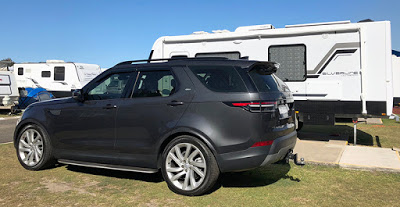
 Discovery Down Under