Whitsundays Cruise

Our final pre-booked trip sees us cruise around the Whitsundays onboard SeaLink’s Reef Quest III, a new and fast, powered catamaran. SeaLink provide courtesy coach transfers from several pickup points in and around the Airlie Beach area for the short drive to Shute Harbour, around 10-minutes from central Airlie Beach.

Whitehaven Big Island Day Tour

Our choice of cruise with SeaLink is the ‘Whitehaven Big Island Day Tour’ taking in North and South Molle Islands, Cid Island and Hook Island, which we saw from the air yesterday but this time cruising through the narrow Hook Passage before taking anchor at Tongue Point. From there we transfer to the beach aboard the ship’s tender to walk up to the Hill Inlet viewpoints before sailing around to Whitehaven Beach for a bush-walk or to pass a couple of hours wandering along the 7KM beach before returning back to port via Chance Bay, Hamilton and Dent Islands.

First impressions

Stepping aboard Reef Quest immediately impresses with two large, immaculate and brightly lit indoor cabins with plenty of outdoor seating also available for those who enjoy the cool sea breeze or keeping a lookout for wildlife. Tea and coffee facilities greet you in the air conditioned dining cabin with large viewing windows and comfortable banket seating.

SeaLink’s Reef Quest III

All aboard

We’re soon underway with the morning snack of fresh fruit and muffins being served. The ship can carry 280 guests but limiting each cruise to only 84 means there is no problem finding a seat or waiting too long to be transferred by tender at each landing.

SeaLink Whitehaven Big Island Day Tour route

Our skipper was also our guide while onboard and ran a commentary throughout most of the cruise detailing the history of the Whitsundays and facts about each of the islands as we passed them. He also kept an eye out from his high vantage point for whales and it wasn’t long before we started sighting them. Perhaps not quite as close as you would see on a dedicated whale watching tour but very visible and on several occasions very active breaching high in the air and creating a huge splash as they dropped to the sea. Giving maximum viewing time the skipper slowed right down to give everyone the opportunity to take a photograph or ‘oooh’ and ‘aah’ each time a whale launched itself into the air.

Humpback Whale breaching

Back on course and speeding towards Hook Passage it was very noticeable that the sea was beginning to churn with waves forming as the tide was being squeezed between the adjacent islands. Next, turning to the south and we’re into clear water again passing along the coast of Whitsunday Island heading for anchorage just to the north of the spectacle that is Hill Inlet. Yesterday we got stunning views of Hill Inlet from our flight above but today was our opportunity to view the swirling sand and sea formation from a vantage point with our feet firmly on solid ground.

Tongue Point to Hill Inlet

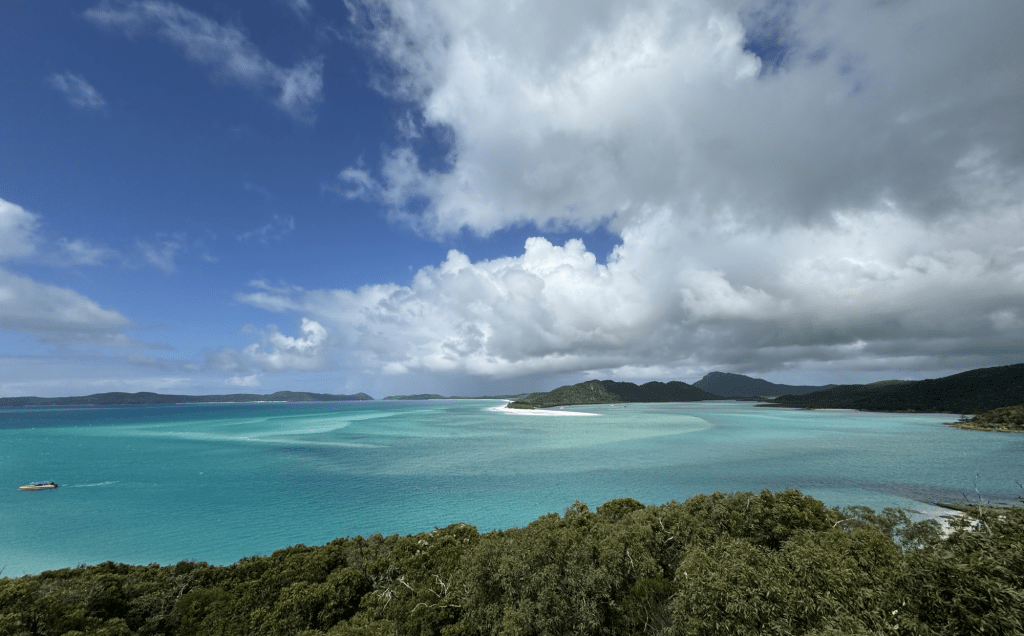
Our boat set anchor in a sheltered bay at Tongue Point to transfer passengers to shore ready for the bush walk up to the Hill Inlet viewpoints. It’s a relatively easy walk with many well built steps to negotiate as it passes through native vegetation and small trees. Brief glimpses of the sea tease before reaching the summit and then a short decent before opening out to the first of three viewing platforms. And what a view! Although quite busy with our three groups amongst others, it was easy to get to the front of each platform. It wasn’t the best weather for photographs today with rain in the distance and low, patchy cloud but the scene was still stunning with the swirling and twisting Hill Inlet passage making its way further into the Island’s interior. Created by the ever changing tides, the wavy patterns are constantly changing with the best views to be had at low tide. To the left of the passage, and continuing into the distance, is the famous Whitehaven beach, which we will be stepping onto next.

As the three groups began their walk back to the beach, I stayed on a little longer when I noticed a gap starting to open up in the cloud shading the inlet. It was well worth the wait to see the sea light up in such a stunning shade of turquoise. It could only have been better if the tide was a little lower.

Before long we were being ferried back to our boat and enjoying a delicious buffet lunch the crew had laid out for us while we continued around to Whitehaven Beach.

Hill Inlet from Tongue Point Lookout

Whitehaven Beach

Our ship’s tender ferried us to the beach giving us two hours to wander, take a guided bush walk or just laze around in the sun. We chose to walk along the almost deserted beach and paddle in the surprisingly cool water for a kilometre or so before sitting under the shade of a tree and watching the waves lap gently against the shore. The beach sand has a few unusual characteristics; being almost white allows it to reflect away most of the intense sun meaning it’s actually cool to walk on and even squeaks as you do so. It is also extremely fine and, apparently, makes an ideal polish for jewellery. I’m sure our feet felt softer after our walk too. Local myth even suggests NASA took advantage of the silica’s purity using it to create glass for the Hubble Space Telescope. When questioned if the story was actually true, allegedly the response was, “um, we may have done.” That’s a ‘No’ then.

Whitehaven’s 98% pure silica beach really is quite special, though, and something of a quandary. Sand is usually deposited on shore from local sources such as finely broken down rock, coral or sea shells. Here, however, there is no known source of silica of such high grade anywhere nearby. It is believed to have been deposited here potentially millions of years ago and is such an important and irreplaceable asset that it is legally protected with heavy fines for anyone attempting to take home a ‘souvenir’ of their visit. That is, of course, unless you are Oprah Winfrey, who’s advisers clearly didn’t make her aware of the rules.

The beach does, however, have a claim to fame being regularly voted best beach in the world and was featured in the ‘Pirates of the Caribbean – Dead men tell no tales’ feature film. Prior to, and during, filming the production company bought every available day trip and boating adventure in the area to ensure the beach was free of tourists and the sea clear of any boat that didn’t fit the era. And just to add to the authenticity of the ‘Caribbean Island’ it was standing-in for, the production crew planted palm trees along the beach, which natively do not grow on the island. After production ended they were removed and replanted at Airlie Beach.

Wildlife

There is plenty of wildlife around the Whitsunday Islands both on land and in the sea. Snakes such as pythons and grass snakes are common but there’s also the highly venomous eastern brown and taipan, though mostly found around properties or sunbathing on the roads. Dugongs, countless reef fish and six of the seven species of turtle in the world call the Whitsundays home and not forgetting the migrating whales, white and blacktip reef sharks, manta rays and several species of dolphin. Of course being in the Australian tropics means stinging jellyfish, some of which can be lethal, should be avoided during their most active time between October and May – probably not the best time of year to go swimming. And I suppose I should mention the common ‘handbag’, known also as the saltwater crocodile, is present in these waters. Usually confined to rivers and river estuaries they do often wander further afield in search of a decent meal. But for us, apart from the odd spider and sea birds, all we saw was a friendly Lace Monitor scavenging for food.
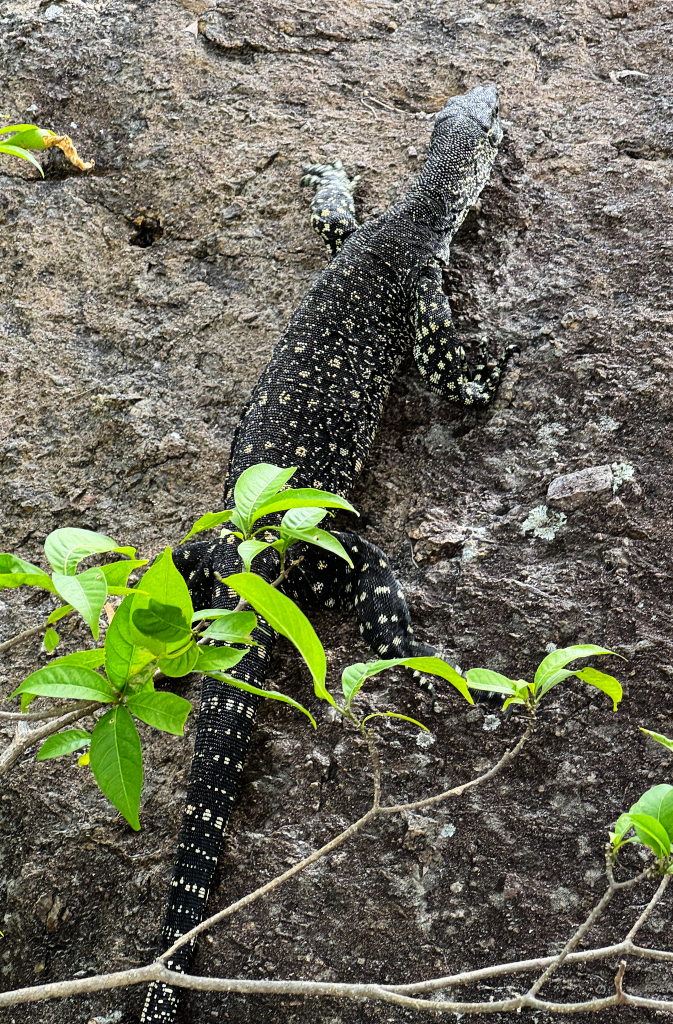
Australian Lace Monitor

The lace monitor is both active and highly agile being just as happy walking along the ground or climbing up rock faces or trees in search of a tasty morsel… and growing up to two metres in length, big enough to scare the life out of an unsuspecting tourist!

Heading for Home

Back onboard we settled in for the return leg of our cruise passing between Whitsunday and Haslewood Islands to follow the southern coast of Whitsunday Island through Chance Bay admiring some exclusive properties. We skirted Hamilton Island, home to a few eye wateringly expensive resorts such as the hyper-exclusive, 6-star ‘qualia’ resort – deliberately written with a lowercase ‘Q’ and a registered name to boot – now that’s exclusive! Well, Chris Hemsworth, Taylor Swift and Johnny Depp must think so being just a few of the celebrities that have stayed there.

Finally passing by Dent, Henning and Long Islands we arrived back at Shute Harbour after a thoroughly enjoyable day, made all the more special by good friends of ours who we have been sharing this week of adventures with in and around Airlie Beach.

A Grand Day Out

We’d highly recommend SeaLink’s ‘Whitehaven Big Island Day Tour’ suitable for all ages with the added opportunity to see whales during July to October and at the very least some magnificent scenery.

More details available from SeaLink’s website.

Heart Reef

Our second day at Airlie Beach and it is an extra special one as we take to the air flying over two famous landmarks and the possibility of sighting whales.

Wasabi

Flying from Whitsunday Airport, just 8-minutes from Airlie Beach, our flying adventure is onboard the Australian designed and built GippsAero GA8 Airvan delightfully named ‘Wasabi’. Unlike commercial passenger planes, Wasabi is designed for short flights with maximum visibility for those onboard. Little legroom, noisy, a low ceiling and certainly no reclining seats on these flights but that just adds to the experience of the real sensation of flying in small aircraft – turbulence and all. As with all aircraft, though, safety is the priority and our pilot Sam took us through the emergency procedures including wearing and operating our life jackets as we were to fly over water.

Our aircraft – the eight-seater ‘Wasabi’

Turbulence

It should be noted that the location of the airfield in a narrow valley is known to experience strong and gusty winds and that was certainly the case as we took-off and made our first turn. It soon settled, though, as we headed out over water with great views along the coast to Airlie Beach and the islands that make up the Whitsundays.

Scenic flight route through the Whitsundays

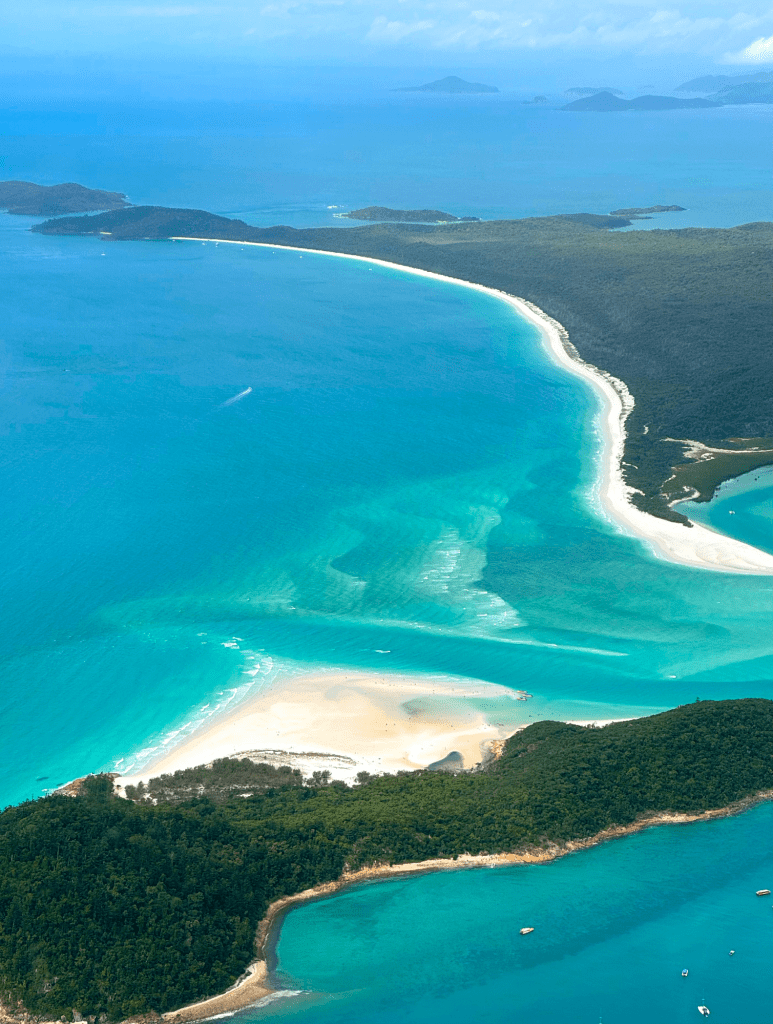
We were soon flying past Daydream Island and south along the tip of Long Island with the largest of the islands, Whitsunday, to our left. Then passing over Hamilton Island known amongst others riches for the famous Hamilton Island Race Week, which attracts ‘yachties ’ and spectators from all over the world. Next was one of the main sights we were looking forward to on this trip, Hill Inlet, surely amongst the most spectacular views in Australia if not the world. The weather wasn’t quite on our side, though, with some low cloud and rain in the distance but it was expected to clear further off the coast.

Hill Inlet from 2000ft with Hamilton Island just beyond

Throughout the flight Sam gave us a comprehensive commentary about the European’s first discovery of the Whitsundays and the Ngaro people’s 9,000-year history of the region. The Ngaro, also known as the ‘Canoe people’, travelled between the islands using sturdy canoes made from lengths of Ironbark timber held together by fibrous roots. In addition to the myriad forms of tropical reef fish calling the waters of the Whitsundays home, sharks, manta rays, stingrays, dolphins, migrating humpback whales and Dugongs* can also be sighted. The dugongs take advantage of the sea grasses that grow around the islands and protected marine parks.

Whitehaven Beach

A very popular day trip from Airlie Beach is the 7KM long Whitehaven Beach. Known for its 98% pure silica bead sand, which has the advantage of staying cool even on hot sunny days and so fine it can be used as a polish.

The sweeping Whitehaven Beach

It can get busy at times and especially during peak season when multiple day trips coincide. However, with such a long beach it’s easy to find a patch of your own to just sit and watch the gentle lapping waves and remind yourself what a magnificent place you are experiencing.

Whales!

Our flight continued further out to sea and we were now spotting numerous humpback whales breaching and ‘fin slapping’, several appearing to be mother and newborns. It wasn’t that long ago that the hunting of whales had reduced the humpback population to the low hundreds. Now protected, recent observations show a dramatic increase and it is now believed 30-40,000 humpbacks populate the migration route between the Antarctic and far north Queensland.

Over the Reef

Five minutes later, just as the sun appeared through light cloud, we were flying over the inner reef and dropping to 500ft tracking the most stunning coral formations surrounded by clear turquoise-blue water.

The inner Great Barrier Reef

Then came a countdown from Sam with cameras ready as we were about to fly low over our target – the perfectly descriptive Heart Reef. First sighted in the 1980’s the reef has become the emblem of the Whitsundays and is now probably the most photographed coral formation in the world. And finally, there it was.

Heart Reef

Not wanting to miss getting the photograph during our fleeting path over the reef I opted to record video and grabbed the best frame. To ensure passengers on both sides of the plane got a good view Sam did a second pass in the opposite direction.

Climbing once again we headed back to the airport spotting further migrating whales along the way. Final approach to the runway presents just as much of a challenge as takeoff and sitting right behind our pilot it was clear just how much counteracting the gusty wind was required to bring the plane safely onto the runway.

A fantastic trip and scenery we will never forget. The highlight of our trip… so far.

For more information and booking options, checkout Ocean Rafting Scenic Flights

*Also known as Sea Cows or Manatees in other countries.

Airlie Beach – The Whitsundays

Famous as the yachting home of the Whitsunday Islands in Tropical North Queensland, its turquoise water, pure white beaches and its proximity to the Great Barrier Reef.

Airlie Beach and the Whitsundays has been on our bucket list for many years and we’re finally here. It is everything we believed it to be and much, much more.

Hill Inlet tidal patterns

Why so Blue?

The water around the Whitsundays is the most beautiful shade of blue bordering on turquoise and glistens in the intense sun. Although stunning it’s not, as you would expect, crystal clear. In fact it’s positively murky. It is by no coincidence that the sea here is the same shade of blue as a glacial lake and for the very same reason. Glacial water owes its colour to the crushed, powdery rock particles suspended in the water and reflects the light that falls upon it in all directions. In the case of the Whitsundays it is near pure silica that sits suspended giving it a milky look but which has even greater reflective properties.

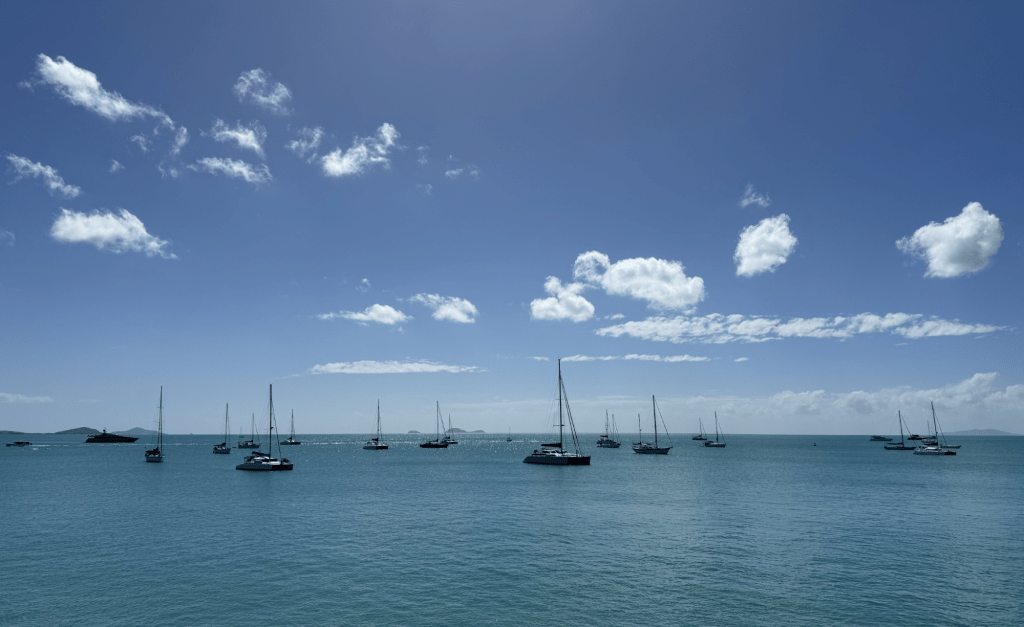
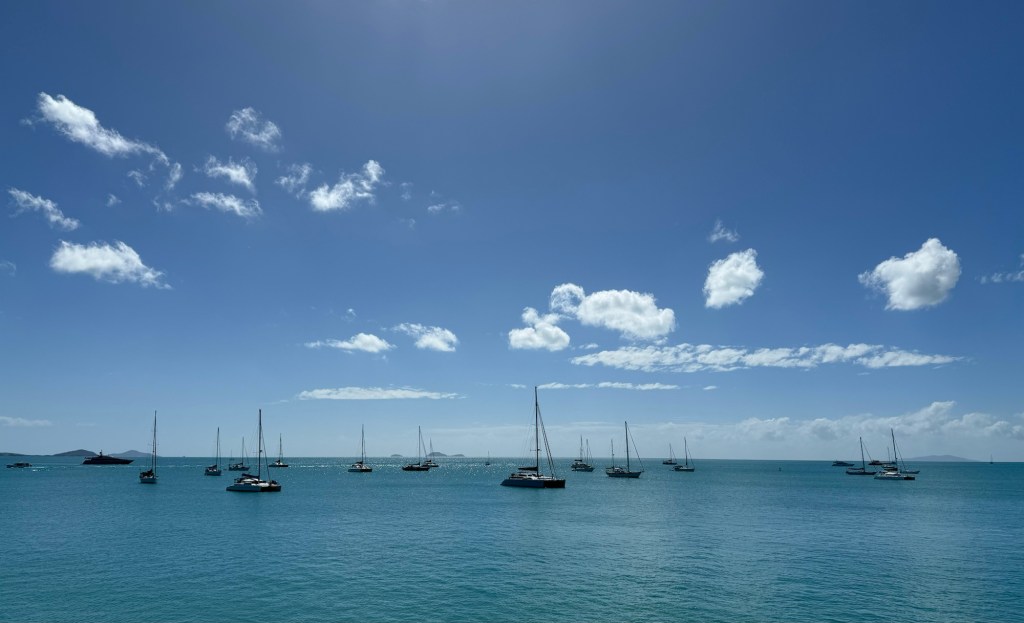
Pioneer Bay – Airlie Beach

A little error in history

Captain James Cook sailed through the Whitsunday Islands in 1770 naming the route between the islands as the Whitsunday Passage and one of the islands in the group Pentecost Island. His journey through the islands was made during the feast of Pentecost, which is traditionally the seventh Sunday (50th day) after Easter. The passage was named after Whit Sunday, meaning ‘White Sunday’ referring to the white gowns worn during the feast of Pentecost. However… on the day Cook named the passage he mistakenly believed it was the Sunday known in the Christian calendar as Whit Sunday when it was in fact a Monday. The Mondays or the Monday Islands just wouldn’t have quite the same ring to it.

Activity Central

Once a small timber, sugar cane and fishing town, Airlie Beach soon became popular as a major Queensland tourist destination. Sugar cane is still a major crop in the region and grown all year round, but Airlie is now the centre for the many active leisure pursuits available to visitors whether on land, sea or in the air. Bushwalking, sailing, kayaking, jet skiing, small boat cruising, body boarding, wind surfing, skydiving and scenic flights are all available for the adventurous. And for those that prefer to soak up the sun the stunning Whitehaven Beach is just a boat ride away.

Day Trippin’

We pre-booked three trips knowing we would be at the mercy of the weather but being peak season we wanted to make sure we got a place on each adventure. First off was a Sunset Cruise on the twin masted, timber hulled ‘Gentleman’s Ketch’ the Lady Enid. Built in 1961 she has competed in five Sydney to Hobart races as well as fifteen Brisbane to Gladstone challenges and was first across the line in the inaugural Sydney to Brisbane Race in 1964.

Lady Enid – Airlie Beach

High winds had delayed the Lady Enid’s return from its daytime cruise, which meant our sunset cruise was late setting sail. It was worth the wait, though, and not just for the included cocktail and antipasto platter as we cruised in near silence with just a single sail set. It wasn’t long, though, before the cool sea breeze sent a reminder that a warm, windproof jacket is very much recommended.

Sunset Cruise onboard Lady Enid

The sunset didn’t disappoint, though, as it passed behind the mountains while creating some beautiful golden reflections on the rippling water. Due to the late departure our return to the harbour was completed in darkness but our skipper did a great job of navigating around the moored boats in the outer harbour and performed a perfect ‘reverse park’ back at the marina.

Lady Enid runs four different tours in and around the Whitsundays and is also available for charter hire. More information and booking details available here: IconicWhitsunday.com.au

Tomorrow we take to the skies and head out to the Great Barrier Reef.

We’ve Started… and we’ve Stopped again

Not quite the way we had intended to head north.

We’re leaving the Sunshine Coast with stopovers at Maryborough, known amongst other things for Mary Poppins, Tannum Sands and Barracrab at Clareview. After a leisurely start, and just 7KM up the road, we came to a grinding halt. Several cars had flashed headlights at us indicating trouble, or a mobile speed camera ahead. It was worse. Traffic was coming to a stop and queuing as far ahead as we could see.

A passing driver, who had just turned around, advised us that a truck had tipped-over its trailer hit a car and completely blocked the road. Fortunately no one was injured but the blockage wasn’t expected to be cleared for at least 3-hours, setting us, and every other vehicle, a long way back. With the road not wide enough to turn around, it was time to setup the chairs, sit it out and top up the suntan.

The long wait

All clear… for now

Fortunately just 2-hours and 30-minutes later we got an all clear in both directions after the truck and trailer had been dragged to a clear space a little further up the highway. It was then we realised just how many southbound vehicles had been held up too after we had driven many kilometres further north where traffic was still waiting to get going again.

Now behind time we were going to be late arriving at our destination of Airlie Beach for the next week. With the sun setting later in the day the further north we travelled we were hoping not to have to setup our caravan in the dark.

As we have found through much of the drive north on the Bruce Highway, so far, the roads were not in the best of shape. Partly due to the previous season’s bad weather and equally the slow process of road repairs, pot holes, dips and rough surfaces were the norm. Bad enough to pull a caravan through, the road surface could be lethal for motorcycles. At least the department responsible for highway repairs made the effort to erect permanent signs indicating rough sections of roadway. It’s a pity equal effort was lacking in fixing the surface. A cynical person may see the permanent signs as a means of avoiding vehicle damage claims.

A very, very close shave

After a brief stop to refuel in Mackay, we continued along the A1 taking a northwesterly track towards Airlie Beach on the coast of the beautiful Whitsundays. Shorty after passing through the small settlement of Bloomsbury we heard on the UHF radio that an accident had taken place in Bloomsbury between a truck and a 4WD vehicle. Expecting the worse we kept a close look ahead for slowing traffic but all we saw were police cars, two ambulances and a fire engine heading in the opposite direction. Somehow the accident must have occurred just behind us as we passed through Bloomsbury. We were hoping it wasn’t a bad one and no one injured.

Airlie Beach at last

After four days of driving with the caravan in tow and a much delayed final stretch, we made it to Airlie Beach by late afternoon and got our first glimpses of the stunning turquoise waters that the Whitsunday’s region is known for.

Airlie Beach… in Winter

In the News

Catching the evening news brought unexpected news. The accident at Bloomsbury was serious. Initial police investigations stated that ‘at approximately 2.50pm, a white 2014 Toyota Landcruiser utility was travelling north along the Bruce Highway when it crossed onto the opposite side of the road and struck a white 2017 Isuzu truck before hitting a white 2018 Cx5, travelling behind the truck.

The driver of the Landcruiser, a 21-year-old Kelso man, and the driver of the Cx5, a 72-year-old Clifton Hill man, sustained serious injuries and were airlifted to Townsville Hospital for treatment.

The passenger of the Landcruiser, a 34-year-old Mundingburra man, the driver of the Isuzu, a 61-year-old Sarina man, and the passenger of the Cx5, a 69-year-old Clifton Hill woman, sustained minor injuries and were transported to Mackay Base Hospital.’

According to the log on our car we had missed the accident by just minutes. At worse we could have been caught up in the collision and at the very least stuck in another delay while the accident is cleared.

We sincerely hope those that were injured have a speedy recovery and suffer no long term effects from the collision.

Tomorrow our adventure in Tropical North Queensland begins!

Bring on the Silo Art

Being a major grain supplier to the world means Western Australia, South Australia, Victoria, New South Wales and Queensland are littered with giant grain silos. Highly visible from the road and railways and a feature of the Wheatbelt, these bland concrete structures are in need of a makeover. Time then to get the paints out.

The Silo Art Trail

After 3-months in Tasmania we’re back on the Mainland and on the trail of Silo Art. We saw our first painted grain silo back in 2017 on an edition of Australia’s TV show MasterChef. The show’s contestants faced the challenge of cooking outdoors for invited diners beneath a giant mural painted on Brim’s grain silo in country Victoria.

It started in the West

What began as a series of painted silos at CBH Northam Grain Terminal in Western Australia in 2015 soon started a trend attracting Australian and international artists to create these immense works of art across the country. And it wasn’t long before communities and regional councils realised the potential of attracting tourists to their small towns putting them on the map as a destination rather than a town to pass through on the way to somewhere else. And there began the Silo Art Trail.

Back on the Trail

During our Big Lap of Australia in 2019 we stopped at many of Western Australia’s Silo Art locations as we headed south and again after crossing the Nullarbor into South Australia. A family emergency overseas meant we had to skip the many silos of Victoria but now, heading back from Tasmania to our home in Queensland has given us the opportunity to visit many of Victoria’s silos, two in New South Wales and one in Queensland.

Silo Art – Victoria

Horsham – Although not the first silo to be painted in Victoria, Horsham Silo was the first on our trail. Painted by artist Sam Bates (aka ‘Smug’) in May 2022, it depicts the western Victorian aboriginal man, Yanggendyinanyuk, who was one of a team of 13 indigenous cricket players who formed the first Australian cricket team to tour England.

Horsham Silo – Victoria

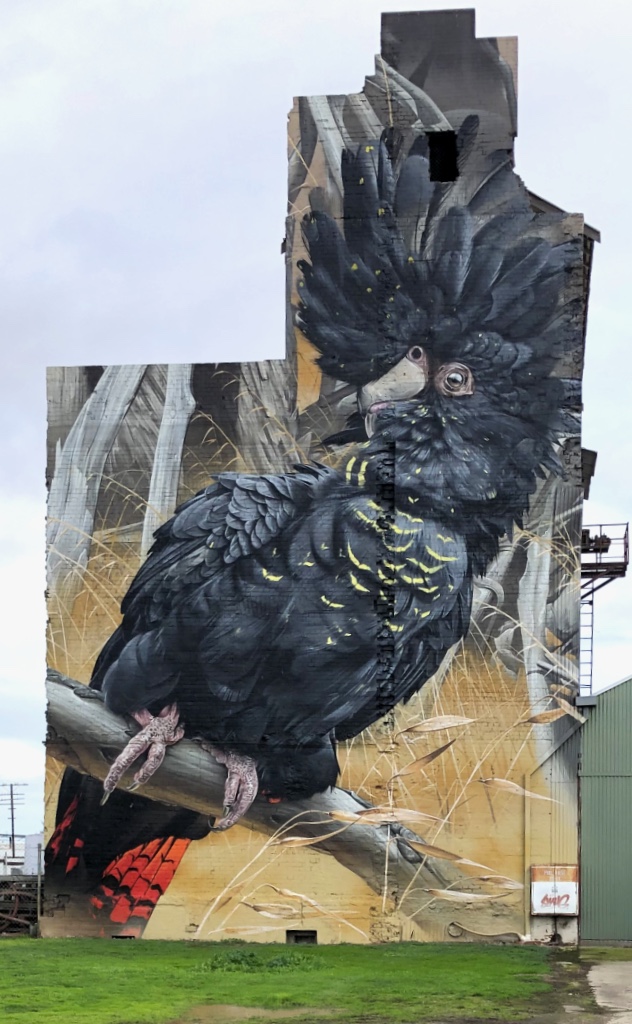
To the left of the silo, and partly obscured by a steel fence, is another highly detailed mural by Sam Bates, this time of a Red-Tailed Black Cockatoo. Many people were unaware of the second mural and so Sam returned to paint the wall in front of the silo in May 2023 to link both murals together while giving the visitor a rare close-up view of the stunning detail of the artwork.

Red-tailed Black Cockatoo – Horsham

Murtoa – Better known for the incredible Stick Shed, Murtoa has also received the painted silo treatment by Sam Bates. Situated in the town adjacent to the railway line and a series of rusting silos, Sam’s artwork has to compete with the graffiti decorated rail cars. The painting highlights 29 species of bird that can be found in the Mallee region and a radiant bird said to represent the one in 30 Australians who experience a Bipolar condition.

Murtoa Silo by artist Sam Bates – aka ‘Smug’

Rupanyup – Next stop on the trail travelling northwards is the twin silos at Rupanyup. Here a convenient visitor shelter has been constructed opposite the silos detailing the many crops grown in the region.

Rupanyup Silo – Victoria

Created by Russian artist Julia Volchkova in 2017, Rupanyup’s twin silo artwork features local residents and sports members, Ebony Baker and Jordan Weidemann.

Sheep Hills One of the more remotely located but accessible silos is the GrainCorp Silos at Sheep Hills. Painted by mural artist Matt Adnate in 2016, it features Wergaia Elder, Uncle Ron Marks and Wotobaluk Elder, Auntie Regina Hood, looking toward the two young indigenous children, Savanah Marks and Curtly McDonald.

Sheep Hills Silo – Victoria

What sets these silos apart are the vibrant colours Matt chose, the detail in the children’s faces and the deep violet of the sunset blending into the deep-black star-trail sky.

Brim – Completed in January 2016 by Australian mural artist Guido van Helten. The GrainCorp silo in the township of Brim was the first silo to be painted in Victoria and only the second to be painted in Australia. It marked the beginning of the silo art trail of Victoria.

The murals depict four hardy, weather-beaten farmers who share the typical resilience needed to farm in the Wimmera Mallee region.

Brim Silo – Victoria

Guido, a talented mural artist, had been looking for a silo to paint and, working with the help of Juddy Roller Art Management, the owners GrainCorp and the Brim Active Community Group, Guido got the go ahead to create a mural on Brim’s silo. But the weather made the task far from easy with extreme heat, strong winds, a dust storm and lightning. Guido often took a break during the afternoons to escape the worst of the heat before returning to continue during the cooler evenings.

Rosebery Silo – Victoria

Rosebery – Created by Melbourne artist ‘Kaff-eine’ and completed in 2017, the Rosebery Silos are said to depict the region’s past, present and future. The left silo shows the future with the stylishly dressed young female sheep farmer wearing turned-down cowgirl boots, jeans and cotton work shirt. By contrast the right silo displays the current and the past with a contemporary horseman dressed in an Akubra hat, Bog boots and oilskin vest.

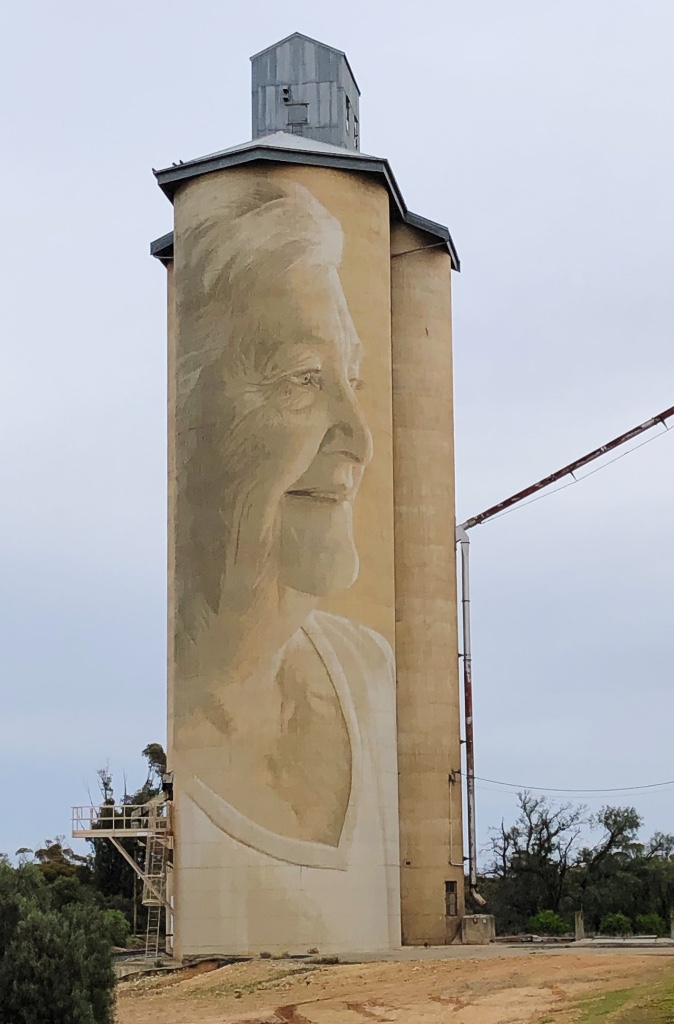
Lascelles – Another of the monochromatic style murals, this time in the settlement of Lascelles 26KM northeast of Hopetoun. Painted by Melbourne-based artist, Rone and completed in mid-2017. Deliberately using muted colours similar to the existing concrete so as not to distract from the environment.

Local farming couple, Geoff and Merrilyn Horman were chosen as Rone’s subjects for their family’s four generations as local farmers in Lascelles. Pictured below is just one of the two images.

Lascelles Silo – Victoria

For photographers, access to the site is difficult due to private land and the adjacent railway.

Patchewollock – Another highly detailed mural featuring local character Nick ‘Noodle’ Hulland. Painted by Brisbane artist, Fontana Magee in 2016 who had spent time in the local pub looking for a suitable subject. According to Magee, Noodle was a rugged, no-nonsense and lanky character ideally suited to the narrow 35-metre twin silos. With his squinting gaze and sun-bleached hair, Noodle was a reflection of the harsh and challenging environment of the Wimmera Mallee.

Patchewollock – Victoria

Silo Art – New South Wales

Not to be outdone New South Wales has got in on the silo painting act too and has begun commissioning artists to paint both grain silos and water towers to entice tourists and passing trade in an effort to boost the local economies.

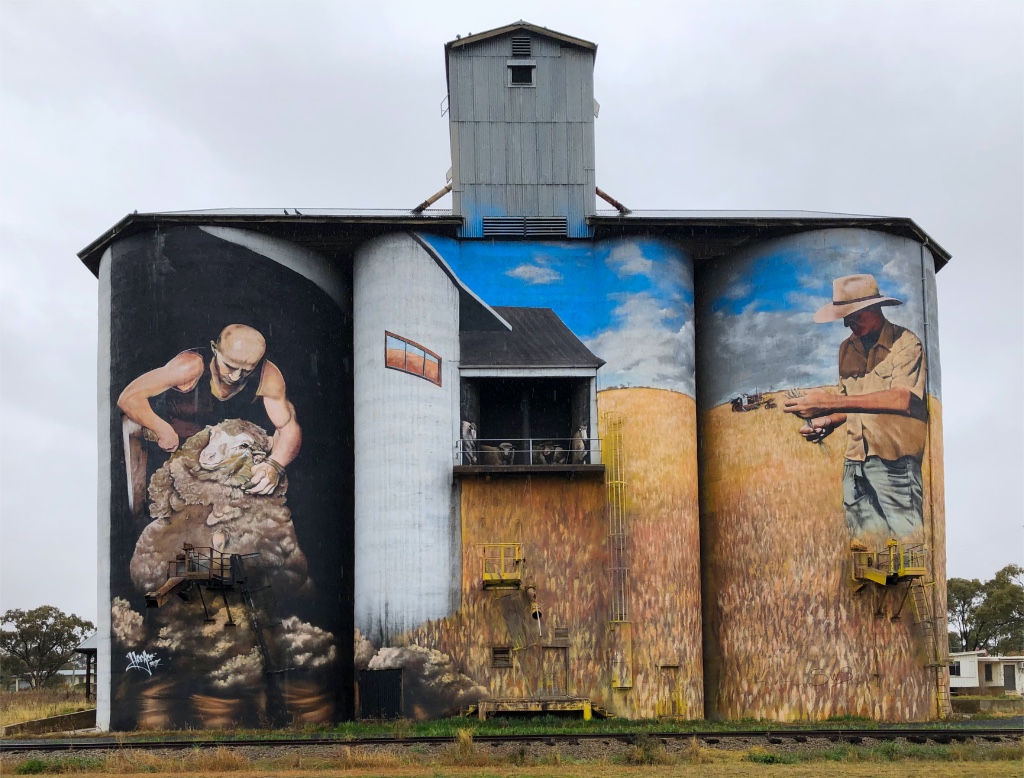
Weethalle – Artist ‘Heesco’ completed painting the silo in July 2017 as a tribute to the agricultural heritage of the small town of Weethalle and the surrounding communities of Bland Shire.

Weethalle Silo – New South Wales

Depicting a typical farming community, Heesco’s image displays the annual task of shearing sheep, a farmer checking the grain readiness for harvest and, curiously, a small flock of sheep standing high on a balcony looking out and enjoying the view.

A dedicated car park with ample space for caravans has been provided to encourage passers-by to stop for a while.

Hay – Like many small country towns in Australia the First and Second World Wars took their toll on the young who took up arms to protect the nation and join the raging wars in Europe and the Pacific. In recognition and memory of those brave soldiers and nurses from the town of Hay in New South Wales, artist Matt Adnate was commissioned to paint five of the veterans from among the hundreds who answered the call. Those selected were Private William ‘George’ Cannon, Corporal Cliff Farlow, Private Norman Flack, Australian Army nurse, Lieutenant Lorna Margaret Whyte and indigenous soldier Private Victor George Murray. Display boards at the site tell the unique story of each of the individuals.

Hay Water Towers – New South Wales

Although water towers and not silos, the towers form part of the Australian Silo Art Trail.

Silo Art – Queensland

Yelarbon – Closer to home and the last silo on our homeward bound trip. Another of GrainCorp’s silos and one of the largest groups of painted silos. Painted in two stages between 2018 and 2020 by artists Jordache Castillejos and Jordon Bruce from the artist collective, Brightsiders along with Steve Falco of ProcreatiV.

Yelarbon Silo – Queensland

The mural is titled ‘ When the rain comes’ and depicts a young child sailing a paper boat as it crosses the nearby Yelarbon Lagoon and traverses the six smaller silos. The boat is said to have been made from old newspaper cuttings found in the town’s historic jail and symbolises the history of the region.

There’s more to come

There are many, many more painted silos across Australia and the number is set to continue in the years to come. To date we have visited just a small collection of what is surely the world’s largest outdoor gallery.