Hervey Bay

First of all, Hervey Bay is just that – a bay, or rather a coastal bay. It’s name is well enough known but should be thought of more as a region than a destination. The coastal region comprises three beachside neighbourhoods; Urangan to the east and nearest to Fraser Island, Torquay in the middle and Scarness to the west. There’s little to separate each with beachfront houses and motels linking them together.

We are staying at the Pier Caravan Site in Urangan. It’s a new site with very modern facilities and a number of 45-degree slabs and driveways making reverse parking much easier. The only downside, there is no shade – at least until the newly planted trees have grown tall enough. It’ll be more of an issue in the summer but fine for the rest of the year. You also feel as though you are in suburbia with the site surrounded by houses.

Urangan Pier – All 868-metres of it

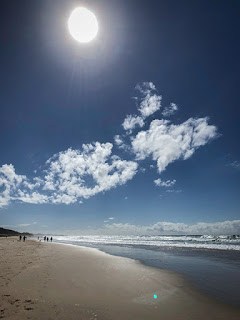
Urangan, incidentally the Aboriginal name for a dugong*, is home to an enormous pier, which provided deep water access to what is otherwise a very shallow bay for freight and produce being sent by rail to and from nearby Maryborough. Sadly no longer used for freight and at one stage being demolished, local residents campaigned to save the pier – well most of it. Originally reaching 1.1KM out to sea but only 868-metres remains. That’s still huge and a good return walk at the start of the day to watch the sunrise over Fraser Island and again at the end of the day to watch the sunset in the west.

Another popular walk is the 17KM beachfront Esplanade. Ideal on a sunny day with many trees providing shelter and pleasantly warm in the winter.

Hervey Bay is probably best known for its whale sightings, regarded as the best place in the world to watch Humpback whales. The humpbacks rest and play in the bay for a few days at a time as they head from the Antarctic to their breeding and birthing grounds of the Great Barrier Reef. The whales appear along most of the east coast of Australia and Hervey Bay in particular between July and October. The timing of our trip means we’ll most likely miss the whales but at least the temperature will be more comfortable and much lower humidity… and we can always return!

One of the main reasons for visiting Hervey Bay, though, is to explore Fraser Island, the world’s largest sand island and the only one with a rainforest. And that’s where we are heading next.

  • Dugong – for our international friends a Dugong, also known as a sea cow, is a large ocean living mammal with front fins or paddles used like legs and a large fluke tail, similar to that of a whale. Partial to sea grass the Dugong is found mostly in shallow tropical and subtropical waters where it has easy access to food, which it eats with its huge, cow-like mouth.
Coolum to Hervey Bay

We were sorry to leave Coolum Beach today but breakfast at Ma Boulange cafe certainly helped us on our way.

Today we are heading north again and this time to Hervey Bay, pronounced ‘Harvey Bay’, or ‘Her vay Bay’ if our English speaking GPS navigation is to be believed. It’s a trip of 202KM on mostly motorways though the word motorway here in Queensland seems to be quite loosely defined.

It’s an unexpectedly interesting drive through rolling tree covered hills and winding roads lined with sugar cane plantations. It is far removed from the dry, open countryside of country New South Wales. But eventually we joined the Bruce Highway at Yandina and the road opened up but we were still surrounded by lush vegetation. It was also quite hilly but nothing that upset the car and caravan.

M1 Needs Funds

Just north of Coles Creek it appears the motorway construction budget ran out of funds and comes to an abrupt stop off to the right of us. Fortunately our route veered slightly to the left becoming the A1 and a reduction to two lanes though still easy driving.

Our GPS announced we were approaching the town of ‘Jimpy’. She does try, bless her. We were actually approaching Gympie, pronounced ‘Gim pee’, which owes its early affluence to the discovery of gold in 1867. At the time Queensland was in a severe economic depression and it is believed the discovery of gold here saved the state from bankruptcy. Unfortunately the money hasn’t saved the town from the severe periodic floods it experiences sitting beside the Mary River.

After a brief stop for lunch we had reached our halfway point. The majority of the trip weaved it’s way along the Mary River valley taking the lowest point to avoid constructing roads through hillsides. Finally we took a turn towards Maryborough, which has an unusual claim to fame and currently quite topical, but more about that later when we return to explore the town.

Urangan

Just a short while later and we were arriving at our next stopping point, Urangan, Hervey Bay. And a very pleasant place the Pier Caravan site is and very close to the enormous Urangan Pier, more of which later.

Being by the sea it’s almost compulsory to have fish and chips and not to break tradition we stopped by at a local shop and enjoyed battered cod and a huge tray of chips. And shortly after, feeling more than a little guilty, we set off along the foreshore to walk-off the excess. And then along to the end of the pier and back while watching the sun set over the sea.

Tomorrow we’ll be exploring the area further and planning a trip over to Fraser Island – the world’s largest sand island.

Coolum Beach Walks

Coolum Beach is a great place for a walk along the shore and especially so today now the recent showery weather has gone… for the moment at least.

Coolum Beach

The warm breeze from the sea increases the humidity and salt spray in the distance limits the view but it is still a comfortable temperature for a good walk. A brisk walking pace is made easy with well compacted sand, which is spotlessly clean with no wind blown junk or plastics but surprisingly few seashells scattered around.

The beach appears to be as popular with dog owners as casual walkers, though dogs must be kept on leads except where signed – not that many took notice. They were at least well behaved and a pair of Dachshunds decided they wanted to run along the beach with us and kept barking each time we stopped.

Coffee on the beach

With a few KMs under our belts we decided to try a different lunch stop, this time at a place called Bean Head Cafe. I would like to say we would recommend it but when the All Day Breakfast option said to close at 2pm closed at 11.30am, the time we arrived, and a very long wait for our meal, then it is not one for our list of great eateries. But, that said, the coffee was excellent.

We had a few errands to run in the afternoon to prepare for the next leg of our trip but one last walk along the beach was in order – this time with a very tasty Campos coffee.

Setting Sun – Coolum Beach

This time the sun was starting to head behind the trees to the side of us as and the distant clouds were starting to take on the late afternoon sun. We were watching a yacht sailing along the horizon when we noticed a rainbow forming in one of the nearby cloud formations. It looked as though there was a light shower being caught by the sun. Without a long lens at hand it doesn’t show quite as well in the photograph as we saw it.

Glass House Mountains

On our drive from Brisbane to Coolum Beach we passed the almost unworldly Glass House Mountains on our left and we had already decided we wanted to take a closer view. We had been waiting for the weather to improve and today was to be that day.

Mapleton

Although the ground surrounding the Glass House Mountains was decidedly flat, the drive to a good viewpoint was anything but, surprisingly so. And so our climb started through the foothills towards the country town of Mapleton. There was no way we would take the caravan along this climb and the number of slow vehicle passing points was good confirmation. Each passing point also had tight turns so getting up to a speed to overtake would also have been quite a challenge. Fortunately driving at a slower speed also meant we could get a better view of the rolling hills and brief glimpses of the Mary Valley falling further and further below.

We reached Mapleton around lunchtime and picked a local cafe just off the main road for a bite to eat. It just so happened to be a bakery full of pies and pastries of all types, which goes by the name Sweet & Flour so you know just what to expect. Good coffee and very nice cakes.

Montville

View from The Edge Cafe

Our drive continues on the narrow ridge that rises above the Mary Valley on one side and Mapleton National Park on the other. Occasional glimpses between hedgerows shows just how narrow a ridge we were driving along. You would thing this wasn’t the ideal place to build a house but with a view like this clearly many people have chosen to overcome the engineering challenges to build on such a steep hillside. A viewpoint to the east showed just what could be done with a house built completely into the slope of the ground with just round skylights and a steep driveway giving any indication that people lived here.

Montville township is larger than Mapleton and more interesting too. Built along the road, steep in places, is a good range of shops, cafes and restaurants as well as a few of the ‘hippy’ style outlets that seem to be common in the Sunshine Coast Hinterland. For those interested in photography there is an excellent photo gallery by photographer Ben Messina and sure to inspire any landscape photographer.

One of the best viewpoints in Montville just happened to be from the balcony of The Edge Cafe. And it would have been rude to just walk in to take a photo, so a coffee and cake was enjoyed as we watched the showers pass and the view opened up all the way to the coast.

Maleny

The last town on our mountain drive is Maleny, which turned out to be a bit of a disappointment. We were hoping to get a good view of the Glass House Mountains to the south but the narrow ridge leading to the town offered few places to pull over safely, something very common on our trip so far. Turning around to head back to the coast, by chance, we drove past a sign to Mary Cairncross Park that we had been advised earlier offered a good view but from what we could see as we followed the road were just houses along both sides of the road and a park. But, just behind the houses to our left, were sneak glimpses of a huge valley. We drove on a little further and persistence payed off. Not only a stunning viewpoint but a carpark and viewing platform above a park visitor centre. For once we could park and get a good view of something without trees being in the way. And what a view, stretching all the way south to the high-rise buildings of Brisbane on the horizon, 90KM away!

The Glass House Mountains

We had hoped to take a walk closer to the mountains but it was starting to get late in the day and we had quite a long drive ahead of us. Hopefully, one day in the future, we’ll be able to visit the area again and spend some time exploring the region on foot.

And just as we wouldn’t have wanted to drive up into the mountains with the caravan in tow, we certainly wouldn’t have wanted to drive down to the valley floor from Melany either with several sections of straight road dropping at 12% gradient. The steeper the gradient, the more emergency lanes there are and there were plenty on this route.

Crikey!

Today was quite a special day for us both. Besides Mum’s Birthday back in the UK, today was our first visit to Australia Zoo, home of the Crocodile Hunter, Steve Irwin, his wife Terry and their two children, Bindi and Robert. Both children have the same infectious enthusiasm for all forms of wildlife as Steve had and both just as keen to share their world and experiences with everyone. Bindi has built a strong TV following in the USA and Robert has developed a very keen eye for photography.

Crikey!!

There’s a great sense of anticipation when you finally arrive somewhere you have always wanted to visit and today was no different. It wasn’t hard to miss either with a huge billboard of Steve holding a crocodile in his ‘Crikey’ pose right beside the entrance. From the road you would have no idea just how extensive the 1,000 acre zoo is. And, unlike many zoos and wildlife parks, Australia Zoo is maintained in pristine condition, still looks modern despite 2020 marking its 50th anniversary and is beautifully landscaped.

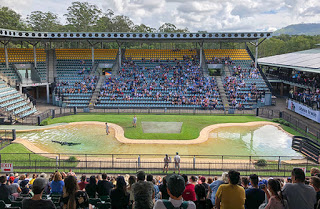
We had arrived just as the crocodile display was about to began and quickly made our way to the Crocoseum, a huge, open air auditorium with a large, shallow pool where the ‘performing’ crocodiles come to feed. I say performing, a large carnivorous animal that can trace its origins back to the dinosaur period, does what it likes, when it likes. But the opportunity of a good feed is too tempting an offer for Alan the saltwater crocodile who takes his time to make an entry despite the encouragement of the handlers. Steve wanted to show crocodiles in a more visual way than through the usual murky waterholes and built the clear water pool in the Crocoseum to that end.

Crocoseum

As we left the show we were greeted with a wombat being towed in a trolley. Apparently it’s easier to move these muscular animals around on wheels than lead them on foot – they are not the most cooperative of creatures. We walked through wallaby and kangaroo enclosures, the kangaroos very at home with humans, especially those with roo food! There’s a Rainforest Aviary and Birds of Prey enclosure, Aldabran tortoises (the worlds largest), a South Asian section with Red Pandas and Tigers surrounded by giant bamboo plants and huge boulders, Bindi’s Island with Parrots and thirteen recently settled Ring-tailed Lemurs soaking up the sun.

The South Asian section leads into a very well designed African Safari with Giraffes, Zebra, White Rhinos and the cute Meerkats with one always on lookout. It is all very well presented, everything looks natural including the large rocks and boulders around the zoo, which are largely man made but very realistic.

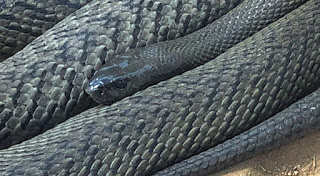
Fierce Snake – Inland Taipan
Timid but has the snake world’s most toxic venom

And so far we’ve only covered a third of the zoo. There are more crocodiles, alligators, koalas, emus, cassowary, wetland birds, Tasmanian Devils, lizards, dragons, echidnas, otters, dingoes and SNAKES… lots of them and all the stars of the most venomous variety… Crikey, as Steve would say.

Death Adder – well disguised
Tiger Snake

It’s a great day out for all the family; there’s lots to do, lots to see, it’s educational, it’s supporting a very important conservation programme… and they do a great coffee!

God Bless You Steve, you have left behind an amazing legacy.