We left Carnarvon this morning heading south on the North West Coastal Highway with a planned stop to see something that happens to be the oldest form of life on this ancient slowly spinning planet of ours and the one responsible for all the early life-sustaining oxygen on our planet.
Stromatolites
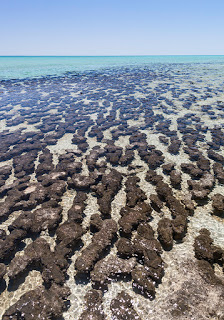
27KM from the North West Coastal Highway on Shark Bay Road is the signed turn-off to the Old Telegraph Station and Hamelin Pool Marine Nature Reserve. Just a short stroll from the car park and onto the boardwalk and you’ll be looking at the very rare Stromatolites – living fossils, growing at less than 1mm a year in the shallow, highly saline seawater.
Living Fossils
And you will be standing in one of only two places in the world where living Stromatolites can be found, the other being in the Bahamas. Hamelin Pool is also unique in having the most abundant and diverse examples of Stromatolites in the world.
Cyanobacteria
Stromatolites form in shallow seawater where there is an unusually high concentration of salt. At Hamelin Pool it is twice the salinity of normal seawater. Cyanobacteria, the earliest form of single-cell life on the planet, secretes a sticky gel trapping other Cyanobacteria as well as sand and sediment to form microscopic layers that harden to create the rocky mound-like structures.
The bacteria use water, carbon dioxide and sunlight through photosynthesis to provide energy and, as a byproduct, expel oxygen. It is this oxygen created over 2.5-billion years of the early earth that enabled multi-cellular life to form. Without Stromatolites we and every other advanced form of life simply wouldn’t exist!
Australia – Really, Really Old
The Pilbara region in the northwest of Western Australia is recognised as possessing the oldest known fossils in the world. Prior to Cyanobacteria no fossil records of any life-formns exist. Organic matter from Cyanobacteria in ancient fossilised stromatolites has recently been dated to around 3.5-billion years old.
The Carnarvon Space & Technology Museum is the reason for our visit to Carnarvon and its role in the 1960’s US Governments plan of: ‘Landing a man on the moon and returning him safely to the Earth.’
INTELSAT
1964 saw eleven international Governments, Australia included, form an International Telecommunications Satellite Consortium known as INTELSAT to provide a global communications system using satellites. In April 1965 Early Bird (INTELSAT 1) was positioned in orbit over the Atlantic Ocean. It was the first internationally-owned satellite and provided reliable telephone links between Europe and North America.
Apollo Command Console
NASA Calling
In the same year NASA approached INTELSAT and commissioned them to provide two satellites, one to sit over the Pacific Ocean and the other over the Atlantic area and partially covering the Indian Ocean. Both INTELSAT 2 satellites would form part of NASA’s early Global Communications Network used to provide voice and data links back to the US as part of the nations’ Apollo Project.
This required Satellite Earth Stations to be built linking the ground with the new satellites to control and relay signals. In Australia this fell to the OTC, the Overseas Telecommunications Commission.
The Casshorn ‘Sugar Spoon’
Tracking Spacecraft
NASA already had a number of radar tracking stations, which were built for the Gemini, Apollo and Skylab missions and used to monitor the location of spacecraft as they passed overhead and deeper into space. With one such tracking station already operating in Carnarvon it was an obvious decision to build the Satellite Earth Station close by.
On the 24th of November 1966 one month after becoming operational, the 12.8-metre Casshorn ‘sugar scoop’ antenna sent its first live television pictures to the BBC in London linking UK families with relatives in Carnarvon.
Three months later, the 4th of February 1967 marked the beginning of the OTC’s 8-year support for the Carnarvon NASA Tracking Station. Just 2-years later on the 21st of July 1969 the 12.8-metre Casshorn antenna carried the Apollo 11 Moon Landing pictures from NASA’s Canberra-based Honeysuckle Creek Tracking Station via Moree Earth Station in New South Wales and on to Perth’s TV audience – the first live telecast in Western Australia.
The 29.8-Metre Dish
The 29.8-metres dish was added in 1969 to provide support for NASA’s later Apollo missions.
NASA closed it’s tracking station in 1975 but the OTC Earth Station continued operating until April 1987 with several notable achievements including the dish’s claim to fame; the prime responsibility for controlling the European Space Agency’s Giotto mission which took measurements and samples as Giotto’s probe passed through the tail of Halley’s Comet.
OTC Space and Technology Museum
Carnarvon OTC now hosts the Carnarvon Space and Technology Museum, which has interesting displays of the station’s history and links with NASA as well as an Apollo Command Module ‘flight’ where you can share the launch experience into orbit.
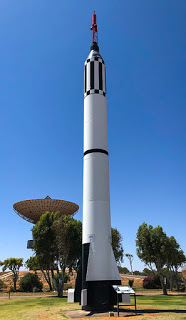
Outside sits a full-sized replica of The Mercury Capsule – Freedom 7 and the Mercury Redstone rocket that marked the start of the USA’s journeys into space launching Astronaut Alan Shepard into history as the first American in space. There’s also the opportunity to get up close with the original ‘sugar scoop’ and dish antennas.
Mercury 7 replica
The OTC Earth Station is still involved with ongoing solar scientific research programmes.
It’s a great place to explore, especially if, like us, you witnessed the moon landings as children, but also for today’s children who may soon witness NASA’s return to the moon and future planned excursions to Mars.
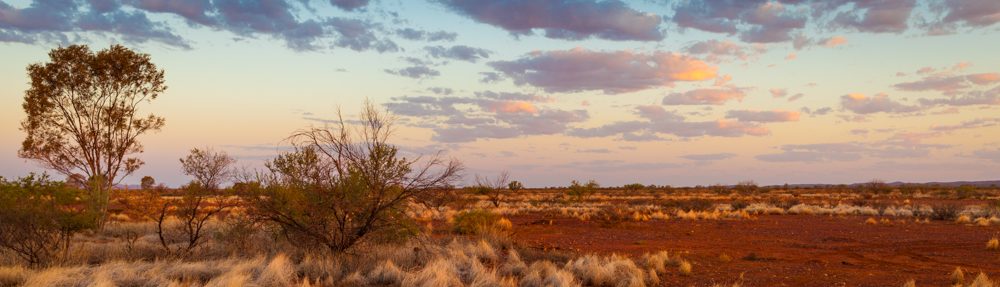
Most of the northwest of Western Australia is dry scrubland known as Mulga and supporting mostly cattle on enormous stations.
Dry creeks and rivers are the norm during the dry season and it is hard to imagine water ever flowing here when everything around us currently is bone dry. Therefore it comes as some surprise to see Carnarvon’s fertile plains rich with fruit and vegetables and all the more so when you see the Gascoyne River – there is no sign of water just cattle footprints and the occasional 4WD tyre tracks on the dry, sandy riverbed.
Only during the wet season does water flow on the surface but the river is still flowing underground and it is this that sustains the abundant crops year round.
Yes, this really is an active river
Carnarvon is definitely worth a few day’s visit but be prepared for the strong winds during Spring as can be clearly witnessed by the angle of many of the trees along the roadside.
Another adventure day for us in Coral Bay. This time we’re taking the Off-Road Rush 4WD Buggy tour with Coral Bay Tours along the Southern reach of the Coral Bay Coast, specifically the Southern Outback & Snorkel Adventure.
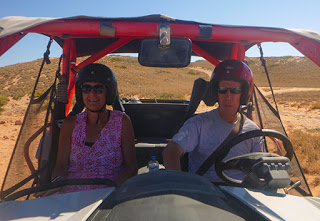
The day started out at 9.15am for helmet fitting and an operational and safety briefing on the Can-Am 1000 Commander buggy. Engines started and we were off along the road to the Marina before taking a gravel side track into the dunes. Stuart, our guide, switched us to Sport and 4WD mode and we were off leading our group. Although restricted to 35KMH it feels plenty fast enough at first on the narrow sand and rutted 4WD track.
Our Can-Am Commander Buggy
Move over Toyotas
We had priority over all the full-sized off-road vehicles meaning they had to give way to us wherever we went but caution was still needed when rounding tight bends with restricted visibility. Most of the tracks are one-way at least but you wouldn’t want to meet the back of a Toyota Land Cruiser in a hurry.
Catherine was holding on tightly to the grab handles as I drove as quickly as the buggy would go while still keeping a safe distance from our guide’s buggy. Zooming through twisting, banked corners was great fun with the back end sliding out and throwing sand into the air. This was just like riding a JetSki though a little slower. Not coincidentally, the JetSki shares the same hi-reving Rotax engines as our buggy and when unrestricted the Can-Am Commander is capable of 100KMH – considerably more than the 35KMH we had.
Cooling-off
Our first stop was at Five Fingers Reef – a beautiful spot with a white sandy beach and turquoise water. An opportunity for photographs, look for Humpback Whales beyond the reef and to give our engines a chance to cool. Then quickly back into our buggies and a change of order to give our tour guide a chance to photograph the next leader in the group while we dropped to the back.
The buggies handle sand ruts more smoothly than our Land Rover with their soft tyres and very flexible suspension making them almost enjoyable to drive over… or at least a bit more fun.
4WD fun in the dunes
Mixing ruts with hill climbs, soft sand, steep descents and beaches we continued to our next stop at Oyster Bridge on a cliff overlooking the sea where we had an unexpected find – five Green Turtles feeding right along the shore as we watched from a cliff above.
It’s a privilege to see these beautiful creatures in their natural environment and so many together. Coral Bay, like the beaches at Cape Range National Park, are protected turtle nesting grounds.
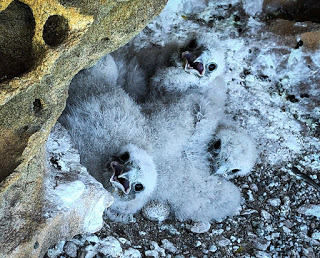
Off again and this time to Turtle Cliffs, a popular viewpoint for watching turtles. Today, however, they appeared to have taken leave – probably to where we were at Oyster Bridge. But as compensation we got to see a nesting Kestrel and it’s three fluffy grey chicks right on the edge of the cliff. And, apparently a Whale Shark was recently sighted here several months beyond its normal presence in the area.
Nesting Kestrel Chicks
Kangaroos!
After one last additional lap around Five Fingers Reef dunes where we startled a pair of Red Kangaroos, we settled back on the beach for those that wished to have a snorkel. Catherine joined the group while I took the drier and less chilly option to take some photographs of the buggies and the incoming tide.
Heading back towards base we took every last opportunity to enjoy the twists and turns and one final obstacle – the steep downhill face of a fair-sized dune.
One-by-one we eased our buggies to the edge of the dune and on our guide’s mark, stepped on it, racing down the incline as quickly as we could go. It didn’t seem that steep in the end but then maybe we had our eyes closed for much of it.
Bigger and steeper than it looks – honest!!
A great morning out on the dunes with a fun group and hopefully the opportunity sometime later during our trip to repeat the experience in another location.
One thing to remember as a driver or passenger on a buggy tour, when in motion keep your mouth firmly closed unless you want to eat dust or sand.
Our first adventure at Coral Bay is the Manta Ray Swim Tour with Ningaloo Reef Dive & Snorkel.
An 8.15am meet at the tour office and fit-out with wetsuits hoping to find one that didn’t look too much like a seal and attract sharks. We already had our rashie’s and swimmers with us but wetsuits make for increased buoyancy and any help with that is welcome, especially in deep water.
After a bad wave bombing experience while snorkelling on our last visit to Vanuatu, I chose to have a practice in the warm, shallow waters of our local Bill’s Bay but I was still a little apprehensive as the continuing Southerly wind was predicted to create choppy waters and a fair swell out in the more open water.
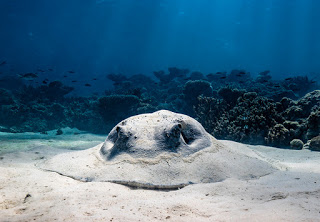
Stingray… or UFO?
Two mini-buses took our group out to the marina where we boarded our boat and headed out to the reef through a narrow navigation channel. The wind had already picked-up blowing small waves across the surface of the sea making it harder to identify the reef below. The team know these waters well though and we were soon mooring to the buoy at a dive site called Blue Maze, named for its shades of blue created by the varying depths of water and the white sand on the sea bed. Blue Maze
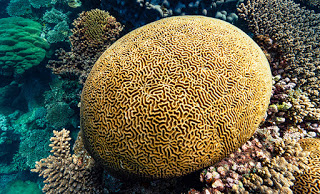
Following those choosing to scuba dive, we slid into the water quickly realising it wasn’t that warm and grateful for having the wetsuits. Unlike the tropical waters of the Great Barrier Reef, Ningaloo Reef is sub-tropical and along with that classification is much cooler water, less colourful and mostly hard coral species. Here there are fewer forms of coral (200 compared to the 500 of the Great Barrier Reef) but blue-tipped staghorn, brain, boulder, mushroom, cabbage and plate corals are common.
Brain Coral
Visibility was around 10-metres but much of the deeper reef lacked colour as the level of sunlight faded. Still, there was plenty to see with schools of tiny bright blue fish, Parrot fish, blue and yellow Dory’s, orange Nemos sheltering in the safety of their favourite sea anemones, Angel fish, Maori Wrasse, Box fish, Butterfly fish, and a Stingray that Peter Wandmaker, the resident professional underwater photographer, dived down to photograph. Not quite on the scale of the Great Barrier Reef but impressive all the same.
I have to admit that the choppy water and strong current at times left me feeling a little uneasy and I opted for the assistance of one of the tour guides with a tow-float – I still hadn’t shaken my Vanuatu experience. But I persisted, I didn’t want to miss the opportunity of later snorkelling with the Manta Rays further up the coast. However it was cold and my back was starting to ache. Fortunately it was time to head back to the boat – everyone had been in the cold water long enough.
Reef Sharks
Once onboard everyone was shaking from the cold and even a hot cup of coffee didn’t appear to be helping me warm-up, nor did a hoodie. I decided it wise not to continue any further and risk the cold water putting my back into spasm again. I was disappointed to miss the opportunity to swim with the Mantas but safety comes first and at least Catherine had other people in the group to snorkel with.
With most of our group warming-up and the divers returned, our boat headed North to the lagoon where the Manta Rays were expected to be found. We arrived as several other boats were on the lookout and the spotter plane was circling above giving directions to follow. It was pretty hectic chasing the fast swimming rays and no sooner had one boat sighted a ray and dropped their snorkellers, the Manta they had located changed direction.
Manta Ray – Feeding
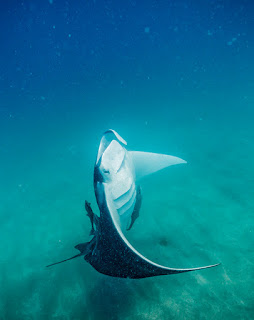
The larger female Manta Rays, almost 4-metres tip to tip, were being closely followed by the males but she was just interested in food and followed a feeding pattern where she swims in a line filtering plankton before performing a barrel roll and returning back along the line again and again.
I was watching with some amusement from the fly deck as the lead snorkeler kept showing the change of direction while everyone tried to keep up. And the boat captains were having just as much fun trying to position one group ahead of the line feed and recover the other while keeping a close eye on the snorkelers from other boats, communicate with the spotter plane and the boat crew.
The wind had increased even more as had the swell but Catherine at last got to see two Manta Rays, one line feeding and the other doing barrel rolls before it was decided to call it a day chasing these huge creatures and head to calmer water for lunch.
Manta Ray – Barrel Roll
Sharks!!
The final snorkel and dive site proved to be the most productive for spotting larger fish though Catherine too had now chosen to stay onboard and keep warm. Ten grey reef sharks were circling around the reef giving our photographer some great shots.
A leisurely cruise back to the harbour and another warming coffee rounded a great day out on the reef. The crew were excellent and made sure everyone had an amazing and safe experience. There are few places in the world where Manta Rays can be found so close to shore and have an almost guaranteed opportunity to swim with them.
Coral Bay here in the Northwest of Western Australia is one such place and if you are ever in this area an adventure with Ningaloo Reef Dive & Snorkel is a must but we would recommend earlier in the dry season when the water is a little warmer and less windy too.
A special thanks to the highly talented Peter Wandmaker for his excellent underwater photography on our trip. His photographs taken on the day are published on this post.
Exmouth is our home for the next week or so. By far the largest town anywhere nearby, it is a modern, well provided and friendly place on the North West Cape, even winning the 2019 Best Town in Western Australia. Praise indeed.
Our choice of campsite, of which there are a few, is the RAC Exmouth Cape Holiday Park. A large site with good facilities and plenty of trees to offer some shade from the sun and a little protection from the wind. It is located on entry to Exmouth adjacent to the new Ningaloo Visitor Centre and close to Town Beach and it’s jetty.
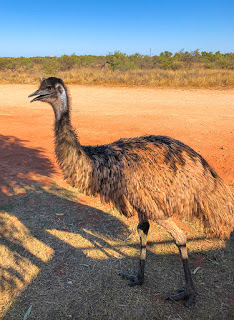
Eric the Emu.. or is it Erica?
Exmouth is known for, among many other things, its Emu population and true to form as we first drove into town a male Emu with 3-stripey chicks was wandering along the roadside. And not to be outdone the caravan park has its own resident birds paying regular visits around the site.
Normally Emus and wild Goats are a common sight throughout the whole of the North West region but this year they seem to be increasingly scarce according to conversations we’ve been hearing and possibly related to the continuing poor wet seasons and lack of fresh vegetation.
Exmouth Past and Present
Exmouth grew as a service town for the US Navy refuelling ships and submarines during the Second World War. However much of the infrastructure was destroyed by a cyclone in 1945. In the early 1960’s, during the Cold War, Australia and the US signed an agreement to build a naval communications facility to plug a gap in submarine communications in the South Pacific. The near complete purpose-built town of Exmouth and the communications station were officially opened in 1967. In current times, although no longer operated by the US Navy, the Harold E. Holt Station is still in use and creates an awesome sight with its enormous array of towers, the largest reaching upwards 387-metres.
Harold E. Holt Station
Still present is the equally enormous 3KM runway at RAAF Learmonth 36KM south of Exmouth town. Used at one time for the General Dynamics F111 bomber defending a perceived threat from Indonesia, it is now a standby bare-base ready for action should the need arise. However, it has an earlier history dating back to June 1944 when Qantas used the airfield as its first hop stop on the Kangaroo route to the UK and marking the first time the now famous Kangaroo image was placed on the tail of its aircraft.
Beach Shack Cafe
As may be obvious by now we like cafe’s especially those that serve good coffee and great food and close by the Naval Communications station is such an example – The Beach Shack. A short stroll from the beach, this delightful beach-themed cafe is right up there with the best on our recommended list.
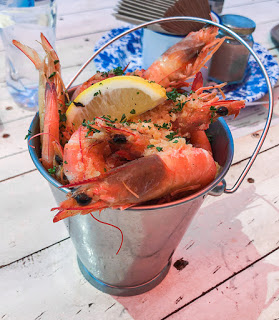
Garlic Tiger Prawns
Both of us agree, the Beach Shack serves the best fish and chips we have ever eaten – Gold Band Snapper being the fish of choice. Coming from the land of fish and chips, that is true praise. And, of course, there’s the prawns. And the coffee? That’s at the top of the list too.
The Beach Shack also offers good views into the bay where you can spot Humpback Whales breaching just off the coast. The cafe has a set of binoculars available for a closer view.
Town Beach
A pleasant stroll down the beach from the cafe is Town Beach, a safe and shallow spot for a swim, snorkel or just sitting in the clear, warm Indian Ocean. A jetty and boat launch facility is also located here and a popular location for fishing. A small mobile cafe provides refreshments but, unusually, it’s opening hours are 6.30am to 11am.
Town Beach Jetty
Cyclone Hit
On 22 March 1999, Tropical Cyclone Vance reached category 5 status creating the highest ever recorded wind gust on the Australian mainland at 267 km/h while making landfall just 35KM south of Exmouth causing major damage to the town. And not to be outdone by strong winds, in April 2014 Exmouth was hit by a massive flash flood, nearly destroying the caravan park and seriously damaging much of the town’s infrastructure causing a severe blow to the tourism trade that the region now depends on.
Now recovered and the town centre shopping precinct having recently been renovated, it is a pleasant town and highly noticeable for its friendliness. Everyone appears chatty and always happy to help out whether it is at the local newsagents, the popular Bakery, camping store, fresh fish shop or either of the two well stocked IGA supermarkets. Unlike Derby, Exmouth is a town very much alive and kicking.
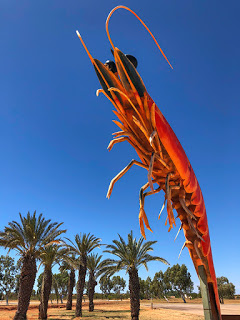
The Giant Prawn
The Giant Prawn
As well as the Naval base and the communications station that Exmouth served it also had a highly successful prawn fishing industry where many prawn trawlers could be seen in the gulf. However, following Cyclone Vance the industry was hit hard while waiting for the Reef and its sea life to recover. The family that first proved prawn fishing was a sustainable and profitable business was the only one to survive and MG Kailis is still in business today, though their factory has since closed and all catch is frozen while still at sea.
The business is now recognised as one of the world’s best managed, sustainable fisheries and to honour them a plaque has been erected in town sitting beneath a giant tiger prawn catching the eye of everyone that passes by and no doubt frustrating a great many hungry seagulls. It is so big that it has to be taken down for the duration of the wet season and its often damaging cyclone activity.
Vlamingh Head Lighthouse
High on a hill at the Northern end of the Cape Range National Park is Vlaming Head Lighthouse. Long known as one of the most dangerous coastlines in the world, it took a board of enquiry 4-years and the wreck of the Mildura before a location was finally agreed upon and construction could begin. It was by no means an easy project with the build team suffering through dysentery caused by contaminated drinking water and all building materials and supplies had to be shipped by sea from Fremantle 1250KM to the South. Almost a year to the day to complete, the Lighthouse first became operational in November 1912.
Vlamingh Head Lighthouse
Using kerosene as a fuel, it required two Lighthouse Keepers to keep the light aflame, which could be seen as far as 40KM away. The Lighthouse continued operation until 1969 before its function was replaced by a light mounted on Tower 11 at the Naval Communications Station just to the East.
During the Second World War a radar station was constructed near to the Lighthouse to help protect the Naval refuelling operations. Extensive damage to both the Lighthouse and radar station occurred during a cyclone in 1953 with repairs to the Lighthouse carried out by the Lighthouse Keepers themselves.
Today the mast for the radar station still stands and remains surrounded by sandbags that have survived, largely intact, since the 1940’s. An excellent interpretive display was recently constructed telling the story of the Lighthouse, Radar Station and Naval Communications Station as well as the wildlife of the Ningaloo Reef that borders the coast here. And thanks to its elevation, the Lighthouse provides an excellent location to spot Humpback Whales as they swim along the coast.
Caravan Service
We haven’t said much about our Jayco Silverline Outback caravan for a while mostly because it has been travelling well and the tyres show very little sign of wear despite 15,000KM on some less than ideal roads. From a distance it still looks clean and shiny but close-to it’s in need of a good clean after all the red dust of the Kimberly and Pilbara. However, the majority of available water has been from bores and the very high mineral content leaves white calcium stains wherever it settles and dries. The same goes for the car too. And not forgetting to mention we haven’t seen rain for nearly 5-months now so there has been no chance of a shower washing away the dust – especially on the roof where the solar panel needs regular cleaning to remain efficient. Unlike large motor homes a roof access ladder is rarely fitted – it needs one.
Our arrival in Exmouth coincided with the need to get our caravan serviced and unknown to us at the time the service centre was just 100-metres from where we camped. Having said that Exmouth is not by any means a big place. What we can say, though, is that Exmouth Caravans has without doubt provided the best customer service we have experienced for a long time. From the initial phone call, dropping the van into the workshop and pick-up on completion, was just how a business should operate. The service centre also has the best stocked store we have seen and all the more remarkable for its remote location in Northwest Australia. Very highly recommend.










 Discovery Down Under