The Day it fell to Earth

During the early hours of the 12th of July 1979 something big was falling from the sky crossing the Indian Ocean and heading towards the Western Australia town of Esperance. It was an object that was to makes news throughout the world and create panic in the Philippines.

We have lift-off

Launched by NASA’s immense Saturn V rocket in May 1973, America’s first space station ‘Skylab’ ran into immediate trouble just 63-seconds into flight when the micrometeoroid shield broke free taking with it one of the two solar panels and jamming the other. Once Skylab reached its orbit the result of the damage became clearer. The remaining solar panel would not deploy and without power there was no way to keep the station cool enough for the upcoming astronaut crews to live in.

Skylab model – Esperance Museum

Space umbrella

NASA’s technical teams rushed to find a solution and a simple, collapsible heat shield – a panel of heat reflecting material that folded like an umbrella  – was the result. The first Skylab crew to the station was a rescue mission that installed the heat shield and replaced the solar panels making Skylab habitable once more. Four crews in total worked within Skylab running experiments in science, astronomy and physiology and setting many endurance records on the way.

Houston we have a slight problem

Designed to stay in orbit for at least 10-years, Skylab’s orbit began to decay as a result of greater than predicted solar activity heating the outer layers of Earth’s atmosphere and increasing the drag on Skylab’s frame as it passed through it. In the same year as launch NASA had been made aware of Skylab’s likely 1979 demise by the British Royal Aircraft Establishment, a fact later confirmed by US-based NORAD in 1977. NASA had planned to use the future Space Shuttle to install a booster to increase Skylab’s orbit but the Shuttle project was two years away from its first flight, which didn’t occur until 1981.

Intending to minimise the risk of dropping debris on a populated area, NASA tried to adjust Skylab’s orbit targeting the South Indian Ocean but a 4% error in calculation meant debris was going to spread further north than anticipated. NASA advised Australia and the Philippines, both in the debris path, and prepared emergency response teams in the event of a landfall over a populated area.

Predicted path over Australia

So, despite last minute attempts to shift Skylab’s failing orbit, the tumbling 77-ton spacecraft was now out of control and heading for Earth with a predicted debris path 6,400KM long and 1,000KM wide cutting a fiery path over the Indian Ocean and across a lowly populated region of Australia. NASA later reported that the spacecraft had plunged harmlessly into the ocean 1,120KM southwest of Perth and no doubt in the process startling any sea life that happened to be in its path.

Startled too was NASA when eye-witness reports started coming in from Australia confirming that debris had hit land in Western Australia. Heavier debris had indeed fallen into the ocean but many fragments and even intact parts landed between Esperance, Rawlinna and a 150KM radius around the outback township of Balladonia. Subsequent analysis of the debris showed Skylab broke apart at a much lower altitude than expected, which meant significantly less of the space station burned up in the atmosphere and scattered over a longer footprint.

Finders Rewards

The San Francisco Examiner newspaper joined in the race to recover pieces of the spacecraft by offering a reward of $10,000 for the first authenticated piece of the station to be handed in. It sparked a treasure hunt in Western Australia but the rules of the reward required the finder to deliver in person to the newspaper within 72-hours of Skylab re-entering the atmosphere.

Helium tanks from Skylab

Not to be outdone, the Western Australia government joined in the hunt offering $1000 for the biggest piece of debris to be handed in. Under its rules the debris had to measure at least 30x30cm and be delivered within a week. The winner was also to be offered a trip around the state as well as, wait for it, two seats to the final of the Miss Universe pageant in Perth – more of which later and believe me you couldn’t make this up.

NASA’s Reward

NASA too was anxious to recover debris, which could provide valuable information on what occurs during re-entry and how any future de-orbit could be performed with greater accuracy. They did not want a repeat of a Russian satellite that crashed into Canada spreading radioactive debris.

NASA’s reward of $98,000 was offered for a piece of debris triggering a wide scale treasure hunt. Then a Hong Kong newspaper upped the ante offering an ounce of gold for each ounce of debris recovered. At the time gold was fetching $259 per ounce.

Water tank and insulation fragments

The winner of the Examiner reward was 17-year old Stan Thornton who caught the first available flight to SAN Francisco and as a bonus became quite a celebrity receiving considerable payments for making public appearances and product endorsements. The Examiner then paid for his family to fly over and join him. On his return to Australia Stan used the money to buy a house.

So much of Skylab survived its fall through the atmosphere that debris will continue to be found for many years into the future. Indeed so remote is much of the debris field that as recently as 1993 a huge oxygen tank, weighing 1-tonne, was discovered laying on the ground of Pauline and Geoff Grewar’s Woorlba sheep station 290KM east of Norseman.

The Woorbla Oxygen tank

The tank was only spotted while the station owners were flying over a remote section of their 2.5 million acre property. Even then it was a challenge just to travel overground to find it. The oxygen tank is now on display in the Esperance Museum.

Fines

In contrast to the rewards being offered for debris finds, and slightly tongue-in-cheek, Esperance Shire slapped NASA with a $400 fine for ‘Littering’. 

Miss Universe

An enterprising American photographer frustrated with America’s lake of interest in their Miss Universe competitor Mary Friel, who was in Perth for the contest, flew Miss Friel to Balladonia to be photographed with the station manager who’s property Skylab was believed to have fallen on. Within hours her picture was being sent to the giant metropolitan city of New York from a telephone kiosk below a large gum tree in the outback.

Meanwhile, back in Perth, and just four days after Skylab’s landfall, the Miss Universe Pageant was about to take place. Australian authorities thought it fitting that such a major international news event as Skylab’s demise would be a great opportunity to put a large piece of debris on display sharing the same stage as the pageant contestants for the rest of the world to see. Unfortunately the recovered oxygen tank proved a little too heavy resulting in the stage collapsing during the coronation of Miss Venezuela, tearing the dress of Miss Brazil and traumatising the diminutive Miss Japan.

Food fridge and insulation fragments

Final Payment

In 2009 on the 30th anniversary of Skylab’s Australian stopover, DJ Scott Barley from Highway Radio in California realised NASA had still not paid the $400 fine for littering. So he started a collection among his audience to raise the funds to finally pay the outstanding fine. Travelling with his wife to Esperance, a giant cheque was presented to the town for payment in full. And for the gesture Mr Barley was presented with the keys to the city. The oversized cheque is now proudly displayed above the Skylab exhibit in the Esperance Museum.

During Skylab’s eleven years in space the station completed 34,981 orbits of Earth while clocking up a staggering 1,400,000,000KM – equivalent to 18,200 trips to the moon… and back.

And finally

This year, in 2019, Western Australia is celebrating the 40th anniversary of Skylab’s inglorious tumble and reacquaintance with terra firma. In the not too distant future the International Space Station will be reaching the end of its design life. Hopefully by now a more precise and thought out plan has been developed for its eventual de-orbit.

Esperance Museum is a must see for space buffs like myself who keenly followed the Apollo programme as a child in the 1960’s and 1970’s.
Lucky Bay

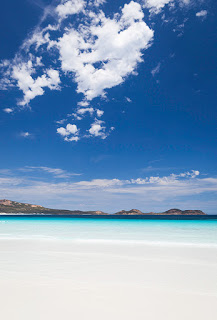
Our second short trip from Esperance takes us southeast to Cape Le Grand National Park. Located here, amid turquoise water and brilliant white sand, is the beautiful Lucky Bay.

Lucky Bay

A Lucky Discovery

Named by explorer Captain Mathew Flinders while seeking shelter from a storm in 1802. With safe harbour, Flinders wrote in his journal ‘The critical circumstance under which this place was discovered induced me to give it the name of Lucky Bay‘. During the four days that the ship ‘Investigator’ was anchored, natural historian Robert Brown and his assistant Peter Good discovered 100-plants that were new to science.

The Whitest White

Lucky Bay is, officially and scientifically tested, the whitest sand in Australia and quite possibly the world. Comprised of quartz of an almost powder-like consistency, the sand is blindingly bright in the sun and squeaks noisily underfoot.

Light reflecting back from the white sand in the shallow bay is responsible for the spectacular turquoise colour of the sea providing a stark contrast to the darker, deeper water where masses of sea grass grows. In sheltered places the sea grass ends up on the beach where it dries scattered on the otherwise pristine beach.

Safe Swimming

The bay is hugely popular as a safe swimming spot and though busy it was far from crowded as we arrived outside of the holiday season. I had hoped to take a photograph from high above with our DJI Drone to capture the colours of the sea and sand but there were too many people to fly safely – and legally. Instead we had a very pleasant stroll along the shore and as we returned towards the car park, right there appeared what has made the bay so well known around the world…

Kangaroos

Having seen so many Roos on our trip among highly-coloured grassy, hilly and red dusty outback locations, seeing them on a pure white beach looks just so unnatural. But it’s an image that sells and published regularly on the cover of many travel guides and tourist brochures.

Chilling on the beach

Say Cheese

The animals are used to human presence and happily wander among sunbathers and pose for photographs. It was an image I was really hoping to capture and patience eventually paid off.

Unfortunately, and despite every notice stating ‘Do Not feed the wildlife’, people still do and in the process affect the natural feeding habits of the Kangaroos. Clearly some folk put their vanity above the health of one of our country’s unique creatures.

Scaling the Plutons… or not

The Brave Pants were on today as we tackled the giant granite boulders known as Castle Rock in Porongurup National Park 48KM northeast of the beachside town of Albany. We had been saving this walk and climb for an improvement in the weather and the forecast today was spot on with the sun breaking through around midday.

Granite Plutons

The Porongurup Range within Porongarup National Park is a 12KM long chain of granite domes reaching a height of 650-metres. While they may not be the tallest of peaks in the region – that honour goes to the Stirling Ranges – they certainly make up for it in inclination as we were about to find out. The granite domes are the solidified remains of an enormous bubble of molten rock formed deep underground known as a ‘pluton’.

Millions of years of erosion by the elements and the remnants of the pluton was all that remained above ground. Continuing exposure to the weather created cracks in the rock forming giant stone cubes much as those seen at The Gap. Further erosion by wind and rain rounded-off the blocks leaving circular domes and giant precariously balanced boulders. In extreme cases even valleys were cut into the pluton creating ideal slopes for the many small wineries in the region.

Balancing Rock

Up in the Air

The Granite Skywalk Trail is not to be taken lightly with an almost continuous 2KM uphill climb from the car park. Good walking shoes or boots are essential and a walking pole is highly recommended. The trail zigzags its way through Marri and Jarrah woodland providing good shelter from the sun and wind of which there was plenty of both today.

As the walk reaches higher ground enormous Karri trees make an appearance giving a welcome excuse to stop, catch your breath and wonder at the age of these immense trees. It’s unusual to see Karri trees at this altitude but the low annual rainfall here is boosted by water running-off from the granite’s non-porous domes and providing just enough for the Karris to survive in such a dry area.

Finally reaching the huge Balancing Rock, carefully supported by Catherine, and the bush opens up to a stunning 180-degree view from the lower observation deck with Albany to the left and right around to the Stirling Ranges 20KM further to the North. But the real highlight is right above and behind us – The Granite Skywalk. It is this that gives the trail its rating of severity a Grade 5.

Castle Rock Granite Skywalk

The last 100-metres of the trail to reach the Skywalk requires a quite strenuous and often exposed scramble across granite slabs using the provided steel hand/foot holds before climbing a steep steel caged ladder with vertigo inducing drop-offs to the right. The top of the ladder connects to the final narrow walkway platform bolted along the side of two massive granite domes. And the reward? A full 360-degree but fearful view.

Now I’d like to say the view from the top of the Skywalk is spectacular and in today’s sunny but cool weather I’m absolutely sure it is but I have to confess the last few steps of the ladder got the better of me. It was very windy and very exposed to the right.

The view – almost from the top

Catherine had already decided to stay at the first platform level avoiding the scramble. But I’ll forever kick myself for going to all the effort to climb the hill and stopping less than two metres from the top. Maybe I just wanted to save it for another visit.

The Granite Skywalk is highly recommended though it is not for everyone. You need a good level of fitness, sensible shoes, plenty of water and above all a head for heights if you want to reach the very top.

Park Pass Required

Don’t forget this is a WA National Park and a Park Pass is required to be displayed in your vehicle. A day pass can be purchased from the automated machine at the start of the walk.

Mind the Gap

Just 17KMs south of Albany, within Torndirrup National Park, is an impressive piece of imaginative engineering that both thrills and frightens the life out of people.

The Gap

The Gap

2016 saw the opening of two lookout structures at an area known as The Gap. As part of a $6.1 million development, an enormous cantilevered see-through platform was constructed hovering 40-metres above the Antarctic Ocean and reaching out 10-metres from the cliff face. Below, huge waves driven by the ocean wind smash into opposing cliffs in a narrow ravine.

Over tens of thousands of years the sea has cut away at the granite cliffs leaving the narrow Gap as a spectacular natural feature in Western Australia’s most popular National Park.

While some people will quite happily walk to the edge of the platform to take photographs and experience the flex in the stainless steel structure, others will grip onto the handrails while those of an even less confident disposition will happily watch from the comfort of solid ground.

The Gap observation platform

It is absolutely worth donning the brave pants to experience the thunderous power of the waves. I can only begin to imagine what it would be like when a full Southern Ocean storm rolls in.

A smaller platform gives safe and flex-free access to views along the coast.

No crossing the Bridge

Just to the west of the Gap, and a short stroll, is a second and just as impressive feature. This time a completely natural one – a rock bridge known simply as the Natural Bridge. Perhaps not the most imaginatively named but how this bridge remains standing is a wonder.

Like The Gap, the rock along this section of the coast is extremely old dating back 1.2 to 1.6-billion years ago when Australia and the Antarctic plates collided. A fault line has allowed the ocean waves to progressively gnaw away at the granite and gneiss rock creating weaknesses that result in the rock breaking into rectangular blocks.

Natural Bridge

In the case of Natural Bridge waves have hammered away at the lower laying blocks and pushed them free to topple into the ocean leaving behind a self-supporting bridge. How long this survives is anyone’s guess but in time the bridge will collapse dropping tens of thousands of tonnes of rock into the ocean. That would be an incredible sight to experience but from a very far away point of safety.

The National Park have done a fantastic job with this development providing easy access for all to experience and a large car park too. Being a National Park fees, of course, apply and an automated ticket machine has been provided for those that don’t already have a Parks Pass. Facilities like these cost considerable money to provide and maintain and it will be interesting to learn just how many people pay or consider this just a car park charge.

Elephant Rocks

Our latest stopover finds us in Denmark – a small town perched on an inlet of the Great Australian Bight in Western Australia. We’re here to view the Elephants at William Bay National Park.

Greens Pool

Greens Pool

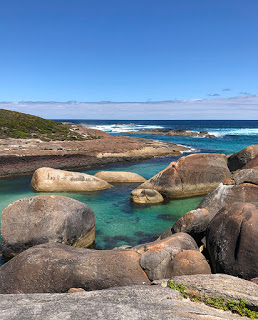
On the way to see the Elephants we take a short detour – conveniently from the same car park – to Greens Pool. It is a highly popular spot to safely swim in the calm waters protected from the pounding waves by a series of granite boulders. With a white sand beach, clear turquoise water and a blue sky, you could easily imagine being in some tropical beach paradise… but a dip in the water might suggest otherwise. Now we’re south of the tropics the sea temperature is markedly cooler but it has to be said the view more than makes up for it.

Access to the beach starts with a stunning view across William Bay and a flight of steps down to a huge bed of granite rock adjacent to the sand beach. A walk over the rock will take you to the stone breakwaters and great views of the incoming waves.

Elephant Rocks

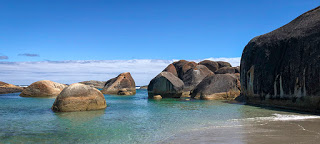
Climbing back up from the beach and a right turn takes you along a short stroll to a second bay. And there, heading out towards the sea, is a herd of Elephants – not quite what you would expect to find on an Australian coastline. However, these Elephants have been sitting right here for a very, very long time. The animals in question are enormous granite rocks, which, and they’re easy to imagine, resemble a herd of elephants heading out to sea. And just beyond them opens up a beautiful, protected shallow bay.

Elephants… with a dose of imagination

Elephant Bay

Access down to Elephant Bay is via a short but steep stairway where you are presented by two huge granite rocks with a narrow passageway between them. You need to time your walk through the passage with care as you will be sharing it with the tide and waves. But the beautiful white beach and calm, inviting water just beyond is well worth a soaking. Remember too the water may not be as warm as you are expecting!

Beware

The beauty and apparent tranquil setting of the bay belies an unexpected hazard, not stampeding elephants but a tidal rip, which can regularly occur here and great care should be taken while swimming within the bay.

It’s also easy to get caught by the tide in the enclosed bay but there are additional steps at the head of the beach though much of the sand beneath them has been undercut by the sea.

Elephant Rocks

Greens Pool and Elephant Rocks are both spectacular places but, as mentioned, they are popular and very busy during holidays and the summer months. So if your intentions are for landscape photography or a little solitude among beautiful scenery, then you’ll need to be here very early in the morning or late in the afternoon just as the sun begins to set.