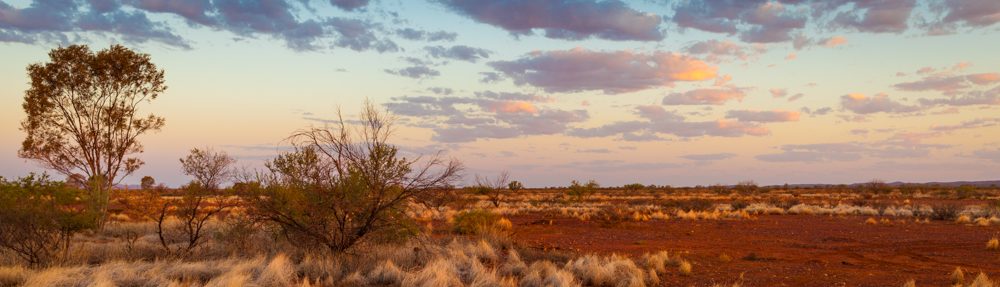
Our time in Cairns has sadly come to an end and today we start the long trek south. We leave after a week of glorious weather in the tropics, the epic rainforest scenery and some great food.
It’s all about the sugar
It’s impossible to miss Far North Queensland’s connection with sugar. Huge fields planted with sugarcane are the most common form of crop grown in the region and they’re everywhere. During harvest time, between July and November, each major town has a sugar mill in operation. Clearly visible are the white clouds of steam set against the dark green of the forested mountains and occasionally smoke billowing from an adjacent chimney stack. Queensland produces over 95% of Australia’s sugar and between 80-85% of it is exported by sea. And that brings us neatly to the location of our next stop, the little town of Lucinda.
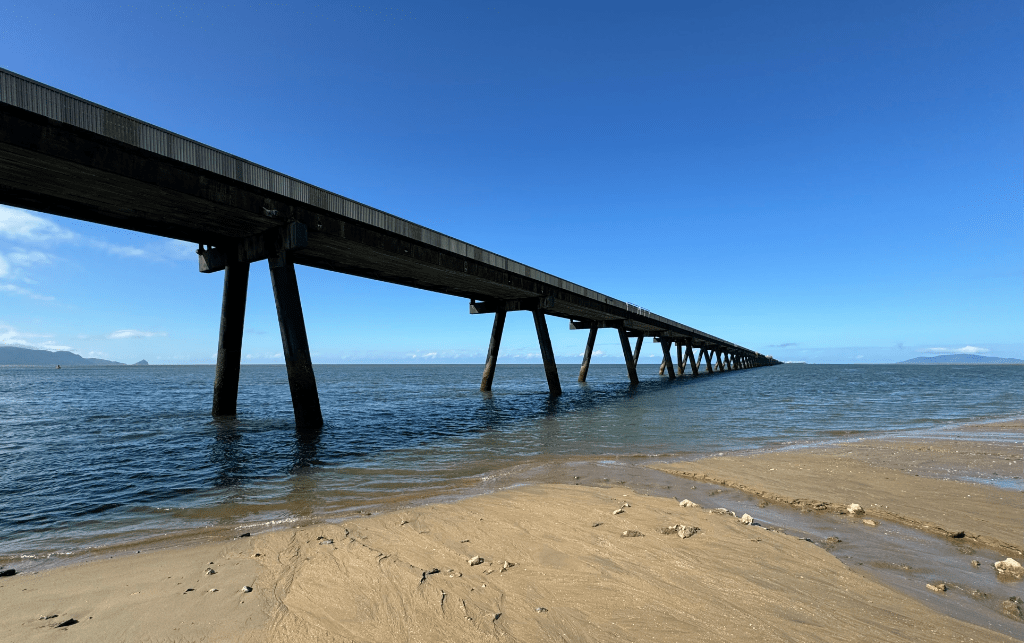
Lucinda sits at the southern end of the World Heritage listed Hinchinbrook Island and is the location of the Lucinda Bulk Sugar Terminal. Not such an interesting place you may think, however, apart from the three enormous sugar storage sheds there is something quite unique, not just for Australia but the whole of the southern hemisphere. With a very shallow bay there is no way for large ships to reach the port – even during high tides. So a jetty was constructed along with the terminal buildings in 1979. It was no ordinary jetty.
It’s big, really big!!
Big enough that it visibly curves from end-to-end following the curvature of the earth, the Lucinda jetty is 5.76KM long (that’s 3.6-miles!!) and supported by more than 660 concrete and steel pylons. A conveyor belt carries the raw sugar along the covered jetty until it reaches the ship loader, which then runs forwards and backwards along the length of each ship delivering 1,400-tonnes of sugar per hour. An average of twenty shipments take place each year with the terminal able to handle ships as large as 50,000-tonnes.

The only way to get a true idea of just how long the jetty is, is to take a look from above. Fortunately, for the terminal workers, a single roadway provides access to the distant loader.
Along the shore
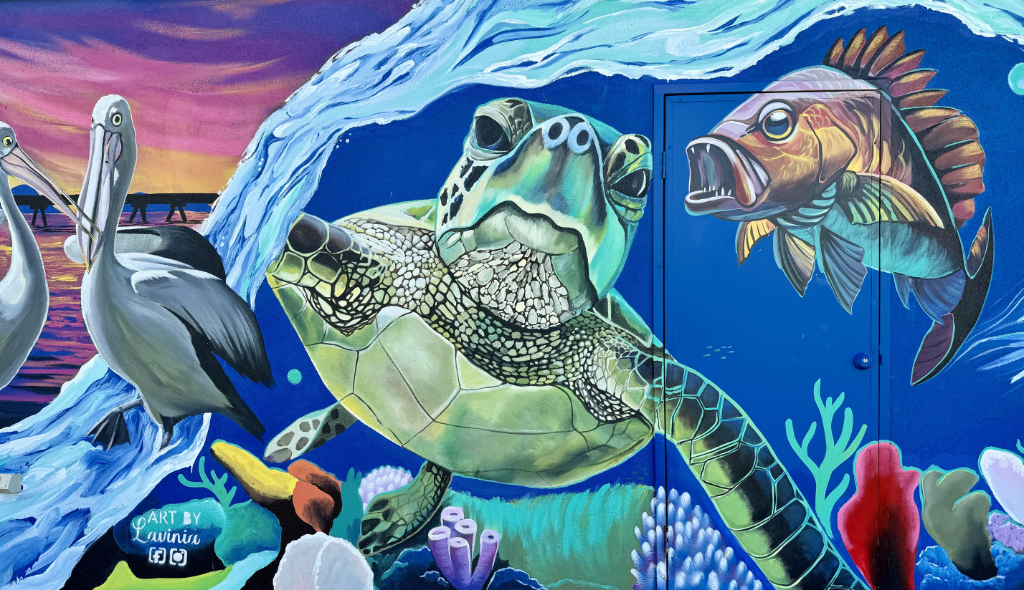
Parallel to the jetty Lucinda council have created a weaving pathway along the shore and parkland featuring sculptures related to the area as well as a memorial to an American WWII airplane that crashed nearby. But most impressive is the artwork painted on the walls of the park’s facilities building depicting the wildlife that calls the Lucinda region home. It’s well worth a closer look to admire the skill of artist Lavinia.
Cyclone Yasi… again
On 3 February, 2011 in the early hours of the morning, category 5 Tropical Cyclone Yasi crossed the North Queensland coast bringing measured peak wind gusts of 185KM/hour at Lucinda. At the height of the storm, waves surged over the top of the jetty destroying the shiploader along with the Lucinda Jetty Coastal Observatory. The Observatory was situated at the end of the jetty delivering valuable data regarding local coastal waters and atmospheric conditions.
Sustaining extensive damage from the cyclone, repairs costing an estimated $50 million and 18-month’s work was required to get the terminal operational again.
Escaping Winter
Today, Lucinda is a popular destination for those that like to cast a line as well as retirees wanting to escape the colder winters of New South Wales, Victoria and South Australia. It’s easily evidenced by the number and variety of vehicle registration plates and fishing boats parked around the caravan site. And who can blame them.
Next stop, as we continue south, the coastal town of Mackay.
 Discovery Down Under