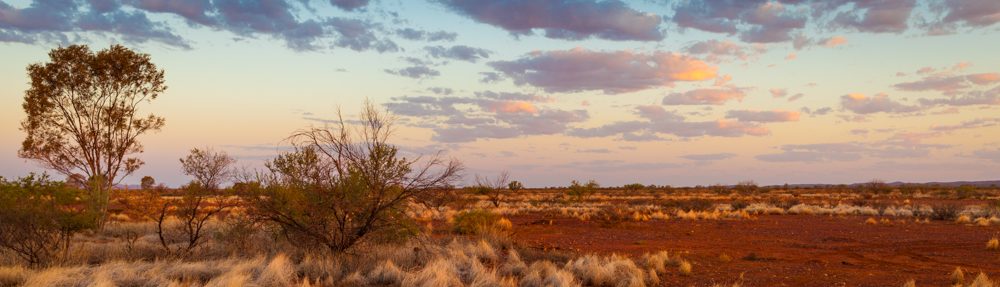
Situated just a few hundred metres from the centre of Launceston, Tasmania’s second largest city, is an unlikely mix of a Victorian Pleasure Garden and wilderness. Rarely will you find such a dramatic location so close to a city.
Cataract Gorge is a 5km long, 65-million year old natural wonder. Comprised of four distinct features; South Esk River, Cliff Grounds, First Basin and Duck Reach, and each of them unique.

In the beginning
A settler by the name of William Collins made note of his visit here while exploring the Esk River and Port in 1804. It is believed to be the earliest record of the area in which he noted, “Upon approaching the entrance I observed a large fall of water over rocks, nearly a quarter of a mile up a straight gully between perpendicular rocks about 150 ft high. The beauty of the scene is probably not surpassed in the world”. Obviously in the early 19th century he would not have seen that much of the world to which he could compare. However, it is certainly impressive in its scale.
Victorian Splendour
The gorge quickly became a popular destination for Victorian visitors to ‘partake in the air’. Access up the river was initially restricted to walkers over a steep zig zag track or by boat to a large rocky outcrop jutting into the river known as Picnic Rock. Access was greatly improved in the early 1900’s when a suspended pathway, known as the King’s Bridge – Cataract Walk, was built by volunteers linking King’s Bridge to First Basin. Anchored high on the cliff wall, it was constructed by volunteers over a period of eight years. The walk provided an easy and mostly level pathway for pedestrians to approach First Basin and Cliff Grounds, once a swamp but converted to a park with exotic plants, specimen trees, Peacocks and a bandstand and restaurant.

To Pay, or Not
The Launceston City and Suburbs Improvement Association, formed at the end of the 19th century, was instrumental in the construction of the suspended walkway and additionally the Toll Keeper’s Cottage and Toll Booth adjacent to King’s Bridge, both of which were built in 1891. Unusually the toll was entirely optional and many, not too surprisingly, chose the option not to pay. The toll was intended to raise money towards further development of the gorge so, again not too surprisingly, the Association made the toll compulsory later in the year.

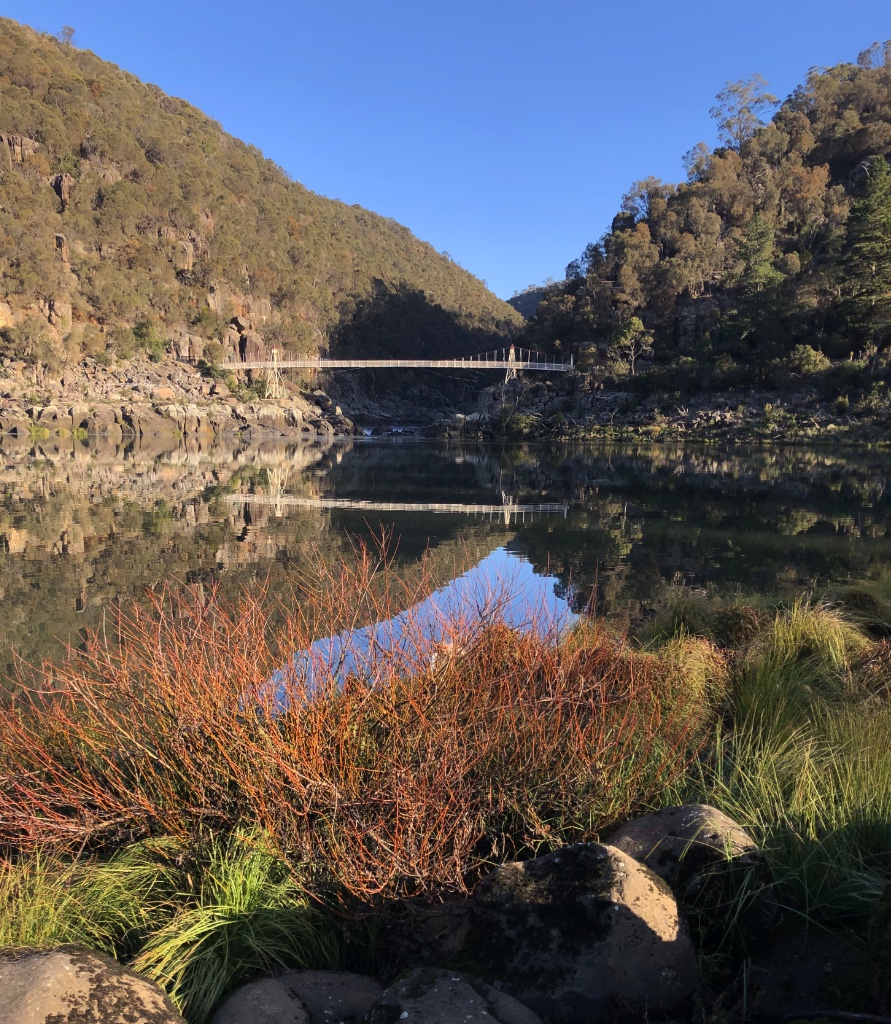
In 1904 the Alexandra Suspension bridge was formally opened. Situated to the south of First Basin, the bridge extended the King’s Bridge Cataract Walk and crossed the South Esk River giving safe pedestrian access to First Basin and a pathway leading further up the river for people to explore.
First Basin
Most visitors today arrive directly at First Basin with its good parking facilities, a cafe, open grassy areas, a playground, the largest single span chairlift in the world and a large outdoor swimming pool. It’s more like a park with cliff side views – ideal for a weekend picnic with a young family. However, looks can be deceptive. Cataract Gorge is a place where raging torrents can and have swept away bridges and carry huge boulders downstream.

Duck Reach Trail
The Duck Reach Trail from the Alexandra Suspension Bridge shows a marked contrast in scenery. No longer a place to sit and admire the green lawns and specimen trees and shrubs, here you are thrown right into a wilderness with native trees fighting for soil among the steep and fractured gorge walls and the boulder strewn river churning the water as it heads downstream towards First Basin.
The trail is a moderate walk with a steady incline and a number of steps as you approach the Duck Reach Suspension Bridge. On crossing the bridge there are two further tracks – the steep Reed Gully and Snake Gully. Both are for experienced and energetic hikers and form a 2km return track to First Basin. But we were here to see the now disused Duck Reach Hydro-Electric Power Station.
Power for the People
In 1893 Launceston City Council commissioned the construction of the Duck Reach Hydro-Electric Power Station. Frequent flooding in the gorge necessitated the station be built high above the South Esk River, which complicated construction and required the building of a heavy-lifting Flying Fox to transport materials across the river. However, just two years later on the 10th of December 1895, the turbines were generating electricity for Launceston and lighting the city with brilliant arc lights. It was Australia’s first commercial hydro-electric scheme and is believed to have been a world first providing water-generated electricity for a city south of the equator.
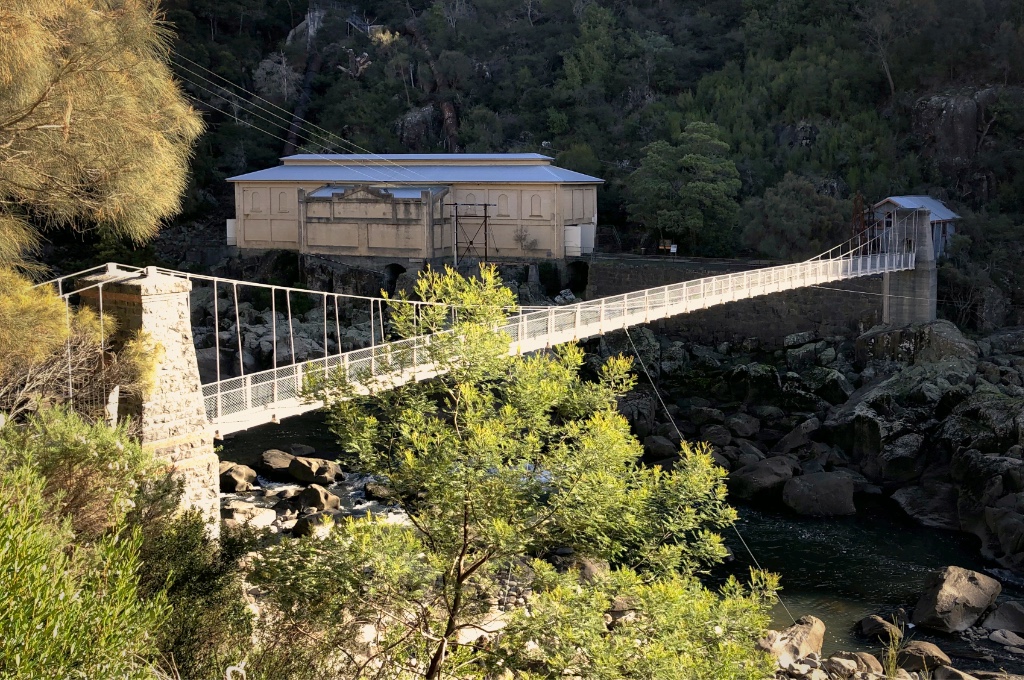
To facilitate safer pedestrian access to the power station a second suspension bridge was constructed creating a permanent link across the gorge.
With a greater demand for electricity, partly triggered by the city’s introduction of an electric tram and the city’s increasing rollout of electric street lighting, the power station was upgraded to double its output and by 1910 it was producing, for its time, a considerable two megawatts of power.
The Big Flood
Even though the power station was built high above the river, the planners could not have anticipated the events that unfolded in the December of 1929. Unprecedented and persistent heavy rain followed a long dry spell flooding much of Tasmania’s low-laying land. The torrent of water forcing its way through Cataract Gorge, compounded by the merging of the flooded North and South Esk Rivers and the tidal Tamar River, raised the water at Duck Reach by 9.5-metres destroying the power station and sweeping away both suspension bridges. Despite such destruction the urgent need for power saw the station being quickly rebuilt and power was again being generated in 1930.
The Duck Reach suspension Bridge wasn’t rebuilt until 1939 but was again swept away by floods in 1969. It wasn’t until 1995 that the bridge was rebuilt following the original design and it stands to this day.
More Power!!
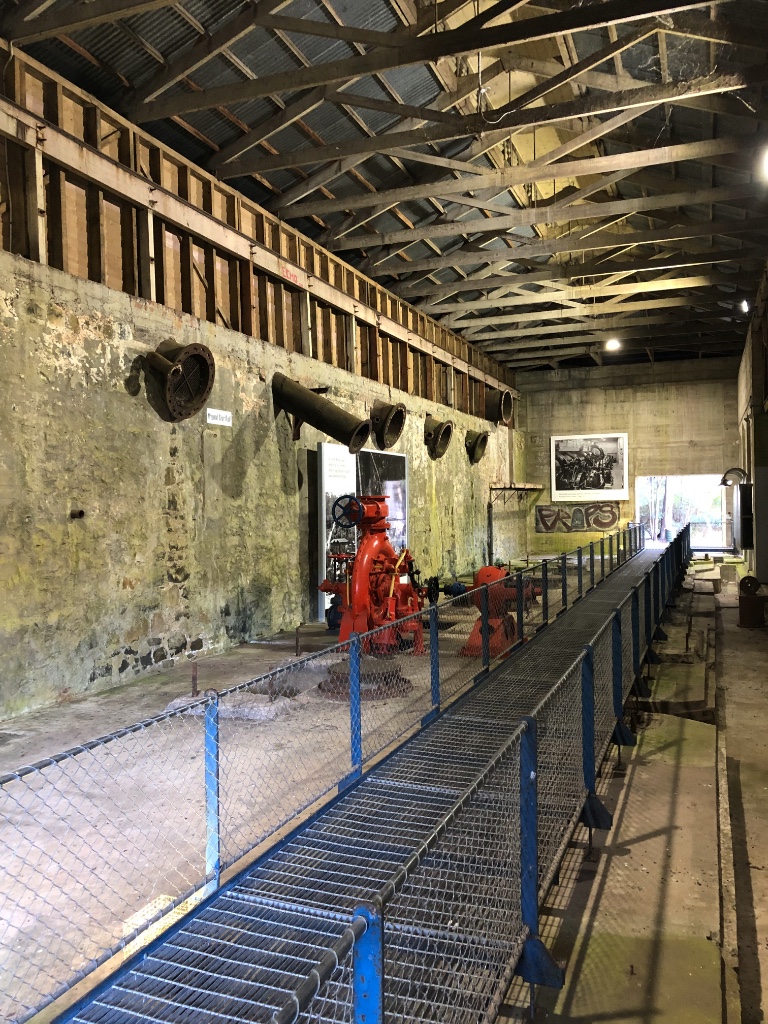
Even following the plants upgrade the increasing demand for electricity was greater than the plant could provide and by 1934 the City of Launceston was also purchasing electricity from the Tasmanian Hydro-Electric Commission. By the early 1950’s the Duck Reach station’s days were numbered and was eventually decommissioned in 1955 when it was superseded by the new Trevallyn Dam Power Station. With the turbines and pipework removed the building remained derelict for the next 40-years until, on the centenary of it first becoming operational, it was re-opened as a museum and interpretation centre for visitors to enjoy.
A Grand Day Out
There’s plenty to see and do at Cataract Gorge for the family and walkers alike. It is a great day out combining great scenery, history and exercise and even a little daring for those who prefer their bridges to stay stationary as they walk over them.
 Discovery Down Under