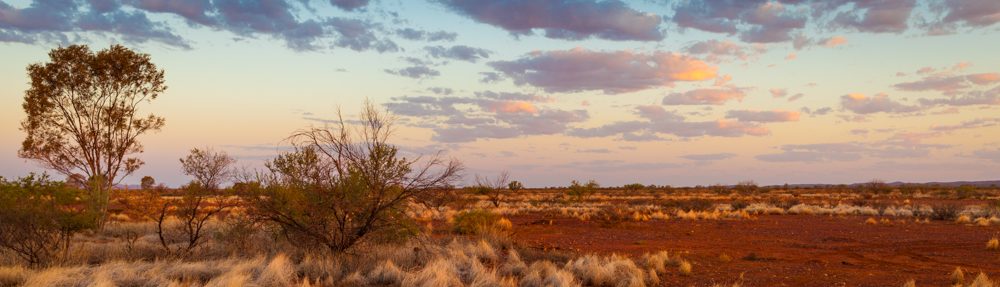
Located within Freycinet National Park, The Hazards are a mountain range on Tasmania’s east coast and gateway to one of the most famous beaches in the world.
Beauty in Pink
Anyone touring around Tasmania, and with the remotest interest in geology, will notice a change in the mountains on the Freycinet peninsula from the grey granite, black basalt, dolerite and sandstone of much of the state’s mountainous regions. As you approach the Hazards via Coles Bay you cannot help but notice their very distinct pink hue and more so in the evening under the setting sun.

Long, long Ago
The granite mountains, believed to have been named after African-American Whaler Captain Richard Hazard, are comprised of a mineral called Orthoclase – a pink form of feldspar that owes its colour to another mineral, iron.

Around 60-million years ago volcanic activity beneath what is now Tasmania, pushed magma upward lifting the land hundreds of metres above sea level creating the Freycinet peninsula. During the same period the land to the west of the peninsula sank forming Great Oyster Bay. As the magma slowly cooled under pressure the Orthoclase formed into the large rectangular crystals that are typical of the rock, granite.
Over the following millions of years the softer ground above the granite eroded away exposing the rock to weathering by ice, rain and wind that has resulted in the giant rounded boulders that now litter the mountains. Today the Hazards stand at a shadow of their former height but still reach an impressive 485-metres above the sea.
Freycinet National Park
Much of the Freycinet peninsula falls within the bounds of Freycinet National Park* with the only access being via a single narrow, and not very well maintained road. Credit, though, is due for the excellent, and unusually large, National Park Visitor Centre, where a large number of park guides and leaflets about the region and activities can be found as well as a good selection of books, outdoor clothing, local crafts and souvenirs.

Time for a Walk
We had been looking forward to exlploring the Freycinet region again following a previous visit in 2008. On that occasion the weather wasn’t in our favour with light rain and low cloud setting in just as we got to a major viewpoint. This time, however, the sun was shining and the sky was mostly clear, perfect walking weather despite the cool late autumn wind.
Our walk was the shortest within the park but with a view worth every step, and ache, up the often steep climb. In 2008 the same track between Mount Amos and Mount Mayson was best described as ‘rough’ with a steep climb on a slippery gravel path interspersed with sharp rocks ideal for tripping the unwary. Now, however, sturdy steps have evened out the steeper sections making the upward path easier, though still requiring a fair amount of effort. Several ‘new’ viewpoints have also been added looking back over Coles Bay towards the distant coastal town of Swansea.
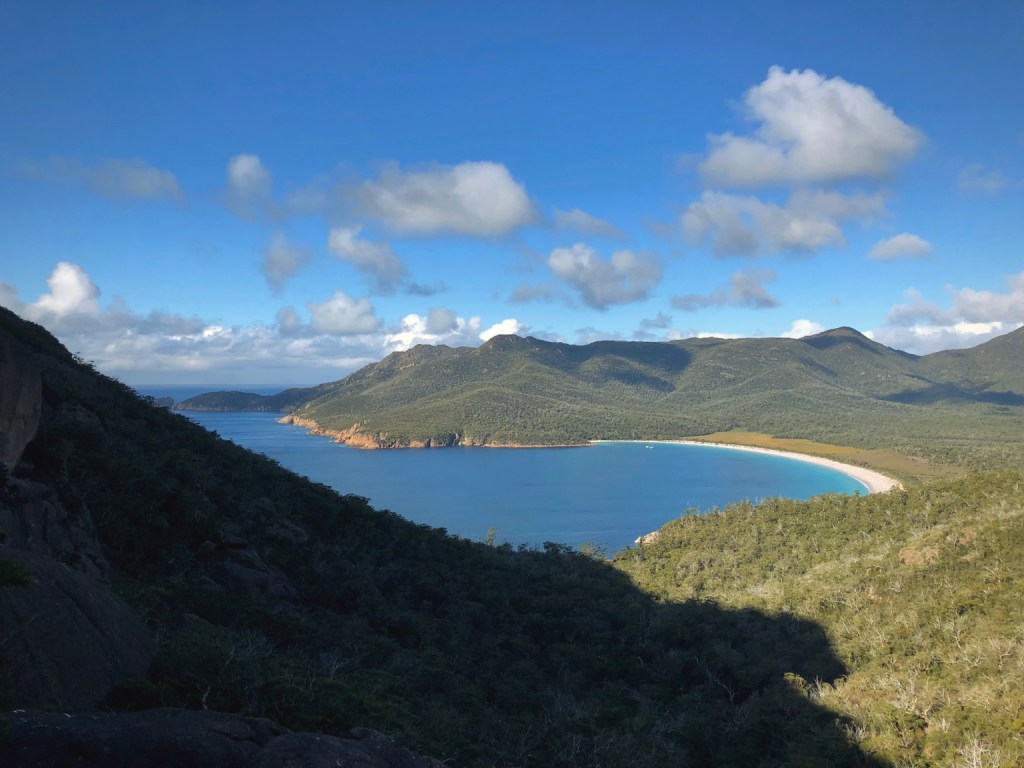
The higher you climb the larger the giant granite boulders become and in places you are walking among and between them towering over you. But there is a very worthy reward for the 45-minute climb when you reach the top of the pass – for this is the Wine Glass Bay Lookout Walk and from here, as the name suggests, you get the most amazing view of the world famous Wine Glass Bay. All the effort to arrive at the lookout weighed down by a heavy camera bag was worth every step. The lookout, too, had been updated with additional platforms giving greater access to the increasing number of walkers being attracted to the peninsula.
1,000 Steps Too Many
We had considered the extended walk that leads down to the white sand of Wine Glass Bay’s beach but we had second thoughts after reading more about the terrain. Access to the beach requires navigating a far steeper track and includes around 1,000 steps down and back to return to the viewpoint. At the end of the day it is just another of the many beautiful white beaches with turquoise water along the east coast of Tasmania and its ‘fame’ due to its curved shape and remote seclusion. So, after several photographs and a chat with a couple of fellow travellers, we headed back down the quite unique one-way track, which separates the freshly rested from the newly exhausted heading uphill.
People often ask, ‘what is the origin of the bay’s name?’, and no one is quite certain. The most preferred, and most pushed by marketeers, relates to the similarity of the bay’s shape to that of a wine glass, but there is a darker and more likely offering, a bloody one, which is where our whaling Captain Richard Hazard features once again.
In the early 1800’s whaling was a significant contributor to Tasmania’s fortunes and much of that was along the east coast of the state. Whaling stations were a common site where spotters would take to the high ground looking for the migrating whales, sending out the boats to harpoon any unfortunate passing whale and dragging them back to the shore-based stations for ‘processing’. The whale’s baleen was used to stiffen corsets and the rings of the fashionable British ladies’ dresses, while whale oil, extracted from the blubber powered the dim lights in Victorian houses and an extremely fine oil for lubricating clocks, watches and the machines driving the booming Industrial Revolution.
A Bloody Past
The more likely origin of Wine Glass Bay’s name, however, is related to the colour of the deeply blood stained water and beach during the whaling season rather than the shape of the bay. Imagine too the putrid stench of boiling blubber and the rotting carcass’s of whales. There could not be a greater contrast to how the pristine bay appears today.
*As with all National parks in Tasmania, a National Parks Pass is required for vehicles entering Freycinet National Park. Passes are available from all National Parks Visitor Centres in Tasmania as well as from the automated machines in Freycinet National Park’s car parks.
 Discovery Down Under