What a Difference a Day Makes

We were right to make the most of the weather yesterday at Cradle Mountain. The predicted change of weather rolled in during the evening with heavy rain overnight and a drop in temperature. That wasn’t going to stop us exploring though.

Marion Lookout!

Assuming we may get a good soaking we had rugged-up with a plan to scale Marion Lookout to get a different viewpoint of Cradle Mountain. It was certainly going to be different – cloud cover had descended over the mountains. But it started well with our shuttle driver, J Dub, at the wheel again and entertaining the passengers.

“In the 1960’s a woman was bitten on the bum by a black tiger snake – no.5 on the World’s most venomous list. She was too embarrassed to tell anyone and subsequently died. She was the last person to be killed by a snake within the park… all the others died in hospital.”

While driving towards Dove Lake, J Dub was asked by a passenger, “what type of trees are these on the left?” Not being an arborist, J Dub replied, “the same as those on the right.”

Someone noted the roadside kerb posts and asked, “why do the posts have black bands around them?” J Dub replied, “Oh, they’re in morning, one of them was run over last week.

Dove Lake as most commonly seen

On arrival at Dove Lake we were presented by a grey and gloomy sky. All the glorious colour of the previous day was gone. Undeterred, our walk to Marion Lookout began at Dove Lake and headed out on the increasing steep Crater Lake path passing both Lilla Lake and the Wombat Pool. As you’ll discover later, Wombats have a peculiarity in the animal kingdom and, not coincidentally, someone had scraped the ‘L’ off the sign for Wombat Pool.

Lilla Lake

Lilla Lake is a good spot to take a breather before climbing the sturdy timber steps. On a calm day the lake acts like a mirror with Dove Lake glistening in the background. As we approached, however, gusting winds were stirring the surface of the water and taking on the colour of the deepening grey sky.
Lilla Lake

Now at over 1000-metres the temperature had dropped further but it helped as we climbed countless steps up towards Wombat Pool. The walk is classed as a Grade 3 and accessible to all but the least fit but it was tougher in places than we had expected, especially on our ageing knees.

There’s Gold in them there Hills

Nothofagus gunnii – Tasmania’s ancient Beech

By now we were just below cloud level and a notable change in flora. Gone were the myrtle trees and panini in the creeks to be replaced with button grass, mosses and an increasing number of Fagus trees.

The Fagus is a cold-climate beech tree, restricted to a small area of Tasmania and Australia’s only winter deciduous tree. It produces masses of golden leaves during autumn that light up the mountain sides attracting those keen to experience what has been named ‘The turning of the Fagus’. The tree is a living relic of the supercontinent Gondwana and shares a similarity to species only found in the once adjacent New Zealand and South America.

Crater Lake

Named after its similarity to a volcanic crater, Crater Lake is one of the few points on the hike that levels-out for a while. Offering amazing views over the valley… on a clear day. The clouds had lifted a little further but it was still restricting a view of our intended destination of Marion’s Lookout. Occasional glimpses of the remaining climb to the summit appeared between the clouds at which point we started having second thoughts about continuing. We could have continued and tackled the steepest section of the walk seeing nothing through the cloud at the top or make our way down past Crater Lake and follow the route down to Cradle Valley to eventually join the world famous Overland Track back to our shuttle pick-up point.

Crater Lake

Needless to say we headed downhill through the beautiful snow gum, myrtle and fagus tree-lined track. Now mostly out of the cold wind the track was busier than expected with a number of young, and no doubt very fit, hikers laden with tents, clothing and supplies for their 65km trek along the Overland Track. Knowing what the weather had in store for the next few days, they were going to experience a very tough time ahead. We wished them good luck and a safe passage.

Falls along Crater Creek

Further down the track a number of small but picturesque waterfalls cascade down Crater Creek among the moss and lichen covered trees. The biggest is easily accessible with steps down to a bench and a few further steps to the water’s edge.

While stopping to take photographs and catch-up on some much needed food, we were joined by a very inquisitive Black Currawong. Also known locally as a Black Jay, the currawong is an intelligent bird with bright golden-yellow eyes contrasting with its deep black plumage and a long, stout beak. It is known to form lasting relationships with humans and is unperturbed when people are around. But then many birds do when there is a chance of food!

Wombat at Ronny Creek

The final leg of the walk drops down to Ronny Creek – a large expanse of button grass with Tasmania’s unique panini trees marking the path of the creek bed. If you are very fortunate you may get to spot a platypus feeding in the shallow water but you’re far more likely see Wombats climb out of their burrows in the afternoon, around 4pm, to feed beside the boardwalk that runs alongside the creek and back to the park road and shuttle stop. Incidentally this point also marks the start of the 65km, 6-day Overland Track.

The marsupial wombat’s closest living relative is, surprisingly, the koala, but unlike other marsupials it’s pouch faces backwards to the to prevent soil from entering while burrowing. The wombat’s earliest known relative was the Diprotodon and the size of a hippopotamus, which became extinct approximately 11,700-years ago.

It’s True After-all!

Now, as mentioned earlier, the wombat has a little peculiarity and often brought up in conversation when discussing this muscular animal. You see, the wombat is the only known creature to do square poops! No, it really is true and here’s the photograph to prove it. The poop often appears on top of rocks and other precarious places as a territory marker and to attract a mate. And being square it isn’t going to roll away!
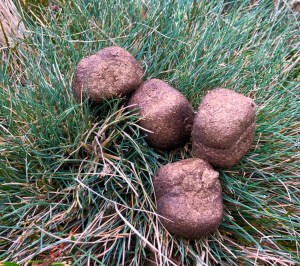
Wombat Poop

Cradle Mountain National Park

A place of spectacular natural scenery, iconic mountain views, alpine flora, endangered fauna, wild weather and world class hikes. We’re camped right in the heart of the Tasmanian Wilderness World Heritage Area.

A Global Treasure

We have been fortunate to have had the opportunity to explore some very special places during our travels together; Yosemite National Park, the Grand Canyon, the Canadian Rockies, the Isle of Skye in Scotland, Arnhem Land in the Northern Territory and the Pilbara of Western Australia to name just a few. But this week we have had the privilege to explore yet another region of the world that truly belongs in that very special category of rare, natural treasures – Cradle Mountain – Lake St Clair National Park, Tasmania.

Dove Lake at Cradle Mountain – Lake St Clair N.P.

The iconic Cradle Mountain, originally named Ribbed Rock for its long, narrow and jagged ridge line, was made popular shortly after the early explorers Gustav Weindorfer and his Tasmanian wife Kate settled here and opened a guest house in 1912. They played a key part in having Cradle Mountain declared a Scenic Reserve and Wildlife Sanctuary in 1922, extended in 1927 and finally, in 1971, the reserve became what we now know as Cradle Mountain – Lake St Clair National Park. Then in 1982 the National Park, along with four others, achieved a truly protected status when it was registered on the World Heritage List.

“This must be a National Park for the people for all time. It is magnificent, and people must know about it and enjoy it”

Gustav Weindorfer 1910

Unpredictable Weather

Now, many will know that Tasmania is subject to somewhat variable weather sitting, as it does, 250km off the south coast of Australia fully exposed to the wild weather of the ‘roaring forties’. But here in Cradle Mountain variable could mean a glorious sunny day one day and snowing the next – even during summer. With 3-metres of rain each year it’s a place where you need to pack well, dress in layers and hope for the best.

Quick, the Sun’s Shining!

We’ve had some cool but glorious sunny days since our autumn arrival in Tasmania and our luck was in as we arrived at Discovery Parks Cradle Mountain campground*. As soon as we had parked up we raced to the visitor centre just a few minutes away to get our bus passes. On our last visit here you could drive right to the edge of Dove Lake – the main day visitor viewpoint of Cradle Mountain. Now, however, access is via a shuttle bus with several drop-off points on the way before arriving at the well designed terminal facility.

A short walk leads right down to the lake with staggering views, and on this day, a rare near cloudless sky. We couldn’t have hoped for better. We had considered taking the circular walk around the lake but it was getting late in the afternoon and, with a predicted change of weather on the way, we chose to walk around to a second popular photo spot – Dove Lake Boat Shed.

There’s always one

For some reason some people do the most selfish thing without any care in the world. In this case a man decided it would be good to strip to the waist and sit in the water right in front of people trying to take a photograph of the scenery. It’s a vast lake. Why right here? Nutter.

Dove Lake Boat House

Eventually he gave up and those that had the patience finally got the opportunity to record a moment in time of this classic scene. It was the Easter holidays and there were many people around, but every now and again you could capture a shot as hikers passed behind the boat house or one of the low growing trees.

Not long after taking several photographs we noticed smoke drifting across the mountain. A change of wind direction was bringing smoke over from a nearby burn-off and it signalled a change of weather ahead. It was time to make our way back.

Smoke driving in from a burn-off

A laugh a Minute

Our shuttle trip back to the visitor centre was a very memorable one. Our driver, J Dub, as he liked to call himself, was a laugh a minute describing, with dry humour, his escapades among the mountains, tripping over tree roots and planting his face in mud only later to discover his animated eyebrows were leeches making a meal of his face. We hoped he would be driving our next shuttle over the following days.

A change of Weather

As unpredictable as the weather is here, the forecast for the next few days was pretty grim with rain moving in from the north and temperatures plummeting as a southerly takes hold. Even snow was expected. We decided a drink at beer o’clock was in order as we discussed plans for tomorrow.

Wasteland

* The site was undergoing a major redevelopment and in places looked as though a tornado had recently passed through. The park had hoped to be finished by now but work had been delayed as a result of Covid.

Rocky Cape National Park

Sitting on the far northwest coast of Tasmania is Rocky Cape National Park. Though smaller than many National Parks in Tasmania, Rocky Cape NP more than makes up for its size with striking coastal rock formations, caves and a rich Aboriginal heritage.

Jagged Rocks – Mary Ann Cove

Ancient Rocks

The rocks around the cape are believed to be among the oldest in Australia. Dated to Precambrian times (4.6-billion years to 540-million years ago) it was a time when life was beginning to form with soft multicellular organisms, algae and jellyfish. Also living during this time, and still to this day, are the Stromatolites that we first saw at Hamlin Marine Nature Reserve, Western Australia. Over the aeons the rock has been uplifted and folded to form the jagged rocks we see today.

Mind the Wasps

For some reason large native wasps and bees are attracted to the bright white paint of the lighthouses along the coast and Rocky Cape Lighthouse was no exception. Among the many creatures to be found here are the graceful but noisy Yellow-tailed Black Cockatoos, White-bellied Sea Eagles, Wallabies and Pademelons, Tasmanian Devils, Spotted-tail Quolls, Echidnas and Bandicoots.

Rocky Cape Lighthouse

Midden Caves

Many caves have formed within the cape region and among those are North Cave, which can be easily spotted from the lighthouse. For a closer view follow the path among coastal heath to the viewing platform. Access into the cave is not permitted as it has significant Aboriginal cultural importance.

North Cave

South Cave at Burgess Cove is amost filled with shells, bones and other artefacts. The mound of remains, known as a midden, are often associated with a long Aboriginal occupation and a gathering place where mobs would eat and discard the shells and bones from their meals.

Wet Cave at Sisters Beach, a little further along the coast, provides a short scramble along the rocky beach and up through banksia groves to an observation platform. There’s not much to see here, though, as no access into the cave is provided – not that it dissuaded a couple of youths that showed no respect to the Aboriginal community.

Just a short trip along the coast today but tomorrow we head to the famous wilderness of Cradle Mountain National Park, one of the big highlights of our adventures in Tasmania.

Fire at Don River Railway

We were said to learn of a serious fire at Don River Railway near Devonport this morning. Only last week we we’re enjoying a ride on one of the steam trains between the Don River and Coles Beach: Letting of a Little Steam

Fire crews from Devonport, Burnie and Latrobe were called to the blaze in the early hours this morning. Around 30-fire fighters from local stations arrived to find three of the sheds ablaze leaving the volunteer rail team, who had spent thousands of hours restoring several carriages, devastated.

More from the ABC: Fire at Don River Railway

The Other Tarkine

Yesterday we were exploring among the forests of the Tarkine but there’s more to the region and there could not be a greater contrast.

The Wild West

A substantial section of the west facing northwest coast is within the Tarkine boundary and offers just as much drama as the forests to the east.

Couta Rocks

Couta Rocks

Nothing quite prepares you for the wild and dramatic view as you climb above the dunes a few hundred metres north of the beach shacks at Couta Rocks. Crashing waves add even more drama to the windswept beach. Many of the rocks are razor-sharp and brittle so care is needed navigating your way among them.

Following the clearly defined path we rounded the dunes to be greeted by a sweeping bay with scattered driftwood, seaweed and a few poisonous Bluebottle jellyfish. Someone had built a beach shelter nearby held together with kelp seaweed but probably not the best protection from the squalls and gusting winds blowing in from the Indian Ocean. But the weather does lend itself to photography as long as you can stand your ground against the wind.

Access to Couta Rocks is along a rutted gravel road but, taken carefully among the potholes, most vehicles will have no trouble reaching the sea.

Nelson Bay

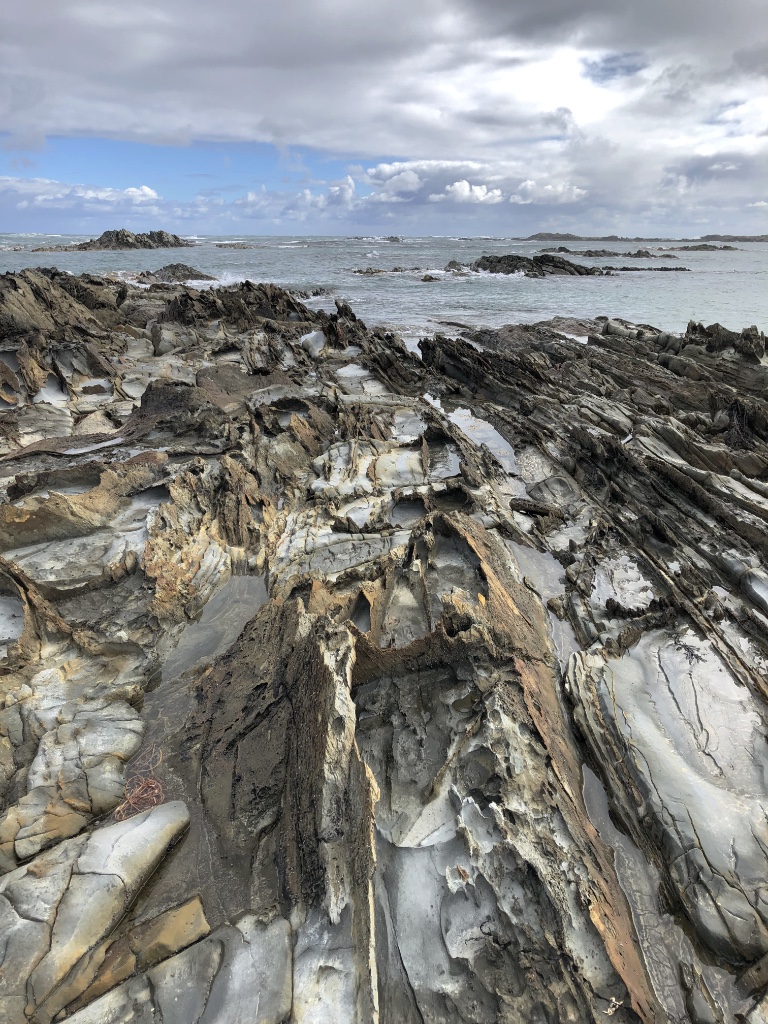
A little further north along the C214 – Temma Road is Nelson Bay. Again access by a gravel road should cause no issue for smaller 2-wheel drive vehicles but leave the caravan behind. The road terminates at a small gathering of homes overlooking the wild sea with plenty of flat ground to park. A short stroll south leads to a path to the beach and again wild seas are crashing over the rocks further out in the bay. Here erosion has created curious formations with jagged rocks standing upright and certainly capable of severe injury if you were to fall awkwardly.

Nelson Bay

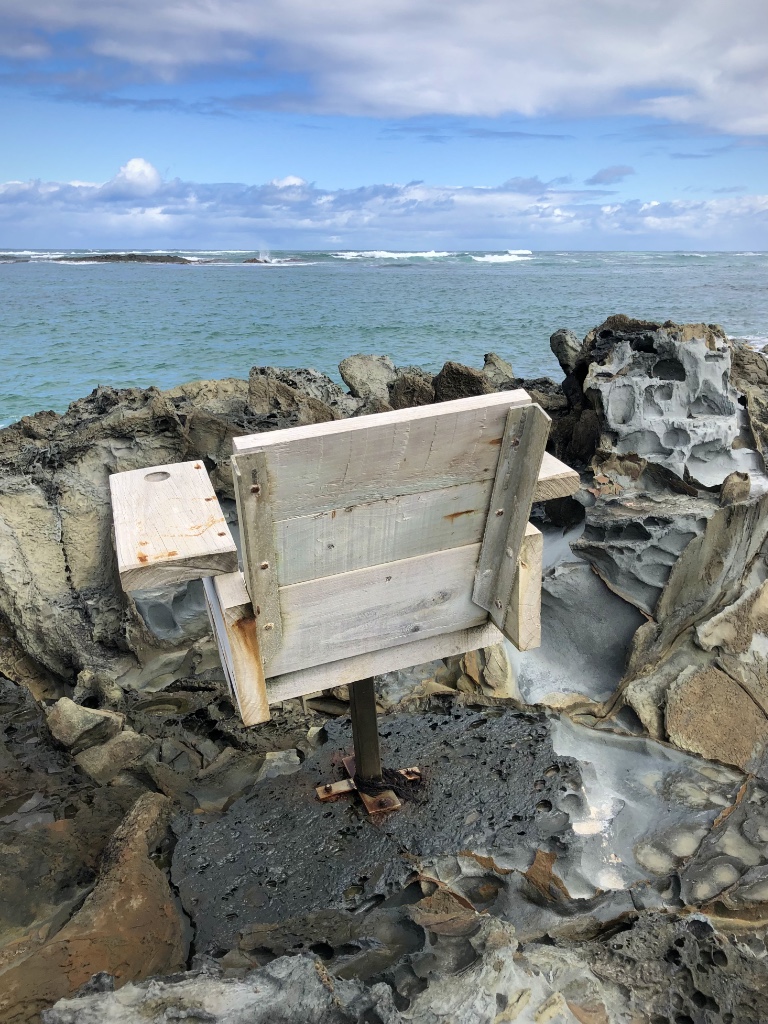
It’s the kind of place you could spend hours staring out to sea, if you hadn’t frozen by then, and coincidentally someone has conveniently mounted a chair right among the rocks so you may do just that. On a calm day this would be a great place to chill but on our visit further rain was racing in from the sea and it was time to take cover.

A chair with a view

Tomorrow we retrace our steps back to the north coast but we’ll miss the tranquility the Tarkine has given us over the past few days. We’ll always remember with great affection what a very special place in the world this is.