An unusually tall stone tower, built in 1870, sits beside the Channel Highway at Taroona 12km south of Hobart. It’s purpose is not obvious. Is it a smoke stack for some Victorian industrial scale boiler, a fire watch tower, perhaps, or an old lighthouse watching over ships entering Hobart Harbour?

It’s a Machine
It’s actually a Shot Tower, a machine of sorts, built to produce the lead shot fired from muskets. By any imagination the tower is not the first thing you would think of as being a machine of any design but innovation leads to success and that was certainly the case for Scots born Joseph Moir, Engineer, Architect, Carpenter and Overseer.
Once the tallest building in Australia, the tallest in Tasmania (until 1960) and believed still to be the tallest circular sandstone tower in the world, Taroona Shot Tower was built in just 8-months by two stonemasons to Moir’s design.
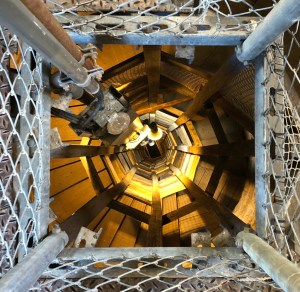
Standing almost 59-metres tall, 10-metres in diameter at the base and narrowing to 3.9-metres at the top, the tower’s impressive dimensions are deceptive. The adjoined stone building, which gives access to the shot tower, looks diminutive by comparison but is actually a substantial building in its own right. It’s only when standing within the tower that its true size can really be appreciated. Looking upward is more than a little daunting. Lining the walls of the tower is a circular wooden staircase comprising 318 shallow steps with a platform every 180-degrees and on some levels an open slot gives views of the increasing loftiness of the climb.
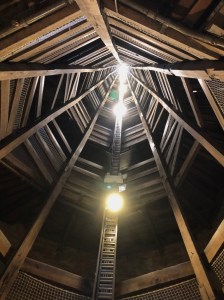
At the top of the tower, the original chimney pot has been removed and the roof made weather-tight. An external, circular metal platform and railing has been added providing excellent views of the Derwent River and surrounding countryside – at least to those brave enough!
Lookout below
Sitting to one side is the wood-fired cauldron originally used to melt a combination of lead, antimony and arsenic. Once molten the metal would have been poured into a steel colander suspended over the centre of the tower. Droplets of metal would begin to form and cascade down the length of the tower creating perfectly round spheres before hitting a tank of water at the base and cooling. The process took a lot of experimentation to perfect but finally produced successful shot on the 8th of September 1870 and continued to do so until 1905 when it was no longer commercially viable.
The size of the shot produced could be controlled to some extent by altering the size of the holes in the colander but it was not a perfect process. The size of the droplets varied with each pour requiring manual retrieval from the water tank and sorting the tiny shot in poor light by hand.
A Victorian tea shop first opened in the late 1800’s is still operating at the base of the tower. Each day they bake the lightest scones you’ll have ever eaten served with your choice of over 70-types of tea. They are among the best we have tasted throughout our travels around Australia and come very highly recommended.
 Discovery Down Under