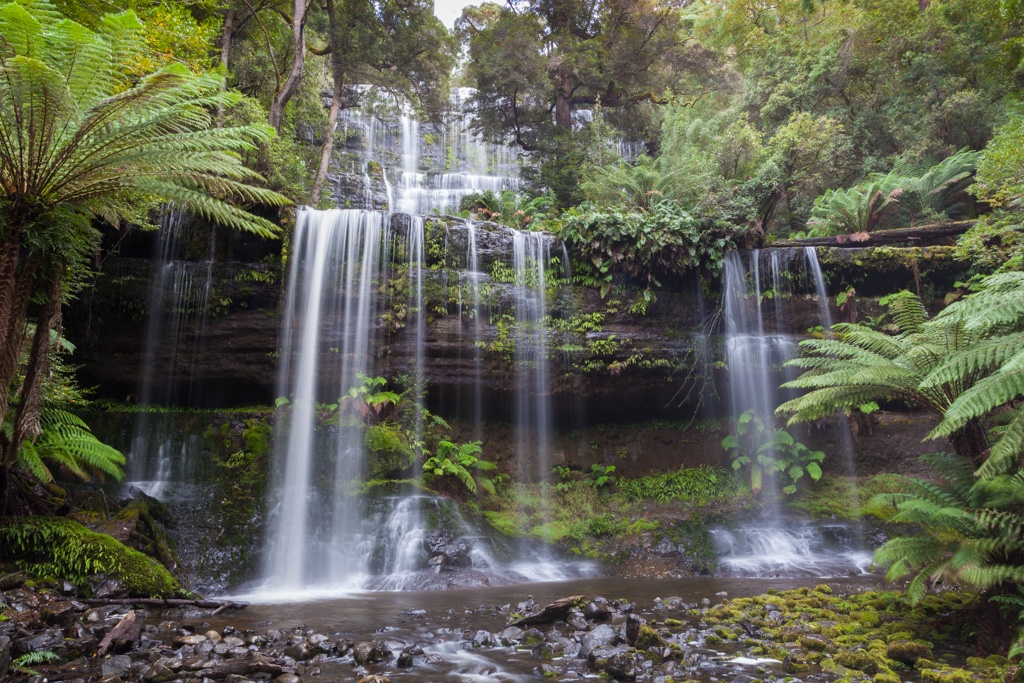
Formed by glaciers thousands of years ago, Mount Field National Park is one of Tasmania’s oldest national parks and reputed to be the most diverse. It also has one of Tasmania’s most impressive waterfalls – Russell Falls. It is with good reason Mount Field National Park was added to the Tasmanian Wilderness World Heritage Area in 2013.
Russell Falls
The national park is home to three cascading waterfalls with Russell Falls being the easiest to access and arguably the most impressive of the three. Situated just a short walk from the visitor centre through ancient tree ferns and towering Swamp Gums – the tallest flowering plant in the world, Russell Falls cascades over several levels of eroded bedrock to form a spectacular tiered waterfall. Although it had been quite wet recently the falls weren’t at their best, apparently.
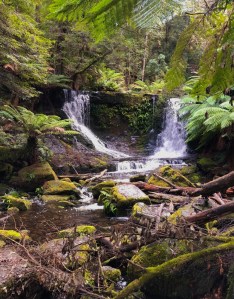
Continuing along the trail, a side walk leads to a set of 200-steps to climb up to Horseshoe falls. Here a semicircular hollow provides a good viewpoint of the falls surrounded by tree ferns and moss covered boulders. Though nowhere near the height and width of Russell falls, Horseshoe falls is still impressive and, from photographs we have seen at the visitor centre, is very capable of putting on a big display after heavy rain or melting snow from the higher alpine region.
Tall Trees Walk
Our walk continued along the Three Falls Track to an area known as Tall Trees. Here, among dense forest, are many of the giant swamp gums that you can stand beside and strain to look upward to the canopy high above. A Clinometer* has been setup so you can measure the height of one of the trees for yourself. A chart beside the Clinometer converts the angle you measure between the ground and the canopy of the tree giving the tree’s approximate height. The correct height is given behind a hinged flap on the chart.
Several of the trees in the this area are known to be in excess of 70-metres tall and 300 to 400-years old.
For those less able to climb the steps along this walk, a car park at Gate 2 is easily accessible from the visitor centre along Lake Dobson Road.
Lady Barron Falls
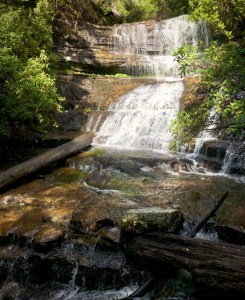
Following the same track up and down and around smaller creeks eventually leads to a short diversion to Lady Barron Falls. Similar to Horseshoe falls but with more water, Lady Barron Falls was a bit of a disappointment after Russell Falls and not the easiest place to take a photograph from. It’s quite a long walk to get here if you follow the circular walk between each of the falls and still more than a third of the walk back to the visitor centre. However, the return walk is well worthwhile as it follows the Lady Barron Creek as it makes its way down to the Tyenna River. Beware though, the return leg includes an uphill flight of steps – all 239 of them!
Fungi Everywhere
Perhaps more than anywhere I have seen yet, Mount Field National Park during Autumn supports an enormous variety of fungi, many of which were new to me. At every turn you will see fungi and lichen growing on trees that have fallen and growing among the leaf litter.
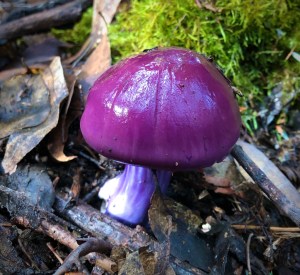
After spotting a few species you may find yourself looking more attentively at the most brilliantly coloured or tiniest delicate fungi. Some that look like coral, some green or even blue and some that look like an alien creature. There is just so much to see but please do not disturb the fungi – they are an essential part of a healthy forest breaking-down fallen trees and branches and releasing nutrients and minerals back into the soil.
Beware – many of the fungi are poisonous and one in particular – the Death Cap (Amanita phalloides) is extremely toxic. It is responsible for 90% of mushroom related human fatalities world-wide. Ingesting as little as half of this apparently tasty and harmless looking mushroom can result in a slow and painful demise. Death usually follows an apparent but temporary recovery in as little as twelve hours as a result of permanent organ failure.

Left of Field

Our campsite during our stay in the national park was the quirky ‘Left of Field Caravan Park’. It’s a great balance between the unspoilt beauty of the surrounding flora and fauna and the necessities of on-the-road life. But then it also has a fabulously stocked bar within a shipping container, a blazing fire to sit around and a live band on Friday nights. Our hosts, Adrian and Mel, are a wealth of knowledge, not just of the local area but much of Tasmania too. You will be made to feel very welcome.
Something’s stirring in the River
We had heard that platypuses can often be seen in the Tyenna River behind the caravan park. So, having always wanted to photograph one, we walked down to the weir and followed the riverside upstream. And right there in front of me was a platypus showing no interest at the long lens I was pointing at it. Over the next twenty minutes it continued diving for food and moving further upstream.
Adrian from the caravan park joined me shortly after and explained he often has an early morning dip in the river, even though it’s very cold, and the platypus is often there to join him.

The following day I got to spend even longer photographing the platypus and was joined by PJ from New York and, just like me, he had always wanted to see and photograph this unusual but beautiful creature. Unknown to us just hours earlier a black tiger snake had been disturbed in exactly the place we had been standing.
*Clinometer. A measuring instrument used to find the angle of elevation. Typically used to measure the height of trees or tall buildings.
 Discovery Down Under