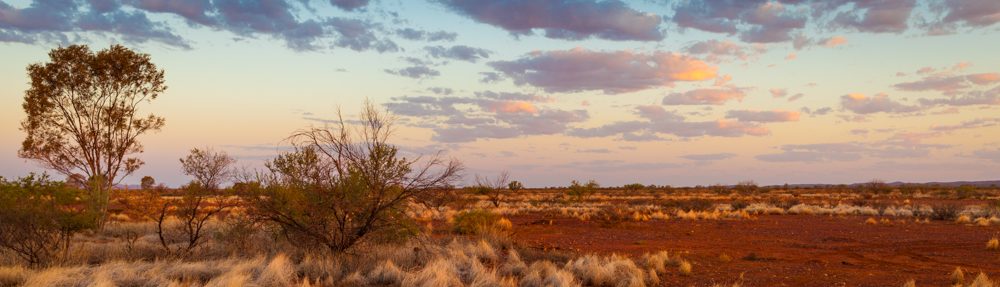
Strahan the gateway to Hell’s Gates
Once a busy port for Macquarie Harbour, Strahan (pronounced ‘strawn’) is now best known as the cruise gateway to the Tasmanian Wilderness World Heritage listed Lower-Gordon River.
There are two companies vying for passengers; Gordon River Cruises and our choice World Heritage Cruises. Both leave from the harbour wharf in Strahan.
Our cruise takes in Macquarie Harbour, the much feared Hells Gates – access to the open sea, the convict prison of Sarah Island, and a glide along the mirror finish of the lower Gordon River to Heritage Landing. In all the cruise lasts around five and a half hours depending on the weather.
Hell’s Gates
Access into Macquarie Harbour – an enormous inland sea – was first discovered in 1812 and within a few years loggers were taking advantage of the ancient Huon Pine trees, which were ideal for ship building. The loggers, and then early settlers, risked life and limb to cross the narrows of the entrance to the harbour and for good reason it became known as Hell’s Gates. Huge waves and strong winds often made access impossible leaving ships waiting in rough seas until the weather eased or, as happened to many, ended up capsizing with tragic loss of life.
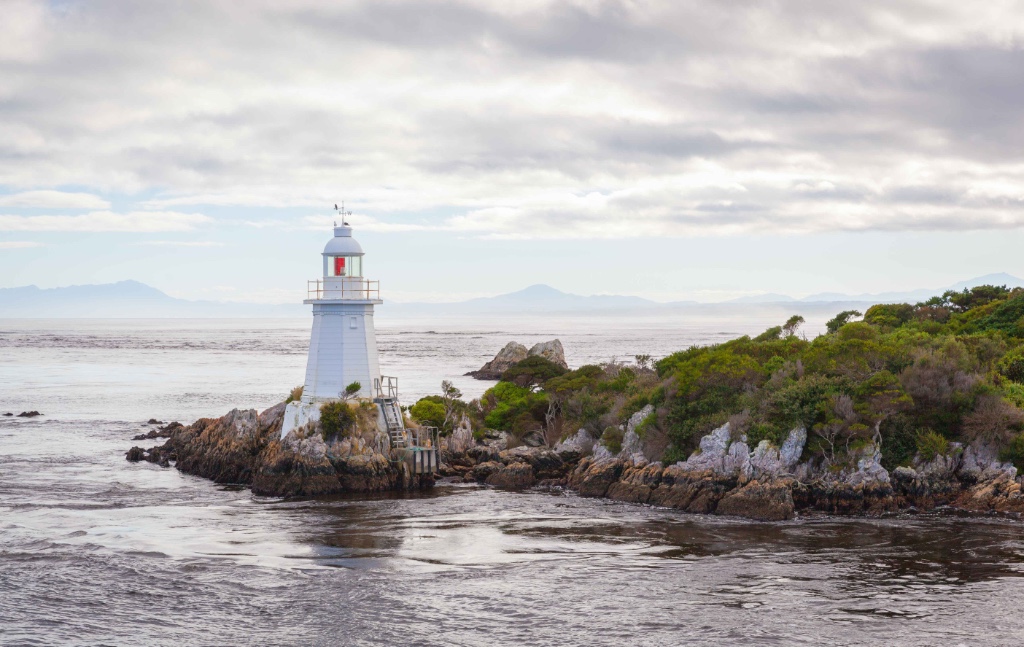
A signal station manned by convicts was constructed in 1822 to guide ships into the harbour and later, in 1891, white timber lighthouses were constructed, one on the western side of Entrance Island, and the other on Bonnet Island. With the increase in traffic and shipments of ore and timber to and from the harbour, larger ships were needed, which resulted, in 1909, of the purchase of a dredger to deepen and maintain the channel for safe passage.
Entering Macquarie Harbour by ship is much safer today with motorised vessels, accurate maps and satellite navigation but is still treated with great respect.
Just beyond Hell’s Gates is the region known as the ‘Roaring Forties’ – the 40-degree line of latitude that spans the oceans all the way to South America. With no intervening land there is nothing to calm the strong winds and ocean currents, which often pummel the shores of western Tasmania.
Sarah Island
Turning around we headed back through the harbour towards Sarah Island. From 1822 until 1833 Sarah Island was a Penal Settlement with an appalling and much feared reputation. Records show Sarah Island was by far the most brutal of all penal settlements in the history of transportation to Australia. Flogging was a very frequent form of punishment and in one case a convict received 100-lashes in an hour – five of those after he was already dead, just to make sure I guess. His crime? Stealing a small quantity of fat. He was lucky, if he had survived he would have been put in irons for 6-months.

Convicts were put to work each day, mostly felling Huon Pine trees for shipbuilding back on Sarah Island. They were given just a bowl of oats soaked in water for breakfast but no further meals while they worked to discourage them from absconding. That didn’t always deter convicts trying to escape, though. Some tried their chance escaping into the bush, preferring likely death trying to gain freedom rather than suffer further on the island. Many, though, were recaptured and returned to face 100-lashes.
The ship that Never Was
One such attempted escape involved the theft of a ship that had been constructed in 1834 by convicts on the island. The ‘Frederick’ was the last of over 100-ships to be built on Sarah Island and was due to be sailed to Port Arthur. Ten convict shipwrights boarded the ship and made their way to Chile in South America. Four of the convicts were recaptured and returned to Hobart to face trial on piracy charges. They proved that the ship had never been completed or officially registered and as such did not officially exist, therefore it could not officially have been stolen. They were never convicted of piracy but were charged with the lesser charge of robbery.
Just Ruins
Little of the settlement has survived the ages, ravages of the weather and the occasional pilfering by tourists. But was does remain leaves little impression of just how much of the island was originally built on and just how quickly the vegetation has reclaimed it.
All together around 1200 prisoners spent time on Sarah Island for offences committed while already under sentence. Of the 112 men who attempted escape 62 died in the bush and 9 were eaten by their companion escapee’s.
And talking of eating… lunch was served as we continued the cruise across Macquarie Harbour making for the Lower-Gordon River.
Such was the impenetrable nature of the bushland lining most of the harbour it was hard to tell where the river entrance began. It was only as the rising, densely forested hills began to narrow-in and the slowing of the boat’s engines, could you tell we were now cruising on the Gordon River.
Perfect Weather
We have been so fortunate with the weather. After the cold and wet weather at Cradle Mountain, today sun is shining from a clear blue sky with just a light wind to break the surface of the river. Occasionally, when conditions are right, early morning mist rises from the surface of the river and the dark, tannin stained water creates a near perfect mirror. It is these reflections, often seen in photographs and travel documentaries, that I was hoping to capture.
Creeping along the river you cannot help but be awestruck by the extent of trees clinging to the hills and cliffs with barely room for anything else to grow. From reeds along the riverbank, trees that have fallen into the river and upward through dense stands of leatherwood, sassafras, myrtle and the infamous Huon pine trees. It’s a true wilderness, untouched and impenetrable.
Heritage Landing
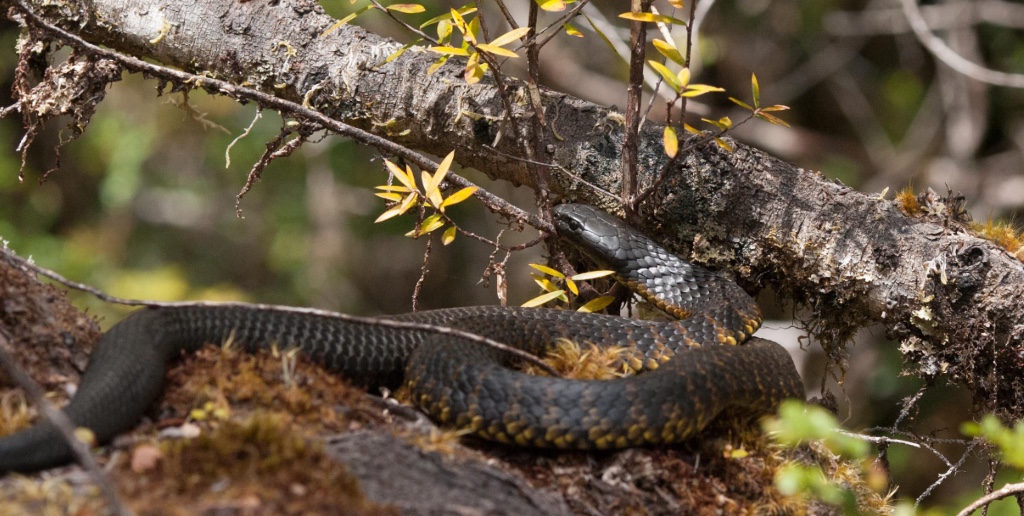
The cruise gives the opportunity to briefly explore a small area of the wilderness at a jetty and boardwalk known as Heritage Landing. Before stepping on land passengers are reminded that there are black tiger snakes in the area and to keep well clear. If proof were needed, in 2008 we visited the same spot and sure enough, right by my side, a tiger snake slithered along a fallen branch and curled-up to take advantage of a patch of sunlight. Apparently, according to our guide, its name was ‘Sammy’.
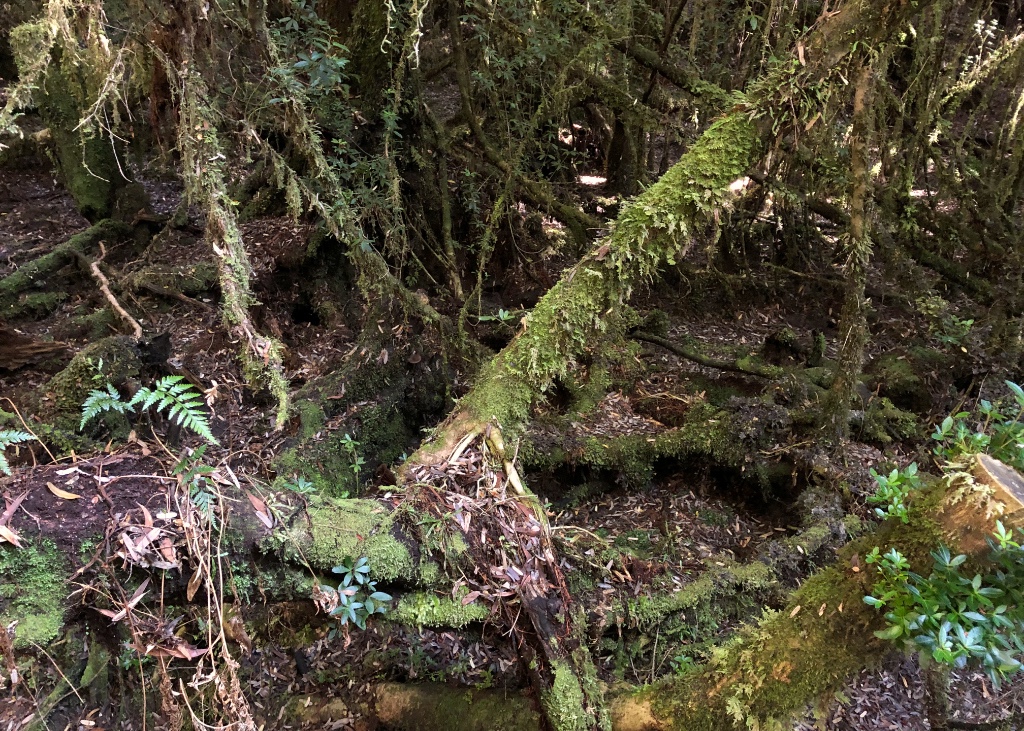
Unfortunately there were no snakes this time as we circled around the boardwalk. Similar to the wooded walks around Cradle Mountain, masses of moss and lichen smothered the ground with brightly coloured fungi growing from rotting branches.
All too soon we were returning along the river for the long sail back to Strahan but not before we got the chance to witness the perfect mirror reflections that we had been hoping for.
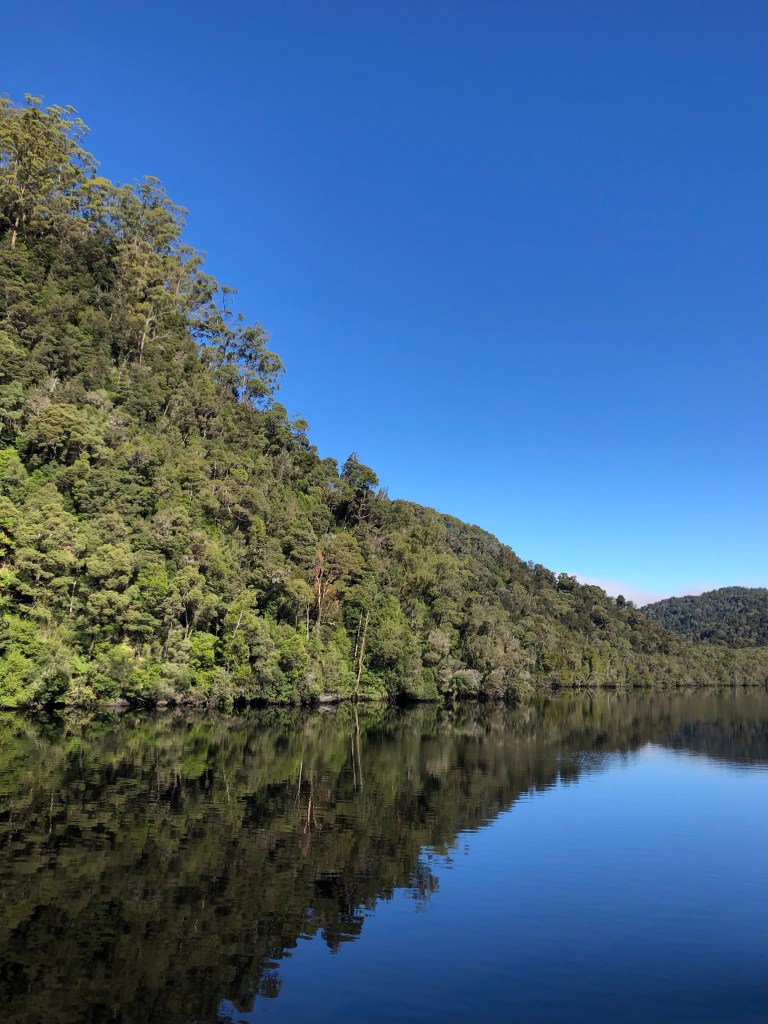
It had been an excellent day trip among magnificent scenery in the most perfect weather. The only thing lacking was the ‘mood’ of our previous visit when the weather wasn’t quite so enticing. Don’t let a dull grey sky or rain put you off taking this cruise, it will just add more drama to this rare and unique place on earth.
Dam Busters
It’s not possible to talk about the Gordon River without mentioning how close we were to having this unique wilderness lost forever.
In 1978 the Tasmanian Hydro Electric Commission (HEC) announced their intention to build a dam below the confluence of the Franklin and Gordon Rivers called, unsurprisingly, the ‘Gordon below Franklin Dam’. This would have permanently destroyed the unique nature of the wilderness and it quite rightly caused an outrage. We have Bob Brown, the leader of ‘The Wilderness Society’ to thank for raising global awareness of the proposal, which led to 10,000 people in June of 1980 to march on the streets of the Tasmanian capital – Hobart in protest.
Under the then premier of Tasmania, Doug Lowe, an agreement was made to place the Franklin River in a new ‘Wild Rivers National Park’. Then in 1981, caves containing Aboriginal hand stencils and stone tools were discovered, which were estimated to be 8,000-20,000 years old. Additionally concerns began to be raised regarding the potential loss of habitat for endangered species.
Later the same year a referendum was held in which there was a majority in favour of the proposed dam. Still, 33% of voters wrote ‘No Dams’ on their ballot papers in protest. In mid 1982 a change of government chose to go ahead with the dam. The new premier, Robin Gray, commented the river is ‘nothing but a brown ditch, leech-ridden and unattractive to the majority of people’.
The Australian federal government offered $500 million to the Tasmanian government to stop the dam, which was rejected claiming the dam was a matter of the state government and not federal. From that point the anti-dam campaigns stepped-up a gear and were joined by David Bellamy, a renowned UK botanist and nature TV presenter, and Australia’s businessman and adventurer, Dick Smith.
What followed were thousands of people protesting, attempts to stop the dam construction by a flotilla of boats on the river, many arrests and eventually High Court action taken against the Tasmanian State government by the newly elected federal government under Bob Hawke. On the first of July 1983 the High Court judges ruled in favour of the federal government and construction of the dam was finally stopped once and for all.
World Heritage Listing at Risk
The Tasmanian Wilderness World Heritage Area, which includes the Franklin and Gordon rivers, was added to the World Heritage list in 1982 with additional areas coming under protection over the following years. However, politics being what it is, the government, under Tony Abbott, couldn’t stop meddling and in 2014 proposed de-listing the Tasmanian Wilderness as a World Heritage Site to allow logging of trees within the protected area. This was formally rejected by the World Heritage Committee and in 2016 the Tasmanian government withdrew their bid to allow logging after a UNESCO report opposed the idea.
How long before the governments try this again and ignore those that put them in power? They’ve already done just that in the Tarkine.
 Discovery Down Under