You cannot think of Tasmania without thinking of the Tasmanian Devil so popularised by the Looney Tunes animated cartoons – once the angry, frustrated, spinning antagoniser of Bugs Bunny and his friends.
The Tasmanian Devil was named by early settlers who thought the mostly nocturnal mammal’s screams and hisses were the sound of the devil. Few other animals are as vocal as this one especially when squabbling over food or fighting for dominance.
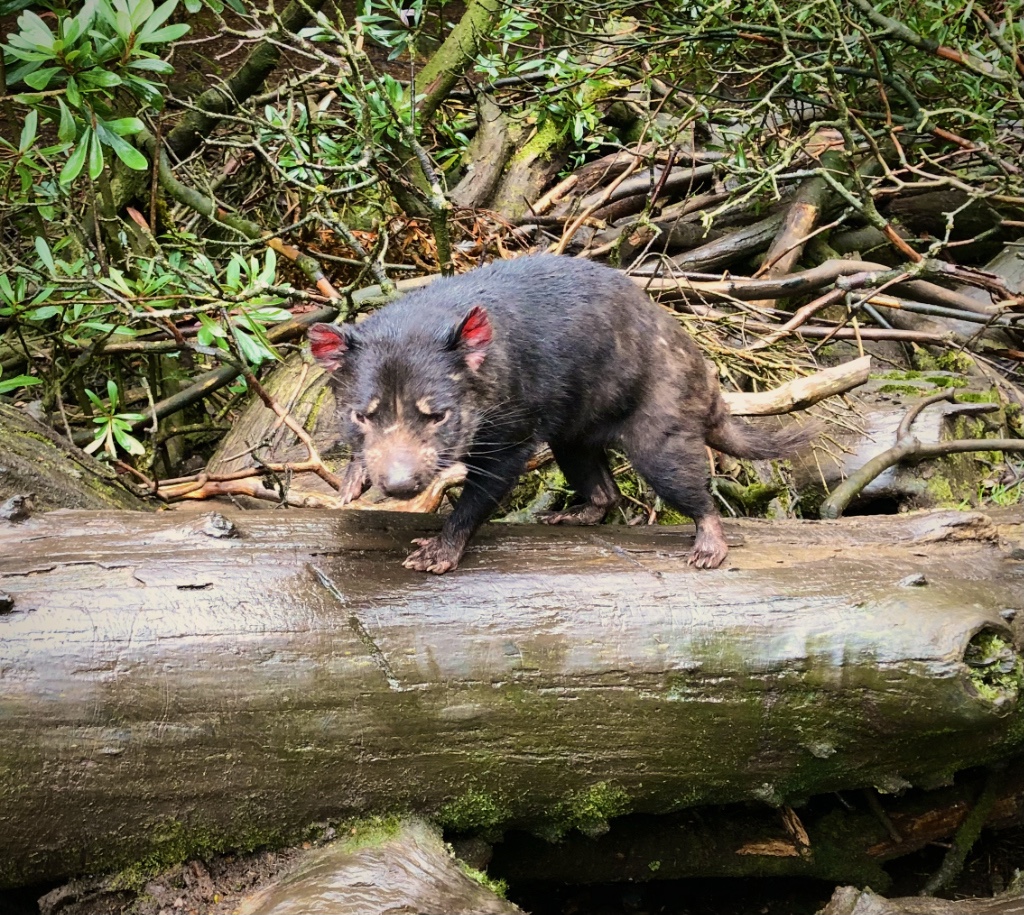
The size of a small dog but with the strongest bite of any animal for its size in the world, it is a fierce meat eating predator who’s jaws easily crush bones, which it dispatches along with the majority of its prey. They will eat just about anything including their favourite the wombat due to its high fat content but also small kangaroos, frogs, rabbits, birds and domesticated animals such as sheep. More often, though, carrion forms much of its diet.
First Extinction
Once common throughout Australia it is believed the Dingo was responsible for the disappearance of the devil on the mainland 3,000-years ago. Dingoes never crossed into Tasmania, though, and as a result, the devil thrived as the dominant predator. But its days may be numbered.
Second Extinction?
In 1996 at Mount William in northeastern Tasmania, the first case of Devil Facial Tumour Disease was identified in a female devil. It is an aggressive and contagious cancer that results in the death by starvation of the animal in just months. The disease is passed-on by bites, which quickly infects the host. It is now believed up to 80% of the decline in population is attributable to the disease with just a few pockets on the west coast and far north-west being tumour free. No cure has yet been found.
A recent estimation indicates just 25,000 devils remain and without the assistance of conservation sanctuaries and disease free breeding programmes such as Devils@Cradle, the Tasmanian Devil may well disappear forever.
Devils@Cradle
While at Cradle Lake National Park a wet day gave us the opportunity to rest from walks for a while and to visit Devils@Cradle sanctuary. It was a very worthwhile visit, not just to see Tasmanian Devils for real but also to learn more about them and what the sanctuary and associated breeding programmes are doing to help prevent their demise.
We joined one of the ranger led tours around the sanctuary and what an experience it was. Our guide, Gemma, was an extremely knowledgeable and capable speaker with a very clear passion for the Tasmanian Devil. We learnt so much about the mammal’s short 5-year life, the fast-passed gestation, born just the size of a grain of rice, less than half making it to adulthood and the devastating effect of the facial cancers.
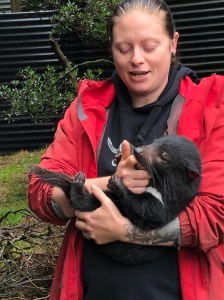
Gemma had helped raise a female juvenile known as Pancake, which had been deserted by its mother. It was clear there was a strong bond between them as Pancake laid in Gemma’s arms suckling on her finger before she decided to give a ‘gentle’ bite, enough to draw blood, when Gemma tried to remove her finger. At some point Pancake will have to be weened away as she grows further and becomes less safe to handle.

Quolls
The devils are not the only endangered resident at Devils@Cradle. The rare and closely related Eastern and Spotted-tail Quolls can also be seen here. Their population has been decimated by feral cats and foxes – both introduced by the early European settlers. Staff at the sanctuary are hoping to breed these timid little mammals and release them into the wild. At the very least captive programmes such as these should help prevent the demise of yet another native animal looking at extinction at the hands of past generations.

Visiting Devils@Cradle isn’t cheap, especially for a family, but the money raised from entry fees goes towards the continuing work of the sanctuary in helping these creatures survive, provides education and gives the opportunity to observe these unique creatures safely and in person.
 Discovery Down Under