We were right to make the most of the weather yesterday at Cradle Mountain. The predicted change of weather rolled in during the evening with heavy rain overnight and a drop in temperature. That wasn’t going to stop us exploring though.
Marion Lookout!
Assuming we may get a good soaking we had rugged-up with a plan to scale Marion Lookout to get a different viewpoint of Cradle Mountain. It was certainly going to be different – cloud cover had descended over the mountains. But it started well with our shuttle driver, J Dub, at the wheel again and entertaining the passengers.
“In the 1960’s a woman was bitten on the bum by a black tiger snake – no.5 on the World’s most venomous list. She was too embarrassed to tell anyone and subsequently died. She was the last person to be killed by a snake within the park… all the others died in hospital.”
While driving towards Dove Lake, J Dub was asked by a passenger, “what type of trees are these on the left?” Not being an arborist, J Dub replied, “the same as those on the right.”
Someone noted the roadside kerb posts and asked, “why do the posts have black bands around them?” J Dub replied, “Oh, they’re in morning, one of them was run over last week.”

On arrival at Dove Lake we were presented by a grey and gloomy sky. All the glorious colour of the previous day was gone. Undeterred, our walk to Marion Lookout began at Dove Lake and headed out on the increasing steep Crater Lake path passing both Lilla Lake and the Wombat Pool. As you’ll discover later, Wombats have a peculiarity in the animal kingdom and, not coincidentally, someone had scraped the ‘L’ off the sign for Wombat Pool.
Lilla Lake
Lilla Lake is a good spot to take a breather before climbing the sturdy timber steps. On a calm day the lake acts like a mirror with Dove Lake glistening in the background. As we approached, however, gusting winds were stirring the surface of the water and taking on the colour of the deepening grey sky.
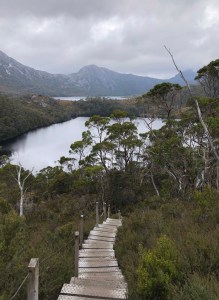
Now at over 1000-metres the temperature had dropped further but it helped as we climbed countless steps up towards Wombat Pool. The walk is classed as a Grade 3 and accessible to all but the least fit but it was tougher in places than we had expected, especially on our ageing knees.
There’s Gold in them there Hills

By now we were just below cloud level and a notable change in flora. Gone were the myrtle trees and panini in the creeks to be replaced with button grass, mosses and an increasing number of Fagus trees.
The Fagus is a cold-climate beech tree, restricted to a small area of Tasmania and Australia’s only winter deciduous tree. It produces masses of golden leaves during autumn that light up the mountain sides attracting those keen to experience what has been named ‘The turning of the Fagus’. The tree is a living relic of the supercontinent Gondwana and shares a similarity to species only found in the once adjacent New Zealand and South America.
Crater Lake
Named after its similarity to a volcanic crater, Crater Lake is one of the few points on the hike that levels-out for a while. Offering amazing views over the valley… on a clear day. The clouds had lifted a little further but it was still restricting a view of our intended destination of Marion’s Lookout. Occasional glimpses of the remaining climb to the summit appeared between the clouds at which point we started having second thoughts about continuing. We could have continued and tackled the steepest section of the walk seeing nothing through the cloud at the top or make our way down past Crater Lake and follow the route down to Cradle Valley to eventually join the world famous Overland Track back to our shuttle pick-up point.

Needless to say we headed downhill through the beautiful snow gum, myrtle and fagus tree-lined track. Now mostly out of the cold wind the track was busier than expected with a number of young, and no doubt very fit, hikers laden with tents, clothing and supplies for their 65km trek along the Overland Track. Knowing what the weather had in store for the next few days, they were going to experience a very tough time ahead. We wished them good luck and a safe passage.

Further down the track a number of small but picturesque waterfalls cascade down Crater Creek among the moss and lichen covered trees. The biggest is easily accessible with steps down to a bench and a few further steps to the water’s edge.
While stopping to take photographs and catch-up on some much needed food, we were joined by a very inquisitive Black Currawong. Also known locally as a Black Jay, the currawong is an intelligent bird with bright golden-yellow eyes contrasting with its deep black plumage and a long, stout beak. It is known to form lasting relationships with humans and is unperturbed when people are around. But then many birds do when there is a chance of food!

The final leg of the walk drops down to Ronny Creek – a large expanse of button grass with Tasmania’s unique panini trees marking the path of the creek bed. If you are very fortunate you may get to spot a platypus feeding in the shallow water but you’re far more likely see Wombats climb out of their burrows in the afternoon, around 4pm, to feed beside the boardwalk that runs alongside the creek and back to the park road and shuttle stop. Incidentally this point also marks the start of the 65km, 6-day Overland Track.
The marsupial wombat’s closest living relative is, surprisingly, the koala, but unlike other marsupials it’s pouch faces backwards to the to prevent soil from entering while burrowing. The wombat’s earliest known relative was the Diprotodon and the size of a hippopotamus, which became extinct approximately 11,700-years ago.
It’s True After-all!
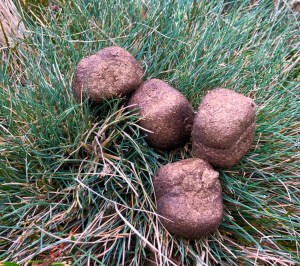
Now, as mentioned earlier, the wombat has a little peculiarity and often brought up in conversation when discussing this muscular animal. You see, the wombat is the only known creature to do square poops! No, it really is true and here’s the photograph to prove it. The poop often appears on top of rocks and other precarious places as a territory marker and to attract a mate. And being square it isn’t going to roll away!
 Discovery Down Under