Letting off a little Steam

A short drive to the west of Devonport is Don Reserve, recommended to us by the enormously helpful staff of Devonport Visitor Information Centre.

The reserve borders the Don River and offers a peaceful environment to walk and lookout for the rare Swift Parrot. Stands of Black Gum, Swamp Paperbark and Coastal Black Peppermint trees provide shade during warmer days and home to many of the species of bird that seek protection here.

We started the walk along a path that seemed to disappear only to reappear a little further on beside a railway track and becoming a recently resurfaced tarmac path. In the background we could hear the whistle of a train, which we assumed was one of the trains servicing the docks in Devonport. However the whistle grew louder when all of a sudden we were being passed by a steam train! Curious we continued further and shortly after sighted the train again at the Don River Railway station.

Rock and Rolling

Having not experienced steam travel for many, many years, we bought tickets for the return trip to Coles Beach – the end of the line. We boarded what was once a women’s section of a coach that had been carefully restored.

Don River Railway Engine

It was a trip back in time to when train coaches were built by craftsmen from timber with a high gloss finish and brass fittings. Fortunately the seats were a little more comfortable than they would have been in the past and we were thankful for them as the train trundled along the very uneven track. Flying in severe turbulence could be considered more comfortable. However it was an experience we’ll remember, the steam, the smoke, the views of the Don River as the tide came in and the bruised behinds we’ll have for a few days.

We can imagine how busy the train would be during the summer tourist season but well worth any queue you would have to join. Any delays could be spent in the little rail museum or shop as you wait for your time to board.

Our circular walk continued on the opposite bank of the river through patches of paperbark and swamp grass before crossing Sawdust Bridge to rejoin the start of our walk. A large timber mill once stood beside the river leaving piles of sawdust from which the latest bridge crossing was named.

NB. Shortly after visiting the railway we heard bad news – a fire in the early morning of March 25th caused considerable damage. More…
Pademelons, Bottoms and a Museum

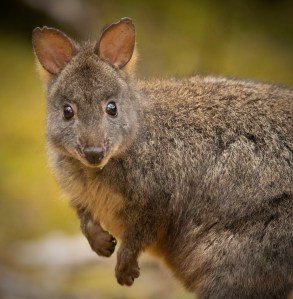
Yesterday we were advised that a likely sighting of the Southern Lights (Aurora Australis) could be had from Devonport due to recent solar activity but unfortunately the town’s street lighting was too bright to see more than the brightest stars. We did, however, see plenty of Pademelons hopping around the Mersey Bluff Caravan Park. These were the cause of the mysterious ‘landmines’ that appear overnight. Thoughtfully the park owners provide a garden rake ideal for relocating these deposits.

Tasmanian Padamelon*

[Pademelons, for those not familiar with Australian wildlife, are similar to wallabies but with smaller, rounded ears, a thicker tail and limbs covered in a dense fur.]

We awoke to another cool morning with a cloudless sky and the sun glittering on the calm sea. Perfect for a stroll along the coast. But first, coffee! And for the morning brew we can highly recommend Drift conveniently located adjacent to the caravan park and looking out over the beach. It’s a popular spot with early risers completing their morning run and those looking to thaw following a dip in the sea.

Spirit of the Seas

The Spirit of Controversy

A little further along the coastline is a 5-metre tall statue titled ‘Spirit of the Seas’ situated at the entrance of the Mersey River. Its installation was highly controversial featuring a naked depiction of a man holding a spear with similarities to Neptune. It was not a commissioned piece of artwork with local artists claiming the $150,000 contribution by the council was a massive overspend. It was also thought not appropriate to have the naked behind of a man greeting passengers of the Spirit of Tasmania. Worse still the view as they leave for the mainland!

Bass Strait Maritime Museum

Time for lunch but first we had arranged to meet our travel buddies at the Bass Strait Maritime Museum just a short walk from the caravan Park. The small museum details the history of the surprising number and style of ships that transported goods as well as early settlers to Tasmania. It also documents the development of Devonport as the primary port on the north coast of Tasmania.

The shallow estuary severely restricted the size of ships that could dock and, prior to dredging the channel, smaller ketches were required to load and unload cargo – a slow and laborious process. Nowadays large ferries and freight carriers are able to enter and manoeuvre within the port, though with just metres to spare.

Children, and many adults, will be entertained by the virtual ship simulator that gives the opportunity to try your hand at docking a ship in Devonport Harbour. It is way more challenging than you would imagine, especially when numerous ships are heading straight for you …in a swell… and at night!

The museum displays continue within the individual rooms of the house the museum is located in. Models of the previous Bass Strait ferries; The Princess of Tasmania and the Empress of Tasmania, give a good idea of just how large the current Spirit of Tasmania ships are. The next generation ferries due to go into service will be even larger.

Not only can we highly recommend the coffee in the museum cafe but also the delicious meals and cakes. The smoked salmon rillettes in particular were superb.

Useful fact for Trivia fans: Railton in Tasmania is the home of a major cement manufacturer that, during the late 1920’s, exported from Devonport the cement used in the construction of Sydney Harbour Bridge.

* Image courtesy of Wikipedia

Leven Canyon

Situated 56km southwest of Devonport is Leven Canyon Regional Reserve and home to the deepest limestone ravine in Tasmania – Leven Canyon.

The drive to Leven Canyon is just as captivating as the chasm itself following winding roads, through rolling hills and straddling forests beyond the motorway with Mount Roland dominating the view to the south.

On arrival we had been expecting something more developed for such a significant geological feature but we were greeted by a simple gravel parking area, good signage and a small display detailing the history of the reserve.

Two routes form part of a circular walk with two viewing decks giving clear views to the Leven River below. Joining the routes is a significant stairway comprised of 679-steps. Not for the faint hearted or those with less than average fitness, the steps are steep and winding.

Cruickshanks Lookout

We chose to follow the short upper walk first to Cruickshanks Lookout and what a great walk it was. Gentle at first interspersed with some steeper sections, the Cruickshanks Lookout walk passes through mixed woodland with plenty of shade but perhaps best walked early in the day in cooler weather as we did. The view from the lookout was worth every step to see the canyon from horizon to horizon while suspended 275-metres above the river.

View from Cruickshanks Lookout

Seeing the start of the steep downward stairway we decided to return by the same route to the car park before following the second path through Fern Glade.

Edge Lookout

The path to Edge Lookout begins relatively level as it passes among the tree ferns but soon begins to descend steeply on a slippery gravel path. In places a rope rail helps steady those with less than suitable footwear or weak knees. It is considerably tougher than the Cruickshanks walk on the joints but definitely the most rewarding walk from a fitness exercise perspective. The view from the overhanging platform doesn’t disappoint with an equally impressive view of the canyon below and a clear view to Cruickshanks lookout far above. Unfortunately reaching this point also means a tough walk back to the car park. Take it easy, enjoy the clear fresh air and use the slower pace to look for wild flowers and fungi growing among the undergrowth.

Penguins, Potatoes and Pickled Onions

It sounds like the name for a recipe but just another day in Northern Tasmania.

We’re digging the North Coast

Rolling hills characterise the agricultural land hugging the north coast from Devonport to Wynyard, some so steep it’s hard to imagine a tractor capable of climbing, let alone plough, the fields. A mix of grass for cattle and dark earthy soil provide fertile ground for vegetables of all types. And local grown is reflected in the price of potatoes – a fraction of the price you would pay in any of Australia’s larger cities.

Not far to the west of Devonport is the town of Ulverstone sitting on the coast beside the Levin River from which it was originally named. Predominantly an agricultural region, Ulverstone is a large potato grower and processor supplying 24% of Australia’s potato market, making it Australia’s second largest producer after South Australia.

Each year 320,000 tonnes of potatoes are processed into frozen French Fries within Ulverstone’s Simplot factory. An additional 75,000 tonnes are supplied to McCains. However, potatoes are not the reason we were here.

In a Pickle

Blue Banner Tasmanian Pickled onions was the reason for our visit. Well, not us personally but our travel buddies. And we were so glad we tagged along.

To the front of the factory is the cafe and shop selling all things pickled and flavoured pickles too. A scent of vinegar wafts through the door as soon as you enter triggering fond memories of the days my grandparents used to pickle their own homegrown vegetables.

Of course you have to give the onions the taste test and we did just that sitting in the large cafe after ordering a savoury cheese scone. Blue Banner claim their locally grown onions are ‘The crunchiest pickled onions you’ll ever taste’. I can say with certainty that they are the, freshest, crunchiest and tastiest pickled onions I have ever tasted. For those that have only experienced pickled onions from a large jar in their local fish and chip shop, you’re missing a lot!

Not to be outshined by the onions, the cafe also makes a very good latte.

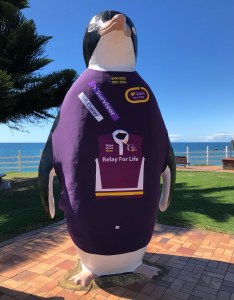
The Giant Penguin

There are many towns in Australia, both large and small, named in part after an animal. The obvious combining the name and a landscape feature such as Kangaroo Flat, Emu Plains or Crocodile Creek. But here in Tasmania they have gone one further and simply named a small settlement on the North Coast ‘Penguin’. And they are proud of it, or I could say obsessed with it.

The Giant Penguin

There can’t be a shop that has neither the name in it or sells penguins in one form or another. Even the street bollards have been made into penguins. It’s all a bit too much and sadly it has become a little ‘tacky’. Still, the children will love it for sure.

The Tardis

Now what I can’t figure out is Penguin’s connection with the Time-lord, Dr. Who. Why is the Dr’s travel machine, the Tardis, standing beside the Giant Penguin on the pavement. A look inside reveals a seemingly enormous library of lending books. It requires a double-take. I don’t know how it is done but the Tardis really is much bigger on the inside. Dr. Who is clearly an avid reader.

Chocolate, Apples, Curios and Murals

Today was our first day of exploring Northwest Tasmania starting from our base in Devonport.

Tasmania is well known as the Apple Isle and with good reason – it is a major supplier of apples to China, Hong Kong, PNG and Singapore. In fact 65% of all Australian apple exports originate from Tasmania benefiting from its cooler climate and extending Australia’s growing season.

Ready for picking

You won’t need to travel far from Devonport to see orchards heavy with the freshest, healthiest looking fruit and with good reason, the Australian Cider producer Spreyton is based in the town of its name with apple orchards growing within the town’s picturesque valley.

Sheffield – Town of Murals

An interesting town we have previously visited in Northern Tasmania is Sheffield situated south of Devonport within the Kentish Region. Previously a hub of the hydroelectric scheme and still a world-renowned dairy producer, the town is now better known for its painted murals on many of the towns buildings and within Mural Park. Each year International artists gather to paint within the Mural Park during Mural Fest. Unusually the theme each year is based on a winning poem entry from the concurrent poetry competition.

Just one of Sheffield’s mural artworks

While not to the same standard of many of Australia’s silo artworks they are well worth a visit when exploring this part of Tasmania. And while you are here we would highly recommend stopping for a coffee and cake at the Epicurean Cafe on the high street.

What’s in a name?

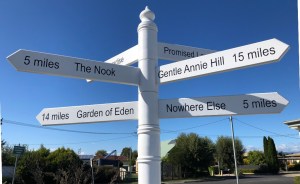
Yes, these are real place names

The Sheffield area also appears to have attracted more than its share of odd place names as can be witnessed outside the town’s Tourist Information Centre. Mounted on a pole are directions to ‘Promised Land’, ‘Paradise’, ‘Nowhere Else’ and ‘Garden of Eden’ and these are just a few of the local settlements presumably named after a long night on the grog. Sheffield, however, isn’t unique in Australia for quirky names. It appears early settlers had an interesting sense of humour.

Reliquaire

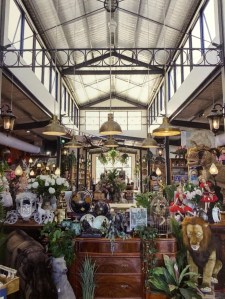
Eccentric or just unusual? That’s a question we were asking ourselves as we stepped into Reliquaire – a unique store in the small town of Latrobe. It’s an assault on the senses, an indoor African jungle, a dinosaur park, a book store, home to Alice in Wonderland, Harry Potter and Dr. Who. Confused? We were.

A store of curiosities

As soon as you open the door to the store you are faced with an unbelievable number of products all fighting for a space along the floor, walls or strung from the ceiling. But it is not disorganised chaos, rather it is themed by product type, size or colour. There are large stuffed animals, bone china tea ware, children’s clothes, toys, door fittings, model aircraft, TV themed merchandise, leather ware and a cafe to mention just a few. You really need to visit this store for yourself to comprehend what the store has to offer. Bring the children too and let them discover what’s behind the secret doors!

Time for Chocolate

Easter Eggs in the making

There’s always time in the day for chocolate and especially from an artisan like Anvers Chocolate located just beyond Latrobe on the road to Devonport. There are viewing windows so you can see the chocolates being made and a small museum displaying chocolate moulds dating back to the 18th century. As we visited in March, Easter Egg production was in full swing.

As chocolate lovers we’d highly recommend stopping buy and buying a block of happiness.