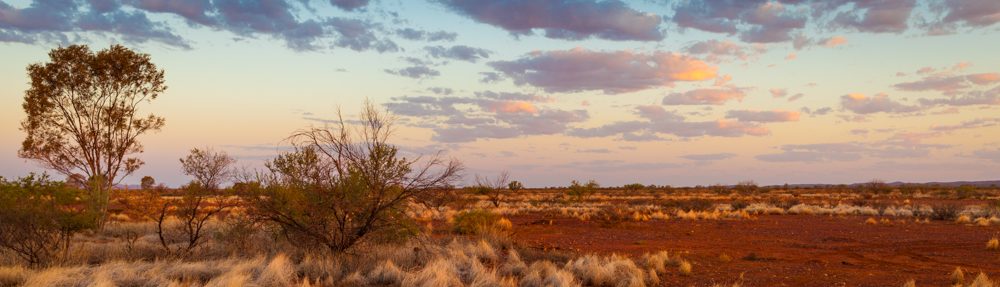
As we continue to head south towards southern Victoria, our next stop-off is the town of Naracoorte and we’re here for one specific reason – to visit the UNESCO World Heritage Listed Naracoorte Caves.
The first discovery by Europeans was Blanche Cave in 1845, located in what is now the Naracoorte Caves National Park, but it is just one of 28 caves so far discovered. At present only four caves: Alexandra, Blanche, Stick-Tomato and Victoria Fossil Cave, are currently open to the public with most of the remainder reserved for scientific research and requiring greater protection. A few further caves are accessible but only through Naracoortes Adventure Cave Tours.
Limestone Coast
Naracoorte sits upon massive limestone deposits left exposed by the rise and fall of sea levels 200-million and 20-million years ago. The caves complex formed from fracturing of the Kanawinka Fault allowing water to enter via cracks and fissures. Over time rain and ground water leaching through surface vegetation created a weak acid, which, to this day, continues to dissolve the limestone beneath. In places the subterranean cave ceilings have collapsed creating sinkholes and traps for unsuspecting wildlife to fall into but often also forming ideal habitats for bats.

The Naracoorte Caves, believed to have formed some 500,000-years ago, are particularly known for what fell into them over a period of hundreds of thousands of years. Soil and sediment that has built-up on the cave floor, 20-metres deep in places, has created a layered history of the species of plant and animal that existed at that time including creatures that are unique to Australia, creatures such as the giant short-faced kangaroo and marsupial lion – the so called Megafauna. Of international significance is Victoria Fossil Cave, which is rated among the ten most important fossil sites in the world.
Alexandra Cave
Discovered by William Reddan in June 1908 and named after Queen Alexandra, wife of King Edward VII. When first explored Alexandra Cave was largely filled with soil and silt, which had fallen or been washed into the cave over a period in excess of 100,000-years. The infill was painstakingly removed by hand to reveal some spectacular caverns, stalactites, stalagmites and helictites.
Just a year after discovery the cave was officially opened to the public with 2,000 people in attendance. Reddan, acting as caretaker of the cave, led the official party through the cave using the brilliant light of magnesium lamps. It is not known how much scientific discovery was lost as the cave was excavated but more recent core samples taken in the remaining sediment have unearthed over 100,000-years of evidence of life in the past including plant, pollen, insects and mammal bones. The search into the past continues in other caves in Naracoorte Caves National Park.
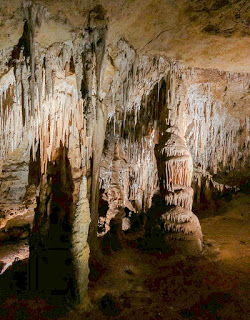
Stalactites & Stalagmites
A regular tour schedule is available during school holidays with a 30-minute guided tour dropping up to 30-metres and 240-metres along the cave where the noticeably humid air remains at a constant 17C year round. Twenty-five steps lead down to the mostly level cave floor that is largely compressed soil with up to 9-metres of sediment still remaining.
Stone Straws
We’ve been spoilt by some of the spectacular caves we have visited in Western Australia and it is hard for Alexandra Cave to compare. That’s not to say it isn’t impressive – far from it, it has some stunning examples of straw stalactites growing just 1mm per year on average making the longest examples many thousands of years old.
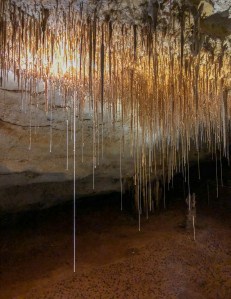
Each straw is formed by calcium-rich water dripping through the centre rather than along the sides of a stalactite. The straws are extremely delicate and hard to believe they are so old and have survived for so long. It would take just one wayward bat or an inquisitive child to destroy them. It is for that reason everyone is constantly reminded not to touch any of the decorations throughout the duration of the tour.
Mirror Mirror
One feature, and one of the highlights, is the mirror reflection in a small pool of water in the main chamber. The complete absence of drafts or vibration gives a perfect reflection of the stalactites hanging from the roof of the cave. You have to look twice to figure which is the reflection and which the real stalactites. However, impressive though it is, it is a man made feature created shortly after the cave was opened to the public.

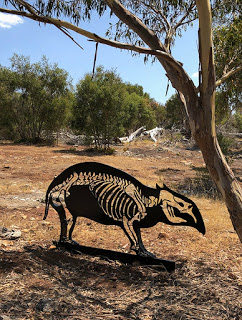
Above ground is a 900-metre walk that, in places, follows the path of the below ground caves as well as passing several other show cave entrances such as the large Blanche Cave and the protected Bat Cave. And giving an idea of the many extinct megafauna that used to roam around this area are steel sculptures in the shape of each creature with the fossil bone structure shown in relief. It’s a clever idea and fun for children (okay, some adults too) to spot as they wander along the pathway.
Victoria Fossil Cave
Given time a visit to Victoria Fossil Cave is recommended to view many of the reconstructed skeletons of creatures that entered the cave but never found a way out. With hindsight we should have visited this cave too if we had known more about it. The available literature at the Visitor Information Centres and online is poor in explaining what there is to see and, unusually, very few photographs too. I guess they don’t want to give too much away.
Entry to each cave is charged on an individual basis but a discount is offered if you want to visit more than one cave on a single day. And for those a little more adventurous there is an option for an Adventure Cave Tour to get down on your hands and knees and crawl. Overalls and safety gear are provided. Bookings are essential.
Somewhere to stay?
You could easily spend a couple of days exploring the Naracoorte Caves National Park and a campground is provided for those wishing to stay close by.
The town of Naracoorte lays just 28KM to the north and provides a number of popular camping and caravan sites including the conveniently located campsite at Naracoorte Showground where we stayed.
 Discovery Down Under