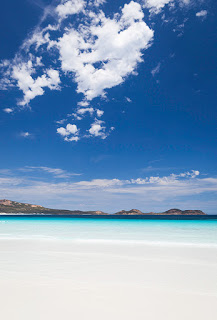
Our second short trip from Esperance takes us southeast to Cape Le Grand National Park. Located here, amid turquoise water and brilliant white sand, is the beautiful Lucky Bay.
A Lucky Discovery
Named by explorer Captain Mathew Flinders while seeking shelter from a storm in 1802. With safe harbour, Flinders wrote in his journal ‘The critical circumstance under which this place was discovered induced me to give it the name of Lucky Bay‘. During the four days that the ship ‘Investigator’ was anchored, natural historian Robert Brown and his assistant Peter Good discovered 100-plants that were new to science.
The Whitest White
Lucky Bay is, officially and scientifically tested, the whitest sand in Australia and quite possibly the world. Comprised of quartz of an almost powder-like consistency, the sand is blindingly bright in the sun and squeaks noisily underfoot.
Light reflecting back from the white sand in the shallow bay is responsible for the spectacular turquoise colour of the sea providing a stark contrast to the darker, deeper water where masses of sea grass grows. In sheltered places the sea grass ends up on the beach where it dries scattered on the otherwise pristine beach.
Safe Swimming
The bay is hugely popular as a safe swimming spot and though busy it was far from crowded as we arrived outside of the holiday season. I had hoped to take a photograph from high above with our DJI Drone to capture the colours of the sea and sand but there were too many people to fly safely – and legally. Instead we had a very pleasant stroll along the shore and as we returned towards the car park, right there appeared what has made the bay so well known around the world…
Kangaroos
Having seen so many Roos on our trip among highly-coloured grassy, hilly and red dusty outback locations, seeing them on a pure white beach looks just so unnatural. But it’s an image that sells and published regularly on the cover of many travel guides and tourist brochures.

Say Cheese
The animals are used to human presence and happily wander among sunbathers and pose for photographs. It was an image I was really hoping to capture and patience eventually paid off.
Unfortunately, and despite every notice stating ‘Do Not feed the wildlife’, people still do and in the process affect the natural feeding habits of the Kangaroos. Clearly some folk put their vanity above the health of one of our country’s unique creatures.
 Discovery Down Under