Wishing everyone a Happy, healthy and peaceful New Year in 2020.
A special heartfelt thank you goes out to all the Rural Fire Service volunteers who have given their time away from their families this year to fight the horrendous bush fires around the country. And our thoughts especially go to the families and friends of those we have lost who, by repeatedly putting themselves in the face of danger, have helped protect us, stock and property from tragedy. Thank You.
We’re taking a break over Christmas and New Year in the Adelaide Hills with fellow travellers. Being from England I doubt I’ll ever get used to an Australian Christmas with sunshine and temperatures in the 30’s along with daylight until 8PM… but I’ll keep trying!
We still have so much more to see and do as we make our way through South Australia, Victoria and New South Wales in 2020.
So many National Parks still to visit, country towns, cities, beaches, painted silos, markets, cheese makers, vineyards, distillers, orchards, galleries and, of course, coffee and cake shops!
We both wish everyone a very Happy Christmas and New Year and thank you for following us on our travels around this great country of ours.
We’ve been taking a break from driving for a couple of days at the seaside town of Moonta Bay on South Australia’s Yorke Peninsula. At any other time this would be the perfect place to chill for a while but, unfortunately, not right now.
South Australia is in the grip of a sustained drought and the current weather is doing little to help. After months of strong winds as we travelled around Western Australia, we arrived in South Australia to a change of weather with light breezes and blistering heat. Today it reached 44.2C after having only dropped to 31C overnight. Two more days of temperatures in the 40’s are predicted before a cooler change moves through the region. We’re fortunate to have air-conditioning in our caravan but feel for those camping in tents right now.
Copper Country
Moonta Bay is located on the Copper Coast, which is a huge wheat and barley producing region but once, as its name suggests, this was copper country. First discovered by shepherd Patrick ‘Paddy’ Ryan in 1861, copper was a major source of wealth for the region through until 1923 and is clearly visible in the number of ornate municipal buildings and stone cottages around Moonta township.
Moonta Bay Jetty from above
The South Australian government put out a call for experienced miners in England, which resulted in an influx of miners from Cornwall just as the tin industry there began to decline. One of the advertisements placed in a Cornish newspaper read:
‘Free Emigration to Port Adelaide, South Australia. Married agricultural labourers, shepherds, blacksmiths, wheelwrights, employers, tailors, shoe-makers, brick-makers, builders and all persons engaged in useful occupations may obtain a free passage to South Australia where they are within the regulations of the Colonial Commissioners. Meeting to be held at Bodmin at 10 o’clock on October 15’.
In fact so many settled in Moonta and the neighbouring mining town known as Moonta Mine, that several cornish traditions have become part of typical Australian life in this region and continue to this day including Kernewek Lowender – the largest Cornish Festival in the world. Even the humble Cornish Pasty can still be found on the menu.
Moonta Bay Jetty
Moonta became the second largest town in South Australia during this period and the largest copper region in the British Empire. A report for the mine in 1914 showed that by that time £5,396,146 worth of copper had been produced. In current times that equates to in excess of A$ 8.6-billion. And for Patrick Ryan’s discovery he received a considerable weekly payment of £6 but died just nine months later from alcoholic poisoning.
Moonta Bay Jetty
The jetty was constructed in 1868 in an attempt to encourage people to build and settle in the town shortly after the area had been surveyed. It was far from the ideal location with a very shallow bay requiring the jetty to reach out 500-metres to a point the water was deep enough to handle any sizeable ship.
The more practical and preferred location, however, was Port Hughes a short distance along the coast and eventually common sense prevailed with the Port Hughes Jetty being constructed shortly after.
Moonta Bay Jetty
Today Moonta Bay is the ideal location for a relaxing seaside break with a large waterfront caravan and camping site, hotel and motel. It is perfect for young children with its very shallow bay, warm crystal clear water and fine white sand. Moonta town has all the usual small shops, supermarket and fuel stations just 2KM from the bay.
Moonta Mine is now under the care of the National Trust and houses an excellent display of life during the mining days as well as many of the original buildings and the typically Cornish Engine House constructed to pump water from the mines.
And if your visit coincides with the extreme heat we have experienced, we can highly recommend the Coffee Barn and Gelateria in Moonta Mines for something to cool you down in their air-conditioned shop.
As we’ve mentioned more than once before, small towns around Australia are creating something of interest or unique to attract passing trade in the hope they will spend some money and help the local community. Times are tough right now and no more so than in our farming regions suffering from an extended drought. So what better way than create works of art on some of the largest buildings that’ll you’ll see dominating the countryside – giant grain silos.
Wirrabara Silos
And so, with local government investment from Mount Remarkable District Council, the town of Warribara in South Australia commissioned a Silo Art painting by Australian born artist Smug (aka Sam Bates). It is by far the most impressive we’ve seen so far on our journey around the country. This was Sam’s first silo painting having earlier made his name as a wall mural artist. He now lives in Glasgow, Scotland and is creating quite a stir with his stunning, photo-realistic paintings throughout Europe.
Like several we have seen to date, a car park and a safe viewing area have been constructed. With travellers in mind too the car park is big enough to handle those like ourselves that are towing caravans. Smug’s Warribara Silo shows amazing detail from the creases in the farmer’s skin, the texture in his shirt and the intricate delicate feathers of the Robin. Bearing in mind these silos are 28-metres tall, nearly all the work was carried out from a cherry-picker platform and painted entirely by hand over a three week period.
Aerial view
Though it was a little windy on the day we visited the silo we were able to take a photograph from our drone to get a better angle on the painting. Wide-angle lenses make tall buildings appear to tilt backwards but the drone can hover half-way up the silo and show the structure as it really appears.
Wirrabara Silo by Drone
And there’s more
There are plenty more silos, water towers and street art to see and the list keeps growing – currently 35 silos alone. Whenever we now pass by a plain white silo we usually comment ‘that one needs painting’.
We’d highly recommend adding a Silo Art Trail to your travels wherever you area around Australia. There are several websites listing the trails and locations. The best we have found so far is: Australian Silo Art Trail Check it out, you won’t be disappointed.
Another one of our stops along the Silo Art Trail and our Big Lap of Australia brings us to the Yorke Peninsula town of Kimba sitting as it does at the midway point between the East and West coasts of Australia. So what better place for another Silo Art painting.
Kimba Silo art
Kimba Silo
Australian artist Cam Scale certainly lives up to his name with this colossal painting stretching 60-metres across five and a half silos and reaching 25-metres skywards. The image of a young girl standing in a wheat field known simply as ‘Nelly’ was completed in September 2017 and is Scales* first silo painting. His latest silo painting in Devenish, South Australia, is an ANZAC tribute to nurses of war past and present.
Unlike most of the Silo Art we have seen so far, Cam Scale uses a mix of hand brush painting along with an industrial scale aerosol spray gun.
Location
Although a viewing area has been created by the side of the highway it isn’t possible to get a clear view of the entire painting due to trees and shrubs. It’s even harder to get a good photograph from ground level and it’s clear from footprints that many people choose to stand on one of the tables the community has installed.
‘Nelly’ among the wheat fields
For anyone wanting to get the best possible photograph late afternoon is by far the best time. Any earlier and the sun is on the wrong side of the silos and the colours just seem muted in the shade.
It would have been good to use our drone’s camera to capture an image from a better viewpoint but the silo is too close to the road, buildings and the local Police Station! A decent viewing platform is definitely needed here.
Getting picky
Having seen several amazing paintings so far, one noticeable difference with the Kimba silos is the poor casting of the concrete when they were originally constructed leaving a pretty rough and uneven surface, which shows through the paint. We’re starting to get picky now!
If you happen to be waiting for the sun to move around or just happen to need a bite to eat or a great coffee, we can highly recommend Eileen’s Cafe just off the high street.
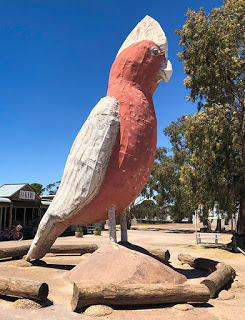
The Giant Galah
Flamin’ Galah’s
This isn’t Kimba’s first attempt to attract passing trade. Just across the railway line sits a rather oversized Galah. It looks as though it has seen better days but it joins the cast of many giants around Australia though their days may seem numbered now that Silo Art is the theme of the Wheatbelt towns in the southern regions of the country.
Halfway between here and there
The official halfway marker lays just beyond the silos and provides a large area to park and signboards to read about the early pioneers who traced a path across the country and ventured from Adelaide through the centre of Australia to Darwin.
* Cam Scale’s website shows many of his mural installations across Australia, which he has been creating since the year 2000.


 Discovery Down Under