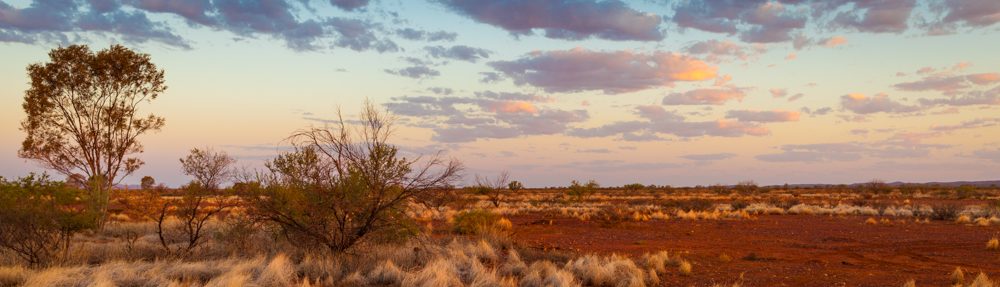
Today was another of our early start days to get to the ferry terminal at Hillarys by 7am. Our destination this time was Rottnest Island named by early Dutch explorers who believed the local marsupials were large rats and so gave the island the Dutch name of Rott Nest – literally Rats Nest.
We had booked ahead and included bicycle hire as the only other visitor transport options on the island are by foot or a Hop-on, Hop-off bus. It was a bold choice as I hadn’t cycled for over 26-years and a long time too for Catherine. Still, if you want to get around the island it is the best way and the glorious weather was on our side with little wind and a clear, deep blue sky.
The 45-minute crossing was surprisingly choppy in a few places with an ocean swell but we were soon into calm waters again and mooring at the Rottnest Jetty. All the bikes had been loaded onto the deck and as a result were exposed to the waves giving them a good soaking.
We set-off, a little wobbly at first but it seems it’s a skill you never forget, just in need of a little practice. We didn’t get far before we were greeted by our first ‘Dutch Rat’ more correctly known as a Quokka though far less easy to spell.
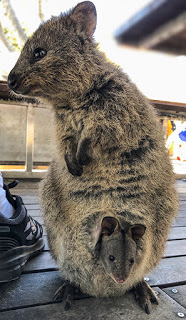
The Quokka, pronounced ‘kwoka’, is a marsupial about the size of a large rabbit with a thick, heavy tail, the same gait as a kangaroo and the most adorable face. They’re friendly too and will happily pose for a photo for a modest fee. It is a current trend to take a selfie with a Quokka though they’re probably tired of having cameras and iPhones stuck in front of their faces when all they really want is some food. Being wild animals, of course, signs are everywhere telling people ‘Do not feed or give water to the wildlife’, ‘Do not touch the wildlife’ but still they do and the poor things become reliant on humans.
I can smell Coffee
But it was time for a coffee, of course, and visitors to the island are well catered for with a few restaurants, a supermarket and our choice – the Rottnest Bakery. They must have known we were coming and had clearly been busy baking for us since the early hours. There were many tempting cakes and pastries and I had my eye on a custard doughnut until Catherine pointed out the enormous cinnamon scrolls big enough for the both of us and the size of a large plate.
Which Way?
Now with an island just 11KM long and 4.5KM at its widest you would think navigating what few roads there are would be simple, especially with the supplied map. However, the road signage appears to have been created by someone with a sense of humour and an interest in bird life of the avian variety. The map clearly shows the three cycle routes in brown and green with a splash of red. But trying to find where any of them start from the jetty or cafe area is complete guess work. Worse still, if you do chance to find yourself on one of the routes then you’ll quickly realise they are signed with images of birds and not the colours of the routes on the map. Still, we were up for the challenge even though our muscles clearly were not.

We took the counterclockwise route and quickly discovered Rottnest Island was nowhere near as flat as it appeared from the sea. We also discovered which leg muscles hadn’t been exercised for a while – going uphill was punishing but we were determined not to get off and walk when we had only just started. The effort was soon rewarded, though, as we topped the hill and got our first view of Parakeet Bay with its clear turquoise water.
Ospreys
More hills, many more beautiful bays and white sandy beaches followed. Rottnest Island is gifted with such stunning scenery and no more so than at the furthest point from the jetty at Cape Vlamingh. Here mighty waves smash into the rocks along the coast pushed by prevailing winds, while just around the corner Fish Hook Bay provides shelter, deep aqua-blue water and provides a habitat for Ospreys. One Osprey nest is clearly visible on a prominent rock in the bay and is believed to be 70-years old.

Saddle Sore
After a brief break from the saddles and a spot of lunch, we retraced our route for a short while before turning towards the southern coast with good views of Wadjemup Lighthouse. A steep track leads up to the lighthouse and, apparently, gives good views across the island but we were happy to let those with less shaky legs enjoy the viewpoint. Instead we took a wrong turn while being distracted by a couple of cute Quokkas by the roadside and inadvertently headed north. To turn back meant a steep hill so we continued on briefly before turning south along a track that followed beside a somewhat smelly lake, past the end of the airport runway and on to a sandy path, which meant dismounting for a while and walking until we rejoined our planned route.

When the wind blows
Rottnest Island is exposed to the full force of the gales that blow across the Indian Ocean before reaching the mainland and its effect is clearly visible across the island with short trees and creeping dunes and none more so than one particular tree that we came across that has given up trying to resist the winds and just grows sideways.
The West coast of Western Australia is particularly windy during Spring and we were lucky to have arrived on the island on one of the few days when the wind was taking a break, though it would have been helpful pushing us up some of the steeper hills.
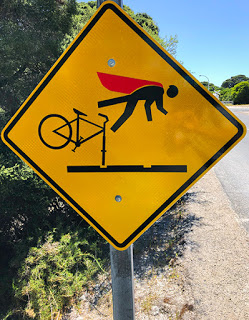
Porpoise Bay was another one of those stunning places providing views back towards Perth and its tall city buildings. With the road flattening out we were soon on our way back towards the jetty before a roadside sign stopped us in our tracks. It was posted where old railway lines cross the road to an old army depot at Army Jetty. It appears to illustrate what happens if you cycle across the rail lines at the wrong angle. From out of nowhere you sprout a red cape and turn into Superman. Cool! How many children seeing the sign would be tempted to give that a try?
Finally back at the jetty we were in need of a bite to eat and a cooling beer and it appeared the Quokkas were looking for food too as they hunted for crumbs around the cafe’s tables.
All Aboard
Back onboard the ferry with bikes safely tied down and we were soon arriving at our starting port of Hillarys after a day of exercise, beautiful weather and lots of beautiful scenery.
Tomorrow was looking like we were going to be aching badly but it will have been well worth it and we would do it all again given the chance.
A day visit to Rottnest is absolutely recommended as long as you feel fit enough to cope with the hills. If not, take the Hop-on, Hop-off bus and enjoy all that the island has to offer.


 Discovery Down Under