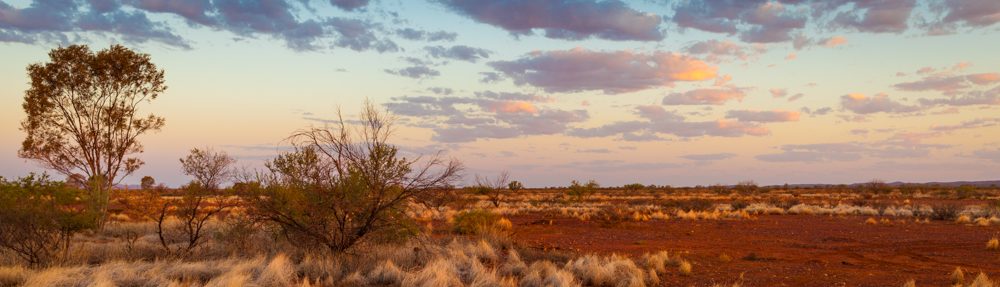
You may be forgiven, reading this, that we have all of a sudden become troglodytes trying to escape the current cooler weather in the southwest of WA. But, again, we’re heading deep underground to explore one of nature’s relatively young but spectacular caves.
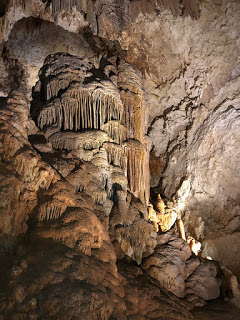
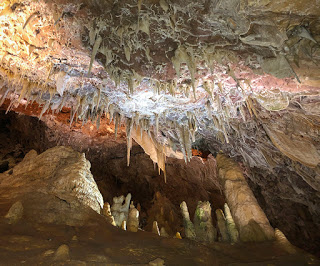
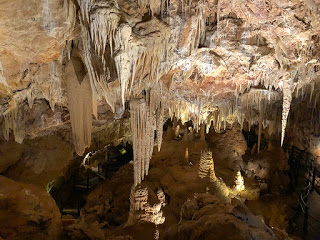
Stalactite overload
We thought Ngilgi Cave was pretty special but Jewel Cave is something altogether different. Situated close to the town of Augusta on Caves Road (where else?), Jewel Cave is the most recently developed of the Cape’s caves open to the public.
Windy Hole
In the early 1900’s a hole in the ground was known about where wind appeared to be emanating from deep below. But it was not formally ‘discovered’ until Cliff Spackman chanced upon a strong upward blast of air from the ground while exploring the area in 1957. The narrow hole had been formed initially by tree roots penetrating the limestone but later widened by the action of water. Cliff’s fellow explorers lowered him by rope through 12-metres of rock to find himself surrounded by a staggering collection of stalactites, stalagmites, pendulums, flowstones and the more unusual, and peculiar, helictites, a crystal formation that Jewel Cave is especially renowned for worldwide.

The following year Cliff, Lloyd Robinson and Lex Bastian returned to further explore the cave, which continued for more than 2KMs and reached down to a depth of 42-metres. And there were more than a few surprises in store. Hidden beneath a layer of soil was uncovered the skeleton of a now extinct Thylacine – a Tasmanian Tiger that must have fallen into the pitch black cave with no means of escape.
The age of the remains are unknown but radio dating of one of the cave’s crystals has put a date on the cave formation at a minimum of 466,000-years and the limestone it sits within a geologically young 1-million years old.
Cliff and his team spent a year developing the show cave as a tourist attraction installing steps, suspended platforms and lighting before opening to the public on Boxing Day 1959.
Defying Gravity
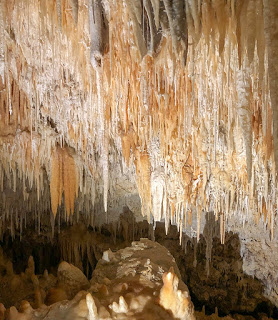
The cave is absolutely crammed with every type of decoration, as the crystal features are known, but a few take on some quite peculiar shapes twisting randomly, often growing horizontally and even turning right around and growing back upwards as if defying gravity.
Known as Helictites they start as a straw-like formation – a hollow tube. Normally the straw will continue to grow downwards but under certain conditions the dripping water from the cave roof settles more to one side of the straw than the other. With each new layer the direction the straw takes depends on how the calcite’s crystal structure forms.
Giant straws
Among the very special decorations in Jewel Cave is an incredibly delicate straw stalactite just millimetres thick but an enormous 5.43-metres long – the longest found, so far, in any cave in Australia and believed to be at least 10,800-years old.

Pendulums
A few similar straws have developed bulbous nodules that look like pendulums. It’s hard to imagine how such a delicate straw can support the weight of these growing crystals. Studies have shown that the crystal formations in the cave grow on average 0.5mm each year. Just one slight touch and they could snap and fall destroying tens of thousands of years growth.
Karri Tree Formation
In the main cavern is a large flow formation that, when observed more closely, resembles a forest of Karri trees.
Carbon Dioxide
As was the case with Ngilgi Cave the level of carbon dioxide in the air is higher than on the surface above. This is a result of the chemical process that forms the cave’s decorations, a process that has existed for hundreds of thousands of years. Though perfectly safe it does reduce your energy levels while in the cave and requires a little more effort climbing the steps back up to the surface. But it is absolutely worth the effort to be rewarded with such a spectacular example of nature and something a very, very long time in the making.








 Discovery Down Under