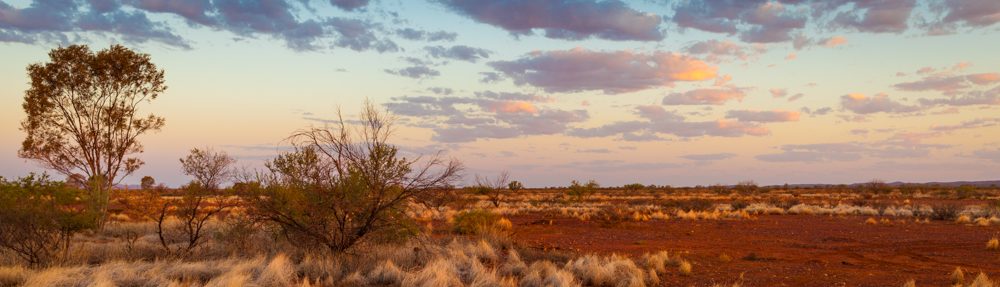
The southwest of Western Australia is known well for its extensive hardwood forests but nothing can quite prepare you for their immense size and extent when you experience them for the first time. Such has been the case for us after driving many thousands of kilometres through treeless plains, deserts and coastal bush.
We have now entered the huge belt of forests that sit along the southwest coast. We are surrounded in every direction by National Parks with the occasional clearing for cattle or sheep farms and an increasing number of vineyards. Long gone are the endless straight roads now replaced with undulating and winding routes through heavy forestation and between giant Karri trees.
Valley of the Giants Treetop Walk
Today’s adventure takes us to the Valley of the Giants Treetop Walk set deep within a Tingle forest northeast of Walpole. It’s not a place for the faint hearted, those with a fear of heights, unsteady on their feet or suffer from dendrophobia, for today we’re up among the tree tops 45-metres above the ground.

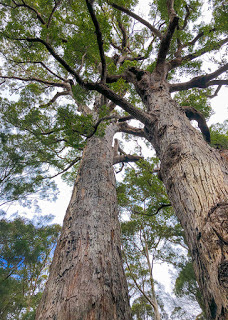
Entry into the Valley of the Giants gives a teasing view of the sheer size of the Tingle tree. Living for as much as 400-years, rising to a height of 75-metres and with a 20-metre girth, the Tingle tree has an extremely restricted range relying on a minimum of 1000mm of annual rain, a low nutrient free-draining gravel soil, hilly terrain and minor seasonal change.
Since the ancient land mass of Gondwana began to break-up all the major continents have drifted away with the exception of the southwest corner of Western Australia. Having moved the least, conditions here remain as they have been for millions of years enabling many species to survive from those ancient times including the tingles, relict spiders and several species of snail.
The red and yellow tingle trees have enormous straight trunks with branching arms almost as thick, though the smaller yellow tingle grows only to a height of 40-metres. They are immensely strong but the red tingle has an achilles heel – its trunk is susceptible to insect and fungus attack that ultimately rots the central core and exposing it to the effects of fire.

Unlike most eucalypt trees the red tingle is unique in not having a central tap root, instead it has a shallow but widespread root system giving the tree a very stable base on which to grow to its enormous height. And, as the tree ages, its base expands forming a buttress unlike the yellow tingle, which helps to differentiate the two species. The yellow tingle is also less susceptible to insect and fungi damage.
Walking the Ancient Empire trail
A short sealed path guides you around the forest’s Ancient Empire Trail where many of the giant tingle trees can easily be identified between the less bulky but significantly taller Karri trees. Standing by one of these giants is an experience, there aren’t many places in the world where you are dwarfed in such a significant way by a living object. To protect the shallow roots from foot traffic raised timber platforms transport you just above the forest floor.
A flash of colour
While admiring the trees and the peace and quiet of the forest, stand still for a while and you are likely to catch a flash of colour from one of the many colourful birds that live among the trees and one in particular the beautiful but tiny Red-winged Fairy Wren. Trying to photograph one of these is a real challenge, not just because of their diminutive size but the fact they don’t stand still long enough! Take a seat by the coffee truck and the Fairy Wrens will soon be paying you a visit along with raucous crows.
Tree Top Walk
The second, and most adventurous, part of our visit is the tree top platform walk that takes you from ground level right up into the tree canopy of the tingle forest. Brave pants may be required as you begin to notice the high-level platform swaying under foot as the well polished handrails attest.
It is very much worth any fear of heights to explore life among the canopy, a far different experience from just looking up to the sky. It makes you realise just how brave birds must be perched up high on a branch. Just imagine the fear an emu would feel up here!

The platform, assembled by hand without the use of helicopters and heavy machinery, extends for 600-metres rising to a peak of 40-metres and creating a circular route. You can go around as many times as you like and for as long as your nerves will bear.
NB. The second time around is easier as I discovered filming the circuit for Catherine so she can later see what it is like when you have your eyes fully open.
The swaying of each of the 60-metre platform spans is apparently intentional to ‘create the sensation of being in the canopy of the forest’. Well it certainly does that as does the steel mesh deck, which ‘reinforces the sensation of being high up in the forest canopy’.
Wildlife
Though not always visible, the Tingle forest is home to many creatures especially marsupials for which this country is famous. Among the collection you may spot the cute Quokka, Brush-tailed possums, Brush-tailed phascogales, Mardos (a shrew-like marsupial), Chuditch (the Western Quoll) and my favourite – the hell-raising Motorbike frog.
The Valley of the Giants and Tree Top Walk is an excellent experience and highly recommended for all ages. There is also a night time tour available during school holidays and for group bookings, where you may get to see some of the many nocturnal creatures that call the amazing tingle forest home.
 Discovery Down Under