Today marks the day that we reach the most south-westerly point in Australia, a place called Cape Leeuwin, named by Mathew Flinders in 1801. It is a place where, somewhat controversially, two great oceans – the Indian Ocean and the Southern Ocean – meet.

It appears all but Australia consider the Southern Ocean to actually begin along the 60th parallel south line of latitude, which is a very long way south of Australia. But let’s not spoil an opportunity to attract tourists to the cape.
Cape Leeuwin Lighthouse
Sitting close to the tip of the cape is Australia’s third largest lighthouse and the largest in Western Australia – Cape Leeuwin Lighthouse. Standing at 39-metres tall, almost twice the height of Cape Naturaliste Lighthouse, Cape Leeuwin’s lighthouse was built from locally quarried limestone and first lit in 1895. Like all other lighthouses around Australia, Cape Leeuwin Lighthouse wasn’t spared the march of ‘progress’ and it too became automated in 1982.
There is a small fee to access the grounds of the lighthouse or a tour of the lighthouse itself giving a grander view from the top deck and a great viewing point for the migrating whales, which pass close by. All proceeds go towards the maintenance and preservation of the lighthouse, cottages and supporting buildings. An onsite cafe serves tea, coffee and light meals with great views of the oceans.

Waterwheel
An unusual attraction in close proximity of the lighthouse is a waterwheel, though it’s not quite what you would expect. Built during the construction of the lighthouse, the waterwheel was powered by a natural freshwater spring and pumped water up to the construction team at the lighthouse for concrete and cement mixes saving transport costs in, what was at the time, a very remote location. Even the limestone was local being extracted from the nearby, and appropriately named, Quarry Bay.
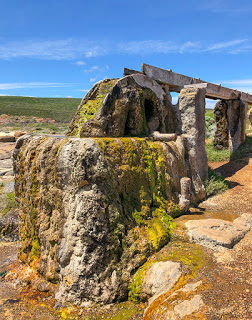
Now, however, the calcium rich water has encased the wheel and much of the pumping mechanism in calcified lime. The water level has since dropped and now an electric pump is used to feed water along the trough to help preserve the timbers from drying and cracking.
It’s certainly an unusual sight but well worth the short stroll from the lighthouse car park even if it’s just to enjoy the views across the bay.
 Discovery Down Under