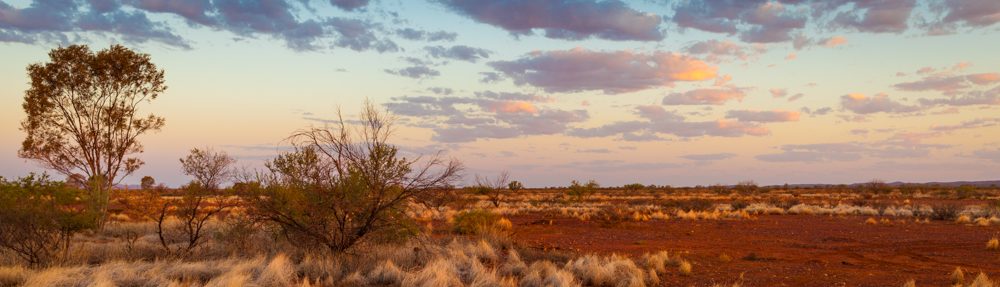
Previously known as Yallingup Cave due to its proximity to the nearby town, it was later changed to Ngilgi Cave, pronounced ‘Neelglee’, to reflect is Aboriginal name. Ngilgi Cave is one of a series of Karst Limestone caves in the southwest of Western Australia. Surprisingly it has had a lot of influence on the development of the region and unusual in that for a visitor it is largely a self guided tour.
Though known for thousands of years by the local Wardandi Aboriginal mob, it was first ‘discovered’ in 1899 by European settler Edward Dawson while searching for lost horses. His chance encounter was a life changing event as he became the resident cave tour guide for the next 37-years.
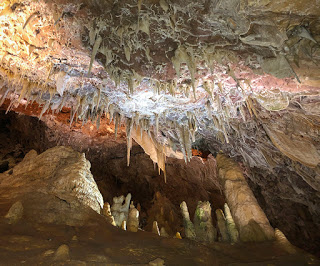
Ngilgi Cave is like no other cave we have seen. Stalagmites and stalactites appear as soon as you begin to descend the steep staircase. Here the crystals take on a dull grey colour due to atmospheric exposure and dust but within metres you are standing in a small amphitheater surrounded by every type of crystal structure from straw-like pipes, wavy shawls, cascades as well as the more common stalactites and stalagmites. Every where you look there is something to see.
Karst Limestone
The cave was formed tens of thousands of years ago by a process that continues to this day. Rain passing through the atmosphere absorbs carbon dioxide forming a weak carbonic acid. The acid then intensifies as it passes through carbon dioxide rich soil and begins to dissolve the limestone beneath. Eventually small cracks appear accelerating the erosion and increasing the flow of water through the rock. In the case of Ngilgi Cave the downward passage of water eventually formed a river deep underground that worked its way out to the sea.
Free to wander
Our tour guide, Andre, explained the story of the cave including the discovery of bones from long extinct animals that fell into the shaft of the cave and evidence of Aboriginal habitation dating back 45,000-years. From here you are free to wander deeper into the cave guided by a well constructed path, steps and handrails. Considerable care is needed as the path is often narrow, the cave roof low and the steps steep – and often all three together.
It requires a certain level of fitness made all the more difficult as the humidity and carbon dioxide levels increase the further you descend into the cave.
The path takes you through multiple chambers often with large cracks in the ceiling and huge chunks of rock locked together as they fell but still forming an alarming looking roof directly above. Andre advised us that as well as friction holding the structure in place, secondary cementation by dissolved limestone bonds the rocks together. It certainly looks precarious but it has been this way for thousands of years. Still, you feel as though it could give way at any time or one of the thousands of needle-sharp stalactites may break free and pin you to the ground.

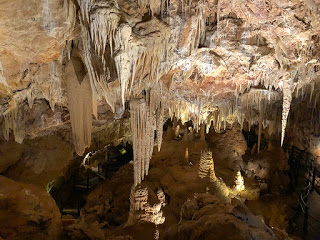
As you descend deeper the crystals become increasingly white and eventually clear enough for light to pass through. Several have lights behind them showing bands of colour formed by tannins leached from the vegetation above ground.
Taking it all in
The highlight of the cave is a large, circular cavern decorated over its entire surface with thousands of crystal structures. It really is an awesome sight and the place you’ll likely spend most of you time looking and wandering around. Andre had arranged a collection of crystals to look at showing how the colour changes by depth and an opportunity to hold them and realise just how heavy they are. Here is a spot to just admire what nature has created or ask any questions that may come to mind before heading back up the hundreds of steps to the surface.
Hidden Treasure
As you begin the accent one last feature will catch your eye. Known as the Jewel Casket, nestled in the cave wall is a miniature grotto with small stalactites that have spiky crystal structures radiating from their tips. These are Dog Tooth Crystals that form where a pool of supersaturated calcium bicarbonate exists. They’re certainly unusual and with the attached stalactites they resemble some form of medieval weapon used to disable your opponent.

The climb back to the cave entrance was much easy than expected, likely a result of the increasingly fresh air, and we were soon back among the scrub where you would have little knowledge that such an amazing sight exists just metres below your feet.
It’s a MUST see
A visit to Ngilgi Cave is very highly recommended but if you are a photographer note that tripods are not allowed in the cave but you are free to use a flashgun. All the photographs here were taken with an iPhone 8 and only the Jewel Casket needed a flash.
Access is suitable for most people including children as long as you are comfortable with confined spaces and a lot of steps.
 Discovery Down Under