We have seen and walked along some impressive piers and jettys in various countries over the years but perhaps none more so than Busselton Jetty in Western Australia. At 1.84KM it is the longest timber-pile jetty anywhere south of the equator.
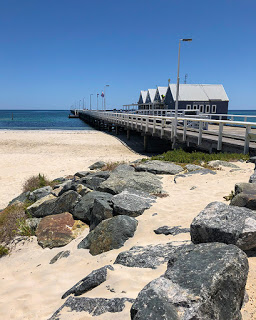
The initial jetty, just 176-metres long, was completed in 1865 and provided a much needed facility for ships to dock at a time when agriculture, tourism and the timber industry was booming. At that time there were no personal income taxes instead the government sourced revenue on imports and exports with the jetty no doubt soon paying for itself.
In 1872 at a cost of £88 the jetty had its first extension to enable larger ships that were finding Geographe Bay to shallow to dock. However, just three years later the extension proved insufficient and with silt building up in the bay another 144-metres were added, this time costing a more considerable £626. Silt continued to build and in 1884 another 229-metres were added. Then another 353-metres three years later and another forty in 1890. And we’re not done yet…
More, bigger
The increasing size of ships required deeper access and so more extensions were added: 130-metres in 1894, 150-metres in the following year and 261.6-metres the year after that. By 1907 the jetty had reached just short of 1.4KM. But, as you will have gathered by now, there was a trend developing and they still had not yet finished.

A rail line was added easing the transport of goods and replacing the existing horse and cart but it also introduced a new problem – fire. Embers from the steam powered engine often took hold on the timber deck requiring someone to follow behind the train stamping them out.
Then in 1911 an additional 603-metres was added. This, and two-months of dredging, allowed even larger ships to dock safely bringing in tourists to visit Western Australia’s first major tourist attraction – Ngilgi Caves, more of which to follow. Sea baths were also created to allow visitors to swim safely away from the ‘Sea Monsters’ and a pavilion for band concerts. Busselton was booming.

Finally one last addition of 16-metres in 1960 brought the jetty up to its current dimensions and the longest of its type in the Southern Hemisphere. But it was all too late to continue efficient operations as the larger port at Bunbury began to take business from the jetty and in 1972 it was closed to trade as a shipping port. Five thousand ships had used the jetty over its 100-years service and significantly helped the development of the South Western corner of Western Australia.
End of the line
Although the jetty’s port operation days were over it wasn’t the end of its working life. Though the state government had it in mind to be dismantled, the local community and Shire campaigned to take control of the jetty and develop it as a tourist attraction even proposing adding an underwater observatory. Nature, though, had other plans and on April the 4th 1978 cyclone Alby swept away 700-metres of the oldest section of the jetty. And there the jetty remained, isolated from the shore and gradually succumbing to the effects of the weather and sea.
However, this was a jetty that had no intention of coming to an end and a survey of the community by the Shire received a 90% response in favour of preserving the jetty and resulting in a $500,000 kickstart fund being allocated as well as the formation of the Busselton Jetty Preservation Committee. Funds raised and the injection of the promised money from the Shire allowed the first part of the major restoration to start at a cost of $660,000.

In 1995 a small train was re-introduced using the original rails and charging a fee to take people to the end of the jetty and back. It additionally allowed the mobility impaired to enjoy the views and fresh air along with the fishing, swimming and sporting events already popular. Diving also became popular and the jetty has become one of Australia’s top ten dive sites.
Fire!!
In 1999 a huge fire took hold and destroyed a 70-metre section of the jetty. Only cutting through sections of the timber deck with chainsaws halted the flames. The fire was believed to have been started by a carelessly discarded cigarette. In order to help raise funds sufficient for significant incidents like this an underwater observatory was created and put in place at the end of the jetty. In the first 6-months from December 2003, 60,000 people took the opportunity to view some of the 300 marine species that call Geographe Bay home.
In 2009, the Western Australia State Government donated $24-million for the complete restoration of the jetty to return it to an ‘as new’ condition, which included replacing the remaining fire prone timber deck with cast concrete panels. And on the 6th of February 2011 with thousands of people attending, Busselton Jetty was re-opened.

But wait, there’s more
Not content, plans are now underway to add a giant glasshouse on the last section of the jetty with a cafe and sunset bar. It will be lit at night providing a warm glow and highlighting the enormous length of this much loved piece of historic architecture.
And finally…
Interestingly, and perhaps to encourage youngsters to make the full walk to the end of the jetty, a number of plaques along the way pose a series of questions about the jetty with each subsequent plaque holding the answer and presenting the next question. We have seen similar with roadside signs on some remote highways to help alleviate the boredom of long journeys. Quite educational too.
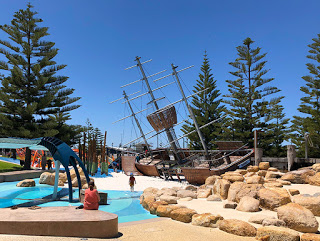
We thoroughly enjoyed our walk along the jetty and wandering around the excellent work that has taken place on the foreshore with new parking facilities, landscaping, eateries and the best children’s adventure playground we’ve seen anywhere with a huge listing ship, a giant squid and a whale swimming through the wake of the ship.
Busselton in a fast growing town and absolutely worth a visit on your West Coast trip. So much so we extended our stay.
 Discovery Down Under