Scaling the Plutons… or not

The Brave Pants were on today as we tackled the giant granite boulders known as Castle Rock in Porongurup National Park 48KM northeast of the beachside town of Albany. We had been saving this walk and climb for an improvement in the weather and the forecast today was spot on with the sun breaking through around midday.

Granite Plutons

The Porongurup Range within Porongarup National Park is a 12KM long chain of granite domes reaching a height of 650-metres. While they may not be the tallest of peaks in the region – that honour goes to the Stirling Ranges – they certainly make up for it in inclination as we were about to find out. The granite domes are the solidified remains of an enormous bubble of molten rock formed deep underground known as a ‘pluton’.

Millions of years of erosion by the elements and the remnants of the pluton was all that remained above ground. Continuing exposure to the weather created cracks in the rock forming giant stone cubes much as those seen at The Gap. Further erosion by wind and rain rounded-off the blocks leaving circular domes and giant precariously balanced boulders. In extreme cases even valleys were cut into the pluton creating ideal slopes for the many small wineries in the region.

Balancing Rock

Up in the Air

The Granite Skywalk Trail is not to be taken lightly with an almost continuous 2KM uphill climb from the car park. Good walking shoes or boots are essential and a walking pole is highly recommended. The trail zigzags its way through Marri and Jarrah woodland providing good shelter from the sun and wind of which there was plenty of both today.

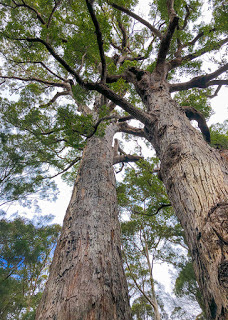
As the walk reaches higher ground enormous Karri trees make an appearance giving a welcome excuse to stop, catch your breath and wonder at the age of these immense trees. It’s unusual to see Karri trees at this altitude but the low annual rainfall here is boosted by water running-off from the granite’s non-porous domes and providing just enough for the Karris to survive in such a dry area.

Finally reaching the huge Balancing Rock, carefully supported by Catherine, and the bush opens up to a stunning 180-degree view from the lower observation deck with Albany to the left and right around to the Stirling Ranges 20KM further to the North. But the real highlight is right above and behind us – The Granite Skywalk. It is this that gives the trail its rating of severity a Grade 5.

Castle Rock Granite Skywalk

The last 100-metres of the trail to reach the Skywalk requires a quite strenuous and often exposed scramble across granite slabs using the provided steel hand/foot holds before climbing a steep steel caged ladder with vertigo inducing drop-offs to the right. The top of the ladder connects to the final narrow walkway platform bolted along the side of two massive granite domes. And the reward? A full 360-degree but fearful view.

Now I’d like to say the view from the top of the Skywalk is spectacular and in today’s sunny but cool weather I’m absolutely sure it is but I have to confess the last few steps of the ladder got the better of me. It was very windy and very exposed to the right.

The view – almost from the top

Catherine had already decided to stay at the first platform level avoiding the scramble. But I’ll forever kick myself for going to all the effort to climb the hill and stopping less than two metres from the top. Maybe I just wanted to save it for another visit.

The Granite Skywalk is highly recommended though it is not for everyone. You need a good level of fitness, sensible shoes, plenty of water and above all a head for heights if you want to reach the very top.

Park Pass Required

Don’t forget this is a WA National Park and a Park Pass is required to be displayed in your vehicle. A day pass can be purchased from the automated machine at the start of the walk.

Mind the Gap

Just 17KMs south of Albany, within Torndirrup National Park, is an impressive piece of imaginative engineering that both thrills and frightens the life out of people.

The Gap

The Gap

2016 saw the opening of two lookout structures at an area known as The Gap. As part of a $6.1 million development, an enormous cantilevered see-through platform was constructed hovering 40-metres above the Antarctic Ocean and reaching out 10-metres from the cliff face. Below, huge waves driven by the ocean wind smash into opposing cliffs in a narrow ravine.

Over tens of thousands of years the sea has cut away at the granite cliffs leaving the narrow Gap as a spectacular natural feature in Western Australia’s most popular National Park.

While some people will quite happily walk to the edge of the platform to take photographs and experience the flex in the stainless steel structure, others will grip onto the handrails while those of an even less confident disposition will happily watch from the comfort of solid ground.

The Gap observation platform

It is absolutely worth donning the brave pants to experience the thunderous power of the waves. I can only begin to imagine what it would be like when a full Southern Ocean storm rolls in.

A smaller platform gives safe and flex-free access to views along the coast.

No crossing the Bridge

Just to the west of the Gap, and a short stroll, is a second and just as impressive feature. This time a completely natural one – a rock bridge known simply as the Natural Bridge. Perhaps not the most imaginatively named but how this bridge remains standing is a wonder.

Like The Gap, the rock along this section of the coast is extremely old dating back 1.2 to 1.6-billion years ago when Australia and the Antarctic plates collided. A fault line has allowed the ocean waves to progressively gnaw away at the granite and gneiss rock creating weaknesses that result in the rock breaking into rectangular blocks.

Natural Bridge

In the case of Natural Bridge waves have hammered away at the lower laying blocks and pushed them free to topple into the ocean leaving behind a self-supporting bridge. How long this survives is anyone’s guess but in time the bridge will collapse dropping tens of thousands of tonnes of rock into the ocean. That would be an incredible sight to experience but from a very far away point of safety.

The National Park have done a fantastic job with this development providing easy access for all to experience and a large car park too. Being a National Park fees, of course, apply and an automated ticket machine has been provided for those that don’t already have a Parks Pass. Facilities like these cost considerable money to provide and maintain and it will be interesting to learn just how many people pay or consider this just a car park charge.

Elephant Rocks

Our latest stopover finds us in Denmark – a small town perched on an inlet of the Great Australian Bight in Western Australia. We’re here to view the Elephants at William Bay National Park.

Greens Pool

Greens Pool

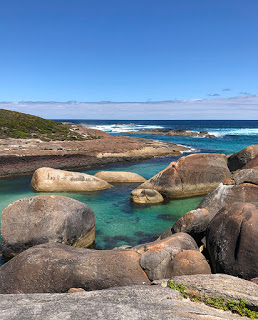
On the way to see the Elephants we take a short detour – conveniently from the same car park – to Greens Pool. It is a highly popular spot to safely swim in the calm waters protected from the pounding waves by a series of granite boulders. With a white sand beach, clear turquoise water and a blue sky, you could easily imagine being in some tropical beach paradise… but a dip in the water might suggest otherwise. Now we’re south of the tropics the sea temperature is markedly cooler but it has to be said the view more than makes up for it.

Access to the beach starts with a stunning view across William Bay and a flight of steps down to a huge bed of granite rock adjacent to the sand beach. A walk over the rock will take you to the stone breakwaters and great views of the incoming waves.

Elephant Rocks

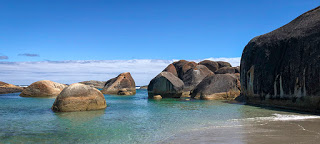
Climbing back up from the beach and a right turn takes you along a short stroll to a second bay. And there, heading out towards the sea, is a herd of Elephants – not quite what you would expect to find on an Australian coastline. However, these Elephants have been sitting right here for a very, very long time. The animals in question are enormous granite rocks, which, and they’re easy to imagine, resemble a herd of elephants heading out to sea. And just beyond them opens up a beautiful, protected shallow bay.

Elephants… with a dose of imagination

Elephant Bay

Access down to Elephant Bay is via a short but steep stairway where you are presented by two huge granite rocks with a narrow passageway between them. You need to time your walk through the passage with care as you will be sharing it with the tide and waves. But the beautiful white beach and calm, inviting water just beyond is well worth a soaking. Remember too the water may not be as warm as you are expecting!

Beware

The beauty and apparent tranquil setting of the bay belies an unexpected hazard, not stampeding elephants but a tidal rip, which can regularly occur here and great care should be taken while swimming within the bay.

It’s also easy to get caught by the tide in the enclosed bay but there are additional steps at the head of the beach though much of the sand beneath them has been undercut by the sea.

Elephant Rocks

Greens Pool and Elephant Rocks are both spectacular places but, as mentioned, they are popular and very busy during holidays and the summer months. So if your intentions are for landscape photography or a little solitude among beautiful scenery, then you’ll need to be here very early in the morning or late in the afternoon just as the sun begins to set.

Valley of the Giants

The southwest of Western Australia is known well for its extensive hardwood forests but nothing can quite prepare you for their immense size and extent when you experience them for the first time. Such has been the case for us after driving many thousands of kilometres through treeless plains, deserts and coastal bush.

We have now entered the huge belt of forests that sit along the southwest coast. We are surrounded in every direction by National Parks with the occasional clearing for cattle or sheep farms and an increasing number of vineyards. Long gone are the endless straight roads now replaced with undulating and winding routes through heavy forestation and between giant Karri trees.

Valley of the Giants Treetop Walk

Today’s adventure takes us to the Valley of the Giants Treetop Walk set deep within a Tingle forest northeast of Walpole. It’s not a place for the faint hearted, those with a fear of heights, unsteady on their feet or suffer from dendrophobia, for today we’re up among the tree tops 45-metres above the ground.

Among the Giants

Entry into the Valley of the Giants gives a teasing view of the sheer size of the Tingle tree. Living for as much as 400-years, rising to a height of 75-metres and with a 20-metre girth, the Tingle tree has an extremely restricted range relying on a minimum of 1000mm of annual rain, a low nutrient free-draining gravel soil, hilly terrain and minor seasonal change.

Since the ancient land mass of Gondwana began to break-up all the major continents have drifted away with the exception of the southwest corner of Western Australia. Having moved the least, conditions here remain as they have been for millions of years enabling many species to survive from those ancient times including the tingles, relict spiders and several species of snail.

The red and yellow tingle trees have enormous straight trunks with branching arms almost as thick, though the smaller yellow tingle grows only to a height of 40-metres. They are immensely strong but the red tingle has an achilles heel – its trunk is susceptible to insect and fungus attack that ultimately rots the central core and exposing it to the effects of fire.

Red Tingle Walkway

Unlike most eucalypt trees the red tingle is unique in not having a central tap root, instead it has a shallow but widespread root system giving the tree a very stable base on which to grow to its enormous height.  And, as the tree ages, its base expands forming a buttress unlike the yellow tingle, which helps to differentiate the two species. The yellow tingle is also less susceptible to insect and fungi damage.

Walking the Ancient Empire trail

A short sealed path guides you around the forest’s Ancient Empire Trail where many of the giant tingle trees can easily be identified between the less bulky but significantly taller Karri trees. Standing by one of these giants is an experience, there aren’t many places in the world where you are dwarfed in such a significant way by a living object. To protect the shallow roots from foot traffic raised timber platforms transport you just above the forest floor.

Yellow Tingles

A flash of colour

While admiring the trees and the peace and quiet of the forest, stand still for a while and you are likely to catch a flash of colour from one of the many colourful birds that live among the trees and one in particular the beautiful but tiny Red-winged Fairy Wren. Trying to photograph one of these is a real challenge, not just because of their diminutive size but the fact they don’t stand still long enough! Take a seat by the coffee truck and the Fairy Wrens will soon be paying you a visit along with raucous crows.

Tree Top Walk

The second, and most adventurous, part of our visit is the tree top platform walk that takes you from ground level right up into the tree canopy of the tingle forest. Brave pants may be required as you begin to notice the high-level platform swaying under foot as the well polished handrails attest.

It is very much worth any fear of heights to explore life among the canopy, a far different experience from just looking up to the sky. It makes you realise just how brave birds must be perched up high on a branch. Just imagine the fear an emu would feel up here!

Among the Tingles

The platform, assembled by hand without the use of helicopters and heavy machinery, extends for 600-metres rising to a peak of 40-metres and creating a circular route. You can go around as many times as you like and for as long as your nerves will bear.
NB. The second time around is easier as I discovered filming the circuit for Catherine so she can later see what it is like when you have your eyes fully open.

The swaying of each of the 60-metre platform spans is apparently intentional to ‘create the sensation of being in the canopy of the forest’. Well it certainly does that as does the steel mesh deck, which ‘reinforces the sensation of being high up in the forest canopy’.

Wildlife

Though not always visible, the Tingle forest is home to many creatures especially marsupials for which this country is famous. Among the collection you may spot the cute Quokka, Brush-tailed possums, Brush-tailed phascogales, Mardos (a shrew-like marsupial), Chuditch (the Western Quoll) and my favourite – the hell-raising Motorbike frog.

The Valley of the Giants and Tree Top Walk is an excellent experience and highly recommended for all ages. There is also a night time tour available during school holidays and for group bookings, where you may get to see some of the many nocturnal creatures that call the amazing tingle forest home.

The Nannup Tiger!!

To survive as a small outback town these days requires the ability to attract passing trade. And it appears to have become customary to try and create, or at the very least promote, something unique about your town to tempt the curious to stop for a while longer than a casual glance or a fuel stop on the way to some distant destination. It may be a collection of old machines stretching for a mile by the roadside as was the case in Ilfracombe, a museum or hall of fame dedicated to some local collection, talent or character such as The Waltzing Matilda Museum in Winton or The Stockman’s Hall of Fame in Longreach, but if it can be made yours only then all the better. And, of course, we must not forget the giant possum, galah, lobster, ram, banana, pineapple…

Nannup

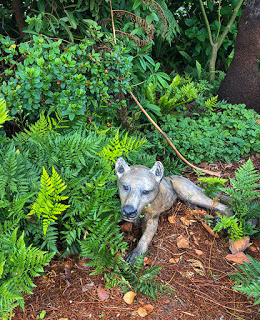
All this brings us to the small and easily passed town of Nannup surrounded by forest at the junction of Highway 10 and Highway 104. Here stalks a local beast rarely sighted but encountered often enough to rouse interest and keep the story alive and in the news. Allegedly a large dog-like animal, of a type previously thought to be extinct, wanders throughout the region occasionally posing for a blurry photograph. The beast has a distinctly long snout with tiger-like stripes to the rear half of it’s body and an unusually long dark tail.

Nannup Tiger

It is thought the creature is a Thylacine – a marsupial carnivore, otherwise known as a Tasmanian Tiger – though the last one believed to exist died in captivity in 1936. Not unique to Tasmania despite its name, the creature became extinct on the mainland about 3,000 years ago but the thylacine is known to have spread as far west as Western Australia and north into Papua New Guinea with fossil records dating back at least 4-million years.

So, it might just be possible in this vast land of ours that a few survivors may still exist out there.

The Nannup Tiger?

But is this just a ruse to attract tourists? After all, Nannup is well provided with cafes and interesting country shops to stop and explore for a while – would it really need to make up such a story? Well, in the brief time that we had to stop for a coffee and stretch our legs along the high street, I was startled to catch sight of the creature lurking among bushes beside the pavement!

It is definitely not a dog. But, despite its rather plastic-looking demeanour and remarkable stillness, it does in fact look like a Tasmanian Tiger and, strangely, it appeared quite happy for me to take a photograph. All I need to do now is add a little blur in Photoshop and add it to Nannup’s collection of sightings.

If you happen to be passing through Nannup, stop for a while, enjoy a great coffee or a meal in one of the many cafes and help support the local economy. And keep your eye out, you never know, you may too encounter the Nannup Tiger.