Monkey Mia Dolphins

We have been camping in the small coastal town of Denham – the most westerly town in Western Australia with magnificent views across Shark Bay towards Dirk Hartog Island. Listed with World Heritage status, Shark Bay is home to the largest and most diverse sea grass reserves in the world providing food and shelter for Green Turtles, Dugongs, Sharks, Rays and the Indo-Pacific Bottlenose Dolphins that feed on the countless species of fish in the bay’s warm waters.

Monkey Mia Dolphins

Waiting for the Dolphins

The bottlenose dolphins have been visiting the shores of Monkey Mia for at least the past 50-years as first witnessed by local fishermen returning from sea and sharing their catch. It has since become a hugely popular tourist experience with upwards of 100,000 people visiting Monkey Mia each year.

However, over time and through scientific research, it was discovered that over feeding the dolphins led to them ignoring their young calves waiting to feed further out from the shallow water of the beach. Research subsequently indicated a 92% mortality rate for calves born to hand-fed mothers and a far higher rate than other dolphin pods in Shark Bay.

In 1995 new regulations came into force to try and address the issue:

  • Only mature females with good survival skills are fed
  • Males are not fed because they tend to be more aggressive
  • The dolphins are never fed more than a third of their daily food requirements – they still have to hunt for most of their food
  • Only fresh local fish hunted by dolphins in the wild are given to them. This is to prevent dolphins from developing preferences for ‘foreign’ foods
  • To encourage the dolphins to spend more time doing their normal activities, feeding only takes place in the morning
  • There are no set feeding times so the dolphins do not become conditioned and alter their natural wild behaviour
  • To avoid stress during feeding the dolphins must not be touched and the fish must be readily available when they want to eat.

Since the introduction of the regulations the calve mortality rate has dropped to 23%, which is more inline with other dolphin populations.

Should we, shouldn’t we?

Initially we were in two minds whether to visit Monkey Mia preferring to see wildlife in the wild but having read the guidelines the team of volunteers and researchers at Monkey Mia have the dolphins welfare at heart. The teams also educate the public on the importance of the no-touch, look only nature of the human-dolphin interaction. Hopefully people watching the dolphins will give the same distance and respect to other wildlife they encounter.
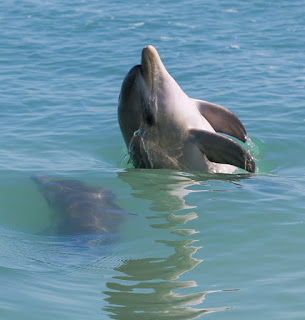
Indo-Pacific Bottlenose Dolphin

Fish Anyone?

The dolphin feeding experience starts with the assembled group quietly approaching the water’s edge waiting for the dolphins to arrive – should they choose to. Only once the larger females stay close to the feet of the guides showing they are ready to feed are volunteers brought out with their buckets of fish.

Each guide picks out several visitors that one at a time takes a fish and places it in the water in front of the dolphin. Each dolphin has 100-tiny teeth and placing the fish directly in the water prevents any unintentional bites.

The encounters only last 25-minutes at a time and each one ends as the volunteers wash their buckets in the sea – an indication that feeding, for now, is over. Only if the dolphins return within 25-minutes and wait by the beach does a second or third feed take place and then only between 8am and midday. The dolphins are always the ones in charge. If they don’t want to come up to the beach they are not encouraged to do so.

Where’s the fish?

It is a great experience to get up close to one of the world’s most intelligent creatures and being so close you can clearly see the bites they have received from the sharks they share this beautiful bay with. Just looking into the dolphins’ staring eyes is a very special experience and one we’ll never forget. Absolutely recommended and suitable for all ages.

The dolphin encounter starts at 7.45am and a 30-min drive from Denham allowing for time to check-in at Monkey Mia. Caravan and camping facilities are available at Denham and Monkey Mia.

For more information visit: Shark Bay – Monkey Mia
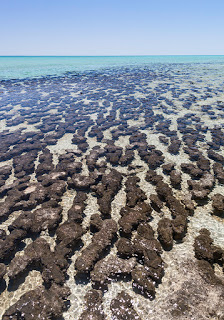
Shark Bay – Fossils Alive

Hamelin Pool Marine Nature Reserve

We left Carnarvon this morning heading south on the North West Coastal Highway with a planned stop to see something that happens to be the oldest form of life on this ancient slowly spinning planet of ours and the one responsible for all the early life-sustaining oxygen on our planet.

Stromatolites

27KM from the North West Coastal Highway on Shark Bay Road is the signed turn-off to the Old Telegraph Station and Hamelin Pool Marine Nature Reserve. Just a short stroll from the car park and onto the boardwalk and you’ll be looking at the very rare Stromatolites – living fossils, growing at less than 1mm a year in the shallow, highly saline seawater.

Living Fossils

And you will be standing in one of only two places in the world where living Stromatolites can be found, the other being in the Bahamas. Hamelin Pool is also unique in having the most abundant and diverse examples of Stromatolites in the world.

Cyanobacteria

Stromatolites form in shallow seawater where there is an unusually high concentration of salt. At Hamelin Pool it is twice the salinity of normal seawater. Cyanobacteria, the earliest form of single-cell life on the planet, secretes a sticky gel trapping other Cyanobacteria as well as sand and sediment to form microscopic layers that harden to create the rocky mound-like structures.

The bacteria use water, carbon dioxide and sunlight through photosynthesis to provide energy and, as a byproduct, expel oxygen. It is this oxygen created over 2.5-billion years of the early earth that enabled multi-cellular life to form. Without Stromatolites we and every other advanced form of life simply wouldn’t exist!

Australia – Really, Really Old

The Pilbara region in the northwest of Western Australia is recognised as possessing the oldest known fossils in the world. Prior to Cyanobacteria no fossil records of any life-formns exist. Organic matter from Cyanobacteria in ancient fossilised stromatolites has recently been dated to around 3.5-billion years old.

Carnarvon – Out of this World

The Carnarvon Space & Technology Museum is the reason for our visit to Carnarvon and its role in the 1960’s US Governments plan of: ‘Landing a man on the moon and returning him safely to the Earth.’

INTELSAT

1964 saw eleven international Governments, Australia included, form an International Telecommunications Satellite Consortium known as INTELSAT to provide a global communications system using satellites. In April 1965 Early Bird (INTELSAT 1) was positioned in orbit over the Atlantic Ocean. It was the first internationally-owned satellite and provided reliable telephone links between Europe and North America.

Apollo Command Console

NASA Calling

In the same year NASA approached INTELSAT and commissioned them to provide two satellites, one to sit over the Pacific Ocean and the other over the Atlantic area and partially covering the Indian Ocean. Both INTELSAT 2 satellites would form part of NASA’s early Global Communications Network used to provide voice and data links back to the US as part of the nations’ Apollo Project.

This required Satellite Earth Stations to be built linking the ground with the new satellites to control and relay signals. In Australia this fell to the OTC, the Overseas Telecommunications Commission.

The Casshorn ‘Sugar Spoon’

Tracking Spacecraft

NASA already had a number of radar tracking stations, which were built for the Gemini, Apollo and Skylab missions and used to monitor the location of spacecraft as they passed overhead and deeper into space. With one such tracking station already operating in Carnarvon it was an obvious decision to build the Satellite Earth Station close by.

On the 24th of November 1966 one month after becoming operational, the 12.8-metre Casshorn ‘sugar scoop’ antenna sent its first live television pictures to the BBC in London linking UK families with relatives in Carnarvon.

Three months later, the 4th of February 1967 marked the beginning of the OTC’s 8-year support for the Carnarvon NASA Tracking Station. Just 2-years later on the 21st of July 1969 the 12.8-metre Casshorn antenna carried the Apollo 11 Moon Landing pictures from NASA’s Canberra-based Honeysuckle Creek Tracking Station via Moree Earth Station in New South Wales and on to Perth’s TV audience – the first live telecast in Western Australia.

The 29.8-Metre Dish

The 29.8-metres dish was added in 1969 to provide support for NASA’s later Apollo missions.

NASA closed it’s tracking station in 1975 but the OTC Earth Station continued operating until April 1987 with several notable achievements including the dish’s claim to fame; the prime responsibility for controlling the European Space Agency’s Giotto mission which took measurements and samples as Giotto’s probe passed through the tail of Halley’s Comet.


OTC Space and Technology Museum

Carnarvon OTC now hosts the Carnarvon Space and Technology Museum, which has interesting displays of the station’s history and links with NASA as well as an Apollo Command Module ‘flight’ where you can share the launch experience into orbit.

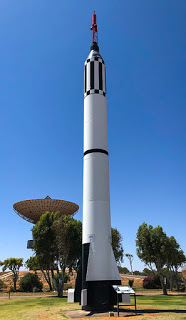
Outside sits a full-sized replica of The Mercury Capsule – Freedom 7 and the Mercury Redstone rocket that marked the start of the USA’s journeys into space launching Astronaut Alan Shepard into history as the first American in space. There’s also the opportunity to get up close with the original ‘sugar scoop’ and dish antennas.

Mercury 7 replica

The OTC Earth Station is still involved with ongoing solar scientific research programmes.

It’s a great place to explore, especially if, like us, you witnessed the moon landings as children, but also for today’s children who may soon witness NASA’s return to the moon and future planned excursions to Mars.

For more details and opening times visit the museum’s website: Space and Technology Museum

Meanwhile… back on Earth

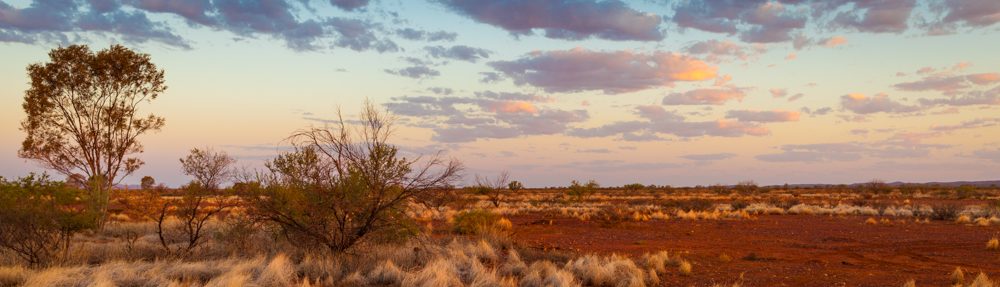
Most of the northwest of Western Australia is dry scrubland known as Mulga and supporting mostly cattle on enormous stations.

Dry creeks and rivers are the norm during the dry season and it is hard to imagine water ever flowing here when everything around us currently is bone dry. Therefore it comes as some surprise to see Carnarvon’s fertile plains rich with fruit and vegetables and all the more so when you see the Gascoyne River – there is no sign of water just cattle footprints and the occasional 4WD tyre tracks on the dry, sandy riverbed.

Only during the wet season does water flow on the surface but the river is still flowing underground and it is this that sustains the abundant crops year round.

Yes, this really is an active river

Carnarvon is definitely worth a few day’s visit but be prepared for the strong winds during Spring as can be clearly witnessed by the angle of many of the trees along the roadside.

Coral Bay – Off-Road Rush

Another adventure day for us in Coral Bay. This time we’re taking the Off-Road Rush 4WD Buggy tour with Coral Bay Tours along the Southern reach of the Coral Bay Coast, specifically the Southern Outback & Snorkel Adventure.

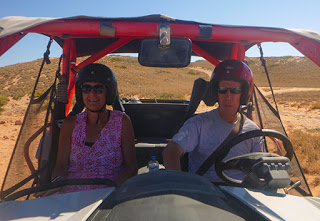
The day started out at 9.15am for helmet fitting and an operational and safety briefing on the Can-Am 1000 Commander buggy. Engines started and we were off along the road to the Marina before taking a gravel side track into the dunes. Stuart, our guide, switched us to Sport and 4WD mode and we were off leading our group. Although restricted to 35KMH it feels plenty fast enough at first on the narrow sand and rutted 4WD track.

Our Can-Am Commander Buggy

Move over Toyotas

We had priority over all the full-sized off-road vehicles meaning they had to give way to us wherever we went but caution was still needed when rounding tight bends with restricted visibility. Most of the tracks are one-way at least but you wouldn’t want to meet the back of a Toyota Land Cruiser in a hurry.

Catherine was holding on tightly to the grab handles as I drove as quickly as the buggy would go while still keeping a safe distance from our guide’s buggy. Zooming through twisting, banked corners was great fun with the back end sliding out and throwing sand into the air. This was just like riding a JetSki though a little slower. Not coincidentally, the JetSki shares the same hi-reving Rotax engines as our buggy and when unrestricted the Can-Am Commander is capable of 100KMH – considerably more than the 35KMH we had.

Cooling-off

Our first stop was at Five Fingers Reef – a beautiful spot with a white sandy beach and turquoise water. An opportunity for photographs, look for Humpback Whales beyond the reef and to give our engines a chance to cool. Then quickly back into our buggies and a change of order to give our tour guide a chance to photograph the next leader in the group while we dropped to the back.

The buggies handle sand ruts more smoothly than our Land Rover with their soft tyres and very flexible suspension making them almost enjoyable to drive over… or at least a bit more fun.

4WD fun in the dunes

Mixing ruts with hill climbs, soft sand, steep descents and beaches we continued to our next stop at Oyster Bridge on a cliff overlooking the sea where we had an unexpected find – five Green Turtles feeding right along the shore as we watched from a cliff above.

It’s a privilege to see these beautiful creatures in their natural environment and so many together. Coral Bay, like the beaches at Cape Range National Park, are protected turtle nesting grounds.

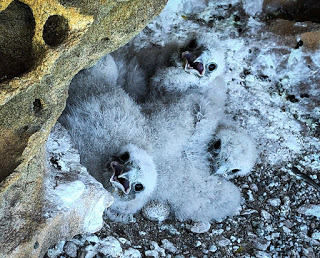
Off again and this time to Turtle Cliffs, a popular viewpoint for watching turtles. Today, however, they appeared to have taken leave – probably to where we were at Oyster Bridge. But as compensation we got to see a nesting Kestrel and it’s three fluffy grey chicks right on the edge of the cliff. And, apparently a Whale Shark was recently sighted here several months beyond its normal presence in the area.

Nesting Kestrel Chicks

Kangaroos!

After one last additional lap around Five Fingers Reef dunes where we startled a pair of Red Kangaroos, we settled back on the beach for those that wished to have a snorkel. Catherine joined the group while I took the drier and less chilly option to take some photographs of the buggies and the incoming tide.

Heading back towards base we took every last opportunity to enjoy the twists and turns and one final obstacle – the steep downhill face of a fair-sized dune.

One-by-one we eased our buggies to the edge of the dune and on our guide’s mark, stepped on it, racing down the incline as quickly as we could go. It didn’t seem that steep in the end but then maybe we had our eyes closed for much of it.

Bigger and steeper than it looks – honest!!

A great morning out on the dunes with a fun group and hopefully the opportunity sometime later during our trip to repeat the experience in another location.

One thing to remember as a driver or passenger on a buggy tour, when in motion keep your mouth firmly closed unless you want to eat dust or sand.

More details of the buggy tours available from Coral Coast Tours