Hamelin Pool Marine Nature Reserve
We left Carnarvon this morning heading south on the North West Coastal Highway with a planned stop to see something that happens to be the oldest form of life on this ancient slowly spinning planet of ours and the one responsible for all the early life-sustaining oxygen on our planet.
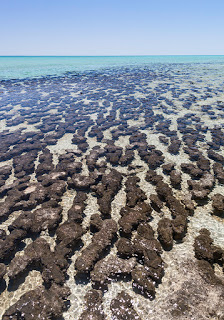
27KM from the North West Coastal Highway on Shark Bay Road is the signed turn-off to the Old Telegraph Station and Hamelin Pool Marine Nature Reserve. Just a short stroll from the car park and onto the boardwalk and you’ll be looking at the very rare Stromatolites – living fossils, growing at less than 1mm a year in the shallow, highly saline seawater.
Living Fossils
And you will be standing in one of only two places in the world where living Stromatolites can be found, the other being in the Bahamas. Hamelin Pool is also unique in having the most abundant and diverse examples of Stromatolites in the world.
Cyanobacteria
Stromatolites form in shallow seawater where there is an unusually high concentration of salt. At Hamelin Pool it is twice the salinity of normal seawater. Cyanobacteria, the earliest form of single-cell life on the planet, secretes a sticky gel trapping other Cyanobacteria as well as sand and sediment to form microscopic layers that harden to create the rocky mound-like structures.
The bacteria use water, carbon dioxide and sunlight through photosynthesis to provide energy and, as a byproduct, expel oxygen. It is this oxygen created over 2.5-billion years of the early earth that enabled multi-cellular life to form. Without Stromatolites we and every other advanced form of life simply wouldn’t exist!
Australia – Really, Really Old
The Pilbara region in the northwest of Western Australia is recognised as possessing the oldest known fossils in the world. Prior to Cyanobacteria no fossil records of any life-formns exist. Organic matter from Cyanobacteria in ancient fossilised stromatolites has recently been dated to around 3.5-billion years old.
 Discovery Down Under
Pingback: Rocky Cape National Park | Discovery Down Under