The Carnarvon Space & Technology Museum is the reason for our visit to Carnarvon and its role in the 1960’s US Governments plan of: ‘Landing a man on the moon and returning him safely to the Earth.’
INTELSAT
1964 saw eleven international Governments, Australia included, form an International Telecommunications Satellite Consortium known as INTELSAT to provide a global communications system using satellites. In April 1965 Early Bird (INTELSAT 1) was positioned in orbit over the Atlantic Ocean. It was the first internationally-owned satellite and provided reliable telephone links between Europe and North America.

NASA Calling
In the same year NASA approached INTELSAT and commissioned them to provide two satellites, one to sit over the Pacific Ocean and the other over the Atlantic area and partially covering the Indian Ocean. Both INTELSAT 2 satellites would form part of NASA’s early Global Communications Network used to provide voice and data links back to the US as part of the nations’ Apollo Project.
This required Satellite Earth Stations to be built linking the ground with the new satellites to control and relay signals. In Australia this fell to the OTC, the Overseas Telecommunications Commission.

Tracking Spacecraft
NASA already had a number of radar tracking stations, which were built for the Gemini, Apollo and Skylab missions and used to monitor the location of spacecraft as they passed overhead and deeper into space. With one such tracking station already operating in Carnarvon it was an obvious decision to build the Satellite Earth Station close by.
On the 24th of November 1966 one month after becoming operational, the 12.8-metre Casshorn ‘sugar scoop’ antenna sent its first live television pictures to the BBC in London linking UK families with relatives in Carnarvon.
Three months later, the 4th of February 1967 marked the beginning of the OTC’s 8-year support for the Carnarvon NASA Tracking Station. Just 2-years later on the 21st of July 1969 the 12.8-metre Casshorn antenna carried the Apollo 11 Moon Landing pictures from NASA’s Canberra-based Honeysuckle Creek Tracking Station via Moree Earth Station in New South Wales and on to Perth’s TV audience – the first live telecast in Western Australia.

The 29.8-metres dish was added in 1969 to provide support for NASA’s later Apollo missions.
NASA closed it’s tracking station in 1975 but the OTC Earth Station continued operating until April 1987 with several notable achievements including the dish’s claim to fame; the prime responsibility for controlling the European Space Agency’s Giotto mission which took measurements and samples as Giotto’s probe passed through the tail of Halley’s Comet.
OTC Space and Technology Museum
Carnarvon OTC now hosts the Carnarvon Space and Technology Museum, which has interesting displays of the station’s history and links with NASA as well as an Apollo Command Module ‘flight’ where you can share the launch experience into orbit.
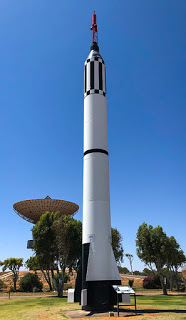
Outside sits a full-sized replica of The Mercury Capsule – Freedom 7 and the Mercury Redstone rocket that marked the start of the USA’s journeys into space launching Astronaut Alan Shepard into history as the first American in space. There’s also the opportunity to get up close with the original ‘sugar scoop’ and dish antennas.
The OTC Earth Station is still involved with ongoing solar scientific research programmes.
It’s a great place to explore, especially if, like us, you witnessed the moon landings as children, but also for today’s children who may soon witness NASA’s return to the moon and future planned excursions to Mars.
For more details and opening times visit the museum’s website: Space and Technology Museum
Meanwhile… back on Earth
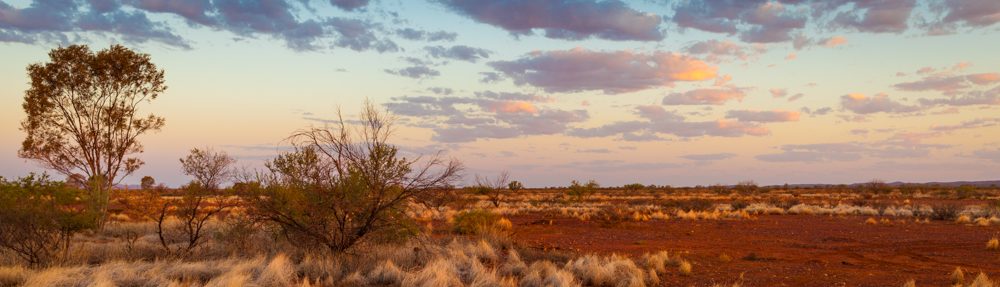
Most of the northwest of Western Australia is dry scrubland known as Mulga and supporting mostly cattle on enormous stations.
Dry creeks and rivers are the norm during the dry season and it is hard to imagine water ever flowing here when everything around us currently is bone dry. Therefore it comes as some surprise to see Carnarvon’s fertile plains rich with fruit and vegetables and all the more so when you see the Gascoyne River – there is no sign of water just cattle footprints and the occasional 4WD tyre tracks on the dry, sandy riverbed.
Only during the wet season does water flow on the surface but the river is still flowing underground and it is this that sustains the abundant crops year round.

Carnarvon is definitely worth a few day’s visit but be prepared for the strong winds during Spring as can be clearly witnessed by the angle of many of the trees along the roadside.
 Discovery Down Under